
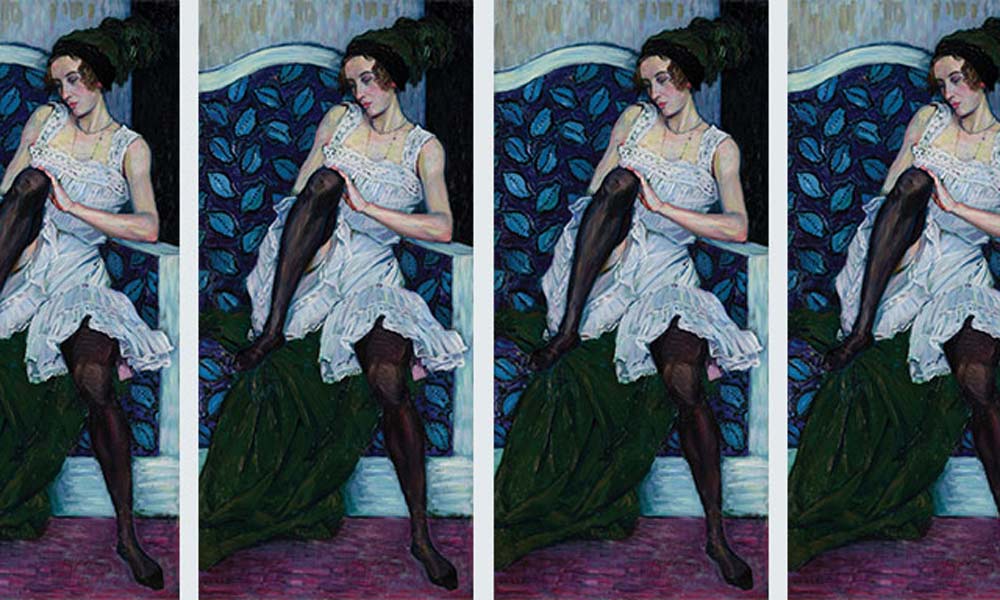
The objects that we live with are given meaning when they accurately and honestly reflect the world that created them. This was the moral imperative of the Wiener Werkstätte (Vienna Workshop), a cooperative endeavor that designed, produced and sold thousands of the highest-quality modern design items and textiles from 1903 until 1932.
“Modernity and Opulence: Women of the Wiener Werkstätte,” running through November 15 at The Jewish Museum, New York, presents an array of both fine art and applied art objects—household goods, ceramics, clothing, jewelry—connected to the Werkstätte. They range from the spectacular collotype prints with gold intaglio in the portfolio works of artist Gustav Klimt, who collaborated with the Werkstätte, to a playful thread drawing, made with linen bobbin lace, of a graceful acrobat standing beside a whimsical owl.
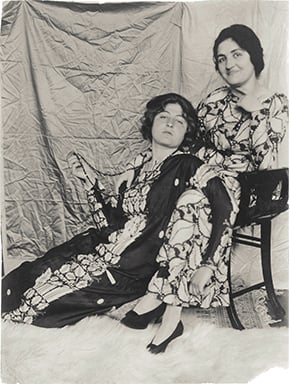
Photograph of Charlotte Beer and Friederike Maria Beer (later Beer-Monti) wearing Wiener Werkstätte dresses, 1914, gelatin silver print (note pattern on dress at right echoes background of New Year postcard below). (Credit: Courtesy of brandstaetter images/Osterreichisches Staatsarchiv, Vienna.)
The exhibit, which is a partnership with MAK, the Museum of Applied Arts, Vienna, was inspired by recent scholarship that has uncovered the identity of about 200 Werkstätte women artists and designers whose contributions previously had been unrecognized. It turns out that about a quarter of these women were Jewish, either by faith or heritage, and the show throws a spotlight on their work as well as on the community of prominent and forward-thinking Jewish women who were among the Werkstätte’s most important patrons. This includes the journalist, art critic and translator Berta Zuckerkandl, who fiercely defended both liberal Austrian politics and modern Viennese art in the many newspaper columns she wrote for the Wiener Allgemeiner Zeitung. Another illustrious supporter, Adele Bloch-Bauer, is known today as the “Woman in Gold” because of Klimt’s haunting portrait of her, faceted like a gemstone within gold and silver leafing.
Like numerous other projects with utopian aspirations, the Wiener Werkstätte existed in a delicate ecosystem with catastrophe looming in the background. Many of the beautiful and useful items it produced were witness to the complex and tragic history of Vienna’s Jews.
The artistic founders of the Werkstätte, architect Josef Hoffmann and artist Koloman Moser, were committed to bringing together the fine and applied arts, focusing at first on metalwork, silversmithing, bookbinding and cabinetry. They were dedicated to making useful objects adhere to good proportion while maintaining respectful treatment of fine materials, including precious and semiprecious stones and rare woods. Committed to revitalizing Austrian design, replacing poorly made and crudely ornamented industrial products with purposefully constructed goods, they wanted to return to a time when one’s possessions carried more meaning. At the same time, they wanted their newly made goods to reflect the modernity of the world in which they were living. With their prosperous customers as partners, they had a unique freedom to experiment with the new artistic ideas of their time. While the original aesthetic of the movement was often modern and geometric, over time it softened and became more organic. When the Werkstätte’s fashion and textile department opened in 1910, it quickly became a main source of revenue for the workshop, and with its finely printed fabrics and free-flowing reform-style dresses, it was even competitive with the Paris fashion houses.
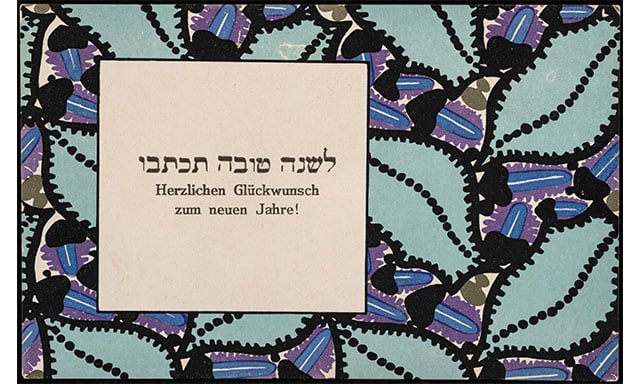
New Year Greeting Postcard, c. 1910-11, designed by Martha Alber, lithograph on paper, printer, Brüder Kohn. (Credit: The Jewish Museum, New York.)
One of the most evocative objects in the show is perhaps the most modest—a New Year’s (Rosh Hashanah) card made on postcard stock with a background pattern of buoyant and abstracted leaves, boldly outlined and delicately colored in turquoise, indigo and lavender. Part of a collaborative project, the card provides a glimpse into the intertwining of artistic production, commercial ventures and mutual aid within Vienna’s Jewish and arts communities. For the holiday, the Werkstätte made a variety of their handblocked textile patterns available to Lehrlingsheim Zukunft, the Jewish boys’ orphanage and industrial apprentice home, a well-established charity supported by many of the Werkstätte’s Jewish clients. Lithography apprentices from the Jewish home overlaid their messages onto the Werkstätte designs, first in Hebrew, לשנה טובה תכתבו (“May you be inscribed for a good year”), and then in German, Herzlichen Glückwunsch/zum neuen Jahre (“Sincere wishes for the New Year”). Brüder Kohn, the largest Austrian postcard company at that time, owned by two Jewish brothers, served as the printer. When the cards were distributed, they provided publicity for the Werkstätte and support for the charity. The Rosh Hashanah postcard suggests that tzedakah, the traditional obligation to practice social justice, had survived assimilation in a new form.
The design motif on the Rosh Hashanah card was titled Blätter (Leaves) and was created by Martha Alber when she was still a teenage student. One of the virtues of her lovely block print was its versatility. In the exhibition, you can see it was used as upholstery fabric on the capacious chair in Secessionist artist Wilhelm List’s painting Young Woman in Undergarments, as well as on the dress fabric worn by Jewish client Friederike Maria Beer in a photograph with her sister Charlotte, who was also wearing a Werkstätte gown.
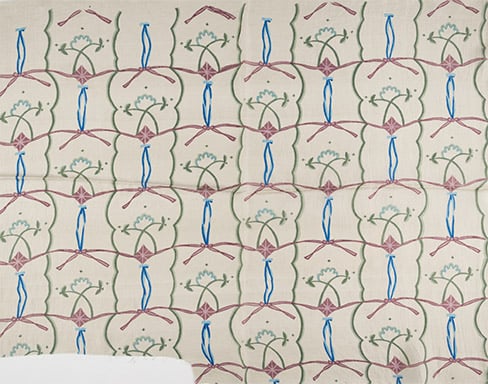
“Konfuzius,” printed plain-weave silk, designed by Eleonore Zuckerkandl, 1918-19. (Credit: MAK – Museum of Applied Arts, Vienna, Photo c MAK/Kristina Wisik.)
Several other photographs suggest a touching camaraderie among the women of the Werkstätte. Many of them had attended the same fine arts classes or worked in the war effort together. As pioneers in the field of design, they were at the forefront of the modern era and eager to challenge Victorian conventions and mores, as is visible in their clothing, some wearing pants and collared shirts and even ties. The Werkstätte provided a sense of independence, as the artist Valerie (“Vally”) Wieselthier reminisced: “Each one of us got a key…and we had all the workshops imaginable for our free use. We also had the best-trained foremen and workers and all the time and materials we desired…We simply did as we pleased.”
Wieselthier, who was born in 1895 and came from a prominent Jewish family, was one of the Werkstätte women who established a reputation beyond Vienna, exhibiting in Paris and New York and emigrating to the United States in 1928. Her father was a court attorney and her mother came from a wealthy background. They supported her, first as an athletic child who won prizes for swimming as well as high diving, skiing, tennis and field hockey. It’s been said that she extracted a promise from her father that she would never have to marry since she didn’t want to be tied down by the traditions and conventions of her upbringing. Before World War I, she attended the Art School for Women and Girls, and later took courses at the School of Applied Arts with Hoffmann and Moser as well as the painter Franz Cižek, whose interest in the spontaneity and vividness of children’s art had a lasting influence on her work. At the same time, she volunteered as an auxiliary nurse, helping doctors and nurses during the war.
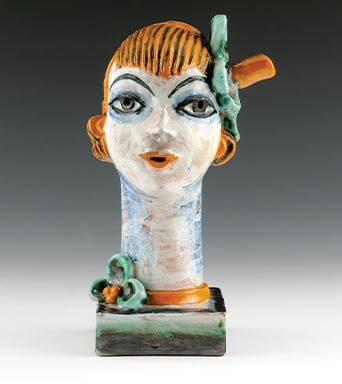
“Girl’s Head with Blue Outlined Eyes,” 1928, by Vally Wieselthier; red pottery, polychrome glaze. (Credit: Galerie bei der Albertina-Zetter.)
Hoffmann quickly recognized Wieselthier’s talent and energy and brought her to the Werkstätte in 1917. In her early work she experimented with a wide range of materials, but her later ceramic pieces, with their rough surfaces and vibrant painted glazes, have a distinct and expressive power. This is especially apparent in her low-fired earthenware Frauenköpfe (women’s heads) ingeniously made with what has been called “hand-formed hollow modeling.” The vibrant oranges, blues and greens of her Fauve-like glazes were hand-brushed with an ease and spontaneity. As she put it, “I place absolutely no weight on achieving a smooth, uniform surface but mix the glaze in all possible nuances and then let the fire reign.” Wieselthier was innovative in her use of materials and also pioneering as a feminist artist, using her pottery figures to challenge conventions, adapting her figures from mythological goddesses into shamelessly fashionable goddesses of their time with jaunty hats, exaggerated makeup and haughty expressions.
Felice (“Lizzi”) Rix-Ueno was another astonishingly productive Werkstätte woman. Just a few years older than Wieselthier, she also came from a well-to-do Viennese Jewish family. Her paternal and Hungarian born grandmother, Wilhelmine Rix, had invented a beauty product that was so successful it was even advertised in the Ladies’ Home Journal in America, and her artistic and entrepreneurial father became a branch manager and later director of the Werkstätte. Her younger sister, Kitty Rix-Ueno, joined the Werkstätte in the 1920s, and her spirited, toylike ceramic figures are represented in the exhibition. Rix Ueno studied at the School of Fine Arts before joining the Werkstätte workshops, where she made textile design her specialty. Over a lifetime of work, she developed hundreds of patterns, establishing a reputation for the sophisticated use of vibrant confectionary colors and the modern way in which she combined Japanese decoration such as bamboo and fans with abstracted Viennese folk motifs. In 1925 she married the Japanese architect Isaburo Ueno. When the couple moved to Kyoto, they opened their own studio. After World War II, she became a professor of design at the Kyoto College of Art and later, with her husband, established what is known today as the Kyoto Interactive School of Art.
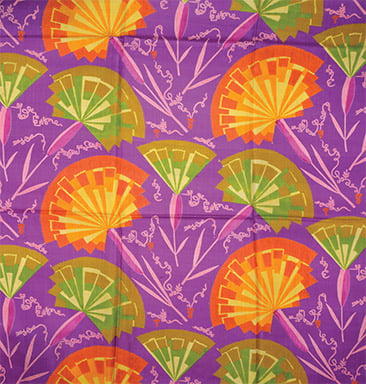
Purple Carnation” (Purpurnelke) textile sample, printed plain-weave silk, designed by Felice Rix-Ueno, August 1924. (Credit: MAK, Museum of Applied Arts, Vienna, Photo: c MAK/Branislav Djordjevic.)
Wieselthier and Rix-Ueno were lucky to have taken part in the experiment of making “good and simple” objects in the “garden of tranquility” that the founders of the Werkstätte had aimed for. The modern liberalism of that moment could not be sustained in Austria, burdened by financial collapse and the pressures of fascism. With the growth of Nazism and the Anschluss, most of the Jewish women artists, designers and clients of the Werkstätte were fated to leave Vienna, scattering around the globe. At least four were murdered in the ghettos and death camps, while the dates and places of death for several remain unknown.
One of the most heartbreaking stories is that of Eleanore (“Nora”) Zuckerkandl, the niece of Berta Zuckerkandl. Nora’s father was a famous Jewish surgeon and her mother, Amalie, was a convert to Judaism. Klimt’s unfinished portrait of Amalie, wearing a black choker and billowing gown, is housed today in the Austrian Gallery Belvedere in Vienna. Both Nora and her mother were deported to the Izbica ghetto in occupied Poland, and it’s thought they were murdered in the Belzec extermination camp. A lovely swatch of plain-weave silk that Zukerkandl designed is displayed in the show. It is a simple and light-hearted pattern of blues and reds and greens, ribbons, abstracted flowers and leaves, reflecting a fleeting moment of confidence, optimism and creativity.


Opening image: Young Woman in Undergarments, c. 1910-11, by Wilhelm List, oil on canvas. Chair is covered in a Werkstätte pattern designed by Martha Alber. (Credit: Minneapolis Institute of Art, The Mary Ingebrand-Pohlad Endowment Fund.)
All images courtesy of The Jewish Museum, New York