
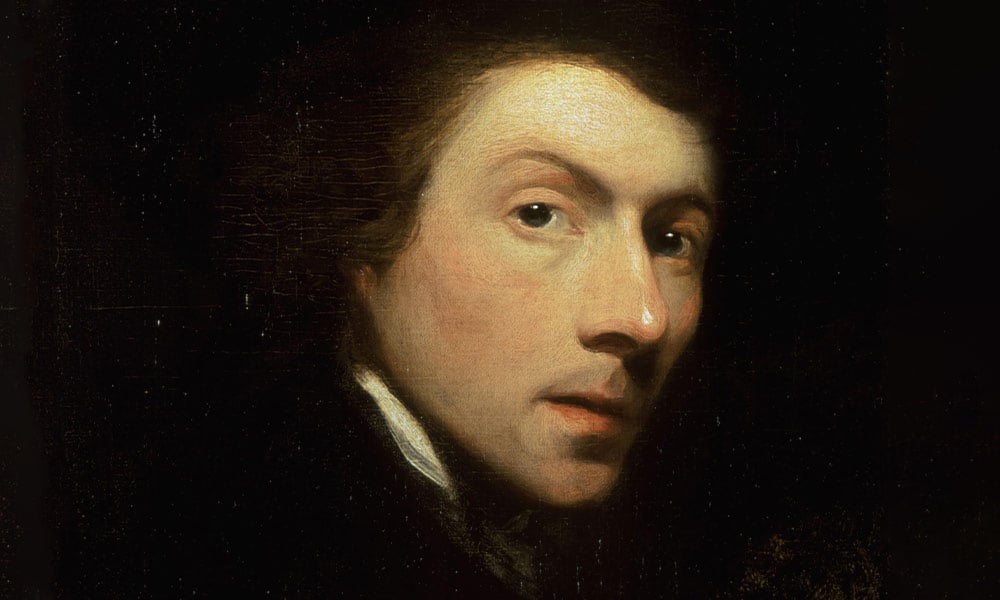
Next time you pull out a one-dollar bill, take a close look at the image of our nation’s first president in the oval at its center. The image is taken from the depiction of George Washington known as the Athenaeum Portrait, painted in 1796 by one of the preeminent portraitists of the late-18th century, American artist Gilbert Stuart.
Over the course of his 50-year career, Stuart painted upward of 1,000 portraits, primarily of prominent American citizens, including all of the first six U.S. presidents, several first ladies, and individuals ranging from Supreme Court Chief Justice John Jay and artist Sir Joshua Reynolds to Mohawk Leader Joseph Brant and British actress Sarah Siddons. Stuart painted a number of portraits of Washington based on the Athenaeum Portrait, which was left unfinished so he could use it as a model. He also famously painted the full-length 1796 Lansdowne Portrait, which is on permanent display at the Smithsonian’s National Portrait Gallery
It is less well known that among the many patrons who commissioned portraits from Stuart were a number of prominent Jewish Americans of the period, including members of the Gratz family of Philadelphia and the Touros of Newport, Rhode Island. The American Jewish Historical Society’s John L. Loeb, Jr. Database of Early American Jewish Portraits lists some ten paintings by Stuart, along with a number of portraits by other renowned artists of the time, including Thomas Sully and Rembrandt Peale.
Gilbert Stuart was born in 1755 in Saunderstown, North Kingstown in the Colony of Rhode Island and Providence Plantations and moved to Newport at age six. He exhibited remarkable natural talent and studied first with Scottish artist Cosmo Alexander and later with American-born British artist Benjamin West. Over the years, Stuart lived and worked in a number of locations—from Scotland and Ireland to Newport, New York, Philadelphia and Washington, DC. Although he supported the American rebellion, he spent the Revolutionary years in England, returning to America in 1793 with the express intention of painting a portrait of George Washington. In 1794 he was commissioned to paint a likeness of John Jay, from whom he received a letter of introduction to Washington. The president posed for Stuart the following year.
Stuart was noted for the naturalness of his work. As Hannah R. London wrote in her 1926 book Portraits of Jews by Gilbert Stuart and Other Early American Artists, Stuart’s “portraiture was enhanced by his capacity to create an environment which banished self-consciousness in his sitters, a feat he achieved largely through his personal charm.” In order to put his subjects at ease and capture their personalities, Stuart liked to involve them in conversation. Washington was apparently not easy to engage while posing, which he found torturous, but the story goes that when Stuart hit on the topic of horses, the president perked up.


According to biographer Dorinda Evans, Stuart was noted for his witty and irascible manner. He also enjoyed an extravagant lifestyle, which repeatedly left him in debt. Despite all his success, at his death Stuart left his wife and five surviving children in dire straits, unable even to purchase a burial site for him. He ended up in an unmarked grave in the Central Burial Ground at Boston Common.
Stuart’s talent and art endure in the many visages he portrayed, including those of the early Jewish Americans whose portraits he painted. A milestone in the history of Jews in early America was the arrival in New Amsterdam (New York City) in 1654 of a contingent of 23 Sephardic Jews from Recife, Brazil. Although some traders and other individuals had arrived earlier, the group established what is considered to be the first Jewish community in North America. Those early settlers, and other Jewish immigrants who followed, developed close-knit settlements in major Atlantic port cities such as Philadelphia, Newport, Norfolk, Charleston, Savannah and New York. A number of those early pioneers built successful businesses in shipping, trade and banking.
During the Revolutionary period, Jewish patriots played a vital role, fighting in militias, providing supplies, and helping to finance the war. Some of those early Jews achieved sufficient wealth and prominence to commission portraits from renowned artists, including from one who painted portraits of the first American presidents.
Moses Myers (1752/3-1835)
The son of Hyman Myers, who was a native of Amsterdam and member of one of the oldest of New York’s Sephardic Jewish families, Moses Myers served briefly in the New York Second Battalion during the Revolutionary War. He subsequently established an import business and was involved in smuggling goods and munitions past the British blockade for delivery to the Patriots. Moses partnered with his cousin Samuel Myers, son of the famed silversmith Myer Myers. Samuel had moved from New York to Amsterdam and together Moses and Samuel set up a network of contacts that extended from Amsterdam to the Caribbean island of St. Eustatius, the Dutch free port that was for a time essential to the Patriots’ cause. In 1786 Moses moved to Norfolk, Virginia, where he worked as a banker. He counted Thomas Jefferson and James Monroe among his friends, served as consul to France and the Netherlands, and was appointed superintendent at Norfolk of the Bank of Richmond.
Eliza Judah Myers (1760-1823)
Born in London, Eliza Judah moved to Montreal with her father, Abraham. She married trader Abraham Chapman, the first known Jewish settler in Detroit, in 1781, but he died a few years later. In 1787, Eliza married merchant Moses Myers and the couple moved to Norfolk, Virginia, where they raised nine children. Norfolk became a thriving commercial center, and Myers & Company played a major role there in trade and banking. The crash of 1819 devastated Myers’s finances, but the Myers family remained among Norfolk’s most prominent residents for generations to come.
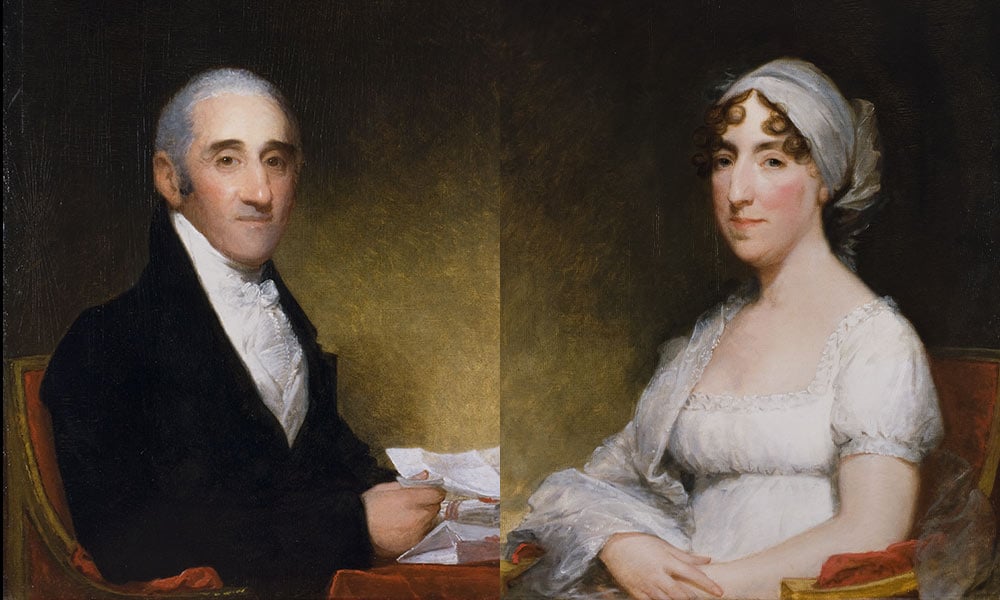
Left: Moses Myers by Gilbert Stuart, 1808; Right: Eliza Judah Myers by Gilbert Stuart, 1808. Credit: Chrysler Museum of Art
Solomon Moses (1774-1857)
Solomon Moses was the son of Isaac and Reyna Levy Moses and the brother of Joshua Moses. His father, a merchant active in the China trade, founded the Bank of New York with Alexander Hamilton and helped fund the American Revolution. Solomon worked for the family business and in 1798 traveled to Madras and Calcutta. He also practiced medicine. In 1804, at the age of 30, he spent a few months with the influential Gratz family of Philadelphia, friends of his parents, and their three daughters, Rachel, Rebecca and Sarah. Solomon was smitten with Rachel but all three sisters reportedly found him a terrible bore. Two years later he returned to Philadelphia and was successful in winning Rachel’s heart. The couple was married that same year and went on to have nine children, six of whom survived childhood.
Rachel Gratz Moses (1783-1823)
A renowned beauty, Rachel Gratz Moses was the daughter of Miriam Simon and Michael Gratz, one of the most prominent and affluent Jewish couples in turnof-the-19th-century Philadelphia. Miriam, whose father Joseph Simon founded the Jewish community in Lancaster, Pennsylvania, in the 1730s, and Michael, who was descended from a long line of respected rabbis, were observant Jews and active members of Philadelphia’s first synagogue, Mikveh Israel. Rachel was one of 12 siblings, but she was closest to her sister Rebecca, who became a noted educator and philanthropist, founding among other associations the Philadelphia Orphan Asylum and the Hebrew Sunday School. When Rachel died in 1823, Rebecca pulled back from that work to help raise Rachel’s children.
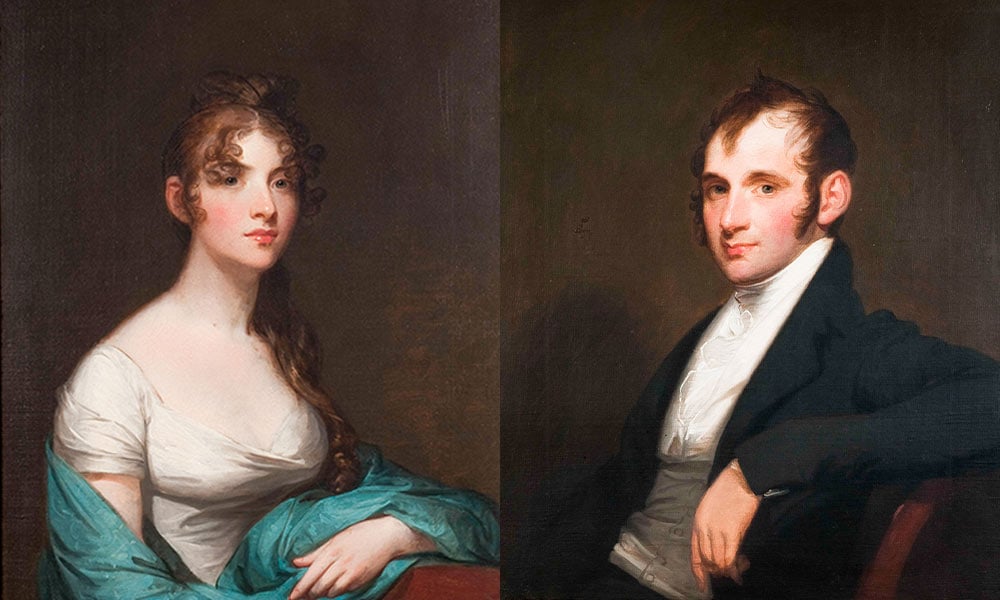
Left: Rachel Gratz Moses by Gilbert Stuart, 1806; Right: Solomon Moses by Gilbert Stuart, 1806. Credit: Rosenbach Museum and Library
Colonel Isaac Franks (1759-1822)
Isaac Franks had a particularly close association with George Washington, and, it would appear, with Gilbert Stuart as well. The portrait Stuart painted of Franks was accompanied by this inscription: “Portrait of Mr. Isaac Franks presented to friend Isaac Franks as a token of regard by Gilbert Stuart, Germantown, October 1, 1802.” A great patriot and officer in the Revolutionary Army, Franks, who was born in New York, was a grandson of Abraham Franks, one of the London-based brothers of New York merchant Jacob Franks. Just 17 when the war broke out, Isaac enlisted in Col. Lesher’s regiment of New York and fought at the Battle of Long Island in August 1776, the first major engagement of the Revolutionary War. Captured when New York fell to British forces, he spent three months as a prisoner of war. In 1777, after escaping to New Jersey, he was appointed to the quartermaster department of the Continental Army. At the end of the war, Franks married Mary Davidson, a Christian. Though born Jewish, Franks had been a practicing Christian for several years prior to his marriage. The couple settled in the Germantown neighborhood of Philadelphia, where Franks prospered as a financial broker. In 1819 he won appointment as Prothonotary (chief clerk) of the Supreme Court of Pennsylvania.
During the yellow fever epidemic of 1793, George Washington relocated the federal government from the center of Philadelphia to the relative safety of Germantown. Thus the Franks’ home became the Germantown White House. President Washington not only slept there, he also held cabinet meetings in the home. Thomas Jefferson, Alexander Hamilton and Edmund Randolph were all visitors there.
Jacob Rodriguez de Rivera (1717-1789)
A merchant, shipowner and candle manufacturer, Jacob Rodriguez de Rivera was a member of a converso family from Seville, Spain. He came to Newport, Rhode Island, in 1748 by way of the Dutch Caribbean island of Curaçao, which had an established Sephardi Jewish community. There he met Hannah Pimental Sasportas, who became his wife. Naturalized as a British subject in New York City, Rivera was able to take part in the transatlantic shipping coming through Newport, trading in rum, molasses, dry goods, whale oil and like many of the city’s leading merchants, in the Atlantic slave trade.
Rivera would become the second wealthiest and most powerful man in Newport’s Jewish community, outranked only by his cousin Aaron Lopez, who also became his son-in-law after marrying Rivera’s daughter Sarah. Rivera introduced spermaceti candlemaking to the area and founded the United Company of Spermaceti Candlers. As a leader of Newport’s Jewish community, Rivera, acting for Congregation Jeshuat Israel, acquired the land for the congregation’s synagogue. The resulting building became known as the Touro Synagogue.
Sarah Rivera Lopez and Son (1747-1840) (1768-1845)
The New York-born daughter of Jacob Rodriguez de Rivera, Sarah grew up amidst the wealthy Sephardic merchant families of Newport. She married her cousin Aaron Lopez, the Portuguese-born “merchant-prince” of Newport, when she was in her teens. At the outbreak of the Revolutionary War, Lopez owned 30 vessels involved in European and West Indian trade. Sarah’s son Joshua, pictured with her in the Stuart portrait, was one of their nine children. Joshua would marry Rebecca Touro, the daughter of Isaac Touro.
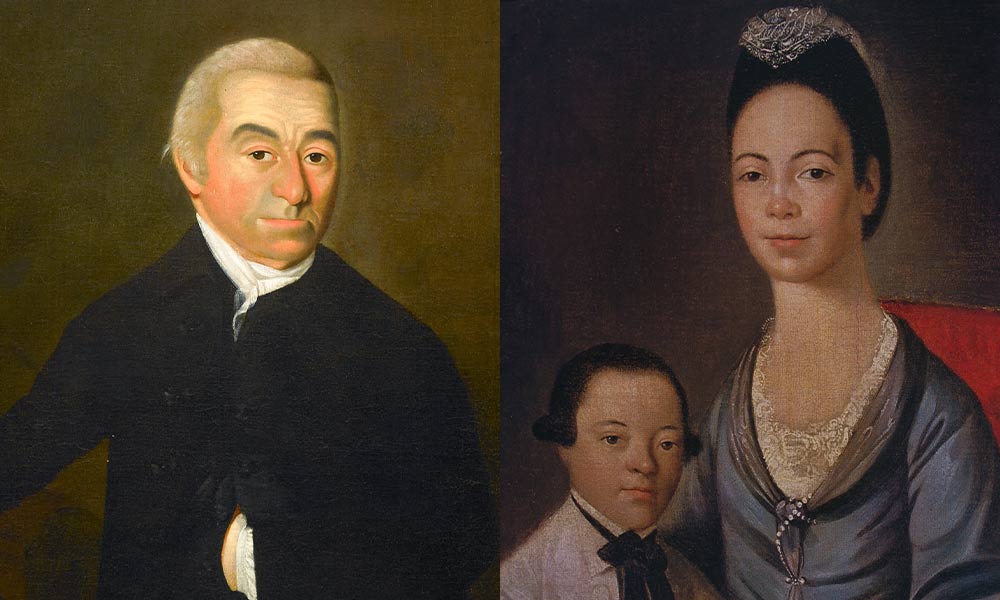
Left: Jacob Rodriguez de Rivera by Gilbert Stuart, c. 1774-1775, detail.; Right: Sarah Rivera Lopez and son by Gilbert Stuart, c. 1775. Credits: Redwood Library and Athenaeum / Detroit Institute of Arts
Isaac Touro (1738-1783)
A Dutch-born Sephardic Jew, Isaac Touro arrived in Newport in 1758, at age 20, in response to the growing Jewish community’s request for a spiritual leader. Touro had trained for the rabbinate in Amsterdam, though he was never ordained. In Newport, Touro developed a close friendship with Aaron Lopez, who, along with Jacob Rodriguez de Rivera, was one of the major benefactors supporting the building of Newport’s synagogue. Touro consecrated the structure on December 2, 1763. Declared a National Historic Site in 1946, the Touro Synagogue is the oldest synagogue building still standing in North America.
In 1773, Touro married Reyna Hays, sister of Moses Michael Hays. They had three surviving children together. Touro was a Loyalist and stayed in Newport when the British took over in 1776, but many of his congregants fled. Faced with financial uncertainty, the Touro family moved first to British-controlled New York and then to Jamaica, where Isaac briefly served as a hazan to a congregation there. He died in Jamaica at age 46, and his wife and children returned to America to live with the Hays family. Touro’s sons, Judah and Abraham, became successful businessmen and generous philanthropists. Judah, for instance, left a large sum for the maintenance of the Touro Synagogue and Jewish cemetery in Newport.
Abraham Touro (1774-1822)
Born in Newport, Abraham Touro was the son of Isaac Touro and Reyna Hays. Soon after Abraham’s birth, the Revolutionary War broke out and the British occupied Newport for three years. It was during this time that the Touro family moved to New York and ultimately to Jamaica. After Isaac’s death, Reyna moved to the Boston home of her brother Moses Michael Hays. There, Abraham and his brother joined their uncle in the family businesses. Abraham also pursued his own endeavors as a merchant, shipbuilder and philanthropist. He helped finance the construction of roads, bridges and theaters around Boston and was one of the first donors to establish what is today Massachusetts General Hospital. At age 48, Touro was thrown from his horse while watching a parade and ultimately died of his injuries. He left bequests to the Massachusetts General Hospital and the Touro Synagogue at Newport.
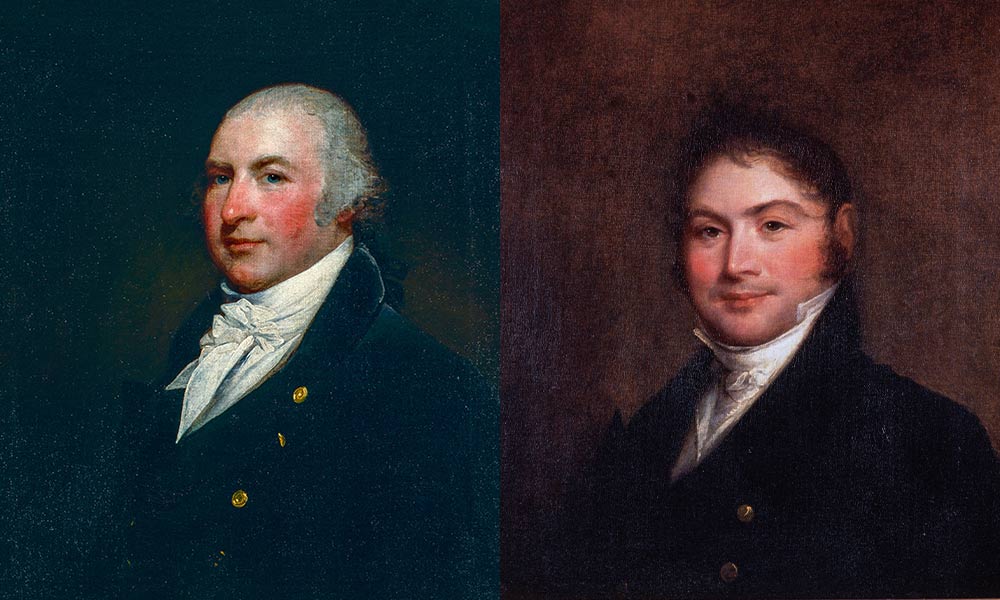
Left: Colonel Isaac Franks by Gilbert Stuart, 1802; Right: Abraham Touro by Gilbert Stuart, 1817. Credits: Pennsylvania Academy of Fine Arts / Private Collection of Touro Synagogue
Moses Michael Hays (1739 -1805)
The son of Dutch immigrants Judah Hays and Rebecca Michaels Hays, Moses Michael Hays was born in New York City. His father was a merchant and brought Moses into the family business. A civic leader, philanthropist and longtime Freemason, Hays was likely the most important Jewish citizen of colonial and early Federalist America. In 1766, he married Rachel Myers, sister of silversmith Myer Myers. A few years later, the couple moved to Newport. There Hays continued to pursue his mercantile career. Although Hays was a supporter of the American cause, in 1775 he refused to sign a declaration of loyalty to the colonies because it contained the wording, “upon the true faith of the Christian.” When the phrase was removed from the oath, he signed. Hays and his family left Newport for Boston before the British occupation. There Hays became one of the largest importers, shipbuilders and insurers in the Far East trade. In 1784, he founded and served as initial depositor in the First Bank of Massachusetts. He also started several companies, including one with his friend Paul Revere, and became an important philanthropist, paying for the upkeep of Boston Commons and helping to endow Harvard College. He and his wife Rachel had six children (five daughters and a son, Judah, who became a founder of the Boston Athenaeum). The portraits of Moses Michael Hays and his wife Rachel, which are attributed to Gilbert Stuart, were purchased at auction in October 2021 and donated to the Arnold and Deanne Kaplan Collection of Early American Judaica at the Penn Libraries.
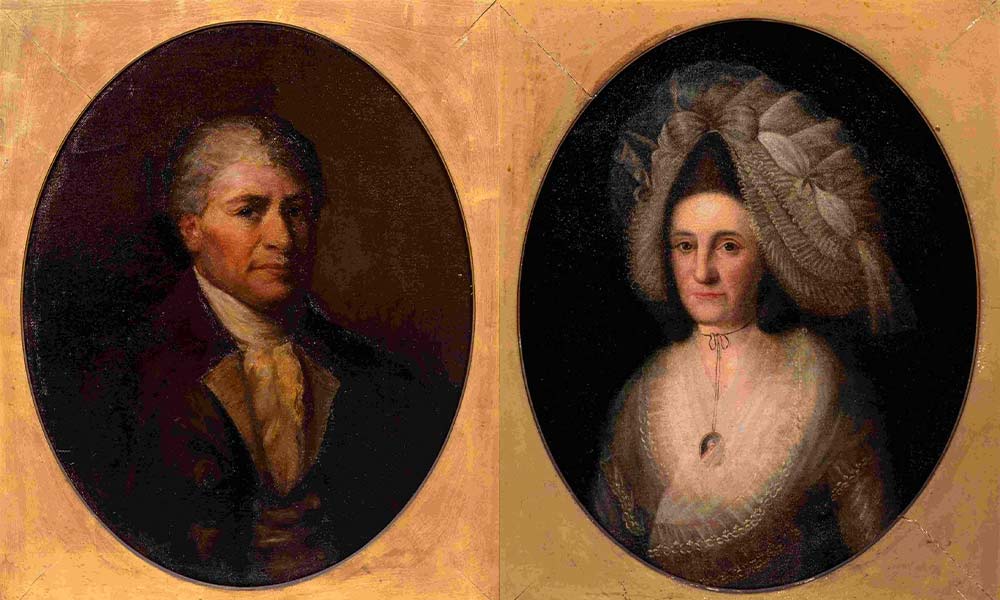
Caption: Left: Moses Michael Hays, attributed to Gilbert Stuart, c. 1790; Right: Rachel Myers Hays, attributed to Gilbert Stuart, c. 1790. Credit: The Arnold and Deanne Kaplan Collection of Early American Judaica at the Penn Libraries
(Top image credit: Image courtesy of the American Jewish Historical Society’s John L. Loeb, Jr. Database of Early American Jewish Portraits / Redwood Library & Athenaeum)
One thought on “Gilbert Stuart’s Brush with Early American Jews”
One other person who was a great supporter of the Revolution I would like to bring your attention to is Haym Salomon. From Expedia:
Haym Salomon (also Solomon; April 7, 1740 – January 6, 1785) was a Polish-born American merchant best known for his actions during the American Revolution, where he was one of the primary financiers for the Continental Congress.
Born to a Jewish family in Leszno, Polish–Lithuanian Commonwealth, Salomon studied finance in Western Europe before emigrating to New York City in 1775. After the American Revolutionary War broke out in the same year, Salomon supported the Patriots by providing financial services while working alongside financier Robert Morris, the Superintendent of Finance of the United States, and risked his life as a member of the Sons of Liberty, leading to multiple arrests by the British for espionage.[1]
Salomon helped convert French loans into hard currency by selling bills of exchange on Morris’ behalf, and also brokered large donations to the Patriot cause. This included a critical $20,000 loan in 1781 that enabled George Washington’s decisive Yorktown campaign, a turning point for American independence. From 1781 to 1784, Salomon helped provide over $650,000 ($15.1 million in 2025).[1][2] He was also an advocate for religious liberty by co-founding Philadelphia’s Mikveh Israel synagogue and challenging discriminatory laws.[3][4] Despite donating his entire fortune to the Continental Army and several Founding Fathers of the United States, Salomon died penniless in Philadelphia in 1785 due to the failure of government officials and private lenders to repay the debt they owed him.[5]
https://en.wikipedia.org/wiki/Haym_Salomon