
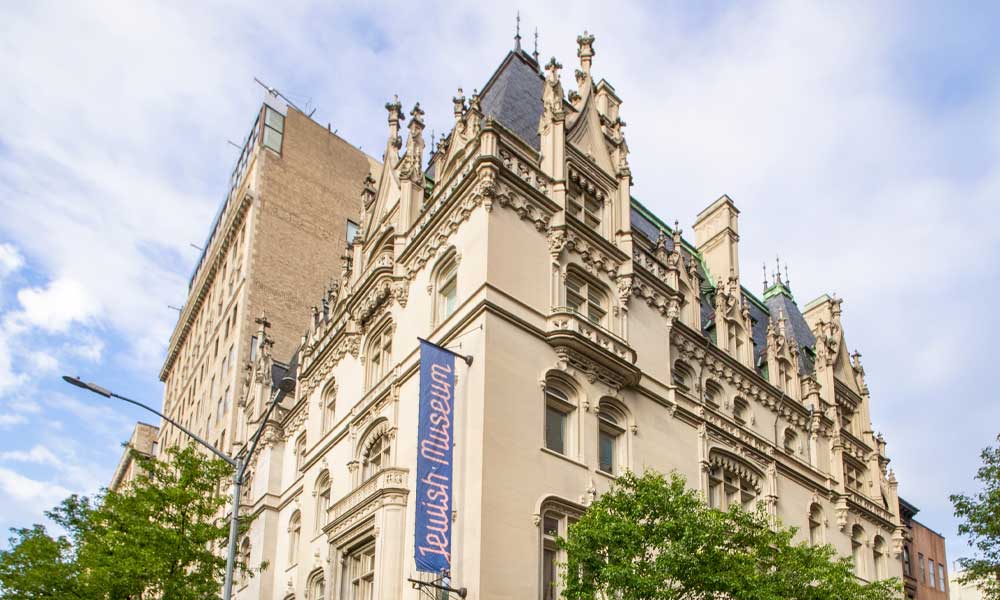
How do you fit this into that? has always been the question since the French Gothic Warburg mansion, now the home of New York’s Jewish Museum, was built in the first decade of the 20th century. Commissioned in 1907 by the young and immensely wealthy German-Jewish banker Felix Warburg and his wife Frieda, the six-story house was designed by the architect C.P.H. Gilbert with arched and square-headed windows, drip moldings, pinnacled pilasters, a slate mansard roof like the one in the children’s series Madeleine, and over 50 rooms.
Even at the very beginning, Warburg’s father-in-law, Jacob Schiff, regarded as a leader of New York’s Jewish community, considered the lavish project to be a folly, warning his daughter, “…it will add to the social anti-Semitism in New York if a young couple build such an ornate house right on Fifth Avenue.” And when they moved in with four sons and a daughter, there was the disparity between the formality of the place and the rowdiness of the Warburg family, who set up a train set to wind through the string of rooms that was the children’s quarters, constructed a squash court on the fifth floor, and invented a roguish game of leaning over the banisters of the grand oak staircase and devilishly spitting down to their target, a Chinese porcelain amphora situated on a table in the austere entrance hall.


The family lived happily in the mansion for some 30 years, until Felix died in 1937. After that, Frieda remained in the house with her oldest son, who had not yet married, and with occasional guests, relatives who were refugees from Nazi Germany. But times were changing and the cost of maintaining such a grand residence was excessively high. In 1941, Frieda moved to a nearby duplex apartment, and in 1944 she deeded the Warburg home to the Jewish Theological Seminary, which already had a small museum of Judaica and historical objects.
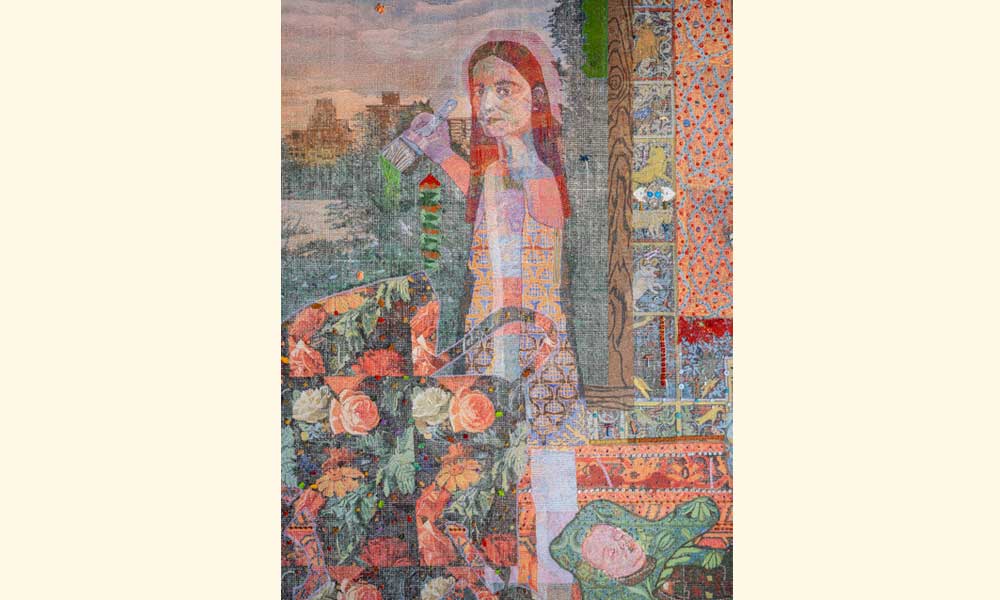
Detail of site-specific 20-foot mural Making Itself by Brooklyn-based artist Talia Levitt features a self-portrait and view out to Central Park. (Photo credit: Courtesy of The Jewish Museum, New York / Kris Graves)
It was her intention to turn the house into a public museum as a tribute to the philanthropic work of her father, her husband and her brother, each of whom had served on the board of the Seminary (Jacob Schiff was the founding benefactor of the institution and Frieda was the first woman to serve on the board). Furthermore, she was well aware of the catastrophe of the war and the Holocaust and wanted the new museum to stand as, in her words, “an affirmation of my faith in the fundamental principles of our tradition, which can be helpful and constructive in the problems of our world today.”
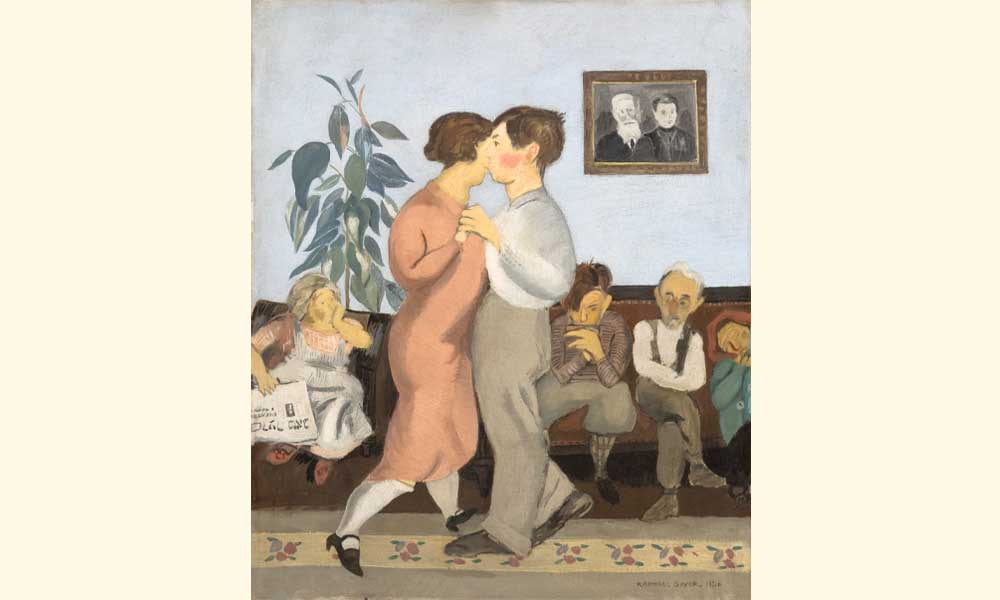
Russian-born American painter and printmaker Raphael Soyer’s 1926 Dancing Lesson portrays his sister Rebecca and her twin brother Moses. (Photo credit: Courtesy of The Jewish Museum, New York / Kris Graves)
Broadly speaking, in the wake of the Second World War, a remnant of the Jewish people had survived, and the museum, situated inside the home of one of the most prominent Jewish families in America, could highlight Jewish values as well as the historical and the modern accomplishments, both of those who had perished and those who had stayed alive. As described in The New York Times, “it would be the only large Jewish Museum on exhibition after the destruction and dispersal of the great collections in Europe.”
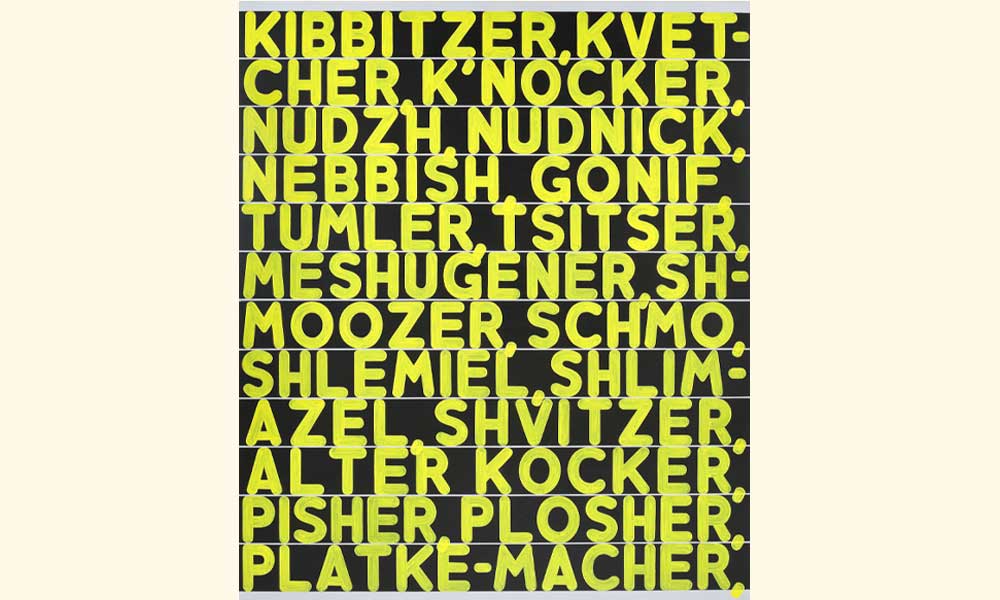
Vibrant yellow words seem to shout out from pioneering conceptual artist Mel Bochner’s 2012 painting The Joys of Yiddish. (Photo credit: Courtesy of The Jewish Museum, New York / Kris Graves)
But the concept of a public Jewish museum in New York raised any number of questions that couldn’t easily be answered: How do you define Jewish principles and values? What exactly is the Jewish tradition? What about those who have lost their faith? Who, in fact, is a Jewish artist? And, who will be the audience for such a museum? There were serious divisions within the Jewish community that needed to be considered in order for a patron base to be established. Strains existed: between Jews who were well-rooted in America and Jewish newcomers; between those in the Reform movement and those who were more observant; between Zionists and anti-Zionists; between those from Eastern Europe and those from Central Europe or the Arab world or Africa; between anti-Communists and fellow travelers; and even between those who championed abstract art and those who championed representation. Would it be possible for the museum to garner the support needed to develop and manage a collection to fit inside the fantastical chateau-like Francois I, French Gothic structure?
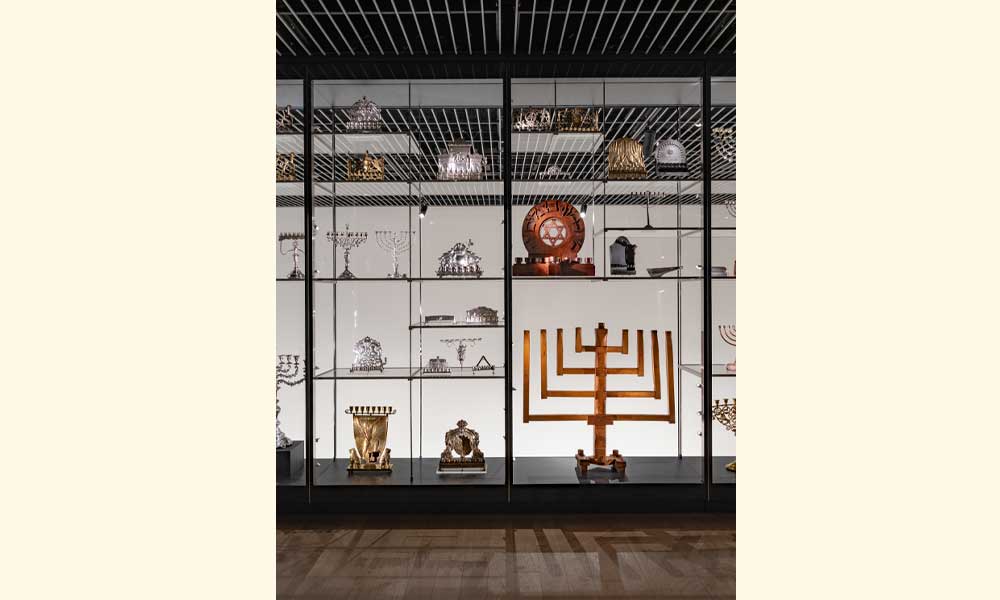
The museum’s renovated fourth floor features a striking display of 130 Hanukkah lamps in a 50-foot vitrine (detail). (Photo credit: Courtesy of The Jewish Museum, New York / Kris Graves)
Work on the building began in 1945, transforming the three lower floors into gallery space with an auditorium on the second floor where the music room had once been. The idea was to leave traces of the salon feeling of the house and its architectural detail—the marble fireplaces, some of the mahogany and oak paneling and the raised plaster medallions and rosettes on the ceilings—so the public would know that this had originally been the home of an eminent Jewish family. In May of 1947 the museum opened its doors with exhibits showcasing 1,000 objects ranging from Jewish ceremonial art to work by modern Jewish artists, including a plaster bas relief by Polish-born Teresa Żarnowerówna entitled Uprising in the Warsaw Ghetto. In the autumn of that year an exhibition of synagogue architecture, which included ancient mosaic tiles, was added. These four categories—ancient artifacts, Jewish ceremonial art, modern art by Jewish artists, and art from the era of the Holocaust—have been the strengths of the museum ever since, even as some of the collection gaps have been filled in and the museum’s holdings have increased to approximately 30,000 objects. In 1963 and again in 1993, the gallery space was enlarged and reconfigured with the same complex mission of respecting the historic architecture while preparing the galleries so they could accommodate 3,500 years of Jewish art as well as wide-ranging special exhibits. In October of 2025, the museum completed a $14.5-million project, once again updating the viewing rooms and the lighting on the third floor and integrating galleries with the new Pruzan Family Center for Learning on the fourth floor.
If you’re sensitive, you’ll inevitably feel a dissonance when you’re in the newly redone galleries—I sometimes think the museum is like a letter with a mismatched envelope. But there’s a dynamic quality created by that dissonance, and the redesign has been engineered with creativity and imagination. You see this especially on the fourth floor where a 50-foot-long vitrine houses 139 Hanukkah menorahs and objects intended to give off light. While the long glass box of the showcase overlooks the double-height gallery below, the glass draws light up and simultaneously allows the viewer’s eye to follow through the transparency of the case, down to the art hung a floor below. The result can be both stunning and destabilizing. For instance, I was looking at a series of 19th-century silver Hanukkah lamps from the Kingdom of Hungary, some of them diecast and silver-plated, some of them hand-worked, all bearing the fingerprints of a lost world, when my eye strayed down to the floor below and caught sight of pioneering conceptual artist Mel Bochner’s “word” painting, The Joys of Yiddish, with its bright yellow lettering of Yiddish words, starting with KIBBITZER, KVET-CHER, K’NOCKER and ending with PLATKE-MACHER (meaning “troublemaker”).

With the new redesign project, the museum has rehung and reorganized highlights of its collection, parts of it filling the renovated third floor and parts of it integrated into the educational space on the fourth floor. It was wonderful once again to see Raphael Soyer’s beloved Dancing Lesson. The 1926 painting, showing his sister teaching her twin brother how to dance, is a tribute to his immigrant roots when the family of nine people lived together in a Bronx apartment replete with a rubber tree plant and the photograph of the grandparents—grandfather with a long, white beard—over the sofa. You will also see Adolph Gottlieb’s red velvet Torah Ark Curtain and Mark Rothko’s Crucifix, both pieces referencing the artists’ idiosyncratic searching for identity. The brilliant glass artist Beth Lipman’s Laid Table with Etrog Container and Pastry Molds brings together objects from all of the Jewish holidays and Jewish ritual—the long glass shofar, candles and candle holders, the handwashing cloth, which represents her mother, and the tallit, based on the one that had belonged to her father. “It’s really a portrait of myself,” she has said in interview. This was also the case for Greta Perlman, who, in utterly appalling circumstances, crafted a bracelet from pieces of glass, porcelain and wood she was able to salvage between 1941 and 1944 when she was in Theresienstadt. Some of the charms she strung on the cord—for instance, a star of David worked around the letter T and a tiny cooking pot with the date of her deportation inscribed on the bottom—tell the story of a love affair it’s assumed that she had with a man named Theo and the work she was assigned to in the kitchen of the Ghettowache barracks.
One of the pieces on view is an elaborate site-specific 20-foot mural by Brooklyn-based Talia Levitt, known for her trompe l’oeil backgrounds inspired by patterned fabric and ornamental carpets. Commissioned by the museum, the multilayered work presents worlds within worlds. While the narrative shows three different contemporary versions of the artist, an image of her infant daughter, born while the work was in process, and a drowsy German Shepherd, embellishments made with cast- and pipe-processed acrylic paint adorn the entire surface with little buttons, zippers and embroidery thread, referencing the generations of her family who worked in New York’s garment district. At the center of the mural, Levitt has painted what appears to be a fringed curtain decorated with pictures of objects from the museum’s collection—an early American coffeepot, a 19th-century Persian wedding gown, a 17th-century Italian floral-patterned cloth used to bind together a Torah scroll, for instance. On either side of the painted fringed curtain you can see the same cut-out views of Central Park that are visible through the mansion’s square-framed windows. When you recall that this is the prospect of the reservoir and skyline that Frieda Warburg looked out on, it becomes apparent that the work is a vivid homage to the museum with its complex task of containing the past as well as the present.
One thought on “Visual Moment | From Mansion to Museum, Imagined Anew”
Cant wait to visit and see the Soyer painting and other treasures.