
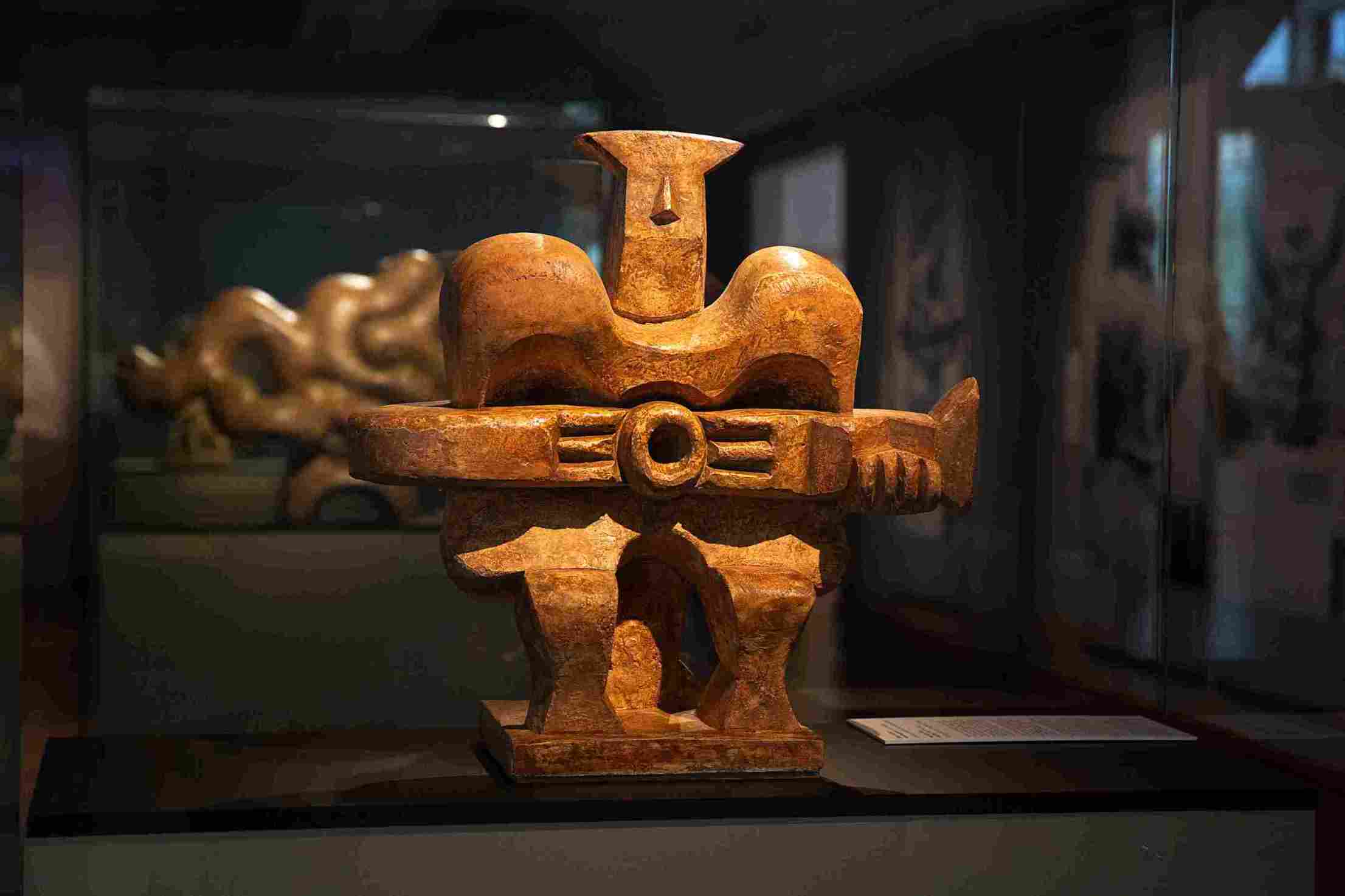
Curators at the Samuel Bak Museum in Vilnius could not safely assemble sculptor Jacques Lipchitz’s Mother and Child. When the exhibition “Jacques Lipchitz: Sculptures – Pilgrims” opened this past July, the broad-shouldered, bird-headed mother stood upright in the gallery, two round openings visible in her body, while her child and several detached sections lay next to her on a black platform. Someone had written the inventory number 927 directly on one curved piece.
Lipchitz, one of the most important sculptors of the 20th century, created Mother and Child in 1930. The plaster working model for the sculpture belongs to the Institut Valencià d’Art Modern, or IVAM, the modern art museum in Valencia, Spain, whose Lipchitz holdings were built largely through gifts from the Jacques and Yulla Lipchitz Foundation, which manages the sculptor’s estate. IVAM holds five bronzes and some twenty original plaster or terracotta models, the forms from which molds for authorized bronze casts could be made. The plaster of Mother and Child was too fragile to assemble as Lipchitz intended, one figure fastened to the other. Instead, the curators made the separation part of the current exhibition, which features works on loan from IVAM’s Lipchitz collection. Eight of these Valencia sculptures are on display in Vilnius and four more in Druskininkai, the spa town where Lipchitz was born in 1891. Both exhibits are on view until November 22. Lipchitz’s work has appeared in Lithuania before—including a 2016 Vilnius retrospective marking his 125th birthday—but this is the first featuring these works from IVAM.
The unassembled plaster of mother and child sits at the center of the Vilnius exhibition. In the finished bronze—one of which is in the collection of the Cleveland Museum of Art—the two figures merge into a single volume. The exposed sockets of the model show how the pieces join, how Lipchitz distributed weight, and how a sculpture that looks monumental can depend on vulnerable internal connections.
“It is like Lego,” says Ieva Šadzevičienė, chief curator of the Samuel Bak Museum, pointing to the openings. “You can see how [they] should be put on top of each other.”
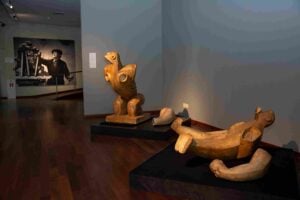
Original plaster working model for Lipchitz’s 1930 Mother and Child. Credit: I. Svirskaite. Courtesy of The Samuel Bak Museum.
Moving the works to Lithuania was an undertaking in itself. Aivaras Poška, the museum’s head of exhibitions, describes climate-controlled trucks, protection from vibration, specialized handling and security. The works are insured for up to 9 million euros ($10.4 million). Up close, the reason is visible. Most are working models and unlike the finished bronze casts, their surfaces preserve Lipchitz’s direct handling—his fingerprints, strokes and corrections. Aušra Rožankevičiūtė, who conceived and curated the exhibition, calls them “the originals of the originals.”
The exhibition’s title refers to the sculptures’ travels from studio model to cast, family to museum, and country to country. Rožankevičiūtė refers to Vilnius and Druskininkai as “a cultural bridge of memory.” The world has known Jacques Lipchitz for a century, she says. Lithuania is now being reintroduced to Chaim Jakob Lipchitz, a Jew rooted in the lands of the former Grand Duchy of Lithuania.
Lithuania’s state-funded Vilna Gaon Museum of Jewish History, whose branches include Vilnius’s Samuel Bak Museum and the Jacques Lipchitz Museum in Druskininkai, is named for the 18th-century Vilnius rabbi and Talmudic authority Elijah ben Solomon Zalman, known as the Vilna Gaon, whose scholarship made the city a center of Jewish learning.
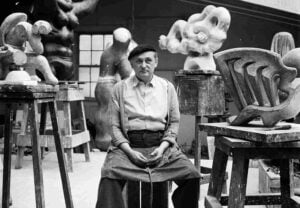
Jacques Lipchitz, c. 1948, in his Manhattan studio. Credit: Guggenheim Bilbao, Bob Hanson, Look Magazine, © Stanley Kubrick.
According to the United States Holocaust Memorial Museum, the Holocaust killed about 90 percent of Lithuania’s Jews. German occupation forces organized the genocide there, and Lithuanian auxiliary units and local collaborators helped identify, confine and murder Jews. Most victims died in forests and pits near their hometowns rather than in distant camps, which means the killing happened in front of their neighbors.
The country still argues about honoring men connected to antisemitic movements because they also opposed Soviet rule. Vilnius has repeatedly fought over memorials to Kazys Škirpa, founder of the antisemitic Lithuanian Activist Front. Protests also followed the 2024 entry of the populist Nemunas Dawn party into the governing coalition. Its leader, Remigijus Žemaitaitis, was convicted in December 2025 of inciting hatred against Jews and trivializing the Holocaust; an appeals court upheld the conviction in July 2026 and doubled his fine. The Lipchitz exhibition, which is state-funded, opened against this political backdrop.
“Lithuania is still healing the historical wounds inflicted during the Second World War,” Culture Minister Lukas Alsys said in an interview at the Vilnius opening of the exhibit. He said much more remained to be done to teach younger generations that the Jewish community had been a vibrant part of Lithuania’s history.
Sergejus Kanovičius, who became director of the Vilna Gaon Museum of Jewish History this past spring, wants the museum to tell the life before the death. Lipchitz offers an unusually prominent example: a Jew from a Lithuanian resort town who left at 17, helped invent modern sculpture in Paris, escaped the Nazis there by moving to the United States, and never returned home. He is being returned not as a victim but as an achievement. Whether a country can claim that achievement while it is still arguing about its own role in the destruction is the question the exhibition raises.
***
Vilnius today moves with the confidence of a capital newly visible to the wider world. Electric ferries cross the Neris below the Old Town’s ochre roofs and church spires; glass towers rise across the river, and studios and galleries fill the leafy neighborhood of Užupis.
The Samuel Bak Museum occupies what was once a Jewish theater on Naugarduko Street, a few blocks west of the wartime “Large Ghetto.” The ghetto is marked but easy to miss. Granite plaques at the old gates, a few scattered murals, otherwise the renovated Old Town gives little sign that tens of thousands were once confined here. German authorities, assisted by Lithuanian police, forced roughly 40,000 Jews into two Old Town districts beginning in September 1941. The smaller of the two ghettos was emptied within weeks and its prisoners murdered at Paneriai, the forest site outside the city known in Polish as Ponary. The larger ghetto survived until September 1943, and inside it, amid forced labor and repeated deportations, inmates maintained a library, theater, schools and art exhibitions. Samuel Bak, the Vilnius-born painter for whom the museum is named, was nine when his work appeared in one of those exhibitions. Now 93, he lives and works in Massachusetts. Bak’s mother also survived, but his father and grandparents were murdered. The building today also houses “The Rescued Lithuanian Jewish Child Tells About the Shoah,” a permanent exhibition built from survivor testimony and family records. The Lipchitz galleries sit a few rooms away.
Kanovičius is the son of Grigory Kanovich, the Lithuanian Jewish novelist whose books returned repeatedly to the vanished towns of Jewish Lithuania. Before taking over the museum, Kanovičius conceived and founded Lost Shtetl, the museum and memorial complex in Šeduva created to recover the world of a destroyed Lithuanian Jewish town.
Kanovičius has said that an artist has two homelands. The first is physical: the place where he receives his first impressions of light and form, sees the forest, the backyard, the chickens, the rabbi crossing the street. The work creates the second. Once an artist leaves, especially when history destroys the place of return, the work, he maintains, becomes “a shelter, a sort of homeland” carried from country to country. Lipchitz carried Druskininkai and Vilnius with him and into his work. Kanovičius places him within a broader migration of Litvak artists, including Marc Chagall and Chaïm Soutine, moving from the shtetl, the small Jewish market town, to the modern metropolis. “The connection is very clear,” he says. “It never breaks…Lithuania is discovering the artists born under its sun.”
Born in Druskininkai in 1891, Chaim Jakob Lipchitz came to Vilnius as a teenager to study engineering. Between 1906 and 1909 he also attended free technical drawing and drafting classes associated with the Vilnius Drawing School. Before turning 18, he left for Paris. The official chronology sounds tidy: engineering, drawing school, Paris, Cubism. Rožankevičiūtė, who has spent years studying Lipchitz, tells a less linear story. The city itself provided another school. Lipchitz recalled in his autobiography, My Life in Sculpture, that he learned sculpture in the churches of Vilnius and that they still stood before his eyes.
Vilnius was the first big city Lipchitz knew. Rožankevičiūtė says that there Lipchitz encountered a vibrant cultural life and “acknowledged what professional art was.” In Catholic churches he saw sculpture built into architecture. On Trakų Street, atlantes, male figures used as columns, held buildings on their shoulders. The Church of St. Peter and St. Paul contains more than 2,000 white stucco figures. Saints lean from niches, columns twist, and changing light breaks the forms apart. Rožankevičiūtė views that theatrical architecture as part of Lipchitz’s education in volume, shadow and movement.
The Vilnius exhibition places early 20th-century photographer Jan Bułhak’s images of prewar Vilnius beside the plaster sculptures, letting visitors look from the churches Lipchitz carried in memory to his own works—pierced with openings and changing shape as you move around them, much as the carved saints seemed to shift in the churches.
In Paris, Chaim Jakob became Jacques. He worked beside Pablo Picasso, Juan Gris, the Mexican painter Diego Rivera, and Amedeo Modigliani, and brought Soutine into Modigliani’s circle. He became one of the first sculptors to work in Cubism, the movement that broke objects into intersecting planes and showed several views of a thing at once. It was, in large part, a Jewish world that carried him, including his dealer Léonce Rosenberg, who gave him his first solo show in 1920, and fellow Litvaks like Soutine and sculptor Ossip Zadkine. Across the Atlantic, a 1922 commission by the collector Albert C. Barnes opened America to Lipchitz’s work.
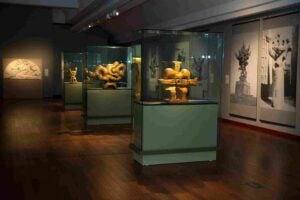
Works from the Institut Valencia d’Art Modern’s Lipchitz collection on view at the Samuel Bak Museum, Vilnius, Lithuania. Display juxtaposes the sculptor’s original models with large photographs of the his public monuments. Credit: I. Svirskaite. Courtesy of The Samuel Bak Museum.
Zadkine, the other great Litvak Cubist sculptor, escaped to New York. Soutine died in 1943 after an operation while hiding from the Gestapo. Lipchitz escaped Nazi-occupied France for the United States in 1941, and his sculpture darkened with the decade—the Cubist play of his youth giving way to heavier, more anguished forms.
Rožankevičiūtė used the eight Vilnius works to make that change visible. She began with the 1923 plaster relief Figure with Musical Instruments, an exceptionally rare Lipchitz relief. A body, a guitar and other instruments break into angled planes until no element has priority; together they form what she called an architectural sculpture. She linked that architecture to the engineering career Lipchitz’s father wanted for him and to the 1922 Barnes commission for a series of five stone reliefs for the outer walls of the Barnes Foundation building in Merion, Pennsylvania.
The nearby Man with Guitar, from 1925, retains the Cubist planes but releases the figure from the wall. The instrument passes through the musician, and openings make light part of the construction. Rožankevičiūtė traces the motif to Lipchitz’s 1914 journey through Spain with Rivera.
In The Supplicant, a darker work from 1943, a figure curls inward, hands and limbs gathering around a central opening. Within the exhibition’s chronology, it stands at the point where the playful cosmopolitan became an artist confronting Europe’s darkness. Rožankevičiūtė describes that larger transformation as a demand to respond “not only as an artist, but as a man, as a Jew, as a human being.” The folding figure enacts prayer —bending inward around a hollow—while the rough surface keeps the marks of Lipchitz’s hand; he made it in New York, two years out of France, while the Vilna Ghetto was being liquidated.
The postwar works open outward. In Song of Songs from 1946, interlaced forms suggest two bodies. Rožankevičiūtė describes the biblical poem of the title as love toward God and between people; the museum reads the closeness and movement as life answering wartime loss. Rožankevičiūtė points to Orpheus as another work joining reflection with hope. Across the group, planes swell and bend into what she calls a pulsating “Baroque Cubism,” her term for the late work’s restless, curving masses, moving toward “the search for God,” she says, and existential reflection.
The small plaster models stand before wall-size photographs of Lipchitz’s public monuments, which reside in cities from Philadelphia to Los Angeles, Jerusalem to Rio de Janeiro. Reflections in the glass multiply them, as though a plaster was already beginning its journey into variants and casts.
The Bak Museum gives the works a context they do not have at IVAM. The display in Valencia, chief curator Šadzevičienė says, begins with the modernist; Vilnius asks how the art relates to Jewish identity, exile and catastrophe. A label for Mother and Child II, which Lipchitz began during the war, connects its raised arms, compressed bodies and instinct to protect life with the persecution of European Jews. “In our museum,” she says , “we always speak about how it is connected to his history and to his Jewish identity.”
Museum director Kanovičius was wary of turning that interpretation, or the language of national recovery, into doctrine. A museum, he said, must never become “a tool of any ideology.” Its obligation is to evidence and open argument. “It is a place where people have a right to ask any question and look for the answer.”
***
The Jacques Lipchitz Museum in Druskininkai occupies a protected wooden building of less than 200 square meters. Built for a physician, the villa later served as a children’s hospital, a residence for doctors and a children’s library. A memorial museum to Lipchitz was established there in 1996; after closing for an extended heritage-constrained renovation, it reopened in April 2026 with a new permanent exhibition on Lipchitz’s life and work.
Before the Druskininkai opening of the current exhibition, the building still smelled of fresh paint. Ieva Bernotaitė had been chief curator for just three months. “I thought I wasn’t ready for this job,” she says, “but I applied, and now I’m here. I’m still new and fresh.”
Lipchitz received a full Museum of Modern Art retrospective in 1954 and another at the Metropolitan Museum of Art in 1972. His work is held by the Met, the Tate, the Los Angeles County Museum of Art and the National Gallery of Art in Washington, D.C., but his later biblical and religious sculpture—the work this exhibition emphasizes—is less familiar to viewers in the United States.
No other museum anywhere is devoted solely to Lipchitz. The only one is this wooden house in his hometown, now a branch of the Vilna Gaon Museum. “It is so small,” Bernotaitė said. “He is so famous abroad, and this is the only museum in the world [to focus solely on him]. I think there is something special about that.”


Druskininkai makes “homecoming” literal. Across the street stands the restored Hotel Central. Bernotaitė says that Lipchitz’s father, the building contractor Abraham Yitzhak, built and owned the hotel; the exhibition panel says his mother, Leah Rachel, managed it and that it also served as the family home. Bernotaitė adds that the Lipchitzes had a small house nearby that later burned. She points out old tiles from the hotel displayed inside the museum. The family knew the parents of Mikalojus Konstantinas Čiurlionis, the painter and composer regarded as Lithuania’s national artist, who also grew up in the town.
The display names all six Lipchitz children—Chaim Jakob among them—and shows a family embedded in resort life. It is the history Kanovičius wants: Jews as hotelkeepers, builders, neighbors, parents and children before they become abstractions of loss.
Another panel widens the frame from one family to a town. Jewish residents sustained the resort through trade and services, it says, and Jewish-owned boarding houses and sanatoriums drew visitors from Vilnius, Grodno and Warsaw. Then the same panel records what ended it. In June 1941, after Nazi Germany occupied Druskininkai, the persecution of the town’s Jews began. On September 11, 156 Jews, among them 26 children, were executed near the Jewish cemetery in Leipalingis. The rest, together with Jews brought from elsewhere—nearly 1,000 people in all—were confined to a ghetto near the Russian Orthodox church. The panel dates the ghetto’s liquidation to November 2, 1943, and says only that the surviving prisoners were deported.
By then Lipchitz had been gone for more than 30 years. Bernotaitė says the artist’s parents died before the war. The family display shows that two of the six siblings also died before it, while Jacques and the other three survived beyond 1945. War and emigration scattered the family across continents; Lipchitz remained closest to his brother Ruvim, who settled in Paris and later gave the sculptor’s early photographs and sketches to the Israel Museum in Jerusalem.
Druskininkai was built around the proposition that a place could heal. Its salty springs made it a spa in the 19th century, and Soviet authorities later expanded it into a major sanatorium center. After communism, the town had to reinvent that inheritance. Today mineral-water pools, mud baths and private wellness hotels operate alongside the surviving sanatoriums.
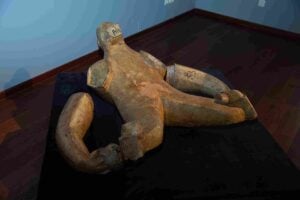
Jacques Lipchitz, Mother and Child. Credit: I. Svirskaite. Courtesy of The Samuel Bak Museum.
I had expected a faded post-Soviet border resort. Instead I found well-kept parks, cyclists following paths along the Nemunas River into pine forest, and families and older couples arriving from across the region. At the local Chabad house, Ukrainian Jews and Israelis gathered for Shabbat meals. Visitors have returned to the waters, including Jewish visitors; the hotelkeepers, physicians and families who once received them have not.
The four IVAM sculptures on view in the museum provide a compact walk through the sculptor’s career. The 1920 Portrait of Raymond Radiguet, a bust of the young French novelist, is unexpectedly classical. On the head, Bernotaitė points out a workshop instruction about refilling the wax, exposing the object as a working master form rather than a finished treasure.
Five years later in Man with Mandolin, torso and instrument merge into a single form, the mandolin seeming to grow out of the player’s body. Bernotaitė connects the sculpture’s rhythm to Lipchitz’s Spanish journey and Mediterranean music. In Biblical Scene I from 1950, figures press into one agitated mass.
In the fourth sculpture, the 1938 Rape of Europa I, the bull’s horns rise over a rough, tangled form in which Europa and the animal are hard to separate. The museum interprets the ancient abduction through its date: Hitler’s annexation of Austria, the Munich Agreement and a continent under coercion. The label says it “can be read as an allegory.”
The town sits about nine kilometers, roughly six miles, from the border with Belarus. To Lithuania’s west lies Kaliningrad, Russian territory wedged between Lithuania and Poland. Between them runs the Suwałki Gap, the narrow land connection joining the Baltic states to Poland and the rest of the European Union and NATO. A sculpture made as fascism prepared to seize Europe now sits near one of the continent’s most consequential military choke points.
Druskininkai already knows the celebrated national artist Čiurlionis. Bernotaitė jokes that her assignment is to talk about Lipchitz until the town knows him just as well.
Groups from the University of the Third Age, Lithuania’s network of courses for retirees, already arrive by the busload. Programs for schoolchildren are planned for the fall. Here Lithuanian pensioners and children encounter Jewish history through artistic achievement as well as extermination. For Kanovičius, that programming reflects museums’ educational and historical obligations, directed toward building “a better society.”
After Lipchitz’s move to New York, biblical stories of suffering and themes of death and rebirth moved closer to the center of his work. He devoted years to the sculpture Our Tree of Life. After his death, his widow, sculptor Yulla Halberstadt, completed the monument and oversaw its installation outside Hadassah’s Mount Scopus hospital in Jerusalem. Looking back, Lipchitz wrote in My Life in Sculpture: “It was only later in life that my Jewish self-consciousness fully awakened.”
He died on Capri in 1973 and was buried in Jerusalem. In a late letter to the Lithuanian sculptor Vladas Vildžiūnas, Rožankevičiūtė noted, Lipchitz wrote that without roots he could not have created his great tree-of-life sculptures. The curator understands the Valencia loan as another kind of pilgrimage: the artist returning through the art to his most important places of memory.
In Vilnius, Lipchitz’s works now stand near a contemporary sculpture yard, a center of Jewish culture and the churches he said taught him sculpture, all within a few streets. In Druskininkai, they sit across from his parents’ hotel, close to the forest of his childhood and to a border where Europe again understands its vulnerability.
The mother remains apart from the child in Vilnius, the sockets between them still exposed.
“Jacques Lipchitz: Sculptures – Pilgrims” is on view at the Samuel Bak Museum, Naugarduko Street 10/2, Vilnius, and the Jacques Lipchitz Museum, Šv. Jokūbo Street 17, Druskininkai, both branches of Lithuania’s Vilna Gaon Museum of Jewish History, through November 22.
(Top image: Working model for Lipchitz’s 1925 Man with Guitar. All photos by I. Svirskaitė, courtesy the Vilna Gaon Museum of Jewish History)
