
An overnight success is never as satisfying as a slow burn. A song’s steady creep up the charts and burgeoning name recognition can make a star out of an underdog hustler, as happened with the mellow country singer Ella Langley, whose single “Choosin’ Texas,” has stayed at the top of the Billboard Hot 100 for 20 weeks, a new record for a non-holiday song. More niche artists are joining her. Audrey Hobert is enjoying her first Hot 100 hit, “Sue me,” a year after its release; ADÉLA, a Slovak newcomer, is charting with “Ain’t In LA,” and Slayyyter, a gritty electropop provocateur, notched a slot after debuting eight years ago. These artists are working uphill against music titans, and are finally getting the breakthroughs they deserve.
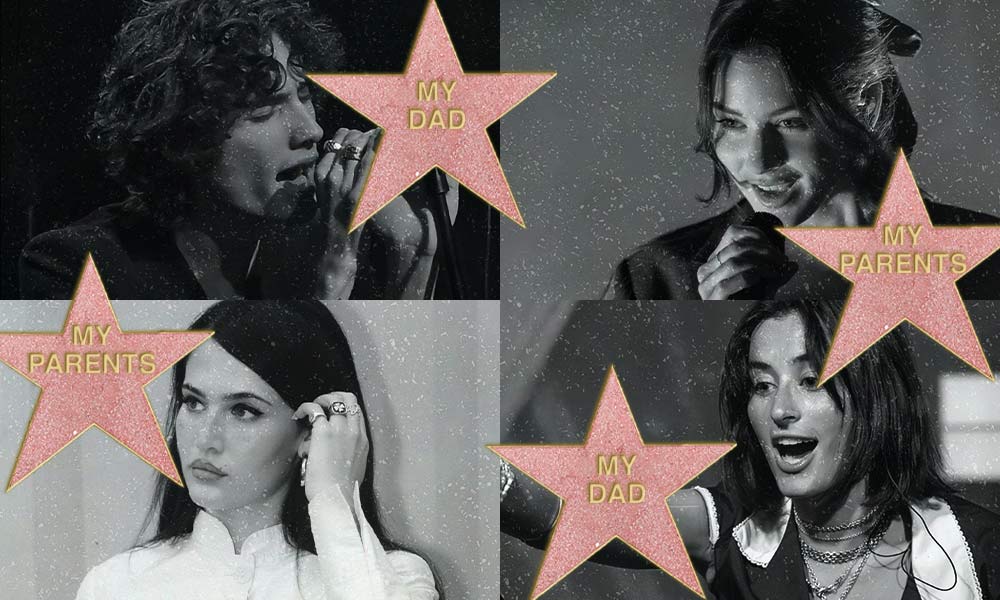
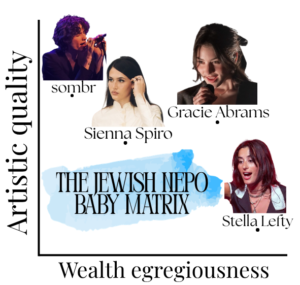
Meanwhile, when a slate of new-ish Jewish stars—Stella Lefty, Sienna Spiro, sombr—hit the charts, they were given the typical asterisks that come with sudden fame—nepotism baby, industry plant. The terms overlap, but both suggest that their success is plastic, purchased either through the industry connections their parents fostered or simply a massive amount of money spent to ensure their songs are heard. While music fans are notoriously quick to pull the trigger and call someone an “industry plant” simply because they’ve emerged somewhat suddenly, some sleuths researched more deeply into this year’s hitmakers and found their parents were surprisingly wealthy or well-connected—their fathers were billionaire founders of AI companies, hotshot jewelers, or J.J. Abrams.
Gracie Abrams, the A-list film director’s daughter, is a pop singer who has opened for (and collaborated with) Taylor Swift for her monumental Eras Tour. Among the season’s so-called nepo baby singers, she’s also the most well-known and the most upfront about her upbringing, though this is a relatively new development. Financial comfort has dogged the singer through her career thus far (her mother is also a co-CEO of a production company). “The nepo stuff is obviously in the discourse appropriately,” she told The New York Times’ Popcast in June. “I had a safety net, and that allowed me the ability to experiment and to concentrate and I had the gift of time to dedicate to doing this thing that I loved.”
Her candor satisfied those who were irritated that she previously didn’t say much about it. A 2024 Nylon profile said she had “transcended” the nepo baby label, but public criticism against her at the time was still strong, despite a hit with “That’s So True.” Allegations of a quick rise were offbase, anyway, since Abrams had a robust catalog; she was signed to Interscope Records in 2019 (“She’s done this on her own without taking any of the shortcuts,” CEO John Janick told Billboard), and released two EPs and three albums since then.
Her new album from July, Daughter from Hell, attempted to capture her rambunctious teenage years but ultimately sounded too gentle to earn that title, even though her writing has evolved from previous works. Her struggle is matching the heft of her words with her voice—images of car crashes, broken hearts or a knife in one’s side fill the record—but her whispery tones often don’t correspond to a mind in turmoil.
Shane Michael Boose, also known as sombr, goes in the opposite direction—his songs are alive with passion and the fresh breath of feeling, countercultural to the cynicism and nihilism plaguing most Gen Zers (Boose is only 21). This makes his newest song, “My Body Isn’t Ready,” that much more of a statement—it’s an admission of self-sabotaging masculine failure, wrapped in the prickly shame of body dysmorphia.
His earnestness is matched with a flair for performance, like at the Grammy’s, dressed in a shimmering disco-ball blazer and pantsuit. His debut album, last year’s I Barely Know Her, pulls from glam and indie rock to blend adolescent melancholy with something universal, even if he gets bogged down at times under the weight of his influences, like The 1975 and Arctic Monkeys.
Sombr’s father is Andy Boose, the founder of the event management company AAB Productions, which has worked internationally with, according to its website, the foundations of Elton John, Leonardo DiCaprio, Prince Albert II of Monaco, Novak Djokovic and Madonna, as well as with Cannes and UNICEF. The elder Boose is also credited as a composer on his son’s song “I’ll Remember Tonight.”
Another artist who has benefited from prestigious and wealthy parents is Sienna Spiro, an English soul singer whose mother, Arabella, is involved with Tikva UK, a nonprofit organization that provides support for neglected or abused Jewish children, primarily in Odessa, Ukraine, but also in Israel and Romania. Her father, meanwhile, is “Britain’s master jeweller” who has previously worked with Jay-Z, Beyoncé and the Princess of Wales. “I’m not saying the rich should be excluded from the arts,” Ian McQuaid, the head of two London-based record labels, tweeted, “but until we start making more routes to success for people other than the INSANELY wealthy or connected, UK culture will slow, stop and ultimately rot.”
While Abrams and sombr both have a decent catalog, Spiro’s is a little bare. She started gaining momentum with last October’s “Die On This Hill,” a smoky, soulful ballad, which has earned her comparisons to Amy Winehouse (who is also Jewish). Spiro’s debut album, Visitor, garnered lukewarm reviews this July but still reached the top ten of the Billboard 200. She plays the imitation game well, and her voice’s personality and heft makes Visitor a solid debut, but nothing compares to Winehouse—it feels like Spiro emulates the emotional turbulence without having experienced it herself. But still, she has an aura and classiness, and at 20, there’s ample time to figure herself out.
While the above artists have a musically steady foundation, Stella Lefty, the newest of the bunch, is up a creek with no paddle. For one commenter, the 24-year-old country singer is “a level of Nepo Baby that makes Gracie Abrams look like an orphan.” She currently has a massive hit in “Boston,” a twangy ode to a city she was neither born in (that would be Glencoe, IL) nor currently resides in (Los Angeles, CA). Pretty quickly, people started noticing the similarities between her song and post-pandemic folk hero Noah Kahan’s “Stick Season,” which are, to be blunt, clear as day. “When I was writing the song, I wasn’t thinking about Noah Kahan,” she told Vanity Fair, a white lie that was disproved by a compilation of her covering “Stick Season” 16 (!) times. (Kahan was later credited on the song.)


Its particular egregiousness is amplified by her father, the billionaire founder of Groupon, Eric Lefkofsky. His net worth ($6 billion) is more than enough for people to point to when discussing Lefty’s rise, which was more meteoric than anyone above—she’d barely started releasing songs when she was featured on the Scream 7 soundtrack earlier this year, which music critic Anthony Fantano said was “even more damning evidence than any amount of money her father has. How are you… after no hits whatsoever, landing a prominent soundtrack placement on a highly anticipated sequel to a major film franchise?”
Nepotism allegations can sound like sour grapes and ignore genuine talent, but it doesn’t help to have your father promote your songs on his LinkedIn page, as Lefkofsky has done (twice). The Vanity Fair profile of Lefty addresses the elephant in the room immediately in its headline: “Can a Chicago billionaire’s daughter be country music’s next big thing?” Unintentionally hilarious question notwithstanding, Lefty also has the least to offer in the current music landscape. Her debut album from August, Long Way Home, is a twee, shiny collection of cosplay country songs that feel like radio-targeted easy hits. If the country accent that Pennsylvanian Taylor Swift hammed up on her debut album feels phony now, Lefty’s sounds totally plastic. You’re better off listening to Noah Kahan (as she herself does, quite often).
For some, a life of wealth is an insurmountable obstacle to producing interesting art; the lack of struggle suggests no opportunity for scrappy self-discovery. I prefer to be charitable and encourage anyone’s desire to be a singer or an artist, no matter whom their fathers have supplied jewelry to or which blockbusters they’ve directed. For these artists, being funded isn’t the problem so much as making songs that people connect with. An audience is surprisingly astute at sniffing out a phony, and just like any musicians, the actual quality of the songs here is quite a mixed bag.
(Top image credit: Forsaken Fotos (CC BY 2.0), Justin Higuchi, (CC BY 2.0), Justin Higuchi, (CC BY 4.0), Drew de F Fawkes, (CC BY 2.0), (Danielle Ernst, CC BY 4.0))