
As a daughter of Holocaust survivors, both of whom are now gone from the earth, I have been listening all of my life to stories about their own and other survivors’ experiences before, during, and after the war. This includes the silences and tears that accompany such tellings, along with the ways in which repeated stories change over time, the ways details get revealed and recollected, the ways memories fade and don’t fade. I have watched for body language to reveal what the words are trying and failing to say; I have absorbed unbearable losses and unanswerable questions; I have written books to make my own art out of this history. The explorations continue to be my life’s work, which is why I was profoundly moved and impressed by Yoav Potash and his extraordinary 2025 film, Among Neighbors.
It can be said that great art enables you to feel things as well as to learn things. Great art can also make you want to understand how it was created and what went on behind the scenes. That’s one of many reasons I watched Among Neighbors twice, and why I urge you to see it yourself, at least once, and maybe more than once, if you can.
The first time I saw the film, I knew the screening was going to be followed by a Q&A with the writer/director/producer, Yoav Potash. The theatre was packed. What I remember most about my response afterward is that I felt a powerfully burning desire to tell everyone to see the film right away. Not only because of the emotional impact of the storytelling and the urgently relevant message about humanity’s capacity for evil and goodness, side by side, but also because of the revelations that broadened my understanding of the past, my own personal history (my mother’s, that is) and the collective history of an entire nation (Poland, in this case).
I always heard my mother say that at the end of the war, Poland still wasn’t “safe.” She was referring to the time immediately after Poland was liberated from the Nazis, after she and her parents were able to emerge from hiding—in the barn of a Polish farmer whom they had paid with jewels and cash, after having previously survived the liquidation of the Vilna ghetto. My mother didn’t have the emotional capacity to tell us much about her experiences in the ghetto or in hiding, but I remember her saying she was always terrified about what might happen if she and her parents ran out of money to pay the Polish farmer who was hiding them. I also knew that after the end of the war, she and her parents realized they had to take refuge elsewhere while awaiting their visas for America. Because Poland wasn’t safe.
After watching Among Neighbors, I have a much deeper comprehension of what my mother must have meant.
In its simplest form, Yoav Potash’s film is a documentary about the brutal murder of five Jewish people in a Polish village six months after the Germans were driven out at the end of the war. The victims had been residents of the village, and the murder was committed by their own neighbors. The film focuses partly on the last remaining Jewish survivor of the village, Yaacov Goldstein, and on witnesses to the murder—as well as the reasons these witnesses remained silent for more than 70 years. As Potash has said in several interviews, this isn’t exactly a Holocaust film. It’s a post-Holocaust film.
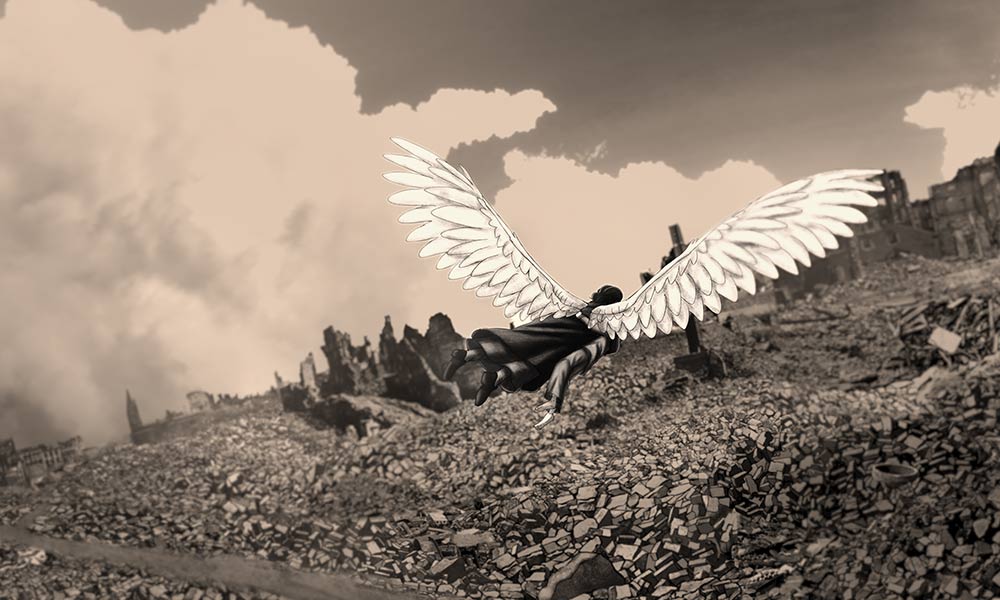
The deft interweaving of hand-drawn animation with archival footage and first-hand testimony is one of many features that sets this film apart from other approaches to representing the Holocaust. Such visual and sometimes non-verbal eloquence allows the viewer intimate access to the stories held for so long by these survivors and witnesses. We see as well as feel Yaacov’s suffering and his miraculous survival; Pelagia’s indelible memories and courageous observations; the village’s pre-war harmony and post-war atrocity. All of these are portrayed with sensitivity and authenticity featuring one small town that likely represents shtetl life across Eastern Europe.
Potash was originally enlisted in 2014 by his friend and colleague Dr. Anita Friedman to document the re-dedication of a Jewish cemetery in her family’s ancestral village of Gniewoszów, Poland, a place that had once been inhabited by a majority of Jews who co-existed for centuries alongside their Catholic neighbors. This shared history was symbolized, as one interview subject explains, by two different pronunciations of the village’s name. Potash decided to ask elderly residents what they remembered about their Jewish neighbors in the shtetl; in the process, what began to unfold was the puzzle-building exploration of “a town hiding something.”
One piece of the puzzle appeared when Potash encountered 85-year-old Pelagia Radecka. Only after learning that the ringleader of the murders had died did she feel ready to share the searing memories she carried. In one of many chilling moments in the film, when Potash—from behind the camera—asks Pelagia about the first time she spoke to anyone about what she witnessed, she says, “You. You are the first.”


Another astonishing piece of the puzzle involved the survivor, Yaacov, now living in Israel, whose story of loss, endurance and resilience boggles the mind. Although his parents paid a Polish family to hide him in their Warsaw apartment, they chose instead to keep him in an attic storage space so cramped his legs nearly wasted away during the two years he remained there. The “miracle” that spares him from execution by a pair of German policemen is one of the film’s most dramatic yet nearly wordless moments, further amplifying the mystery of human choice in the most dire of circumstances.
It was during my second viewing of the film that I was able to recognize even more fully its brilliant structure. As Potash has described regarding the process of making the film, he rebuilt it at least three times over the course of a decade, each rearrangement following discoveries that entirely changed his own understanding of the story. Indeed, by framing the film with a focus on the tombstones stolen from the nearly-erased Jewish cemetery, Potash employs a symbol of denial transformed into courageous remembrance. “In each town,” explains Polish journalist and social critic Konstanty Gebert, “you will find both the most vile and the most noble examples of human behavior. And the truth about us is in the totality of it all.”
Already receiving multiple awards—most recently, the prestigious Robert F. Kennedy Journalism Award, honoring storytelling that advances human rights, social justice, and moral courage—the film doesn’t answer every question it asks. There are moments of redemption and tenacious denial; there are quiet acts of restitution shown in the close-up expression on a man’s face, accompanied by his admission that “it’s wrong to destroy someone else’s history.” There is covering up alongside restoration, and love that stretches beyond time. Against a backdrop of Poland’s contemporary nationalist campaign to silence the truth about the brutal past, in a time of a catastrophic rise in global antisemitism, Among Neighbors plays an essential role. For individuals as well as nations, a “pleasant history” is almost inevitably preferable to a “difficult” one. But here we are: facing ourselves in the mirror. What are we willing to see?
Elizabeth Rosner is an author and poet whose books include Survivor Café: The Legacy of Trauma and the Labyrinth of Memory and Third Ear: Reflections on the Art and Science of Listening.
(Photo courtesy of Yoav Potash)