
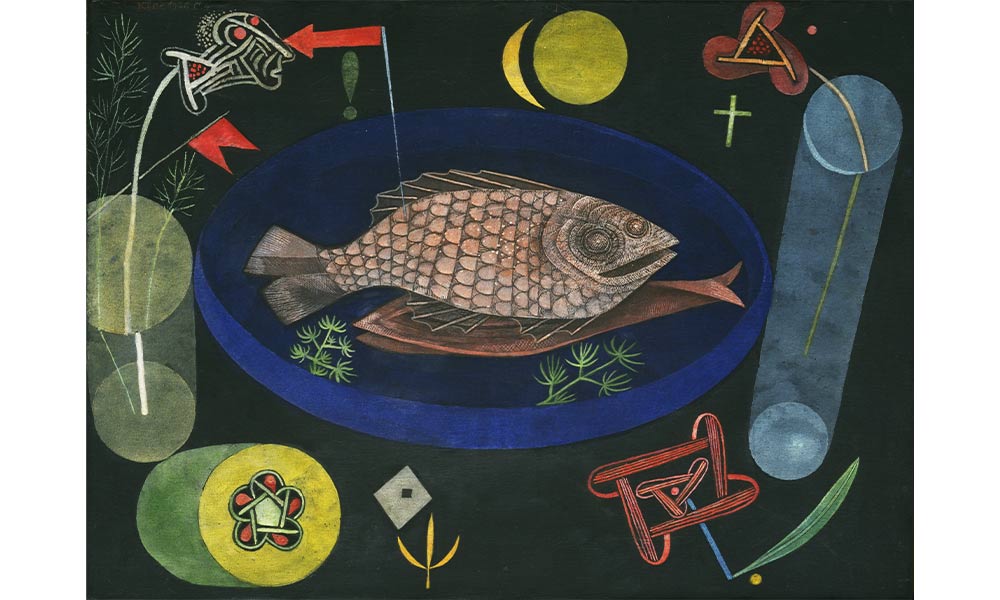
During World War I, when the 37-year-old, Swiss-born German artist Paul Klee was serving as a reserve soldier, he wrote in his diary: “I have long had this war in me. Therefore, it does not concern me inwardly. In order to work myself up out of my ruins, I had to fly. And I flew. I remain in that shattered world only in memory, as one does now and then in retrospect. In that sense I am ‘abstract with memories.’”
It was Klee’s contention that he could deflect the horror of history by flying above it through abstraction. This would be his life’s work, the project of becoming abstract, of breaking art down to fundamental components of color theory, the flat plane, the point and the line, while adding pictograms and hieroglyphs—private symbols such as arrows, zigzags, crosses, crescent moons, and even the Star of David. Like many artists of his time, Klee was interested in the simplicity, vibrance and freedom of primitive masks and children’s art, which he hoped to incorporate into his own adult work. To that end, he invented a lyrical and hermetic visual language, producing more than 10,000 works of art and becoming famous in his lifetime for the plurality of his experiments with avant-garde style. His ideas about the creative process were compiled in his published lectures at the Bauhaus, where he was a form master from 1921 until 1931, inspiring students and other artists to imagine alternatives for “nature’s finished project,” which increasingly was becoming corrupted by the rise of fascism. “In its present shape,” he wrote, “this is not the only possible world.” Many of us today can commiserate with Klee’s defiant spirit.
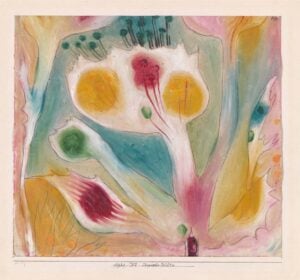
Tropical Blossom (Tropische Blute), 1920, 203. Oil and pencil on primed paper on cardboard, Zentrum Paul Klee, Bern
“Paul Klee: Other Possible Worlds” is the title of a current exhibition at The Jewish Museum, New York. While the show, which runs through July 26, presents a survey of the artist’s development—including several much-celebrated early works such as the lyrical and exuberant Tropical Blossom and the brightly painted and enigmatic Around the Fish—it focuses especially on his last years, from 1933 to his death in 1941 from complications of the painful and debilitating disease scleroderma. It was during that final period of great creativity that Klee’s art became profoundly and openly engaged with the calamity of National Socialism.
Klee was not Jewish and he did not speak out directly against antisemitic invective or attacks, although he had many colleagues and friends who were Jewish. The Jewish Museum has chosen to showcase his work because of the way he confronted the problems of fascism during the Nazi period on his own terms as an artist. As early as 1919, he was falsely referred to as “Paul Zion Klee” by political agitators because he was affiliated with the revolutionary action committee of artists in the short-lived Communist Republic of Munich. Characteristically, he fought back with his art rather than with political rebuke, inserting, for instance, a prominent Star of David in his painting Harlequin on the Bridge, where the Jewish star hangs directly above a motley-dressed figure, a misfit like the artist, standing between two different worlds. After Hitler became chancellor on January 30, 1933, Klee’s situation as a revered figure in the left-leaning cultural avant-garde became dire. Within weeks he was denounced in a local journal by a Nazi propagandist: “He tells everybody he has pure Arabian blood in his veins, but he is actually a typical Galician Jew. He paints in a crazier and crazier way, he bluffs and baffles, his students goggle and gape, as a new, unheard-of art makes its appearance in the Rhineland.” In March of 1933, Klee’s Dessau apartment and studio were ransacked and six baskets of materials were confiscated. Shortly after that, he was dismissed from his faculty position at the Düsseldorf Academy of Fine Arts. Like so many other modern artists, his work was declared degenerate, and 102 of his pieces were removed from German museums. Without a source of income, Klee chose to leave Germany with his family rather than defend himself against the accusations. Still in Dusseldorf, he explained the decision in a letter to his wife, who was at their home in Dessau: “It seems unworthy of me to undertake anything against such crude attacks. For even if it were true that I am a Jew and came from Galicia, that would not affect my values as a person or my achievement by an iota.” By the end of December they had moved to Bern, the city of his childhood.
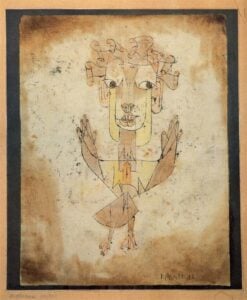
Angelus Novus, 1920, 32. Oil transfer and watercolor on paper, The Israel Museum, Jerusalem, © 2026 Artists Rights Society (ARS), New York
Throughout his career, while artistically imagining “other possible worlds,” Klee, in his abstract way, depicted any number of phantom figures—witches, ghosts, spirits and angels. The show at The Jewish Museum is especially replete with angels. The exhibit includes In Angel’s Care—a playfully efficient line drawing of what looks like a shape-shifting and ghoulish angel with an especially wide wingspan—and also several tormented angel figures from his last years: Forgetful Angel, Angel Applicant, Angel Still Female and Angelus Militans. An unintended irony (and perhaps miracle) of the exhibition is the late arrival of its centerpiece, Angelus Novus, which is owned today by The Israel Museum in Jerusalem and was delayed for six weeks because of the war with Iran.
Created in 1920, Angelus Novus is actually a modest work—a rather small monoprint only slightly larger than a sheet of copy paper—but it has become famous through the accident of provenance since it was originally the most valued possession of the German Jewish philosopher and cultural critic Walter Benjamin. Benjamin purchased Angelus Novus at a Klee exhibit in Munich in 1921, paying 1,000 marks for it. With its prominent and jagged teeth, raised arms extending into what could be construed as webbed fingers, and tiny, clawed toes, the drawing of Klee’s seemingly weightless angel looks like a scrappy bat with a humanoid face encircled by scroll-like curls. Art historians have speculated that Klee made this creature and similar ones as hand puppets for his son Felix, but a work of art can acquire unintended meaning because of the way it changes hands and acquires its own fate.
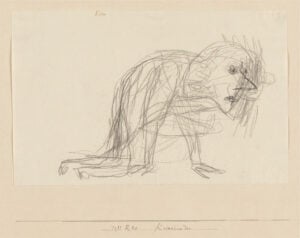
Crawling Man (Kriechender), 1933, 140. Chalk on paper on cardboard, Zentrumm Paul Klee, Bern
Benjamin projected an intricate fiction onto the picture, which he cherished, and it became the impetus for his celebrated and controversial theory of history: “This is how one pictures the Angel of History,” Benjamin wrote in 1940, “His face is turned toward the past. Where we perceive a chain of events, he sees one single catastrophe that keeps piling wreckage upon wreckage and hurls it in front of his feet.” That perception of wreckage was more than theoretical when, just months later, Benjamin left Angelus Novus in Paris with his friend, the writer Georges Bataille, and made a futile attempt to get to Spain by escaping Vichy France through the Pyrenees. The night after he and a group of other refugees were caught by local Spanish policemen, Benjamin committed suicide, swallowing the morphine tablets he had carried with him on the arduous journey. During the remaining war years, Klee’s picture was hidden in the Bibliothèque nationale de France and subsequently was sent to German philosopher Theodore Adorno in the United States. It ultimately found its way to Benjamin’s longtime friend, historian Gershom Sholem in Jerusalem and, when Sholem died, his widow gave it to The Israel Museum with the assistance of several New York patrons of the arts and art dealers. In this way, one could say a divergent chain of events carried the angel to safety.
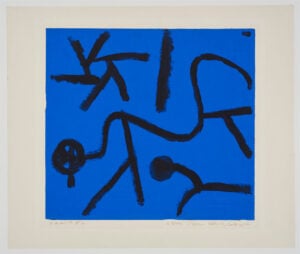
This Star Teaches Bending (dieser Stern lehrt beugen), 1940, 344. Colored paste on paper on cardboard, Zentrum Paul Klee, Bern, Livia Klee donation
One of the interesting things about Klee was the plasticity of his creative hand, the way his style shifted and fluctuated, even in his early years, incorporating new ideas and new materials. He often talked to students about the way in which an artist will naturally change through time and he took his example from nature: “Nobody would affirm that the tree grows its crown in the image of its root,” he would say. Nonetheless, it’s shocking to see examples from the series of 246 chalk drawings Klee began making in 1933 when he directly confronted the National Socialist Revolution and for a short period released the suppressed rage he had kept at bay for so long. These drawings are not well known and, for the most part, haven’t been exhibited in New York before. Unlike the efficient, linear, flattened and abstract work Klee’s viewers usually have to puzzle out, these works are rounded and composed with free-flowing lines. Close to being representational, they demonstrate some of the shrewd caricature and bite of Belgian artist James Ensor’s drawings. In general, the titles in this unusual series are broad, like Barbarian Mercenary or Violence; they could be studies from any period in history, but of course they were made during the Nazi period, speaking to the cruelties of the moment and somehow looking forward to the worse brutality that was to come. In that respect, Crawling Man, a figure on his hands and knees, with an expression of disbelief on his face, could be the stock character Everyman, an icon representing the state of mind of Germany’s liberal citizens, or one of the humiliated Jews forced by SS thugs to scrub the sidewalks in the later years of the the Hitler era.


Even with virulent politics in the background and the prolonged pain of his illness, Klee continued working until the very end of his life. Due to his illness, his lines were often thick and calligraphic, imparting an expressive and spiritual quality to the compositions. This Star Teaches Bending, painted just months before he died, shows what looks like a child’s rendering of stick figures bowing beneath a radiant star. The lines are heavy and laden with expression and the radiant blue background indicates that this is the time of day that’s called the gloaming, when the sun has set but the darkness hasn’t yet arrived. You can see the essence of his art here, how abstraction gave him the key to maintaining his creative spirit, flying with fixed concentration above the shattered world, the one he saw in ruins in his early memories.
(Top image credit: Around the Fish (Um den Fisch), 1926, 124. Oil on canvas, Museum of Modern Art, New York, Abby Aldrich Rockefeller Fund)