
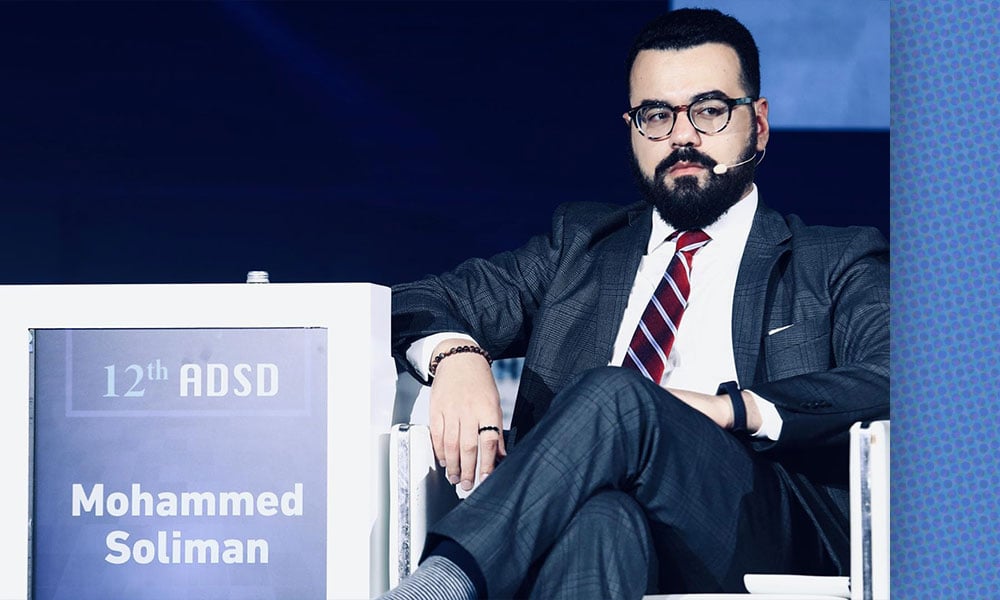
Mohammed Soliman anticipated the logic and the alliances that would later underpin the Abraham Accords years before they were signed. Now, in a new book, West Asia: A New American Grand Strategy in the Middle East (Polity Press, February 2026), he argues that a larger system is already taking shape, that Israel’s place in the emerging regional order depends on Palestinian statehood—and that American Jews need to pay attention.
Six years ago, Mohammed Soliman, a Georgetown-educated analyst, started telling people that analyzing Israel and Palestine in isolation made no sense because India, Israel and the Gulf states were forming an integrated trade and security system. Not eventually. Now. At the time, many dismissed the idea.
Then, in April 2024, Iran launched more than 300 missiles at Israel. Jordan, Saudi Arabia, and the United Arab Emirates (UAE) coordinated with Israel and the United States to shoot them down. Command-and-control systems that hadn’t existed two years before functioned under fire.
He’d called it. The Gaza war was supposed to kill the Abraham Accords—popular opinion in the Arab “streets” overwhelmingly backed Palestinians, and analysts assumed Gulf normalization with Israel would freeze. Instead, six months into the war, those same Arab states coordinated air defense with Israel against Iran. The integration didn’t just survive Gaza. It became operational.
“If there is one main takeaway from the war in Gaza, in addition to the moral and legal arguments, it is that there is a realpolitik case for the establishment of a Palestinian state.”
Soliman grew up in Egypt. He was 12 when police beat his uncle Nabil and dragged him through their Cairo neighborhood to deter protests that had broken out against the government. At 14, he joined Kefaya, an Egyptian opposition movement founded in 2004 that brought together liberals, leftists, nationalists and Islamists to oppose authoritarian rule under Hosni Mubarak. Plunging into the wave of activism that became known in the West as the Arab Spring, he helped lead the 2011 revolution that originated in Cairo’s Tahrir Square and dislodged Mubarak, then the 2013 uprising against President Mohammed Morsi, the Muslim Brotherhood-affiliated politician who had taken power. From 2012 to 2014, he ran Al-Midan, a short-lived liberal Egyptian political party formed after the revolution and associated with reformist, non-Islamist politics, organizing in Aswan and Sinai. His goal then was to build a Sinai think tank offering “a platform for the free exchange of ideas” while challenging government overreach.
By 2017, many of Soliman’s friends had been jailed. The revolution’s collapse shaped his pivot from activism to analysis. He came to Georgetown in 2018 focused on geopolitical risk, grand strategy and energy security—appearing on Sky News Arabia, networking with UAE officials he’d once opposed, and researching the Gulf Crisis and Iran strategy. The progressive idealism of his youth gave way to cold pragmatism. Now a U.S. citizen advising governments and corporations, he argues what once seemed impossible: that Israel’s full integration into this emerging order actually depends on Palestinian statehood—not as a moral imperative but as a strategic necessity.
His new book, West Asia: A New American Grand Strategy in the Middle East, reads less like prediction and more like documentation of what’s already happening while most policymakers look elsewhere.
Gulf states want continued normalization with Israel in order to contain Iran and access advanced technology, but their domestic politics require visible progress on the Palestinian issue. Without it, Soliman argues, Israel stays partially integrated—benefiting from backchannel cooperation but excluded from the full economic and strategic architecture taking shape among other players in the region, from the Gulf states to India.
Soliman’s central argument is blunt: The map we’re using is obsolete. “We still call it ‘the Middle East,’” he tells me when we speak by phone. “That’s a leftover Cold War concept. What we’re actually looking at is West Asia—a system running from the Indian Ocean to the Eastern Mediterranean, held together by connectivity. Trade volumes, supply chains, port capacity, capital flows.”
The numbers back him up. India-UAE trade is at $100 billion annually, heading to $250 billion this decade in medium-term projections. India-Saudi is $50 billion, heading to $80-90 billion. For comparison, India-EU trade amounts to $120 billion. The Gulf Cooperation Council—the six-nation bloc including Saudi Arabia, the UAE, Kuwait, Qatar, Bahrain and Oman—is now India’s largest trading partner.
“People do not comprehend these numbers,” Soliman says. “The trade cohesion between India and the Gulf has already happened. Past tense.”
The India-Middle East-Europe Economic Corridor—a connectivity system combining ports, railways, shipping lanes, energy pipelines, digital cables and regulatory coordination, intended to knit India, the Gulf and Europe into a single trade and logistics space via the Levant—was announced at the G20 in September 2023. Less than a month later, on October 7, Hamas attacked Israel. The Gaza war should have frozen the project—it depended on Abraham Accords normalization, which popular backing for Palestinians in Arab countries should have undercut. Instead, by December—two months into the war—Gulf officials weren’t debating whether to continue. They were mapping port upgrades, rail corridors, data center locations. The infrastructure planning moved forward as if the war wasn’t happening.
Gulf states could do this because they’ve become the system’s engine—not through oil wealth alone, but through what Soliman calls “execution capacity.”
The UAE shows how this works. Soliman describes the UAE’s evolution into “a scale-up nation—an economic and geopolitical force multiplier” as a fusion of “the ‘Manhattan of the Middle East’ and ‘Little Sparta’”—terms that have been applied, respectively, to Dubai and Israel.
Egypt also demonstrates the pattern. The Suez Canal Economic Zone is 455 square kilometers of integrated industrial zones, ports and manufacturing capacity. Most Americans have never heard of Ras El Hekma—the UAE’s $35 billion investment in Egyptian development rights. But it took place in February 2024, just months into the Gaza war.
“That’s not charity,” Soliman says. “That’s the Gulf betting Egypt’s geographic position becomes more valuable as this West Asian system takes shape.”
The contradiction he keeps returning to: Egypt lost billions in Suez revenues when Houthi attacks disrupted Red Sea shipping during the Gaza war. Yet Gulf states still poured $35 billion into the Suez Canal Economic Zone during the conflict.
“My view is not that politics ‘don’t matter’ or that economics override conflict,” he says. “But the underlying integration pressures are structural. Trade doesn’t stop because politicians are angry. Energy interdependence, demographics, capital flows—these create gravitational pull regardless of the political weather.”
That’s why it survived Gaza. The integration was already deeper than politics.
This is where Soliman’s argument becomes essential reading for Israel-watchers. He writes: “If there is one main takeaway from the war in Gaza, in addition to the moral and legal arguments, it is that there is a realpolitik case for the establishment of a Palestinian state.”
The logic is straightforward: Gulf states want normalization with Israel for hard strategic reasons—containing Iran, accessing Israeli technology, integrating economically. But their domestic politics require visible progress on the Palestinian issue. Without a credible pathway to Palestinian statehood, normalization remains fragile, reversible, constrained. Saudi Arabia has made it clear that it will not support full normalization unless it can point to meaningful movement in that direction. .
That leaves Israel with two options. One is to maintain the status quo, with partial integration and back-channel cooperation but without access to the full economic and strategic possibilities of the emerging regional architecture. The other option is to deliver on Palestinian statehood—treating it as a strategic imperative, not a moral one—and become fully integrated into the West Asian system Soliman describes. “Look, Israel has agency,” he says. “That’s the starting point. And it has choices that directly affect whether this wider West Asian system can fully cohere or whether it stays fragmented by unresolved conflicts.”
And where does India come in?
The Abraham Accords in 2020 did more than just normalize relations between Israel and the UAE, Bahrain, Morocco and Sudan. They signaled “a new era of hard-nosed realpolitik between Arab states and Israel—less about ideology, more about shared interests in containing Iran, accessing technology and integrating economically.”
The first concrete manifestation of that new era came in 2022 with an agreement referred to as I2U2—bringing together Israel, India, the United States and the UAE. “It was explicitly framed not as a rigid military bloc but as an economic instrument: joint investment in food security, clean energy, technology,” Soliman writes. Modi, he explains, was “the first Indian leader—or even global leader—to recognize the Gulf not merely as a labor or energy hub, but as a scale-up power capable of acting as a force multiplier.”
The strategic alignment went beyond economics. In 2019, the UAE invited India to an Organization of Islamic Cooperation foreign ministers’ meeting—the first time ever—and granted Modi the “Order of Zayed,” the Emirates’ highest civilian award. By 2020, India’s army chief made an unprecedented visit to Saudi Arabia and the UAE. In March 2021, India participated in a UAE-hosted air exercise alongside Saudi, Bahraini, American, French and South Korean forces. The UAE even mediated a cease-fire agreement between India and Pakistan in February 2021.
The alignment runs deeper than economics or even security coordination. Soliman traces how Turkey and Pakistan’s expanding partnership—especially around Afghanistan—pushed India to formalize relationships it had kept informal for decades. As Turkey positioned itself to lead a Muslim order and deepened cooperation with Pakistan, India needed counterweights. The Abraham Accords provided political cover for India to deepen public ties with Israel while Gulf states served as the bridge. The result: a three-way alignment where Israel gets regional integration, the Gulf gets a counterweight to Iran and Turkey, and India gets leverage against Pakistan and China.
The India-Gulf-Israel alignment also extends to the Eastern Mediterranean. India supports Greece against Turkish maritime claims and conducts naval exercises there. The more Turkey and Pakistan expand their strategic partnership, Soliman argues, the more Turkey becomes India’s geopolitical rival. That dynamic pushed India closer to Turkey’s opponents—Greece, the UAE and Israel—creating overlapping security interests across multiple theatres.
In his acknowledgments in the book, Soliman thanks the Abba Eban Institute. When I press him on what Israeli strategic thinkers actually say about all this, he’s measured. He won’t name names, but he makes it clear he’s having conversations across Israeli political circles.
“The question is whether Israel can align its politics with the system it clearly wants to benefit from,” he says. “And whether the United States can help produce a viable political horizon—a real two-state framework, not just process for process’s sake—that prevents the Israeli-Palestinian conflict from repeatedly detonating the region’s larger strategic trajectory.”
The April 2024 Iranian missile attack on Israel tested whether this framework was aspiration or operational reality. The operational integration worked. But the contradictions remain real. Those Jordanian pilots defended Israel while Jordanian public opinion overwhelmingly backed Gaza.
Soliman doesn’t ignore the tensions. He’s clear-eyed about them. But he insists the integration pressures are structural and growing. The book describes the India-Middle East-Europe corridor as ushering in “a recalibrated geopolitical landscape, melding the pre-European power networks with the post-European reality of Asia’s ascent.”
For American Jews trying to envision an Israel-Palestine outcome, the stakes are clear. Can Israel afford to stay outside this regional order? Can normalization hold without Palestinian statehood? What happens when Gulf economic interests diverge from Israeli political choices?
Soliman isn’t selling a vision of the future. His book is important because he’s describing what’s already being built. The integration survived Gaza. Whether Israel participates in shaping this emerging order or gets shaped by it is up to Israelis. But understanding what’s happening—and what choices Israel faces—is no longer optional for anyone who cares about the country’s long-term security.
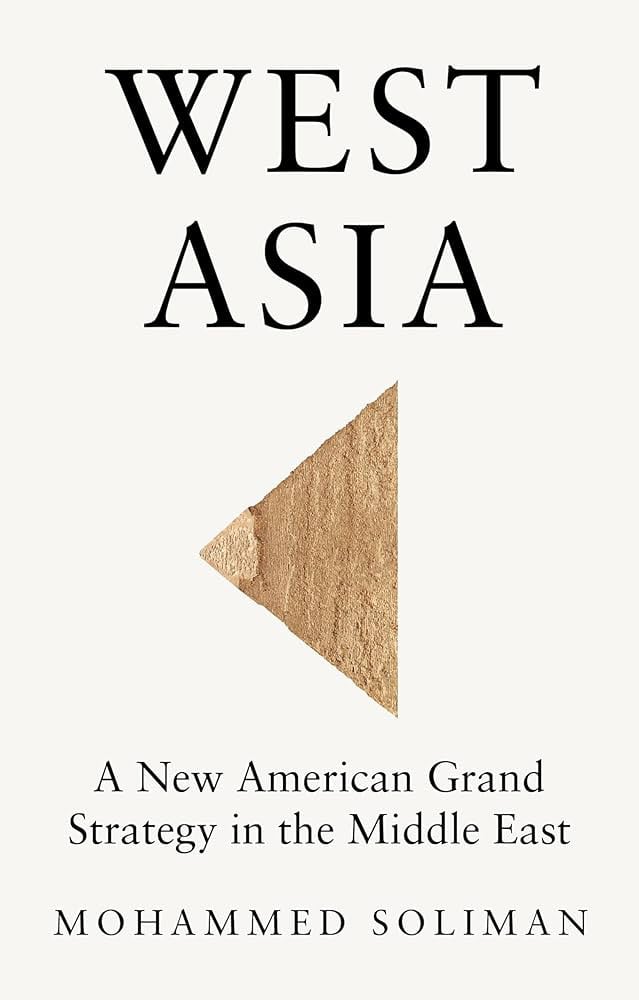
Q&A: Mohammed Soliman: Reframing the Middle East
Jacob Wirtschafter: You’re Egyptian, a member of the Arab Spring generation who became a U.S. citizen, and now you’ve written a book that lays out a grand strategy that integrates Israel into a wider region you call “West Asia.” That’s an unusual path. How did your background shape this book?
Mohammed Soliman: Being Egyptian gives you a particular vantage point. You understand how the Gulf works, how India matters, how these relationships actually function—not how Washington imagines they function. But I’m also American enough to translate it.
I’m not coming at this as Edward Said. I’m a cold-blooded realpolitik guy. I’m looking at port capacity, trade volumes, capital flows. The numbers tell you where power is actually moving.
The direct inspiration—and I’m very explicit about this in the book—is the late Japanese prime minister Shinzo Abe’s strategic imagination. In 2007, at the height of Washington’s entanglements in Iraq and Afghanistan, Abe delivered what became a landmark speech to India’s parliament. It was called “Confluence of Two Seas,” and he argued that the Pacific and Indian Oceans were forming a single strategic theater. That speech essentially planted the seed for what we now call the Indo-Pacific framework.
What’s really interesting—and what I think gives the idea deeper historical resonance—is that Abe’s title for the speech itself reaches back centuries. He was referencing the Mughal prince Dara Shukoh, whose Majma-ul-Bahrain, or “Confluence of Two Seas,” was written in 1655. Dara Shukoh was exploring commonalities between Islam and Hinduism, two neighboring civilizational streams. So there’s this beautiful historical continuity: You have a 17th-century Mughal text about convergence, then a 21st-century Japanese prime minister using it to redefine regional order.
Similarly, I’m not inventing history here—I’m applying it. Abe helped the world stop seeing “Asia-Pacific” as the frame and start seeing “Indo-Pacific” as the new strategic reality. What I’m arguing is that we need a comparable re-mapping for this region.
You argue Israel needs to deliver Palestinian statehood for strategic reasons. Walk me through that logic before we get to whether it’s feasible.
In the book, I write that “if there is one main takeaway from the war in Gaza, in addition to the moral and legal arguments, it is that there is a realpolitik case for the establishment of a Palestinian state.” Here’s the logic: Gulf states want normalization with Israel for hard strategic reasons—containing Iran, accessing Israeli technology, integrating economically. But their domestic politics require visible progress on the Palestinian issue. Saudi Arabia has made this explicit: No full normalization without meaningful movement toward Palestinian statehood.
That means Israel faces a choice. It can maintain the status quo and stay partially integrated—benefiting from back-channel cooperation but excluded from the full economic and strategic architecture taking shape. Or it can deliver on Palestinian statehood and unlock full integration into this West Asian system.
But Israeli politics seems to be moving in the opposite direction. How does this actually happen?
The question is whether Israel can align its politics with the system it clearly wants to benefit from. And whether the United States can help produce a viable political horizon—and I mean a real two-state framework, not just process for process’s sake—that prevents the Israeli-Palestinian conflict from repeatedly detonating the region’s larger strategic trajectory. Because right now, October 7 and what’s followed is a stress test for the entire model.
In the book, I treat the Abraham Accords as a timing hinge. They signaled a new era of hard-nosed realpolitik between Arab states and Israel—less about ideology, more about shared interests in containing Iran, accessing technology and integrating economically. And importantly, the Accords expanded India’s maneuverability across the region in ways that weren’t possible before.
Now, my view—and I try to be clear-eyed about this—is not that politics “don’t matter” or that economics automatically override conflict. They don’t. But the underlying integration pressures are structural. Technology transfer doesn’t reverse because diplomatic relations freeze. Energy interdependence, demographics, capital flows—these create gravitational pull regardless of the political weather.
Let’s talk about India. You positioned it as the counterweight in this system back in 2021. But India hedges—it buys Russian oil, stays neutral on Ukraine, maintains strategic autonomy. Is it actually a reliable partner in what you’re describing?
India is doing exactly what you’d expect a rising power to do—maximizing its options. But look at where the structural weight is going. The Gulf Cooperation Council is now India’s largest trading partner bloc. That’s not rhetoric. That’s realized integration.
And it’s not just trade. One of the first concrete manifestations of this Indo-Abrahamic logic was the creation of I2U2 in 2022—that’s Israel, India, the U.S. and the UAE. It was explicitly framed not as a rigid geopolitical bloc like NATO but as an economic instrument: joint investment in food security, clean energy, technology. That’s the kind of “minilateral” format I’m talking about when I say West Asia operates differently from the old alliance structures.
After I2U2, the book examines another West Asian minilateral: the France-UAE-India trilateral, which was forged on the margins of the UN General Assembly in September 2022. That grouping is built around a shared maritime conception of the Gulf–Arabian Sea–Red Sea–Suez–Mediterranean as a unified theater. It’s exactly the kind of flexible format that makes sense for this geography.
India’s hedging doesn’t negate the integration. If anything, it proves the system works—India can buy Russian oil while deepening ties with the Gulf and Israel simultaneously. That’s the flexibility of the West Asian model versus rigid Cold War alliances.
You use the phrase “maritime pivot” in the book. What do you mean?
You’re seeing states shift their entire economic strategies toward coasts and sea lanes. They’re building new nodes specifically designed to link the Mediterranean, the Red Sea and the Indian Ocean into a functional system.
Take Egypt. The Suez Canal Economic Zone—the SCZone—is described in the book as Egypt’s most ambitious effort to turn maritime geography into a global industrial and logistics platform. This isn’t just dredging a canal deeper. It’s 455 square kilometers of integrated industrial zones, ports and manufacturing capacity. And it’s attracted serious investment momentum since COVID scrambled everyone’s supply-chain thinking and made people realize they needed alternatives to over-dependence on any single route. The Houthi disruption actually proves the point. Egypt lost billions in Suez revenues. Yet the Gulf states still poured $35 billion into Egypt during the conflict through the Ras El Hekma agreement—framed explicitly as Egypt importing “the Dubai model” of state-led development, backed by Emirati capital. That’s not charity. That’s the Gulf betting that Egypt’s geographic position becomes more valuable as this larger West Asian system takes shape, and they want infrastructure in place to capitalize on it.
But we just watched Houthi attacks shut down Red Sea shipping for months. Doesn’t that show how fragile these maritime corridors actually are?
The disruption was real. But the response by India, Egypt and the Gulf states was not to abandon maritime connectivity. It was to double down on diversification, redundancy and maritime security.
Europe is trying to decouple from Russian energy and Chinese manufacturing. Where does that fit in your framework?
Europe’s behavior matters here. European capitals accelerated their decoupling from Russian energy in the wake of the full-scale invasion of Ukraine, and they immediately began searching for new footholds in the rising power centers along this rimland—the Gulf, Egypt, potentially the Levant if stability returns. That’s not nostalgia for colonialism; that’s Europe recognizing where energy, trade and strategic position are going to matter for the next generation.
Europe is looking for a new economic and industrial orientation. Russian energy is gone, no matter if you settle Ukraine. Second, Chinese manufacturing overcapacity is destroying every single industrial economy globally. If you’re Europe, you need different thinking about where you’re sourcing. That’s where the Suez corridor comes in.


What’s your message to Washington about all this?
Don’t treat this as yesterday’s Middle East file, where the question is just “How do we manage these problems with less friction?” West Asia is becoming a central arena where trade transformation, energy transition, technology competition and hard security all intersect. It’s where China is testing its Belt and Road model of gaining influence through building infrastructure, where India is projecting influence, where Europe is hedging its dependencies.
Washington’s job is to engage West Asia with a framework that matches the system’s scale—and that means understanding connectivity as power, infrastructure as strategy, and regional integration as something that happens with or without American leadership. The question is whether we shape it or just react to it.
The premise of the book is that a West Asia lens helps Washington engage a system that runs from the Indian Ocean to the Mediterranean without pretending it can—or should—micromanage every crisis that erupts. This is about shaping order, not policing every border.
Top image: Mohammed Soliman, senior fellow at the Middle East Institute, speaks at the 12th Abu Dhabi Strategic Debate in Abu Dhabi, November 2025. Courtesy of the Emirates Policy Center.