
“I’ve forgotten how to say car seat,” I texted in Yiddish, except for “car seat,” which I wrote in English. “And my dictionary is packed away. What is it?”
My husband David and I were driving from Los Angeles to San Francisco, to stay with my in-laws for a few weeks. Whoever wasn’t driving was constantly handing snacks or toys to our toddler in the back.
“I say zitsele,” replied my friend Yekhiel, mirroring me and staying in Yiddish. Little seat.
“Dos leygt afn seykhl,” I wrote. That makes sense.
He continued, “By the way, my phone fell in water and I lost all my numbers. Who is this?”
***
On the afternoon my boyfriend Reuven begins to teach me Yiddish, I am probably 21. If that’s right, then he is 23. We are on a grassy hill, far from New York City, where we both live. Bushes behind us, dandelions all around. The warm thrum of summer.
I must have expressed an interest in learning Yiddish. I’ve always liked languages. I speak English, Hungarian and schoolgirl Spanish. At this point, Reuven is learning Hungarian, and also speaks English, Hebrew, Portuguese and Yiddish, which he taught himself a few years earlier during college. He moved, after graduation, to New York in part to dive into the niche but bustling scene of young Yiddishists, Yiddish-language activists of all stripes eager to engage with the language as a living, breathing, daily vernacular. (New York has everything.)
Reuven is my first serious relationship after years—eternities for my little romantic heart—of unrequited crushes and false starts. He is passionate about speaking Yiddish with his many Yiddishist friends, and we are so into being with each other that I am more than game to jump in. When I fall for someone, I also fall in love with what they love. I just don’t remember now what precisely led up to the click, the switch, the go.
“Ikh,” he says, pointing to himself. The kh is the guttural sound in Bach, Chanukah. We don’t have the sound in English.
“Ikh,” I say, pointing to myself. We see a bee on that grassy hill. “Bin,” says Reuven, pointing. “Bin,” I say. The word for “bee” sounds just like the English word “bean.”
My first Yiddish sentence is: “Ikh bin a bin.” I am a bee. And then different combinations, conjugations: Are you a bee? No, you are not a bee. Is she a bee? Yes, she is a bee. Are we bees? No, we are not bees.
We laugh and buzz with the fun of it, a new project, and that too-good feeling of being loved back.
***
When David and I became parents, I needed to build up my nerve before returning to Yiddish. I gave myself one month of speaking English with our baby daughter. Besides, English is my native language, the one I’m most comfortable speaking. One month wouldn’t make any difference to our newborn (she was still relying on scent anyway) and it gave me time to learn how to change a diaper, how to nurse, how to function on two hours of sleep, how to become acquainted with her new body and my own.
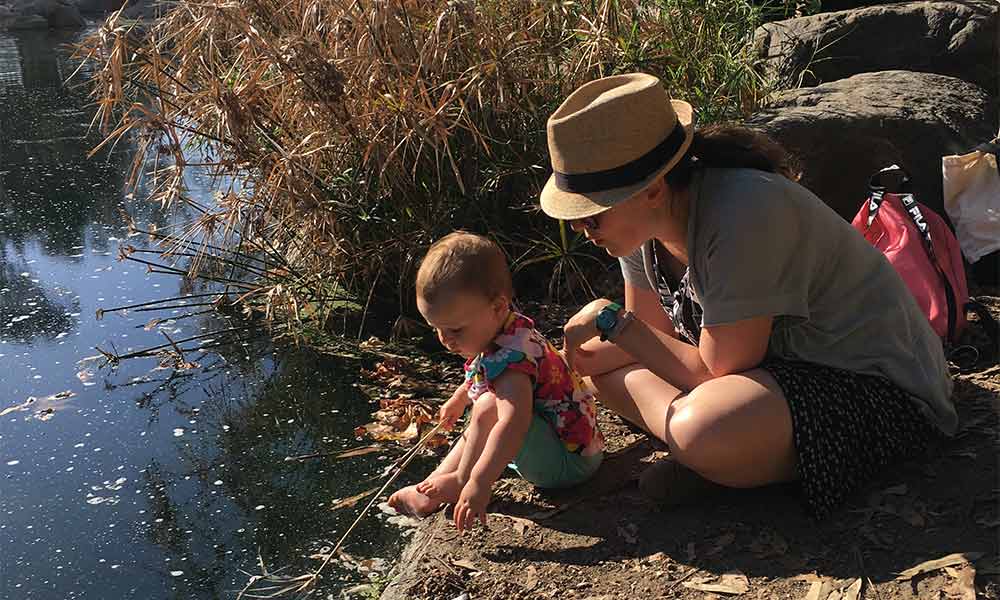
The author and Hannah in Kenneth Hahn Park, Los Angeles, May 2020.
After the baby naming, after Thanksgiving, after our families drove or flew back from our apartment in Los Angeles, an enormous quiet settled in, bright white hues of a home becoming a nursery. I hauled out my 800-page English-Yiddish dictionary. My Yiddish was conversationally fluent—how I also described my Hungarian, which I learned from my parents—but suddenly there was an endless list of words I needed to know. Burp. Sneeze. Yawn. Sleeve. I loved the Yiddish word for diaper: vindele. I applied coconut oil to my daughter’s scalp and forehead, her skin coming off in flakes, while saying aloud resuscitated, relearned words: shtern, forehead. Boyml, oil. How could I have forgotten the word “boyml”?
***
Reuven creates our signature dish at the grocery store soon after we get married. He wants something cheap and filling and puts in his shopping cart a package of pasta and a can of beans. We eat pasta and beans about four nights a week. Neither of us are particularly proficient cooks, but we’re both more than capable of making this dinner. You boil the pasta—any kind of pasta is fine, though we like the kind that look like shells. In a separate pan, you dump the canned beans along with its canned bean juices. You add oil and spices; I like adding garlic powder and paprika. Stir. Strain the pasta, put some in your bowl, top it with the rich beany sauce. Eat it hot. Pasta and beans.
This is the boyml that I know—oil, for cooking. Olive oil for pasta and beans. But though now I remember cooking with boyml and writing “boyml” on grocery lists, I don’t remember us saying “pasta and beans” in anything besides English. Surely we must have, in Hungarian or Spanish (which Reuven also learned) or Yiddish. We never tire of the dish.
[Related: Kids’ Tales Told In a Distinctively Yiddish Key]
Lokshn mit beblekh. Pasta with beans. Maybe that’s what we say. We serve our friends bowls and bowls: first in our happy little newlywed one-bedroom in Midwood, Brooklyn, then on the Upper West Side, in our equally small two-bedroom, when we live with Yekhiel. We throw and attend frequent parties with the understanding that those coming will speak only in Yiddish, or at the very least, abi nisht english: anything but English.
And I speak Yiddish. I do! It’s a wonder. Somehow over the course of our relationship I learned to get by in a language I never knew before my twenties. Reuven and I spend a lot of time hanging out with our friends exclusively in Yiddish, which is not the point, except that it is. My memories are images, scenes: free-styling verses to a never-ending drinking song, writing the phrase for “safe travels” in icing on a homemade cake for a friend’s going away party: for gezunt un kum gezunt, go in health and return in health. We devise translations that don’t yet exist in Yiddish; I translate “Diva Cup,” a popular brand of menstrual cup, as malke bekher—queen’s goblet. Reuven and I frequently go to a weekly party in New York for ex-Hasidic Jews, or Hasidic Jews on the fringes (we are neither), and we speak in Yiddish with them.
One thing that surprises me at these parties is how often the Hasidic Jews there feel a connection to Hungarian. When I tell people that my parents are Hungarian immigrants, it turns out that many of the Chassidim I meet also have parents or grandparents from Hungary.
“My parents spoke Hungarian when they didn’t want us to understand,” I hear at these parties. They speak lovingly about the language they don’t speak or understand. A few people share with me the few words and phrases in Hungarian they do know, like szeretlek, I love you, and csirkepaprikás, chicken paprikash. Their associations with Hungarian remind me of how some non-Yiddish-speaking Jews from European backgrounds feel about Yiddish. It strikes me and Reuven as funny and strange to hear Yiddish speakers repeating, almost word for word, exactly what we so often hear about Yiddish: that their parents spoke this other language as a code language, hidden from them, and they wish they had learned more.
Reuven and I throw endless time at Yiddish gatherings, this specific party and many others. We frequently host couch-surfers from other countries, and we practice our Spanish, and he helps me improve my prayerbook Hebrew. At night, Reuven is often awake until two or three in the morning, reading Yiddish books, learning other languages, working on his graduate studies of computational linguistics. On those nights, I fall asleep on the couch, and when it’s finally time to go to bed, Reuven brings me my toothbrush with a dot of toothpaste on it.
***
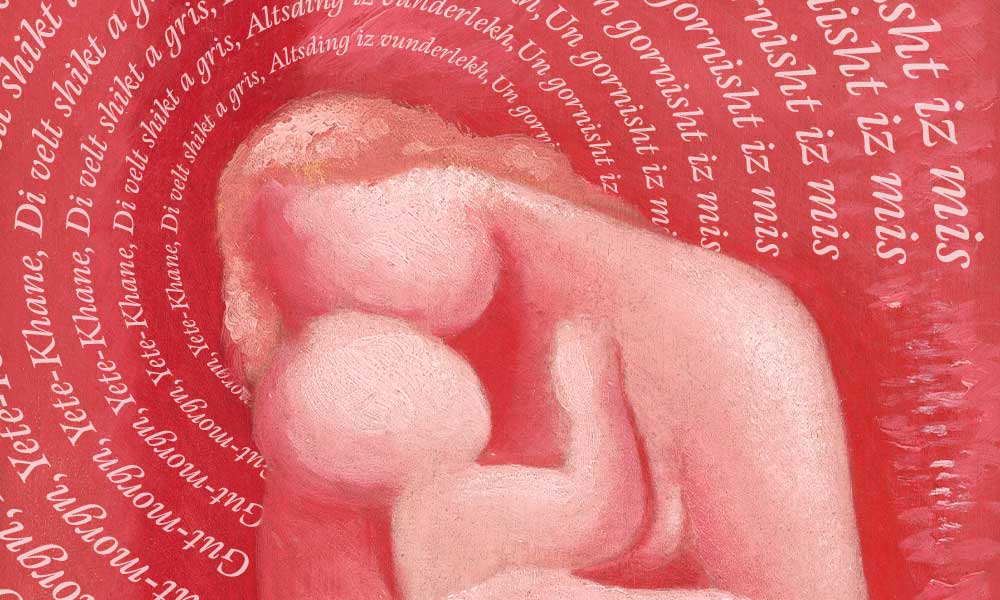
“Gut-morgn, Yete-Khane,” I sang every morning for months, to the tune of “Good Morning Starshine.” My daughter stretched and yawned on the changing table as I gave her a fresh, tiny diaper and cooed new words:
Gut-morgn, Yete-Khane
Di velt shikt a gris
Altsding iz vunderlekh
Un gornisht iz mis
(Good morning, Yetta-Chana,
The world says hello
All things are wonderful
And nothing is bad)
After a while, I changed the last two lines to something a titch more realistic. Most things are wonderful, and little is bad. Whenever I sing the song these days, the lyrics feel like radical optimism, and possibly denial.
Her Yiddish name is Yetta-Chana (there’s that guttural ch again), and her “English name”—for lack of a better term—is Hannah. I call her by both her first and middle name, doubling them as one. Yetta-Chana. Yete-Khane, in proper Yiddish transliteration. And when I speak or write in English, I refer to her as Hannah.
“Ikh hob dikh lib,” I said to her yesterday. I love you.
She pointed to herself, finger in chest. She often does this in response.
I laughed, and replied in Yiddish: Yes, you! I love you. Do you love me?
She pointed to David and smiled. David and I both laughed.
“Du host lib Abba-n. Un mikh—host mikh lib?”
You love Dad. And me—do you love me?
She looked at me, raised her eyebrows, and nodded vigorously.
***
Reuven’s brain reminds me, when I’m at my most insecure, of how the Terminator screens and assesses the world: searing vision, numbers flying, immediate answers. Does the person engaging with him speak another language? How well? What can he learn from them? His Hungarian grammar and accent have far surpassed mine, though maybe our Hungarian vocabularies can still go toe-to-toe. Meanwhile my Yiddish is a subset of his; there is nothing I know in Yiddish that he doesn’t know. Sometimes, at the end of an evening, I can sense his brain cooling down as we talk. It’s not that we don’t have what to say to each other. But he isn’t actively learning from me.
I also am no longer actively learning from him. We both try to let go of the teacher-student dynamic in our marriage. I’m tired of constantly being corrected, and besides, I’m content with my Yiddish plateau. I can be understood, and can understand most things in most conversations. I’m not shy to ask a question if there’s something I don’t understand. It’s how I was in college: I don’t want to bother spending extra hours to get an A when a B is perfectly fine.
But letting go marks a loss. I wish with all my heart that my immigrant parents had spoken only in Hungarian with me, that my Hungarian were as good as a native speaker’s. Then Reuven could be constantly learning from me, constantly improving. He now studies Russian, Polish, French, German, Ladino. We talk about one day living in another country, being immersed in other languages. Reuven’s dream is Antwerp, Belgium, where all kinds of Jews, not just Chassidic Jews, speak Yiddish. We travel to Puebla, Mexico, to visit my best friend from high school—she teaches English there and has been a happy ex-pat for years—and Reuven asks that we speak Spanish when we’re together, for fuller language immersion. My friend and I have only ever spoken in English with each other, but my Spanish is passable enough and we agree, in turns bemused and begrudging.
The undercurrent between me and Reuven is rising up, revealing itself. Back in New York, we sit cross-legged on our mattress on the floor. This room is honestly too small for such a big conversation. Yekhiel must be in the living room.
“When I’m with you I feel like you’re more aware of who I’m not than who I am,” I say to Reuven. “I keep feeling like if I were from another country or fluent in such-and-such or if I were a scholar…then you’d be happy with me.”
The room is so quiet. He is always so quiet, but this is different.
“It’s existentially exhausting,” I conclude.
Reuven is crying. He cries for a while.
“I know,” he whispers at last. “I’ve felt too guilty to say anything before.”
***
In her wonderful essay “What I Wish People Knew About Yiddishists,” writer Rokhl Kafrissen defines Yiddishists as “people who have chosen to learn and/or use Yiddish in their everyday lives. The choice to use Yiddish is an affirmative statement of value as well as an identification with Eastern European Jewish life and its present continuity around the world.” Kafrissen goes on to address a misconception that Yiddishists are hobbyists or a breed of historical reenactors:
Yiddishists are a diverse group of people, but one thing we have in common is that we’re not reenacting anything. In most ways, learning Yiddish (and Eastern European folk arts) isn’t much different than learning any other language or culture, except you can’t go back to the source country.
Nostalgia is sentimental, personal, and, most importantly, transient. Learning Yiddish is the opposite of nostalgia. Nostalgia is cheap and easy. Learning a language is active and generative, it makes new connections and creates community, it opens paths to new ways of seeing. And it takes a hell of a lot of work and commitment.
Unlike many Yiddishists, I didn’t learn Yiddish in a class or from my parents. I didn’t go to one of the intensive Yiddish-language summer programs, or to the one-and-only Yiddish farm, an immersive, yes, farm outside of New York City. I learned Yiddish in large part from my boyfriend, who became my fiancé, who became my husband, who became my ex-husband. And I learned it in part from friends, from parties, from wanting to understand what someone had said that made everyone else in the room laugh. I learned Yiddish almost entirely socially and then, after my divorce, I withdrew from the scene.
Part of my flight was simply using my wings. Reuven hadn’t clipped them, but I had stopped being a certain kind of person around him. (Perhaps I clipped my own wings in anticipation of what I thought my partner wanted.) I had identified before as a writer and a seeker—but during most of our four-year marriage I wasn’t writing and I no longer felt comfortable exploring and questioning my religious practice. And Yiddish and Yiddishism was such a defining aspect of our life together that it felt natural to walk away from the language as part of the fallout from our divorce. Reuven had taught me Yiddish and, as I navigated my new identity, at first I thought he was the reason I cared so much about the language.
***
Five years ago, after I left New York and before I moved to Los Angeles, I gave myself a “space out” topic in advance of Rosh Hashanah. I was about to spend many hours in services, and thought it would be helpful to have something in particular to chew on when overwhelmed by the infinite liturgy. My husband David, whom I had recently married, was the assistant rabbi at a Modern Orthodox synagogue in the South. Since Rosh Hashanah marks the beginning of a month of back-to-back Jewish holidays, I was preparing for a long ride in my spot on the wooden pews.
“Are you okay?” an older congregant asked me during one holiday, in between services. He had been watching me fall deeply and completely into my thoughts, and apparently my face—usually, in that public space, lit with a smile—looked troubled. I was taken aback that he had been watching me at all, but it’s true that I wasn’t the only one who needed something to space out and consider.
“I’m fine,” I quickly assured him, “I was just thinking.”
My space out topic was: if and when David and I had children, would I speak to them in Hungarian or Yiddish?
The general understanding of raising children in a two-parent, bilingual home is that it’s best if each parent speaks one language to them exclusively, and the other parent speaks the other. Since David speaks neither Hungarian or Yiddish, I would have to choose.
I had a third option: I could speak English to a future child. But I spoke both Hungarian and Yiddish, and it seemed a massive shame to not pass one of them on. David was supportive, and easy-going about the idea that I would end up speaking a language at home that he wouldn’t understand.
The choice itself was a doozy. I was almost completely disconnected from my previous Yiddish life, though I remained close with Yekhiel and a couple others. Hungarian was in some ways a more natural choice for me, since I grew up speaking it, but I didn’t feel very connected then to Hungarian history and culture—it didn’t help that Hungarians were atrocious to Jews during WWII, helping the Nazis, with pleasure and alacrity, kill hundreds of thousands of Hungarian Jews at the tail end of the war. My father, my main touchstone when it comes to all things Hungarian, can be quite negative about his people. When I lived on the Upper West Side, he loved meeting me at the Hungarian Pastry Shop because it had, in his words, “Hungarian food without the Hungarians.” Still, I didn’t grow up with Yiddish; I grew up with Hungarian. It was the primary language I spoke with my father. This was no small detail.
Unfortunately, having experienced three miscarriages over three years, there ended up being a lot of time to consider my space out question, but as my fourth pregnancy continued blessedly into the second and third trimesters, I still wasn’t sure what to do. Sometimes, when I told people about my conundrum, I was asked, “Which language would be more useful, Yiddish or Hungarian?” The question to me felt like: “Which is more useful, to play an oboe or a viola?” or “Which is more useful, to dance a tango or a waltz?” I hoped to give a second language to my child because language is powerful and beautiful and because it was something I was capable of passing on.


Well, maybe capable. An acquaintance who grew up in a Yiddishist home described Yiddishists as coming in three categories: the geboyrener, the Yiddishist-by-birth; the bal tshive, the reborn; and the mitgeshlept, the shlepped-along. Using this framework, she was a geboyrener, someone like Reuven was a bal tshive, and I was of course a mitgeshlept. My heart jumped—I do love a good framework—and also sank. The categories presented themselves as holy, self-evident, immutable. A mitgeshlept did not, it seemed, have either the background or the fire to turn around and shlep others along.
When I thought about Yiddish, I often looked up an old email exchange, in English, that I had with Yekhiel a year or so after my divorce. I had sent him a note like one to a revered rebbe, sealed with tears. There were so many Yiddish experiences that I dearly missed. Some of them had continued without me, and some of them, like the frequent Yiddishist gatherings, had evolved to other situations, other locations, as everything in New York changes with time. Reuven and I were on good terms, but I remained unsure of my boundaries when it came to all things Yiddish. The Yiddishist world was “his”—could I enter it?
Yekhiel wrote:
There is one thing that I would like to emphasize to you in case it isn’t clear. None of us ever saw you as simply an extension of Reuven, his side-kick, a side-door Yiddishist. You always were and still are an eygener [your own person]. Just because you are no longer married to Reuven doesn’t mean that you lost your seat in the Yiddish world. We miss you and we are still saving you a seat. Please give yourself permission to be part of the Yiddish world as Julie Sugar, the individual who has her own direct connection to Yiddish.
I chose Yiddish.
***
Hannah is beginning to speak. Her first words were basically the same in English or Yiddish: Mama and Abba for me and David, banana, challah, bear. But before she said anything that was definitely in Yiddish, she could understand me. One evening months ago, during bathtime, I said to her, “Vu iz dayn bukh? Kenst mikh brengen dayn bukh?” Where is your book? Can you bring me your book?
She looked around at her various bath toys, saw her waterproof bath book in the corner of the tub, reached for it, and gave it to me. David was there, he saw it too. We cheered! (Though the next night, we did the same thing, and she gave me a domino.)
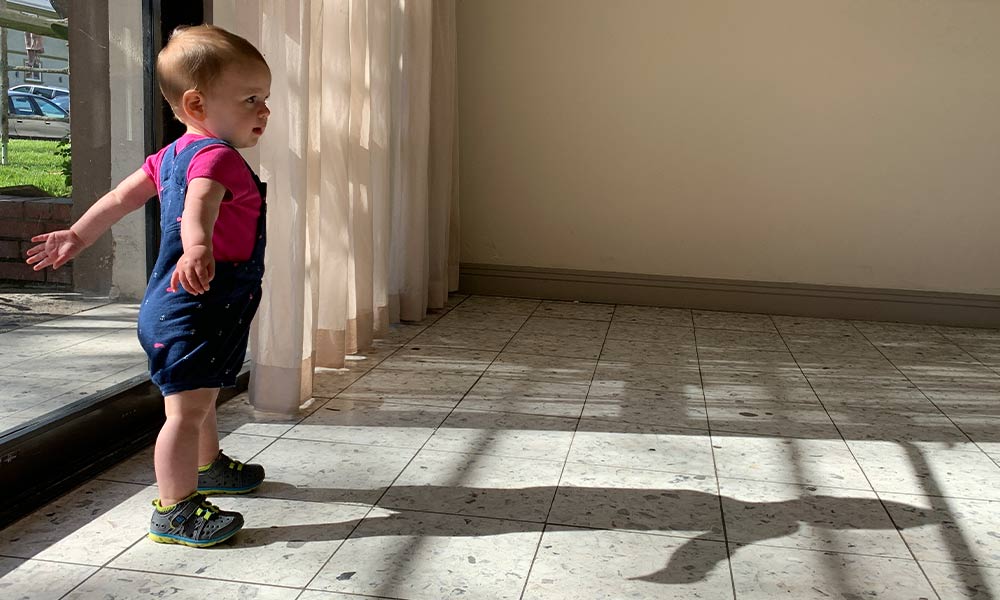
Hannah as a toddler on the ground floor of their Los Angeles apartment building, April 2020. (Names have been changed throughout the essay.)
She’ll say a word and then not say it for a while. She said “water” once and hasn’t said it since; that was four months ago. Earlier this week she said “blanket.” And we’re pretty sure she says a whole sentence: “Iwantdis,” I want this. She has said “gopl,” fork, and “a dank,” thank you. She says “no” to me and I pretend not to comprehend: “Vos meynstu? Ikh farshtey nisht.” What do you mean? I don’t understand. This is a tactic that apparently encourages your child to speak to you in a certain language, but it hasn’t yet worked for us. She probably knows damn well that I understand her when she says an English word. But maybe not. She’s not yet two.
Speaking Yiddish with her reminds me of when I began seriously exploring my Jewish faith, which I knew little about. I didn’t know where the path would take me, but I had a sense it was where I wanted to be. With Yiddish I still feel that I’m at the very beginning, that I’m skating atop the goldene yerushe—an incredible inheritance—without accessing its depths. By choosing to speak Yiddish, and not Hungarian, with Hannah, I have anchored myself to the language I was the least likely to continue. By speaking it every day, I am banking the hope that her and my Yiddish futures will open up more beautifully than I can imagine right now.
Meanwhile, the pandemic slammed shut doors I never even knew were doors. I couldn’t fly with Hannah to Yidish-Vokh, Yiddish Week, an immersive Yiddish-language family camp that usually meets every year in New York’s Hudson River Valley. Yiddish Week became a series of online offerings, which was great, and safe. But of course it wasn’t the same. I wished I could absorb some khizek, strength, from being in the same physical space as my Yiddish friends, especially the ones who are also Yiddish-speaking parents, like Yekhiel, and like Reuven, who now has a toddler son.
***
Sometimes, when I put Hannah to sleep in her crib, I sing her a song from Itsik Manger’s Megile Lider, which subverts the traditional Purim story with a new character—Fastrigose, imagined to be Queen Esther’s first love. “Fastrigose’s Elegy” is haunting and tragic and one of the only Yiddish ballads I know by heart. Though perhaps it’s far too sad, I sing it to Hannah as a lullaby.
In the beginning of the song, Fastrigose reminds Queen Esther of their young romance, before she left:
Gedenkstu, gedenkstu yene nakht,
mir zaynen geshtanen in toyr,
es hot geregn un ikh hob dir gezogt
a sod in oyer, a sod in oyer…
(Do you remember, do you remember that night,
we were standing in the door,
it was raining and I said to you
a secret, a secret…)
***
The day before we left for San Francisco, before I texted Yekhiel about the word “car seat” in Yiddish, Hannah was sitting on my lap outside of our apartment building. We had been outdoors all afternoon, walking and playing together.
“Happy,” she sighed.
I wasn’t sure if I heard her correctly. She had never said “happy” before.
Happy? I asked in Yiddish. Are you happy, sweetie?
“Tsufridn? Bist tsufridn, ziskayt?”