
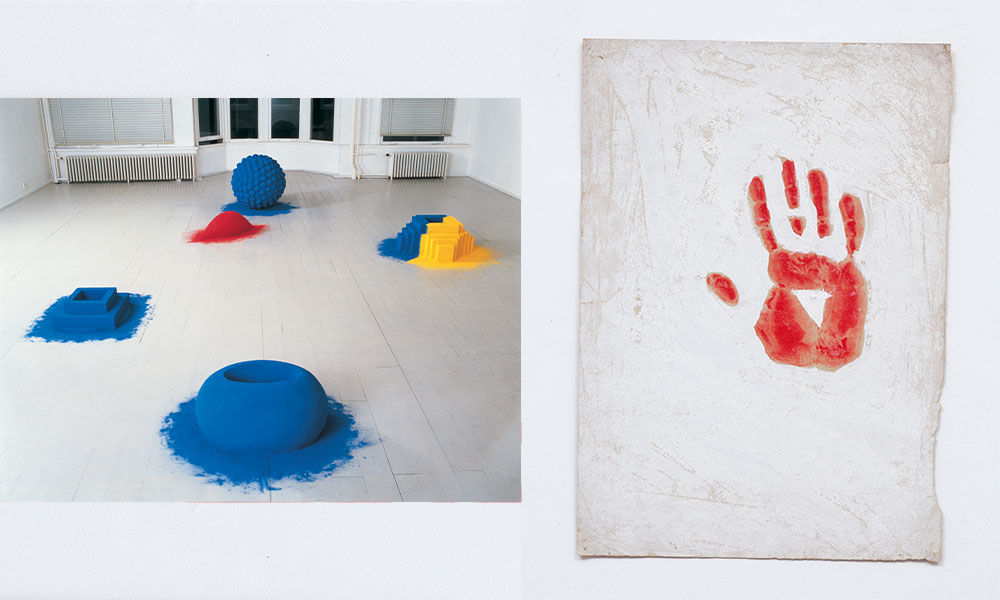
It will take a concentrated effort if you want to experience The Jewish Museum’s new exhibit, Anish Kapoor: Early Works (on view in New York City through February 1, 2026), the way the renowned British sculptor would like you to. That’s because, from the very beginning, even though he arranges his materials with precision and intentionality, his practice has been to withhold conclusions while asking the viewer to take in the mysterious possibilities he provokes.
In one installation, “Part of the Red,” for example, Kapoor has arrayed five monochromatic forms on the gallery floor: a pair of what seem to resemble miniature ziggurats; the thick cross section of a scooped-out sphere; a little hillock-shaped object; and a small globe that is covered with florets or buds or what the curator calls “the stylized ‘snailshell curls’ commonly found on representations of the Buddha.” After grouping them together, he’s dusted the surfaces with saffron, indigo and henna-red pigments, allowing residual powder to fall to the floor in what he’s called “a halo.”
Certainly, the work inspires myriad questions: What are these alien things? Are they meant to tell you something? How do they belong together? Do they come out of one another? Do they tell a story? Why are they colored in this fashion? Are they paintings or are they sculpture? What exists inside their geometry? What exists underneath? Are they dream-objects or part of a mythology? We know they were made by a man, but are we supposed to be reminded of the way nature, perhaps wind, carries dust from surface to surface? Do they connect in any way to thought or feeling? What is present and what is absent? One wonders but there are neither clues nor answers.
Though he has an unusual background, Kapoor has made it clear, in numerous interviews and lectures, that while this enigmatic art might inadvertently be touched by life events, going against current fashion, it is not about cultural identity. By now, after decades of exhibiting esteemed work, Kapoor’s biography is well-known. He was born in Mumbai in 1954, the son of a totally secular and cosmopolitan Hindu father, who was a hydrographer in the Indian Navy, and a Jewish mother, who came to India with her family as an infant refugee from the Baghdadi Jewish community. Although his maternal grandfather was the cantor in Pune, southeast of Mumbai, his family was not religious. Rather, they were aligned with modernity and progress, basically, spectators or observers, looking at the ritual and mythology that was going on around them but guided by the scientific inquiry of his father’s discipline. In an interview Kapoor gave to The New Yorker in 2022, he talked about his father’s oceanic research: “There were literally lines let down to measure the depths—making the invisible visible.” You might think of Kapoor’s artistic practice as a translation of that rigor, struggling to make the invisible visible, while acknowledging the terrifying darkness that is part of the external and internal reality.
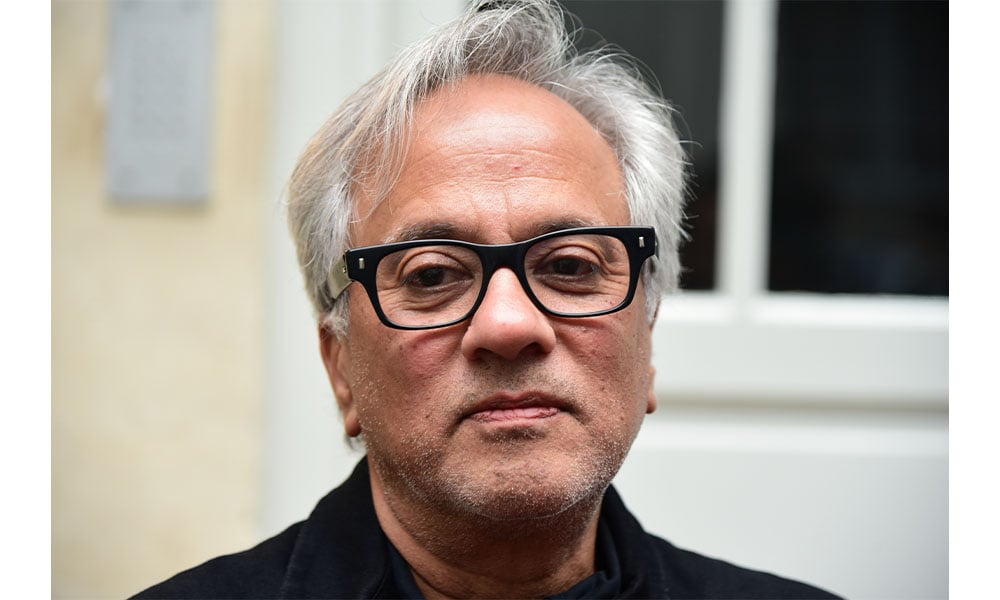
Anish Kapoor by Christophe Becker (CC BY-ND 2.0)
Until he was sixteen, Kapoor lived in India and was educated at the elite Doon boarding school in Dehradun. Then, with one of his younger brothers, he was flown to Israel, along with so many others from India’s emigrating Jewish-Baghdadi community. At first he lived on a kibbutz, learning Hebrew, and beginning to study for a career in engineering, a profession his parents approved of. As Kapoor has said in many interviews, it was an emotionally turbulent time for both boys, who felt like outsiders, not adequately Jewish, just as they previously had been insufficiently Indian. Following his parents’ wishes, he enrolled at the university in Be’er Sheva (now Ben-Gurion University) and began to study electrical engineering, but, as he put it in an interview, he “lasted only three months” before experiencing a severe nervous breakdown, as well as an introduction to psychoanalysis, exploring consciousness and the unconscious, which has influenced his approach to creativity ever since.
Kapoor returned to the kibbutz and in a little studio began taking his first steps as an artist. In 1973, before the Yom Kippur War, he and a friend flew to Istanbul and then hitchhiked across Europe, making their way to London, where he managed to enroll at the Hornsey School to study sculpture. This was a period of great artistic and personal experimentation. His “pigment sculptures,” represented in this current show, date back to the late 1970s when he had just finished art school and was living in London with little money. Sometimes, he likes to recall, he found himself re-using the paint chips and dust he was sweeping off the studio floor. At about that time, his family made a return visit to India and, while they were there, he noticed the pigments that were available in the markets. The colors reminded him of rituals he had observed as a child and, without knowing what he would do with them, he purchased them. When he returned to London, he began working with the new material unclear about where he was headed and gradually, by doing the art, he found his way forward.


In a recent talk at The Jewish Museum, Kapoor spoke about questions that have driven him throughout his long career: What is the relationship between consciousness and ritual, and how does that fit into an artist’s practice? What does it signify to be an artist? What is the artist’s responsibility? Is the hand of the artist everything because it connects what is made to what is in the world? Or is it irrelevant because there is something else, something larger, that takes place? “I have a deep conviction,” he said, “that the artist has nothing to say…maybe there’s a possibility of maybe a meaning but you’ve got to finish the circle.” The process of finishing the circle necessitates engagement from the viewer, a willingness to participate in a way that was required by performance art in the 1960s and 1970s when many people were thinking about the ritual basis of the arts. Significantly, one of Kapoor’s earliest drawings, a red handprint, resembles the imprints that were found in Paleolithic caves. The art reminds us that we can speculate about the meaning of those ancient imprints; perhaps they were affirmations of humanness, signs of self-awareness or consciousness, but we can’t know. As Kapoor says, “The hand is everything. Maybe the hand is nothing.”
Today Kapoor is a superstar in the art world and has gone a huge distance from the days when he swept scraps of paint off the studio floor. Although the questions about the practice of art and the hand of the artist persist, his reputation and success have given him the privilege to experiment with the old questions raised by his early pigment sculptures while using massively expensive and cutting-edge science and new technologies. His most famous public sculpture, the gigantic omphalos-shaped Cloud Gate in Chicago’s Millennium Park (often called “The Bean”), 66-feet-long by 33-feet-high and weighing 110 tons, took more than five years to produce from 168 stainless steel plates using computers and robots, engineers, designers, fabricators, welders, finishers, polishers, movers, builders and installers. More than 125 people worked on it, sometimes in excruciating heat, wearing full-body Tyvek® suits, gloves and hoods, half-mask respirators and face shields. It can appear seamless and light as a balloon while reflecting the sky, the skyline, and masses of tourists surrounding it or walking through its “gate,” or arch. At the same time, like a drop of mercury, it can seem changeable and ephemeral, causing the viewer to question the nature of materiality.
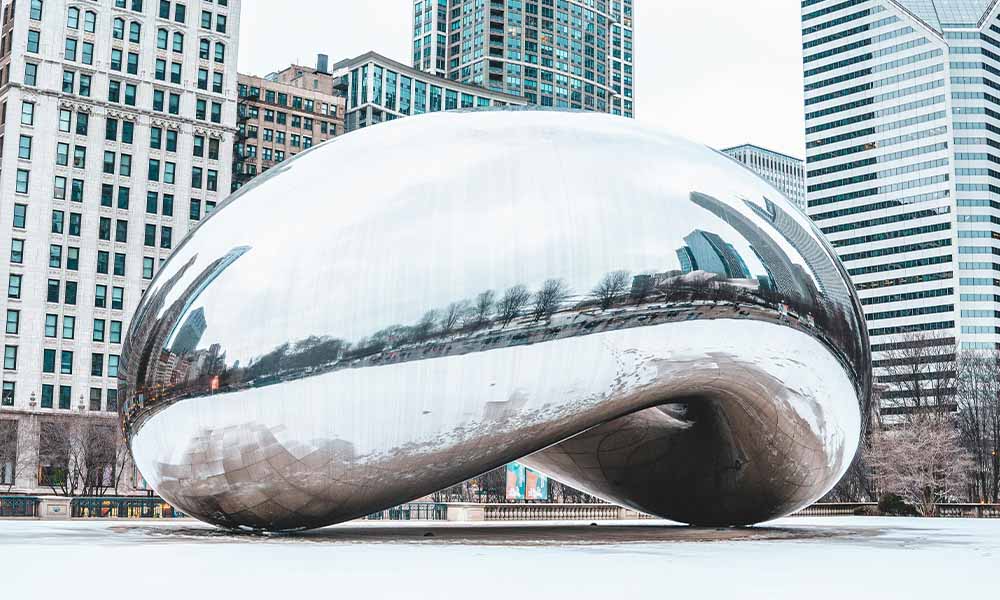
Kapoor’s “The Bean,” Millennium Park in Chicago
More recently Kapoor has been covering three-dimensional objects with a coating called Vantablack, which was first developed for space technology. Not a paint but a nanotechnological substance that absorbs the highest levels of light, it is recognized as the darkest man-made material and can trick the eye to play endlessly with the perception of flatness and continuous space because the coating makes the surfaces look like holes. As with Cloud Gate, the process has been phenomenally costly and complicated, involving years of research with specialized support, since the objects must be placed inside a high-temperature reactor chamber in order to be properly coated. Although the exhibition at The Jewish Museum is entitled Early Works, it also includes four Vantablack pieces dating from 2013 to 2025, and you can see in them a literal extension of the artist’s original probing. Standing in front of the blackness, the viewer has to ask: What is a surface and what is a cavity and what is the potential of the mysterious practice of art?
Top image: “Part of the Red,” 1981, (left) mixed media, pigment. ©Anish Kapoor. All Ri
One thought on “Renowned Sculptor Anish Kapoor’s Challenging Early Work”
This is such a rich and illuminating look at Kapoor’s early work and the threads that run through his entire career. I love how the piece captures the tension at the core of his practice—the way he builds with such precision yet insists on withholding answers, inviting us into a space of uncertainty and possibility.