
The day after a man yelled “Free Palestine!” and threw Molotov cocktails at a group of Jewish community members in Boulder, CO, killing one person and injuring many others, Susan Rona arrived at the Boulder JCC. It was June 2, 2025, the first day of summer camp. Rona, a longtime JCC leader and volunteer, who five months prior had been named the new Mountain States regional director for the Anti-Defamation League, watched happy children blowing bubbles in the sunshine. She’d gathered with her ADL team and JCC leaders to draft a statement about the attack and strategize how to support the community. “When things got really heavy, we would go out to the patio to see the kids,” she recalls, “to see that Jewish life was still happening.” She says she was struck by the simple yet profound thought: “Every one of us deserves to feel safe in spaces of joy and community.”
The Boulder attack came on the heels of the May 21 shooting outside the Capital Jewish Museum in Washington, DC, where an anti-Israel activist murdered two young Israeli Embassy employees as they left an event there. Three weeks later, the Department of Homeland Security (DHS) announced, as part of its Nonprofit Security Grant Program, $94 million in grants to help Jewish synagogues and institutions protect people who work and congregate in their buildings. Enacted in 2005 and administered by the Federal Emergency Management Agency (FEMA), the program helps houses of worship and secular entities such as universities or medical centers beef up their security. Funds go toward hiring security guards; installing blast-proof windows, reinforced doors or surveillance cameras; and providing security training for employees. Grant applicants must demonstrate that they face a high level of risk from a terrorist attack to qualify.
“Smaller Jewish communities outside the metro Detroit area are like sitting ducks, without a lot of security capability. A Nonprofit Security Grant would really help with that.”
In the first decade, annual funding for the Nonprofit Security Grant Program (NSGP) fluctuated between $10 and $25 million, then saw a big increase after the Tree of Life shooting in 2018, jumping to $60 million. In 2024, after the dramatic spike in antisemitic violence following Hamas’s October 7 attack on Israel and the subsequent war in Gaza, the NSGP funding allotment jumped to its highest-ever annual allotment of $454.5 million. (This included a $180 million national security supplemental.)
And yet, as NSGP funding has increased along with increased violent acts and threats—to Jewish sites but also to churches, mosques and faith-based learning centers—so have the number of grant requests, which translates to less than half of NSGP applicants getting money.
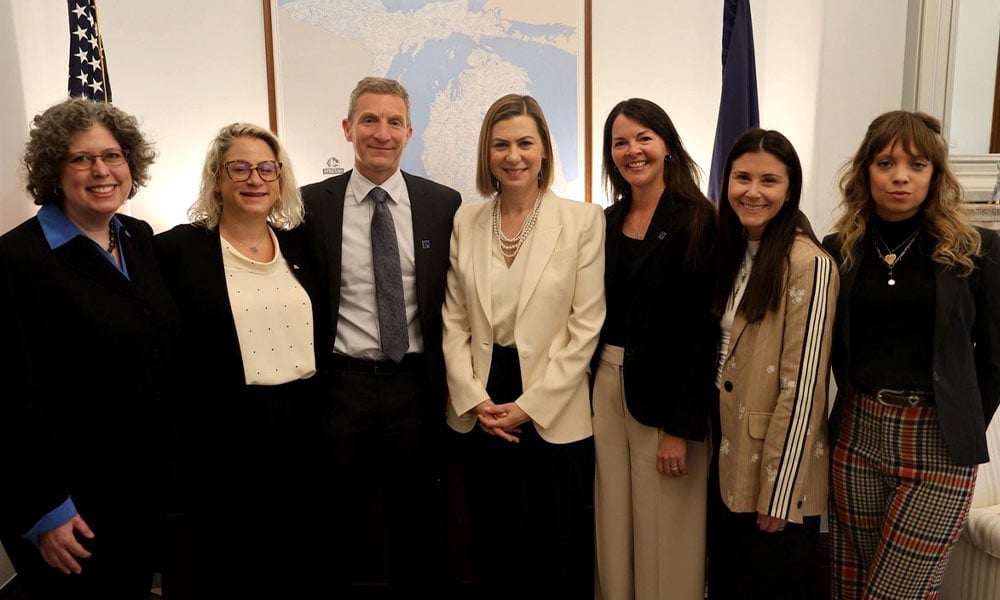
Which is what brought leaders of communities that have experienced antisemitic attacks in the last year to Capitol Hill on Wednesday to lobby members of Congress to allocate more funding to protect religious institutions and other nonprofits targeted by hate. Rona and her JCC colleague Cynthia Weinger were joined by Yoni Kalin and JoJo Drake Kalin of Washington, DC—Drake-Kalin had organized the event at the Capital Jewish Museum and now works at Moment—and Michele Schipper, a board member of Beth Israel in Jackson, MS, which was attacked in January by an arsonist who called it “the synagogue of Satan.” A contingent of four people came from Temple Israel in West Bloomfield, MI, where less than two months ago, on March 12, a man drove his explosives-filled truck through the front of the building before getting stuck, igniting a fire, and dying by suicide. The temple’s school was in session at the time. The group who traveled from Michigan to DC for the Anti-Defamation League-sponsored press briefing and lobby day included Taylor Weintraub, the mother of one of the Temple Israel students and a board trustee of the temple; Cassie Cohen, the temple’s director of development; Jason Ishbia, board vice president; and Elyssa Schmier, a temple member and ADL Michigan regional director.
Following the attack at Temple Israel, Schmeir says every single Jewish school, preschool and institution in Michigan has gone through a security analysis and each is figuring out what safety measures to take, though often without a clear way to pay for them. Moreover, Schmeir says, “there are a lot of smaller Jewish communities outside the metro Detroit area that are really like sitting ducks out there, without a lot of security capability. A Nonprofit Security Grant would really help with that.”


In addition to lobbying members of Congress to allocate $1 billion to the NSGP next year, the group also spoke to members—including some direct meetings, such as with Michigan Senator Elissa Slotkin, and others with policy teams from the offices of House Speaker Mike Johnson and Senate Minority Leader Chuck Schumer—about two related pieces of legislation that have been introduced in the House and Senate. The Pray Safe Act would establish a DHS information hub to assist faith-based entities in navigating the grant process and offer other resources and best practices for ensuring safety. Drake-Kalin noted that it can get confusing as some states offer their own form of security grants with different parameters and also that the FEMA distribution process has been very slow given reduced staff. A second bill, the Safeguarding Access to Congregations and Religious Establishments from Disruption (SACRED) would, as described by the ADL, “create federal penalties for intimidating, obstructing or harassing people exercising their right to pray within 100 feet of a place of worship.”
“Thank God none of the children were physically hurt, but that wasn’t luck,” Michigan parent Taylor Weintraub said at the press briefing at ADL’s DC offices Wednesday, describing the recent terror attack. “Temple Israel was fortunate to receive NSGP funding and utilized it to enhance our security camera systems.” The man who attacked the synagogue had joined a line of cars in a food drive happening that day, but when his truck jumped out of the line and began driving toward the entrance of the building, security cameras picked it up and staff inside quickly began putting their safety training into effect, sheltering in place and alerting security guards.
“That’s the reason I was able to walk out alive. Why Taylor’s son was able to come out alive,” said Temple Israel’s Cassie Cohen. “If I can be a voice to help other houses of worship get the resources and funding to prevent something as catastrophic as we went through, then I’ll do this every day.”
NSGP-funded security cameras likewise helped to identify the person who set fire to the historic Beth Israel Congregation in Jackson, MS, in January. He told investigators he’d targeted the site over its “Jewish ties.” Several Torah scrolls were destroyed and the library completely gutted. Michele Schipper, who represented Beth Israel at the lobby day, says that they’re currently holding their services at a nearby Baptist church and that they bring their own security. “When you’re targeted by hate, you feel really alone,” she said, but added that it was empowering to come together with the group to support effective change. “It’s my sacred duty to represent my congregation here.”
Top image (from left): Cynthia Weinger, Elyssa Schmier, Jason Ishbia, Cassi Cohen, Taylor Weintraub and JoJo Drake Kalin meet with Michigan Senator Elissa Slotkin (middle). Credit: Senator Elissa Slotkin via X.