

Jewish Politics & Power is published every other week. Sign up for our newsletter for updates.
1. A historic shift, in numbers
The fact that Americans are turning their backs on Israel shouldn’t come as a huge surprise. The signs have been out there for years: incremental drops in favorability toward Israel as shown consistently in polls, mainstream politicians distancing themselves from pro-Israel causes and lobbies, and anti-Israel vitriol becoming mainstream in the far-left and far-right.
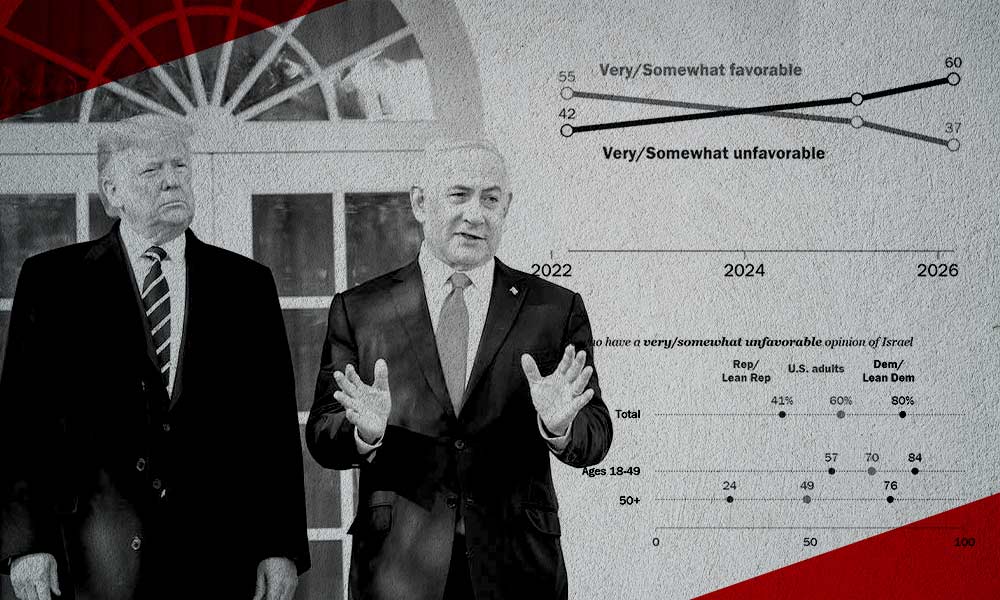
But the latest Pew Research Center’s poll puts clear and definite numbers behind this trend. According to the survey, conducted during the last week of March, 60 percent of adults in the United States hold unfavorable views of Israel. A year ago this number stood at 53 percent. Of those who do not see Israel favorably, 28 percent say they have very unfavorable views of Israel. A year ago this figure stood at 19 percent and in 2022 only 10 percent of Americans held very strong unfavorable views regarding Israel.
And here comes the number that should concern Israelis and pro-Israeli Americans. Remember the old theme that it’s mainly Democrats and younger Americans who dislike Israel, while centrists, Republicans and older Americans haven’t shifted? Well, that’s no longer the case.
Dems dislike Israel more than ever (80 percent unfavorability), but so do 41 percent of respondents who self-report as Republican voters. Among Americans under 50 years of age, a clear majority disapprove of Israel (84 percent of Democrats, 57 percent of Republicans), but even among Americans over 50, the numbers aren’t great: 49 percent disapprove of Israel (76 percent Dems, 24 percent Republicans). Basically, the only constituency that are still staunchly pro-Israel are Republicans over 50. In terms of religious affiliation, Israel still enjoys support among two faith groups: white evangelicals (65 percent) and Jews (64 percent ). All the rest, including non-evangelical Protestants, Catholics, Black Protestants, the unaffiliated and Muslims, view Israel unfavorably.
One caveat: This poll was conducted at the height of the Iran war, which some have suggested was initiated by Israel, and these circumstances might be unfavorable to Israel compared to calmer times (that is, if there were any calmer times in the past three years).
But still, the trend is striking. Israel has lost the special place it had in the hearts of Americans. The idea of a Western bastion in the Middle East that shares America’s values and interests has lost its charm. Israel and its supporters may want to maintain the special relationship that defined Washington’s ties with Jerusalem for decades, but they can no longer count on the American people for political backing and support.
2. Bibi and Trump: Where legitimate influence meets conspiracy
Last week’s New York Times deep-dive report into the decision-making process that led President Trump to launch war against Iran shed light on the unusual role played by Israeli Prime Minister Benjamin Netanyahu in convincing the American president there was an immediate need to take military action against the Islamic Republic. According to the report, in a top secret Situation Room briefing during his last visit to the White House, Netanyahu presented Trump and a handful of top advisers with his take on the threats posed by Iran and the suggested U.S.-Israeli military action needed, while also promising that the war would be successful and would not only degrade Iran’s nuclear and ballistic capabilities but also lead to regime change shortly after the attack began.
For those on both the right and the left who seek to place all the blame on Israel for the Iran war, the report’s revelations were a gift from heaven, a chance to hit back both at Trump and at Netanyahu.
“Trump having Netanyahu [in the Situation Room] before launching an immoral and illegal war is a betrayal of the American people,” said progressive Democrat Ro Khanna, a harsh critic of both Trump and Netanyahu.
“What led Trump to sit in that Situation Room, where Bibi sat as an equal… and buy what that guy was selling hook, line and sinker when all other presidents were able to see through that liar?” asked commentator Megyn Kelly, once a Trump supporter and now a top right-wing critic of the president, Israel and the Iran war.
These messages were amplified all through the far-left and far-right political ecosystems, providing critics with a perfect answer to everything they dislike about the Iran war: It was Bibi who pushed Trump into a war that would advance Israeli interests at the expense of American lives and fortune. Trump, according to their theory, is a weak and ineffectual president who ignores his team and caves to mighty Israel.
Criticism of the war is, of course, legitimate, and given how the war is going, such criticism is necessary and probably should have been voiced earlier. But trying to cast Netanyahu as an evil genius ignores the fact that the Israeli PM did exactly what his people expected him to do—he advocated for action that, in his perception, would help Israel. That’s his job. It is Trump who chose to listen to Netanyahu instead of his advisers.
3. Is Trump too soft or too tough on Bibi?
And while in the United States the perception of Netanyahu as the puppetmaster leading Trump is taking root, in Israel an opposite notion has become popular since last week’s ceasefire. Judging by commentators in the Israeli press, Netanyahu, and for that matter all of Israel, was taken by surprise by Trump’s decision to pause the war for two weeks and felt that the ceasefire was imposed on Israel prematurely. A day after announcing the ceasefire, when Trump called Bibi and demanded that Israel tone down its attacks on Lebanon that had been jeopardizing the ceasefire, this notion of Netanyahu being dragged by Trump became even clearer.
“Once again Netanyahu caved in to Trump,” wrote a commentator on Israel’s KAN-11 public broadcaster. “Netanyahu’s desperate move to appease Trump” is how Maariv, a centrist publication, described the Israeli leader’s sudden announcement about opening direct peace talks with Lebanon shortly after his call with Trump. Other reports noted that Bibi had warned Trump against declaring a ceasefire, only to be ignored by the American president.
So who’s the puppet and who is the puppeteer in this relationship? That depends on whom you ask. For American critics of Trump and his war, it’s all about Netanyahu pulling the strings. For Israelis who dislike their PM, it is Trump who is calling the shots, whether Israel likes it or not.
4. J Street and the Iron Dome consensus
When it comes to U.S. military aid to Israel, there are several schools of thought: There are those in Congress (almost all Republicans and until recently a majority of Democrats) who strongly support all military aid to Israel and vote enthusiastically in favor of the full $3.8 billion of annual funding; then there is a growing group of Democrats who support most military funding, especially for defensive needs, but are open to conditioning aid on Israel’s actions and to blocking certain arms deals that would provide Israel with equipment and ammunition that could be used for military actions that are not aligned with U.S. legal restrictions; and then there’s a small but growing group on the left that believes the United States should stop funding Israel’s military purchases altogether, regardless of whether they are defensive or offensive. Most recently, New York Democrat Alexandria Ocasio-Cortez joined this camp, declaring she will not support the funding, since Israel can pay for its own arms purchases.
J Street, the dovish pro-Israel lobby, drew attention last week when, for the first time, it began supporting Dems who, like AOC, believe it is time Israel pays for its own military needs, including for the Iron Dome interceptors made in the United States and used to protect Israel from rocket and missile attacks.
[Read: “Inside the Iron Dome.”]
The group’s president, Jeremy Ben-Ami, tried to explain. The lobby, he wrote, still supports American supply of Iron Dome interceptors to Israel, it just believes that the funding for that and other weapon systems should be phased out, just as Netanyahu himself had recently suggested. “Israel is more than capable of paying for its own defense—just as America’s other wealthy allies already do,” Ben-Ami wrote. “Why should American taxpayers continue to subsidize the defense budget of a prosperous ally, particularly at a time when the U.S. faces its own significant fiscal pressures?”
J Street calls it “normalizing” the U.S.-Israel military relationship and says stopping taxpayer funding for arms systems to Israel would benefit both sides.
By adopting this approach, the lobby is walking a fine line. It is easy to understand the rationale for transitioning from subsidies to sales, especially when you have Netanyahu (and Republican Senator Lindsey Graham) saying the exact same thing. But it is still a hard case to make for pro-Israel Americans who might feel that at this point in time, when Israel is attacked daily by rockets, missiles and drones, making it pay for defense systems doesn’t sound like something that friends do.
And it is also a sign of how the politics of military aid to Israel has shifted in the past decade. The idea of conditioning aid on Israeli actions and of voting against certain offensive arms sales was once unheard of and is now completely acceptable in Democratic circles. Now the call to stop subsidizing the supply of defensive systems is being mainstreamed. It’s a new world out there, and with 60 percent of Americans espousing unfavorable views toward Israel, this approach probably reflects the direction in which U.S.-Israel relations are headed.
5. What to look for in ceasefire negotiations
With the first round of talks between the United States and Iran in Pakistan failing to reach an agreement, this next week is shaping up to be critical for the future of the Iran war. Here are a couple of things to watch for:
– Will Trump, who has already announced a full American blockade of the Strait of Hormuz, decide to give diplomacy another chance, despite the significant gaps between the sides that became apparent during the Islamabad talks, or choose to go back to the battlefield and fight it out? The former would lead to more tension with Israel, the latter is likely to get Trump even deeper in trouble with American voters.
– If and when a deal is reached, will the United States allow Israel to continue attacks on Iran? Or on Lebanon?
– What will a post-war relationship between Trump and Netanyahu look like? Will Trump decide that it is time to keep some distance from Bibi, who has become a political liability in certain Republican circles, or will he double down on their friendship and push forward with his attempt to force an Israeli pardon for Netanyahu?
One thought on “Wavering Support, Unsure Influence”
I disagree with your assertion that when he made his presentation to Trump in the Situation Room Netanyahu was doing nothing more than what the people of Israel expected him to do. It’s a leader’s job to assess various courses of action and pursue those that are in the best interest of the country, not indulge his longstanding obsession with Iran as the be-all and end-all of Israel’s troubles. One can’t separate this war of choice, and its timing, from Netanyahu’s current campaign to win the upcoming election. If the people of Israel had known in February what they know now – that Iran would not instantly collapse in response to US-Israeli air power – I don’t think they would have supported the decision to launch this war at this time. Obviously Netanyahu (and Trump) lied or at least misrepresented things last June in saying that the 12-day war had obliterated Iran’s nuclear program (Trump) and had eliminated the threat posed to Israel by Iran for a significant amount of time (Netanyahu).