
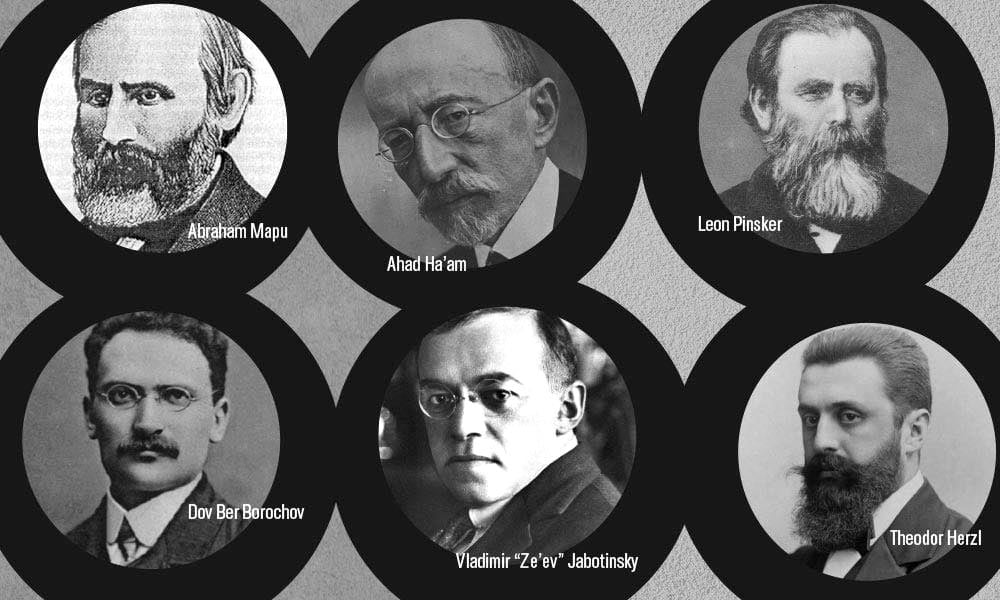
In my essay in Moment’s spring issue, “The Word Zionism Is Dead,” I argued that the meanings of the Z words—Zionism, Zionist, anti-Zionist—are too imprecise today for constructive political discourse. Like people caught in an infinite time loop, I noted, we’re still arguing over competing cultural, political and religious visions that already burdened the word when it was coined in 1890. While I understand that the term has come to represent, for many, a deep emotional attachment to Israel and/or Judaism, I suggested that people plainly state what they support or oppose—Israel’s existence, settlement policy, the current government and/or Jewish identity, etc.—without hiding behind the ambiguity of “Zionism” or “anti-Zionism.”
Most people don’t agree with these points and others I made, and I never expected otherwise. At most, I hoped for thoughtful engagement, and with some minor exceptions from the usual hotheads, I have been heartened by the remarkably respectful conversation this essay has sparked. We all know how rare this is in today’s polarized, reactive world. Letters and comments have poured in, and the essay has been discussed by Rabbi Donniel Hartman and Yossi Klein Halevi on their admirable For Heaven’s Sake podcast and has been addressed in other publications by thinkers such as the historian Gil Troy.
Here we are publishing four essay-length responses, each of which disagrees with me in its own way. Judea Pearl objects that without the word “Zionism,” it becomes impossible to state clearly the contrast between Israel and those who seek its destruction; Shaul Magid suggests that dropping the word accomplishes little unless the underlying concepts of Zionism are also challenged. Paul Barrett sees moving away from the word “Zionism” as a start, part of an effort to move a still imperfect Israel in the direction of its founding ideals. Fania Oz-Salzberger won’t give up on the word, which hostages in Gaza clung to during their imprisonments, until a democratic Israel flourishes alongside a secure and hopefully democratic Palestinian state. While I learned from all of them, I continue to believe that the problem with the word Zionism is similar to what George Orwell said about certain other words: “Fascism has now no meaning except in so far as it signifies ‘something not desirable,’” he wrote in his 1946 essay “Politics and the English Language.” “The words democracy, socialism, freedom, patriotic, realistic, justice, have each of them several different meanings which cannot be reconciled with one another.”
Why did I publish my essay now? To be clear, it is not because I’m afraid of using the Z words; I am not. I don’t use them, because they simply don’t make sense to my writer’s brain, which craves exact language and detests words with clusters of definitions that end up masking meaning and clogging political discourse. The essay is part of a broader personal quest: taking on the words that divide us.
Today, words such as Zionism (and sadly, antisemitism, although that’s a different essay) lead us to fight over definitions. Many people have responded to my contention that there are too many definitions of Zionism by doubling down on their chosen definition. I am suggesting that we step back, take a deep breath and consider that words are containers for ideas. Some are overstuffed and for those, we need to pull ideas out strand by strand to understand.
I don’t expect the word Zionism to disappear overnight, or anytime soon, but a conversation has started, and if all it does is push us to think about how we use words, then we may be able to speak to one another about the politics of our time after all.

[Judea Pearl’s “Zionism Is the Jewish Quest for Normalcy—it Should Shine, Not Retire”]
[Shaul Magid’s “Long Live Zionism!”]
[Paul Barrett’s “Israel, Zionism and American Jews”]
[Fania Oz-Salzberger’s “Zionism Is Still Alive—Here’s Why”]
[Daniel Chamovitz’s “The Word Was Already Dying When We Were Debating It”]