
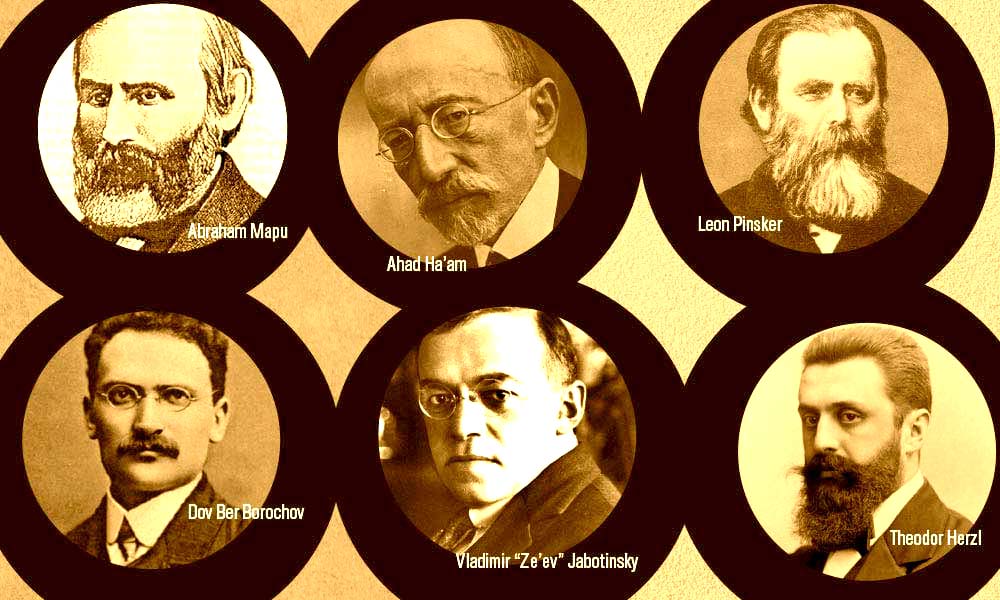
“A rose by any other name…”
Shakespeare, Romeo and Juliet, 1599
“And the people is broken into fragments.”
Ahad Ha-Am, “The Wrong Way,” 1899
Reading Nadine Epstein’s trenchant essay reminded me of something we learned in graduate school. The role of the historian, we were taught, is not to tell us that something happened, or even why something happened. The historian’s question is, or should be, “Why did something happen when it did?” Why in 2026 does Moment magazine publish an essay calling for the death and burial of the term “Zionism”? Why now? Why here?
On the surface there is much in this essay I agree with. Terms are born and then die; unlike the creator of the universe, nomenclature is not eternal. Epstein points that out when she quotes David Ben-Gurion, who famously argued that Zionism ended in 1948 with the establishment of the state. Zionism was an aspirational, even revolutionary, ideology to establish a secular nation-state. Once that was achieved, the movement was over. Or was it? Ben-Gurion also said after statehood that a Zionist was a Jew who chose to reside in the State of Israel. A Jew who lived in the diaspora, he argued, was not, nor could be, a Zionist. After the state, Zionism was a decision, not an ideology—an identity, and certainly not the replacement of, nor identical to, Judaism.
But Zionism persisted, even—maybe predominantly, contrary to Ben-Gurion—in the diaspora. In Israel, to some extent, it was replaced by Israeliness, that is, an identity rooted in where one chooses to live. Israelism is, in some way, a replacement of Zionism. However, for others, in the manner of Trotsky, Khomeini or Castro, Zionism became a “permanent revolution.” The State of Israel was the Zionist state. And in the diaspora, it almost became fused with Jewishness itself.
Epstein acknowledges all this and ostensibly wants to end it. Or does she? The “word” Zionism is dead. But the issues surrounding Zionism, and what Zionism produced, are not limited to the word. And maybe that gets me to the historian’s question, “Why now?”
For the third time in Israel’s history, the term “Zionism” is seriously on the defensive. The first time was in November 1975 when the UN passed Resolution 3379 determining that “Zionism is a form of racism and racial discrimination.” That resolution was revoked in December 1991, but the sting remained. It is noteworthy that the 1975 resolution was two years before the Likud government was elected that made the settlement project and land expropriation part of government policy. And the revocation in 1991 happened two years before the signing of the Oslo Accords in 1993.
The second time was at the Durban Conference in 2001, a year after the onset of the Second Intifada. Both moves met with stiff resistance not only from the pro-Israel/Zionist camp but from many other countries that supported Israel. Zionism largely had the support of the “West” against its detractors, who were mostly but not exclusively in the Arab world.
The third time “Zionism” as a term seriously came under attack was in the wake of the destruction of Gaza and Israel’s choice to respond to the October 7 massacres by Hamas by engaging in what sociologist Keith Doubt calls “sociocide,” the intentional destruction of a society and its infrastructure that disables that society’s ability to function.
The result of the destruction of Gaza was the transformation of the Palestinian cause into an international movement. This had never happened before, and it is not likely going away anytime soon. Throughout the entire history of the Israeli/Arab-Israeli/Palestinian conflict, the Palestinian movement had never achieved the kind of widespread support it has achieved in the wake of the destruction of Gaza. And not only in the Muslim world but in large swaths of Europe, the Americas and the Global South as well.
As important, the Gaza war has resulted in a considerable number of Jews, including many young Jews, abandoning Zionism altogether. This is indeed new. Traditionally, the American Jewish left—the New Left in the 1960s, the Breira movement in the 1970s, Peace Now in the 1980s and 90s, T’ruah and J Street in the 2000s—mostly considered themselves Zionists, that is, they all believed in the viability of a Jewish state that would live up to the humanistic and liberal values of earlier Zionist thinkers such as Martin Buber and Judah Magnes (even though both of these favored not a “Jewish” state but a binational one).
Unlike the UN resolution in 1975 or the Durban conference in 2001, the Gaza war has introduced a rupture external and internal to the Jewish people and to Zionism. The common trope that “these young people do not know the history and context of the conflict” is empirically false. Many are products of day schools, summer camps, Hebrew schools and Birthright trips. That is, many are products of the Zionist education that American Jewry has produced over the past half-century (the film Israelism is one example). In many cases, those making the “ignorance claim” are less knowledgeable about the conflict than those they are targeting.
One common tack to defend against the anti-Zionism of this moment is to make a stronger case for Zionism. This can be done in various ways. We can take the more reactionary, let us say Jabotinsky or Kahanist, view and say that the land belongs to the Jews, they are the sole indigenous people, and the Jews can decide to do with that land, and its non-Jewish inhabitants, what it deems necessary. End of story. This view is becoming more common even among those who would never identify with Meir Kahane. The liberal view would say that this is the Jewish homeland, and Jews have a right to establish a state there while we also acknowledge Palestinians have a right to the land, and we will give them a piece of it on conditions we determine. This is what Chaim Ganz calls “proprietary Zionism.”
Epstein has decided on a different, innovative tack. Her way to fight anti-Zionism is to say that the word “Zionism” is dead. It’s an interesting move, albeit flawed. It suggests a sleight of hand, because words, while connected to the ideologies that produce them and that they represent, are not identical to those ideologies. If you want to subvert anti-Zionism by saying “Zionism” is dead, that is little more than semantics unless that “death” implies something beyond language.
For example, in the mid-19th century Joseph O’Sullivan invented the theologically and politically charged phrase “manifest destiny” to justify killing and displacing Native Americans in conquering the Oregon Territory. Among other things, this gave birth to American exceptionalism and white Christian supremacy. I think we can agree that “manifest destiny” is no longer an operative term in America. And yet what it implies seems quite operative today, justifying inequality, systemic racism, America Firstism, renewed imperialism, etc. We no longer need to support “manifest destiny” to support what it represents operative term in America. And yet what it implies seems quite operative today, justifying inequality, systemic racism, America Firstism, renewed imperialism, etc. We no longer need to support “manifest destiny” to support what it represents.

So let’s take Zionism. While Epstein is surely correct that Zionism has been a vexed term from its origins and thus difficult to define, it is not exceptional. “Communism” and “democracy” share those complexities, and as we know, even during Marx’s lifetime communism was a highly debated term—so much so that Stalin (a communist) later had Trotsky (a communist) killed because of a disagreement on the meaning of the term. And even though there remains much to debate about the word “Zionism,” it has come to mean a few basic things.
First, the establishment of a Jewish ethnostate (many people don’t like the term, but it is an accurate description) founded on the proprietary precept that the land belongs to the Jews. Second, “majoritarianism” (an idea championed by Vladimir Jabotinsky in his 1925 essay “The Iron Wall”) that Jews must remain the majority for the Jewish state to remain intact. While these were once debated in the Zionist camp, certainly by binationalists, who were not majoritarianists and did not believe in a “Jewish” state, those arguements no longer exist under the broad tent called “Zionism.” For most Zionists today, a binationalist state would no longer be a Zionist one, even though in practice we presently have a binational state from “the river to the sea,” just not a democratic one.
If Epstein wants to declare that the word “Zionism” is dead, this would, or should, open up new possibilities for all those who live in the land. It could eliminate what A.J. Heschel said in regard to race in America in the 1960s, “the monstrosity of inequality.” A “Jewish” state would not be required, a constitution assuring the equal rights of all those who reside in the state could be easily achieved, territorial compromise would be easy on terms negotiated and agreed on by all parties as the proprietary nature of Jewish residence in the land would be erased. The idea that the State of Israel is a refuge for all Jews worldwide, that is, the law of return, could be curtailed. Jews would have the right to immigrate equal to others who would have the right to immigrate. Security concerns would exist, but for all inhabitants of the land, not just for Jews.
Needless to say, much of this is unlikely to happen, even if we bury the word “Zionism.” Because, whatever the fate of the term, Zionism persists as a normative principle for most Jews, except those who have abandoned it.
So “why here, why now?” becomes clearer. Zionism is under siege in ways it hasn’t been for some time, maybe ever. The reactionary response has not worked outside of a narrow constituency. Hasbara, Israeli public relations, is seemingly on the ropes. Liberal Zionism is groping for ways to recalibrate in light of Gaza, annexation, settler/army violence and the most right-wing government in Israel’s history, with or without Netanyahu. I don’t think it’s overreaching to say that for American Jews under 40, Zionism is hemorrhaging. Given this moment, Epstein’s death call is understandable. But for it to be efficacious, it must extend beyond the “word” for two reasons.
First, because words don’t change realities; in fact, sometimes erasing them can further instantiate the realities they created. And second, because for those who have abandoned Zionism for something else, they don’t really care that the editor of a magazine they see as Zionist writes an insightful essay calling for the death of the word. So, I applaud Epstein’s intervention as potentially a move in the right direction. Zionism achieved a lot, and also created many of the problems we now face. After we return from the funeral of the word, perhaps we need to work on changing, and to some degree erasing, the realities that the word Zionism produced.
[This piece is a response to Nadine Epstein’s essay “The Word Zionism Is Dead.” For all responses, click here.]
Shaul Magid is Professor of Modern Judaism in Residence at Harvard Divinity School and rabbi emeritus of the Fire Island Synagogue. His forthcoming book is The Scourge of Jewish Nationalism: Rabbi Yoel Teitelbaum’s Anti-Zionist Thought.