
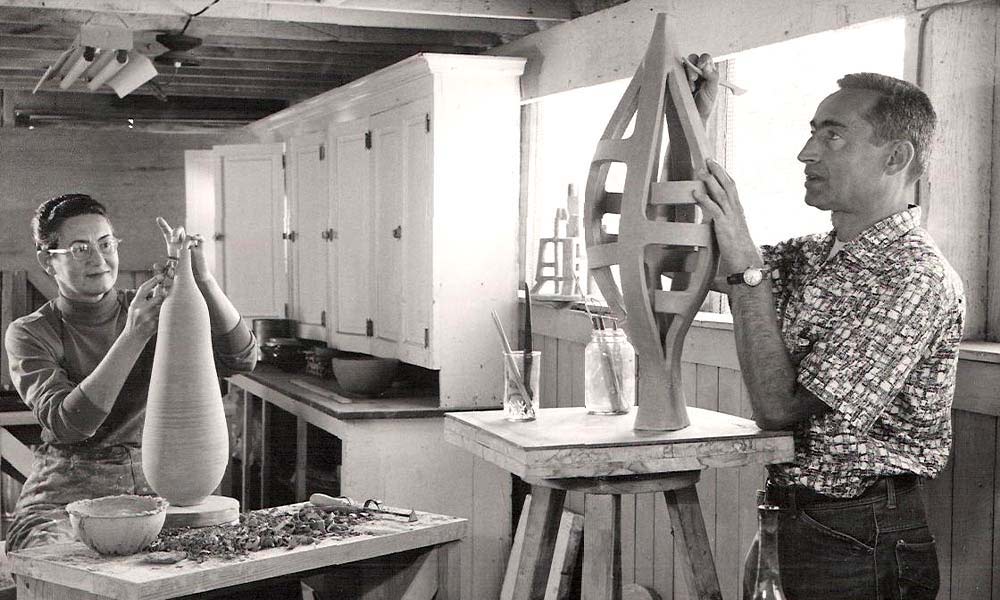
In 1968, when the Los Angeles County Museum of Art exhibited a collection of 56 pieces by ceramic artists Gertrud and Otto Natzler, the accompanying catalog was introduced by an unusually personal document, a charming autobiography in which Otto described their courtship and early days in 1930s Vienna. Characteristically modest, Otto explained that his story was essentially “cherchez /la/femme…and happily accepting all that was connected with one femme in particular.”
Both Gertrud and Otto came from the close-knit Jewish Viennese middle class, and he remembered that first rainy Sunday, the 30th of July, 1933, when in pursuit of his friend’s attractive sister he made the arduous trip by streetcar, train and “a little old rickety electric train” to Gertrud’s parents’ summer house in the Vienna woods. While it rained, they sat under a veranda, looking out at the garden. They played cards, ate supper, and Otto recalled he “watched only her.” That night, as they traveled back to Vienna together, Gertrud spoke about her current preoccupation with pottery and the pottery wheel she had just begun to use. In her animation, she convinced Otto to try it out himself, persuading him to join her at a ceramics studio run by a pompous Mr. Franz Iskra, who was too busy and self-absorbed to pass any knowledge on to his students. With pottery in the foreground, their relationship blossomed.
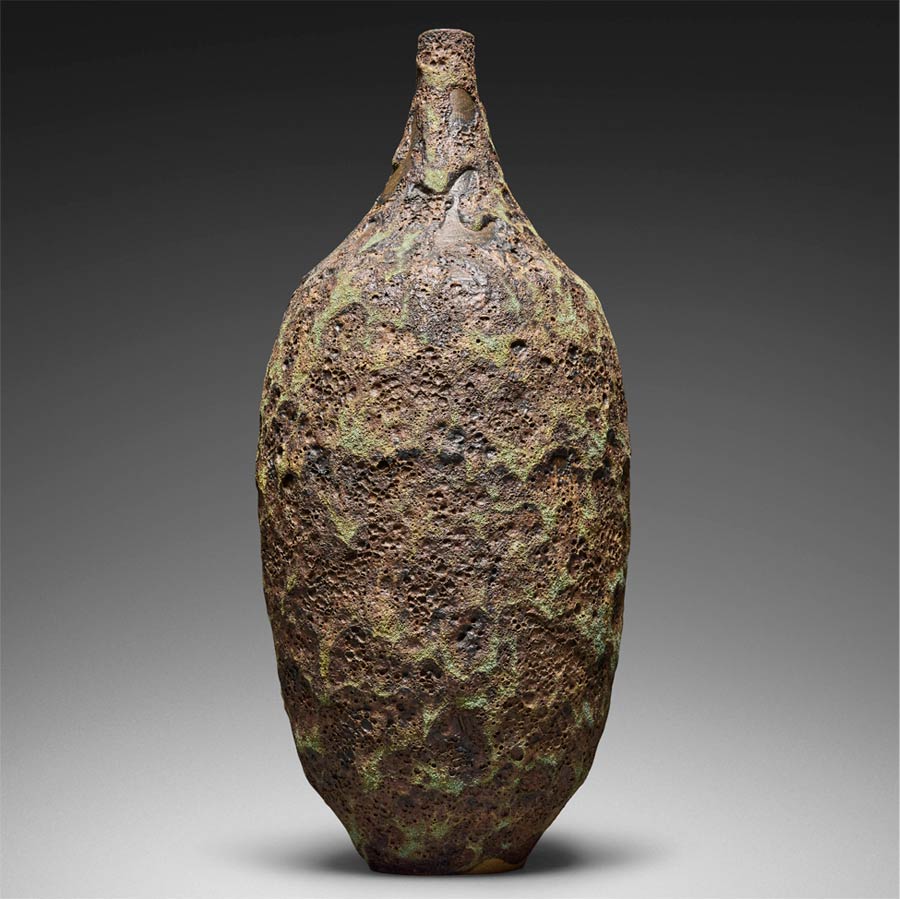
Gertrud and Otto Natzler, Tall Bottle Form. Courtesy of Rago/Wright (www.ragoarts.com)
From the beginning, Gertrud had a natural agility with the material and process, operating the flywheel with a uniquely spontaneous elegance that allowed her to make bowls that had flowing and harmonious lines, while the walls could be as thin as eggshells. You can see this on the internet in a short video that shows her beautiful hands building and shaping a pot.
Otto, who came to pottery accidentally, developed a deep knowledge of the more technical aspects of the art. As they eventually worked collaboratively on every pot, he took charge of the selection of clay and the firing techniques that he managed in his electric kiln. He also experimented with glazes that he brushed onto the surfaces of each pot, often several times through multiple firing reductions. Without previous knowledge, he proceeded scientifically and by trial and error, keeping detailed records of his many applications and the way that chance and accident left their imprint, sometimes resulting in fingerprints, blisters, pockmarks or bubbles adhering to the surfaces like lichen. Because of his attention to detail and what he referred to as “conscious exploitation,” he produced remarkable variations on the pots’ surfaces, developing more than 2,000 glazes during his lifetime. The pots the Natzlers made together are appreciated both for the purity of their design and the organic quality of their finishes; in this way they were truly modern objects, in the tradition of Bauhaus design. Widely collected nationally and internationally, their works are part of the permanent collections of such museums as New York’s MoMA, the Art Institute of Chicago and England’s Victoria and Albert.
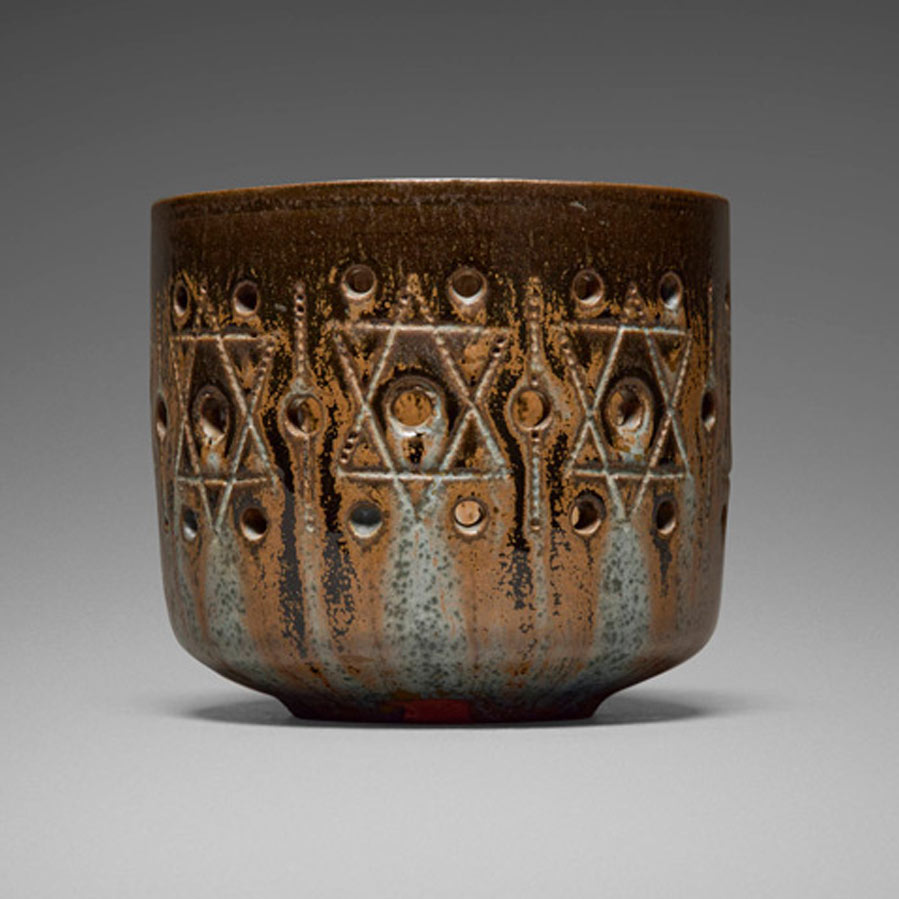
Gertrud and Otto Natzler, Yahrzeit (memorial) Lamp. Courtesy Rago/Wright (www.ragoarts.com)
Like many from his generation, Otto downplayed the troubles of two Jewish artists working together in an antisemitic and unpredictable era, emphasizing instead the serendipity—finding, for instance, in Vienna “the most beautiful studio one could imagine” rented to them at a discount from a Jewish landlord in 1934 or, in 1938, receiving the extraordinary news that they had won the Silver Medal at the World Exposition in Paris, unfortunately on the same day that the German army marched across the Austrian border. From the moment of the Anschluss, the Natzlers knew they needed to leave Vienna, and in September of 1938, having obtained identity papers, travel documents and sponsorship, they departed for the United States, going directly to Los Angeles, which became their home for the rest of their lives. In his introduction to the LA County Museum of Art catalog, Otto wrote that he was presenting his memoir in place of a list of credentials, art schools or mentors since the two of them were essentially self-taught. This is astonishingly true, although they quickly came to produce museum–quality, deceptively simple but perfectly flowing bowls, pots, trays and bottles permeated with the wizardry of Otto’s hand-brushed glazes.
In New York City this past winter, it seemed that work by the Natzlers was everywhere. Although Gertrud died in 1971 and Otto in 2007, it was only after the recent death in 2025 of Otto’s second wife, the photographer Gail Reynolds, that the last pieces from the family’s private collection were ready to come onto the auction market. In January, the Rago Gallery exhibited more than 50 objects before the auction sale on January 22, with just about everything selling at double or triple their estimates, including an exquisite tall earthenware bottle form, covered with a verdigris crater glaze, that went for almost $70,000.
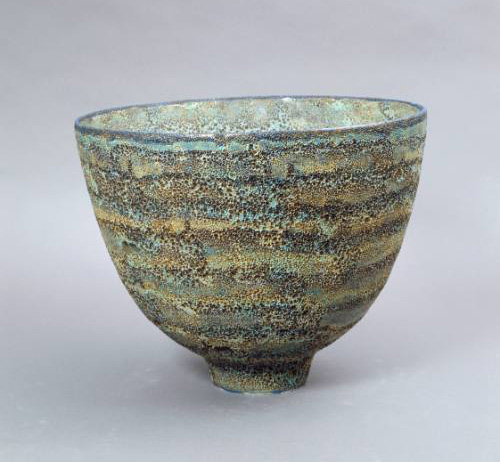
Gertrud and Otto Natzler, Large Bowl (H331) 1956. Courtesy of Museum of Arts and Design
Pots by the Natzlers were also on view at the Metropolitan Museum of Art, the Museum of Arts and Design and The Jewish Museum. Two earthenware bowls at the Met, both from the 1950s, demonstrate the crisp and simple elegance of Gertrud’s classical forms as well as the scope of the early finishes, one bathed in a glossy canary yellow and the other covered in a deep black-brown glaze, showing the unpredictable swirl of smoke and fire that had emerged from the reduction process. An expansive pot at the Museum of Arts and Design stands 19-inches tall with bands of melt fissures and what Otto called “elephant skin texture.” When your eye follows along the surface, you experience the same sense of energy and flow, the expressive power, that comes from Jackson Pollock’s paintings of the same era.
On the third floor of The Jewish Museum, as part of their redesigned and rehung permanent collection, you can see a memorial, or Yahrtzeit, lamp that Gertrud made c.1958 when the Natzlers were teachers at the Brandeis Camp Institute for college-age students in California. The founder and director of the camp, Shlomo Bardin, inspired the Natzlers to construct a few ceremonial objects. Otto’s slab-like Hanukkah lamp is also part of The Jewish Museum’s collection and a second memorial lamp attributed to both the Natzlers was sold by Rago in the January auction.
Both of the lamps are small, just about 6 inches tall, and pierced with holes to let the light of a candle glow through. There is something stark and foreboding in the little pots–one inscribed with Hebrew characters referring to the Biblical text “Man comes from dust and returns to dust,” and the other ornamented with a series of Jewish stars. While Otto’s parents, sister, brother and sister-in-law were all able to emigrate to the United States, Gertrud’s father died in Austria in 1940 and her mother, transported to Lodz in 1941, was murdered there. We can only guess what those small clay pots meant to the great ceramic artists, assimilated Viennese Jews, who carried their creative and collaborative spirit to a new life in Southern California.
Opening image: Ceramicists Gertrud and Otto Natzler in their studio, circa 1963, photo by Hella Hammid. Courtesy of the Natzler Family Trust, all rights reserved.