
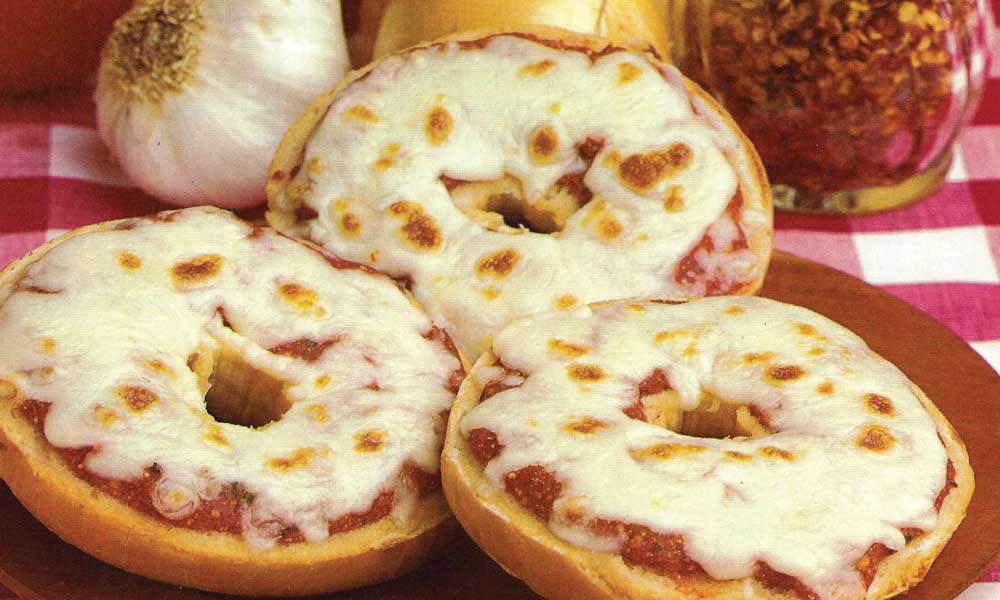
For the millennials among us, the pizza bagel is iconic. A culinary chimera that drops tomato sauce and melted mozzarella on top of the classic Jewish baked good, it is a snack food that somehow manages to straddle the line between the sacred and the profane. A concept so quintessentially American that even denizens of the 31st century can’t help but take note—as Lord Nibbler, a high-ranking alien diplomat from the TV show Futurama, so eloquently describes our planet: “Earth, homeworld of the pizza bagel.” Apparently, even in a future teeming with robot overlords and interplanetary delivery services, the humble pizza bagel endures. Maybe the appeal is in the unlikely fusion of a Jewish staple wedded to an Italian-American one. But just how did this marriage come about?
Whether you view the pizza bagel as deeply ingrained in our cultural consciousness or a random result of some stoned college students putting “necessity is the mother of invention” into practice, the pizza bagel’s origin story is a mess of competing claims. Was it born in a Massachusetts bagelry, a California storefront, an Ohio bakery or in a hole-in-the-wall on the bustling streets of Manhattan?


One of the most cited names in the pizza bagel discourse is Harry Katz of Katz Bagel Bakery in Chelsea, MA. Katz opened the store in 1938, and it’s been a local institution ever since. But it was not until 1970 that Katz invented his version of the pizza bagel. Katz’s concoction, which remains one of the eatery’s most popular menu items, is made from bagel dough and topped with tomato sauce but notably lacks the traditional hole in the middle. (Bagels are created when the dough is formed into a log and then curled into a ring or shaped into a ball into which a hole is poked. Whether the holeless variety can rightly be called a bagel is a topic for another column.) “Nobody makes ’em like we do,” says Robert Katz, Harry’s son and current proprietor of the storied establishment. “Most people just take a regular bagel and top it with sauce and cheese; that sucks compared to what we make.”
Then there’s Bruce Treitman, an investment banker and one-time employee at Western Bagel in Woodland Hills, CA. He offers a different narrative, one that would place the creation of the pizza bagel a little later, in 1974. “I worked eight-hour shifts and got tired of just eating bagels, so I went to the Vons grocery store next door and got some pizza sauce and mozzarella cheese and made my own little creation, and they sold like hotcakes,” Treitman reports. His pizza bagel, unlike Katz’s, uses a regular boiled bagel, which is then flattened and covered with marinara and mozzarella before being baked. As for Katz’s pizza bagel, Treitman says it’s anything but. “It’s like an English muffin bagel; just because it uses bagel dough and pizza sauce and cheese doesn’t mean it’s a pizza bagel.”
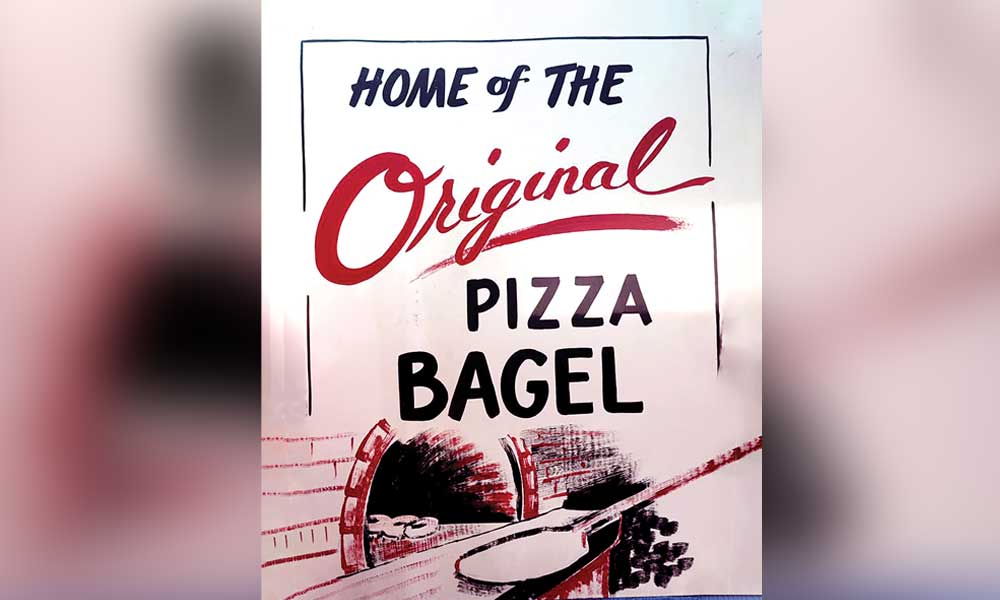
Sign at Katz Bagel Bakery in Chelsea, MA.
There are whispers that the first pizza bagel was invented even earlier, by Anthony DeMauro, at the now defunct Amster’s Bagel Bakery in the Cleveland suburb of South Euclid, OH. DeMauro claimed to have come up with the pizza bagel all the way back in 1957 and even registered “Amster Pizza Bagel, Inc.” with the U.S. Copyright Office in 1970.
But the dispute goes even further, with various Miami-area establishments making competing claims over the invention of the pizza bagel (or “bagelizza,” as some unfortunately have called it). And even as far back as 1952, the popular department store S. Klein in New York advertised pizza bagels in their cafe (for 25 cents no less!) in the New York Daily News.
The truth, as is so often the case, is likely a tangled web of regional innovation and culinary coincidence. It’s entirely believable that the pizza bagel, like so many great American ideas, was born of multiple minds, each adding their own doughy twist.
But what really cemented the pizza bagel in the cultural zeitgeist, and in the freezer aisles of grocery stores across the country, was the Bagel Bite—a bite-sized mini-bagel with pizza sauce and cheese on top, perfect for the microwave. One of the most iconic snack foods of the 1990s and 2000s, Bagel Bites captured the hearts of a generation.
The snack was invented in 1985 by Bob Mosher and Stanley Garkzynski, two caterers from Fort Myers, FL. After seeing how popular the appetizers were in their own business, they decided to try and market them elsewhere—first to local bars and restaurants, and then nationwide. In 1987 they sold the Bagel Bites rights to John Labbat Co., who in turn sold them to the H.J. Heinz Company in 1991.
With a massive new distribution platform, the mini, saucy circles of bagel perfection were engineered for the microwave and became a staple of after-school snacking. The Bagel Bites TV jingle is a cultural artifact in its own right, a catchy earworm that burrowed its way into the collective consciousness of a generation. “Pizza in the morning, pizza in the evening, pizza at suppertime—when pizza’s on a bagel, you can eat pizza anytime!” Bagel Bites went on to be endorsed by professional skateboarder Tony Hawk, and they were an official sponsor of the 2000 Winter X Games, cementing their place in the pantheon of extreme sports snacks. Later, the popular NBC comedy Brooklyn Nine-Nine tapped into the nostalgia for the snack in a 2016 episode where Detective Jake Peralta (played by Andy Samberg) is confronted over his decision to eat pizza for breakfast, and shouts “When pizza’s on a bagel, you can eat pizza anytime!”
Beyond the Bagel Bite, the pizza bagel offers a glimpse into the evolving landscape of American Jewish identity. When the bagel, a staple of Ashkenazi cuisine, meets the pizza, a symbol of Italian-American influence, the fusion reflects a broader story. “Bagels are a perfect food to look at in order to parallel Jewish integration into America, because they started as a specialty Jewish bread, then gained awareness beyond the Jewish community and then, with modernization and industrialization, they took over America,” says Joel Haber, a writer, researcher and lecturer on Jewish food history. “Frankly,” he adds, “they took over the world.” Putting the bagel and the pizza together, he says, “expresses the integration of Jews and of Italians into American society, because their foods both had become known outside of their closed communities.”
And while pizza bagel aficionados have a firm idea of what makes a pizza bagel, they can also voice strong opinions about what doesn’t cut it. In a 1997 episode of Seinfeld, for example, Jerry and his date are talked into taking Kramer’s Peterman Reality Bus Tour, on which they and their fellow tourists are served subpar snacks.
His date scrutinizes her bagel and winces: “You know, when you make a pizza bagel, you really shouldn’t use cinnamon raisin.”
“You also shouldn’t use a donut,” Jerry deadpans, holding up a glazed topped with sauce.
The pizza bagel’s significance even transcends the mere culinary. For instance, it’s come to be an expression to describe people of mixed Jewish and Italian descent. Sarah Bunin Benor, a professor of linguistics and contemporary Jewish studies at Hebrew Union College, cites the use of “Jalapeño Bagel” to describe people of mixed Jewish and Hispanic descent as a corollary: “Both highlight that bagels are still seen, in some circles, as a symbol of Jewishness and that pizza and jalapeños are seen as symbols of Italian and Hispanic people.” While some may find that analogy offensive, she notes that others embrace it “to refer to themselves and/or their friends and relatives.”
So, whether the context is culinary or cultural, the pizza bagel, like so much of American life, is a delightful contradiction.

One thought on “Talk of the Table | The Pizza Bagel”
I never heard of it, never ate it and I was actually working at Kleins in 1952. Guess I missed out …..
However, I am sure it was not invented by a Jewish person… Foods with a long cultural history within a group are usually sacrosant — for example , No Jewish person i knew would ever put peanut butter and jelly on a bagel. It was meant to be eaten with cream cheese and lox….salty, not sweet. And if you think about it, few Italians really appreciate pineapple on their pizzas. Once again — sweet items don’t belong on this traditional dish. So most such changes come from the outside… My brother-in-law , who came from Alabama, had never seen sour cream until he married my husband’s sister. We were eating together one evening and my In-laws served sour cream. He love d it and put it on everything — including ice cream– (it is not a bad idea because it cuts the sweetness) . He spent a lot of time trying to find sour cream in Texas — where he and his wife lived. This was 1950 — and sour cream was only available, as far as we could tell, in New York Chicago, LA ,and parts of Florida…. And so it goes. I really have a hard time imagining Kleins selling pizza bagels. I worked there inl949 and l950 and never heard about it. Nor do I recall Kleins having a cafe….. — there was an Automat next door and that is where we all ate.
Today there are far fewer boundaries around traditional foods and we are used to to making matcha icec ream, putting soy sauce on everything, and eating eggplant in sweet amd sour sauce…..We live in a whole new globalized world where almost anything goes….