
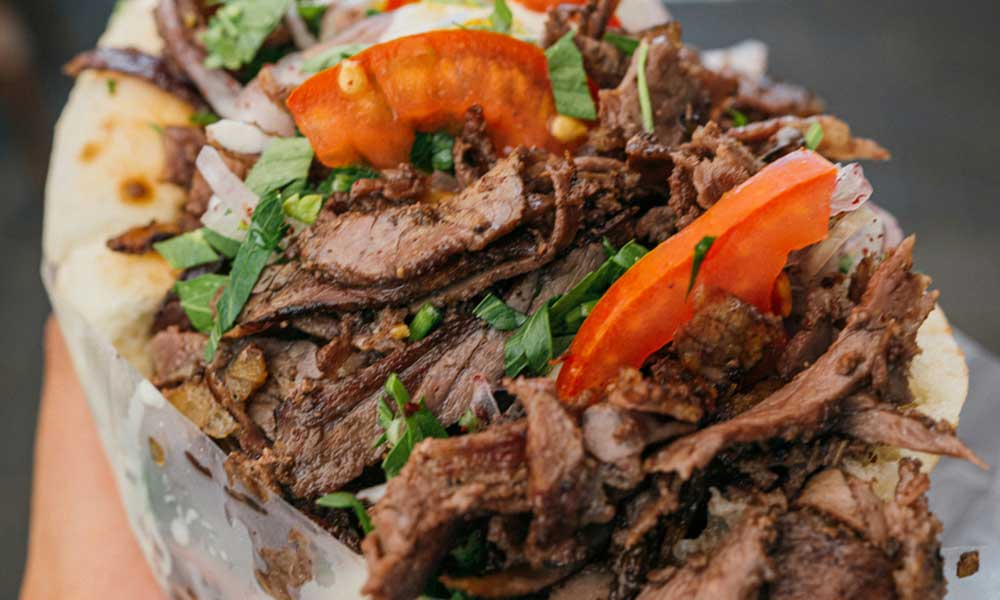
Ah, shawarma! What is it about a rotating tower of turkey (or lamb or chicken) that grips the imagination and taste buds? “The name alone makes our mouths water,” Michael Solomonov and Steven Cook wrote in their lavishly illustrated 2018 cookbook Israeli Soul.
In Israel, shawarma is the street food of choice. Searching for the best of the best is a foodie’s obsession. For Israeli-born shawarma spice producer Ron Arazi of Brooklyn, NY, a shawarma run is among the first things he does upon landing back in Israel. But the truth is you don’t have to leave the United States to get acceptable (even fantastic) shawarma. Outlets have mushroomed in the past decade or so in New York and elsewhere.
For the uninitiated, shawarma is all about the rotating vertical rotisserie of meat. Tender pieces are shaved off, sometimes with a specially made trimmer, and put into a pita pocket or thicker laffa flatbread. Then the true alchemy begins. The consumer picks from an array of vegetables and sauces as toppings, a mix-and-match that puts a near-unique imprint on each order.


It is important to say up front that even though love of shawarma is virtually the 11th Commandment in Israel, shawarma is not strictly an Israeli product. It is, in fact, a classic case of culinary colonialism in which a food technique is developed over time and then exported or refashioned as borders shift and populations move from place to place. Tea time in Britain wouldn’t exist without centuries of the colonial Raj in India. And what about how the Americanized frankfurter and hamburger owe their names to German cities?
In the case of shawarma, the name comes from the Turkish word çevirme (che-VEER-meh), which means “turning” or “rotating.” Starting in 1516, the Ottoman Empire ruled what is now Israel, as well as the neighboring Arab states and Palestinian regions. (Their dominion ended in 1918, after Turkey, an ally of Germany, was defeated in World War I and Britain declared its mandate.) Çevirme became “shawarma” in Arabic. In the early 20th century, the Turks themselves gravitated to what ultimately became “döner kebab.” (“Döner” is another term for “turning” or “rotating.”)
The technological innovation underlying modern-day shawarma was the invention of the vertical rotisserie (an improvement on the hand-turned horizontal rotisserie). Historians give credit mostly to an enterprising young Turkish cook, Iskender Efendi (literally “Sir Alexander”), who developed it circa 1860 at his family’s restaurant in the Turkish city of Bursa. His vertical rotisserie allowed fat to drip down and tenderize the meat while the outer edge stayed crusty.
Thus was born modern-day shawarma. While döner kebab is minimally spiced, no such inhibitions guide the spicing of shawarma. Brooklyn-based spicemaker New York Shuk (shuk in Hebrew means “market”), founded by Arazi and his Israeli-born wife Leetal, offers an inventory of 18 hard-to-find Middle Eastern spices and condiments. Among them is a one-stop shawarma spice blend.
The karma of shawarma, according to Arazi, is “the magic of the sandwich.” Good shawarma requires a symphony orchestra of intricate food harmony, with pita, meat, cabbage, onions, mango amba sauce, tahini, pickles and hot-spice red harissa all playing in unison. Home cooks who lack a vertical rotisserie can still make authentic-tasting shawarma by using the appropriate spices, Arazi says. (Full disclosure: I made Arazi’s chicken shawarma recipe and it was close to the rotisserie ideal!) For vegetarians, there’s even cauliflower shawarma.
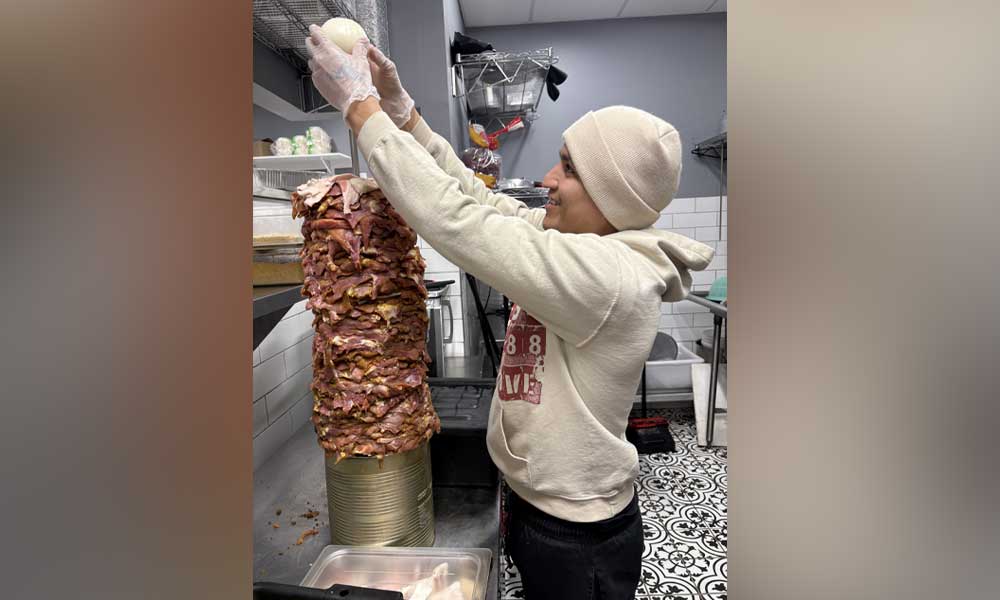
A degree of complex structural engineering is, however, needed to successfully spin a three-to-four-foot shawarma rotisserie tower. At Oh Mama Grill in Rockville, MD, construction begins a few hours before lunchtime. Slabs of marinated turkey breast are wrapped around the rotating pole or punctured through on top. Pieces are lowered downward and the mass is shaved on the side for a uniform look. Slabs of lamb fat are placed between thick turkey slices for moist flavor. It is then topped with an onion, hoisted and placed on the gas-fired vertical rotisserie.
The alchemy begins when the rotation yields an evenly done mass of meat. As the outer edges are sliced off for customers, the inner core gets done and stays moist. (A word of advice: If the counter shawarma slicer insists on giving you pre-cut pieces and refuses to trim pieces right off the tower slab, you should walk out! The exception is if your shawarma place is very busy, and there’s a short slab-to-sandwich turnaround.) Turkey is the shawarma meat of choice in Israel because it is popular, plentiful and relatively cheap.
Inevitably, and especially in the post-October 7 era, questions have intensified around authenticity, origin and appropriation. Shawarma is “definitely not Israeli,” said Micheline Maalouf, an Arab-American therapist and online personality. In posts on Instagram and TikTok, Maalouf contends that with the creation of Israel, “Arab culture was stolen…And shawarma was rebranded as Israeli even though it was taken from displaced Palestinians.”
Jewish Israeli proprietors of shawarma outlets mostly shrug. “There’s always a fight over who this food belongs to,” says Riki Alkoby, who owns Oh Mama Grill. Nevertheless, she says, “Jews who came to Israel from all over brought along their own food traditions.”
Alkoby was born in Israel, but her Jewish heritage is rooted in Tunisia and Morocco. Growing Sephardic and Mizrahi populations embraced shawarma long before anyone thought to identify it as Israeli.
Spice merchant Arazi’s father came to Israel from Lebanon; his mother from Morocco. “In all those countries, you can find shawarma in one form or another,” Arazi says. “So what are you going to say? Because you’re Jewish and you brought it from your homeland, it’s not yours?”
CHICKEN SHAWARMA
This recipe from Ron Arazi, co-owner of NY Shuk in Brooklyn, gives you a flavorful and authentic chicken shawarma without the rotisserie tower. Ron’s recipe calls for his own excellent proprietary shawarma spice blend (check www.nyshuk.com). But for Moment, he has kindly reconfigured it with individual spice measurements.
INGREDIENTS
1 1/2 pounds boneless, skinless chicken thighs
– (about 4 thighs)
6 tablespoons neutral oil
1 tablespoon coriander seeds
– (or ground coriander)
1 teaspoon ground cumin
1/2 teaspoon paprika
1/2 teaspoon turmeric
1 teaspoon salt, or to taste
1 large yellow onion, peeled
INSTRUCTIONS
1. Cut the chicken thighs into small pieces. Place the chicken in a large bowl, add 3 tablespoons of the oil and season with 1/2 teaspoon of the salt. Add the spices. Toss to coat evenly. Set aside.
2. Cut the onion in half lengthwise, then crosswise into thin half-moons. Place the onions in a large sauté pan and cook over medium-high heat without stirring until they start to brown, about 1 minute. Stir the onions so that more of them are exposed to the heat of the pan and cook without stirring to promote more browning, about 1 minute. Add the remaining 3 tablespoons oil and season with the remaining 1/2 teaspoon salt, or to taste. Continue to cook, stirring occasionally, until the onions are caramelized but still slightly firm. Transfer the onions to a bowl; set aside.
3. If needed, wipe out the pan with a kitchen towel to remove any bits of onion. Set the pan over medium-high heat and add the chicken in a single layer. Sear the chicken without stirring for about 1 minute, then stir and continue cooking until the chicken is just cooked through. Add the caramelized onions and stir to combine. Taste and adjust the seasoning with salt.
4. Transfer the chicken to a platter.
Serve with favorite toppings—among them: pickles, red cabbage, red (spicy) harissa sauce, tahini. Place inside fresh pita bread.
Moment Magazine participates in the Amazon Associates program and earns money from qualifying purchases.