
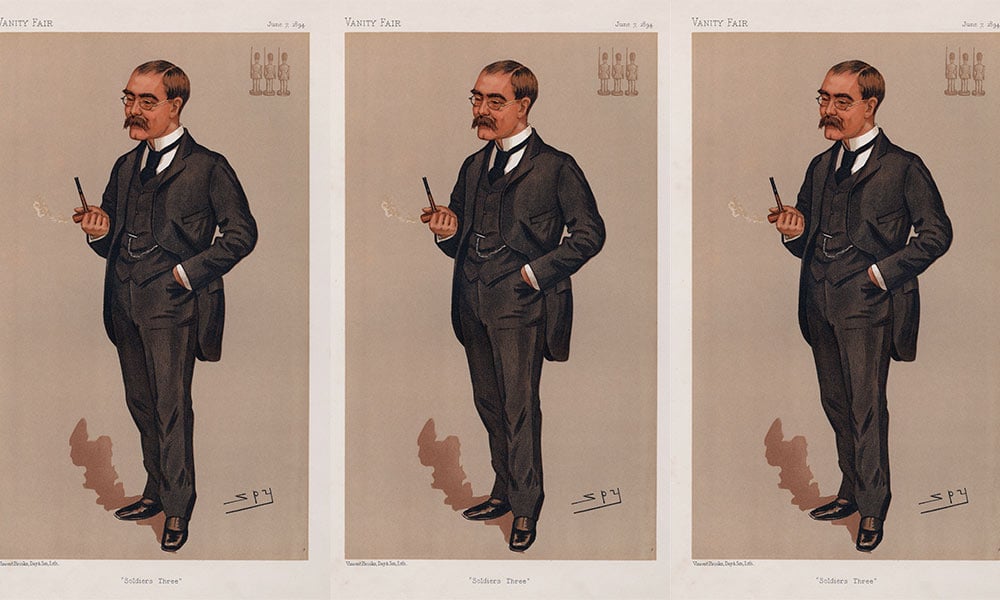
English literature has long carried within it a troubling current of antisemitism, going back to medieval times. Centuries before the sinister Fagin in Dickens’s Oliver Twist, there was Shakespeare’s Shylock in The Merchant of Venice, and centuries before that, Chaucer’s “The Prioress’s Tale” in The Canterbury Tales.
This troubling literary history often omits one author who has been criticized and sometimes canceled for other reasons: Rudyard Kipling. Kipling (1865-1936) built his reputation through evocations of imperial confidence and justifications of the British Empire. But he also lent his literary efforts to the othering of Jews. He wrote during an era that codified racial hierarchies and treated Jews, though formally emancipated, as suspect outsiders.
Kipling was born in Bombay to British parents, spent part of his childhood in England, returned to India as a journalist and eventually had homes in London, Vermont and Sussex as his literary fame grew. His children’s stories such as The Jungle Book, imperial ballads, and short stories of Anglo-Indian life constructed a world in which British rule appeared natural and righteous.
Kipling’s best-known and perhaps most-criticized poem, “The White Man’s Burden” (1899), urged the United States to imitate British imperialism and to assume colonial rule in the Philippines. Its first stanza reads:
Take up the White Man’s burden—
Send forth the best ye breed—
Go bind your sons to exile
To serve your captives’ need;
To wait in heavy harness
On fluttered folk and wild—
Your new-caught sullen peoples,
Half devil and half child.
“Half devil and half child,” indeed.
Or, for a taste of Kipling’s romanticization of the East, which he combined with the messy tasks of empire, consider “The Road to Mandalay” (1890). The poem makes a guest appearance in the Netflix series The Crown (Season 3, Episode 5), in which Lord Mountbatten, contemplating a coup that would restore the empire to its former greatness, recites the poem from memory to a group of supporters.
In the poem, a British soldier waxes nostalgic about his time in Burma, where “the dawn comes up like thunder outer China ‘crost the Bay.” He imagines the lover he left behind and the “temple-bells” calling, “Come you back, you British soldier; come you back to Mandalay!”
Kipling lived in a culture not unlike our own—one that distrusts cosmopolitan financiers and immigrant masses—and he inserted those anxieties into his verse.
Many critics have noted that Kipling loved the idea of imperial hierarchy but was nervous about the future of that hierarchy. The British Empire was already weakening; its subject peoples were uneasy. He feared that those he thought of as barbarians stood perpetually at the gate. That anxiety spilled over into his perceptions of Jews, whom he viewed as cunning outsiders whom Britain could never fully assimilate. This perception doesn’t appear much in his published works. But it emerges in a poem that was never published, “The Burden of Jerusalem,” which he wrote shortly before his death in 1936.
Unlike “The White Man’s Burden,” which provoked debate and even parody upon publication, “The Burden of Jerusalem” never saw print, either during Kipling’s lifetime or after his death. His widow, acting as his literary executor, made sure of that.
But Sir Alfred Webb-Johnson, the surgeon who had attended Kipling in his final illness, received a copy from Mrs. Kipling herself. Years later, in 1943, he gave it to Winston Churchill—a gift marking Churchill’s election as an honorary fellow of the Royal College of Surgeons, which Webb-Johnson led. Churchill urged Webb-Johnson to send it along to Franklin Roosevelt as well. In the letter that accompanied the gift, Webb-Johnson wrote: “I understand that Mrs. Kipling decided not to publish them in case they should lead to controversy, and it is therefore important that their existence should not become known and that there should be no public reference to this gift.”
Why would this poem have caused controversy? Most likely because its particular brand of antisemitism—what has sometimes been called genteel antisemitism—crossed a line. And that, in turn, tells us something interesting about British antisemitism. The poem portrays Jews as unloved, predatory and eternally brooding over Jerusalem. It dismisses Muslims as robbers and depicts Ishmael’s descendants as usurpers. Unlike Kipling’s other “Orientalist” works, this poem struck too directly for public consumption at the raw nerve of racial and religious hatred, even for the early 20th century.
As a result, while readers knew and debated “The White Man’s Burden,” “The Burden of Jerusalem” remained largely invisible, confined to private correspondence and archival shadows.
It’s worth looking at the text in full:
In ancient days and deserts wild
There rose a feud—still unsubdued—
Twixt Sarah’s son and Hagar’s child
That centred round Jerusalem
(While underneath the timeless boughs
Of Mamre’s oak ’mid stranger-folk
The Patriarch slumbered and his spouse
Nor dreamed about Jerusalem.)
But Ishmael lived where he was born,
And pastured there in tents of hair
Among the Camel and the Thorn—
Beersheba, South Jerusalem
But Israel sought employ and food
At Pharoah’s knees, till Rameses
Dismissed his plaguey multitude,
With curses, toward Jerusalem.
Across the wilderness they came
And launched their horde o’er Jordan’s ford,
And blazed the road by sack and flame
To Jebusite Jerusalem.
Then Kings and Judges ruled the land,
And did not well by Israel,
Till Babylonia took a hand
And drove them from Jerusalem.
And Cyrus sent them back anew,
To carry on as they had done,
Till angry Titus overthrew
The fabric of Jerusalem.
Then they were scattered North and West,
While each Crusade more certain made
That Hagar’s vengeful son possessed
Mohammedan Jerusalem.
Where Ishmael held his desert state
And framed a creed to serve his need—
“Allah-hu-Akbar! God is Great!”
He preached it in Jerusalem.
And every realm they wandered through
Rose, far or near, in hate and fear,
And robbed and tortured, chased and slew,
The outcasts of Jerusalem.
So ran their doom—half seer, half slave—
And ages passed, and at the last
They stood beside each tyrant’s grave,
And whispered of Jerusalem.
We do not know what God attends
The Unloved Race in every place
Where they amass their dividends
From Riga to Jerusalem.
But all the course of Time makes clear
To everyone (except the Hun)
It does not pay to interfere
With Cohen from Jerusalem.
For ’neath the Rabbi’s curls and fur
(Or scents and rings of movie-kings)
The aloof, unleavened blood of Ur,
Broods steadfast on Jerusalem.
Where Ishmael bides in his own place—
A robber bold, as was foretold,
To stand before his brother’s face—
The wolf without Jerusalem.
And burdened Gentile o’er the main,
Must bear the weight of Israel’s hate
Because he is not brought again
In triumph to Jerusalem.
Yet he who bred the unending strife,
And was not brave enough to save
The Bondsmaid from the furious wife,
He wrought thy woe, Jerusalem.
The poem is singsong, almost a childlike doggerel. From the start, Kipling casts Jerusalem as the epicenter of eternal strife.
He traces that strife to Abraham’s divided household—the rivalry between Isaac (“Sarah’s son”) and Ishmael (“Hagar’s child”). Isaac becomes the ancestor of the Jews, Ishmael the ancestor of the Arabs. Kipling imagines that even then a feud smoldered over control of Jerusalem, though the city would not exist until centuries after the events described in Genesis.
The poem then marches through Jewish history. When Kipling describes the Exodus, he resurrects one of the earliest antisemitic myths, first articulated by the third-century BCE Egyptian priest Manetho, which claimed that Egyptians expelled Jews because they were lepers. Kipling moves through the conquest of Canaan, Babylonian exile, return under Cyrus, Roman destruction, dispersion across Europe, Crusades, persecution, and survival in the diaspora. He portrays Jews as both victims and provocateurs—eternal aliens, perpetually hated, stubbornly persistent. He even mangles history: When Ishmael, whom Kipling uses as a symbol of Muhammad, “preached his creed,” he did not do so in Jerusalem.
The language bristles with contempt. Kipling labels Jews a money-grubbing “Unloved Race” (racial thinking about Jews being in its heyday) who “amass their dividends/From Riga to Jerusalem.” His contempt is theological: “We do not know what God attends the Unloved Race…” He describes their blood as “aloof” and “unleavened,” a sarcastic allusion to matzah and a marker of alienness. Jews persist, in his telling, not through faith or learning but through obsessive brooding that stretches back to Ur, Abraham’s birthplace. Jewish resilience becomes both threat and provocation: “It does not pay to interfere / With Cohen from Jerusalem.”
Kipling’s poem, and its antisemitic attitudes, did not arise in a vacuum. Neither was “The Burden of Jerusalem” his first foray into Jewish themes. There was also the far more sympathetic “Jews in Shushan,” published in his collection Life’s Handicap (1891). It tells the story of Efraim, a despised debt collector and shochet (ritual slaughterer) in a small community in northern India. He longs for a community in which there would be enough Jews for communal worship.
“There be eight of us in Shushan, and we are waiting till there are ten. Then we shall apply for a synagogue, and get leave from Calcutta. To-day we have no synagogue; and I, only I, am Priest and Butcher to our people. I am of the tribe of Judah—I think, but I am not sure. My father was of the tribe of Judah, and we wish much to get our synagogue. I shall be a priest of that synagogue.”
Alas, plague hits, and most of the Jews are killed.
Kipling was a product of Victorian and Edwardian England. Yes, Jews had achieved civil emancipation. Figures such as Benjamin Disraeli rose to prominence, serving as prime minister of Great Britain, though his father had converted him to Protestantism when he was 13.
And yet, such civic advances could not erase the antisemitism that remained deeply embedded in English culture. Popular caricatures portrayed the Rothschilds as sinister financial manipulators, a trope that persists today.
The English elite and working classes alike feared Jewish immigrants from Eastern Europe as alien intruders. A polite, “genteel” antisemitism became socially acceptable—what the scholar and lawyer Anthony Julius has described as “an antisemitism of rebuff and of insult, not of expulsion and murder,” an antisemitism of the remark.
Kipling lived in a culture not unlike our own—one that distrusts cosmopolitan financiers (i.e., “globalists”) and immigrant masses—and he inserted those anxieties into his verse. His Jew appears as both usurer and eternal alien, forever brooding over Jerusalem. In this, Kipling followed Chaucer, Shakespeare and Dickens, updating antisemitism for an imperial age that measured peoples by their fitness for sovereignty and “civilization.”


Was Kipling antisemitic? It does not matter; he used antisemitic ideas and themes in his literary offerings—which is precisely where Julius locates much of English antisemitism. As Julius shows, English literature repeatedly casts the Jew as the other. “The Burden of Jerusalem” fits squarely within that tradition. His mastery of rhythm and myth-making could amplify the power of both an ode to empire and an ancient hatred.
Why talk about Rudyard Kipling now? Why revisit a poem that he swept under the rug?
Because Kipling was creating an argument against Jewish sovereignty that is alive and well today. Kipling’s accusations—that Jews remain unloved wherever they dwell, that they secretly plot and profit, that they obsess over Jerusalem—resurface constantly in contemporary antisemitic and anti-Zionist discourse—both on the right and on the left.
These tropes sit at the heart of today’s debates over Israel and Jewish power. Consider the claim that Jews care only about money and control. Or that Israel constitutes the root of global unrest. Or that Jews, whether dispersed or sovereign, remain an eternal problem—unassimilable and unredeemable. Kipling anticipated them all.
When Kipling wrote this poem, the conflict between Arabs and Jews in Palestine was heating up. The infamous 1929 pogrom in Hebron had happened only a few years earlier; the Jaffa riots, which claimed the lives of 14 Jews and two Arabs, were to follow in 1936. Kipling locates the source of modern hostility not in British duplicity, colonial policy or even Zionism, but in the Jewish origin story itself. He traces everything back to Genesis, when Sarah, with Abraham’s acquiescence, drives Hagar and Ishmael into the wilderness to near-certain death, until an angel intervenes.
From that primal rupture, Kipling derives all subsequent conflict. When Arabs violently responded to Jewish presence in the Land, he implies, they were merely channeling what must have been the repressed, generational anger of Ishmael—what scientists would later label as “epigenetic.” Call it the primal wound of Jewish history.
In the 20th century, such ideas fueled catastrophe. Today they reappear under the banner of anti-Zionism, recycling medieval anti-Jewish themes in modern language. The obsessive focus on Israel as uniquely illegitimate, the revival of blood libels through accusations that Israel deliberately murders children, the targeting of Diaspora Jews as agents of a foreign power—all recycle old hatreds in new forms.
Kipling wrote of “the burden of Jerusalem.” What, then, defines the burden of the contemporary Jew?
First, we must recognize that Jew-hatred does not always come in the form of violence or shrill, vulgar statements—either online or in person. Sometimes, the Jew-hatred is suave, sophisticated and buried in the subtleties of literature. That is how it often played out in English history, as well as in upper-class antisemitism in America. Kipling was a literary genius, but his genius coexisted with contempt for Jews and others. He was not alone. Writers such as F. Scott Fitzgerald and Roald Dahl belong to that same grim circle.
Second, literary and cultural antisemitism is neither quaint nor incidental. As the scholar David Nirenberg showed in a groundbreaking 2013 book, anti-Judaism is baked into Western culture. It functions as a default setting of European civilization—for both the masses and the elites.
Finally, the Jewish burden is to stand—to stand for an unedited Jewish identity; to stand for Judaism in all its expressions; to stand out even when doing so proves inconvenient or countercultural; and to stand with allies who recognize the persistence of this hatred.
When accusations against Jews or Israel echo Kipling’s beliefs—that Jews remain universally hated, obsessed with Jerusalem, i.e. Israel and Zionism, brooding and unassimilable (the last being a charge that both right and left have in common)—Jews must name those accusations for what they are: the latest mutation of an ancient disease, a virus that resurfaces whenever the body politic weakens, the familiar horror-movie trope of the monster presumed dead whose hand emerges from the grave during the final credits.
Rabbi Jeffrey K. Salkin is a contributing editor to Religion News Service, author of the award-winning column “Martini Judaism: for those who want to be shaken and stirred,” and the author of 12 books.
5 thoughts on “Rudyard Kipling’s Burden—and Ours”
As a Jew who grew up in England before coming to the US in my twenties, I can attest to the antisemitism of rebuff and of insult. There are, however, two categories of rejection of Israel – for what it is, usually from the Right, and what it does, more associated with the Left. Let us not confuse the two and let us work to improve the latter.
Excellent review. My favorite poem by Kipling was If. I never would have realized this aspect of of the poet .
It is remarkable how much history repeats itself.
Excellent article bringing to the fore an unpublished poem and the real sentiment politely covered in British society: ani- Judaism !
Rudyard Kipling’s attitude toward Jewish people was complex, rooted in late Victorian and Edwardian imperialism, racial thinking, and imperial nationalism. While he occasionally portrayed individual Jewish figures with nuance or respect—such as the devout shochet in his short story Jews in Shushan (1888) or the Jewish mason in The Mother Lodge (1894)—his broader worldview was infused with the “genteel” and systemic anti-Semitism characteristic of the British ruling class of his era.
I had no idea..I have not thought about ” genteel anti-Semitism.