
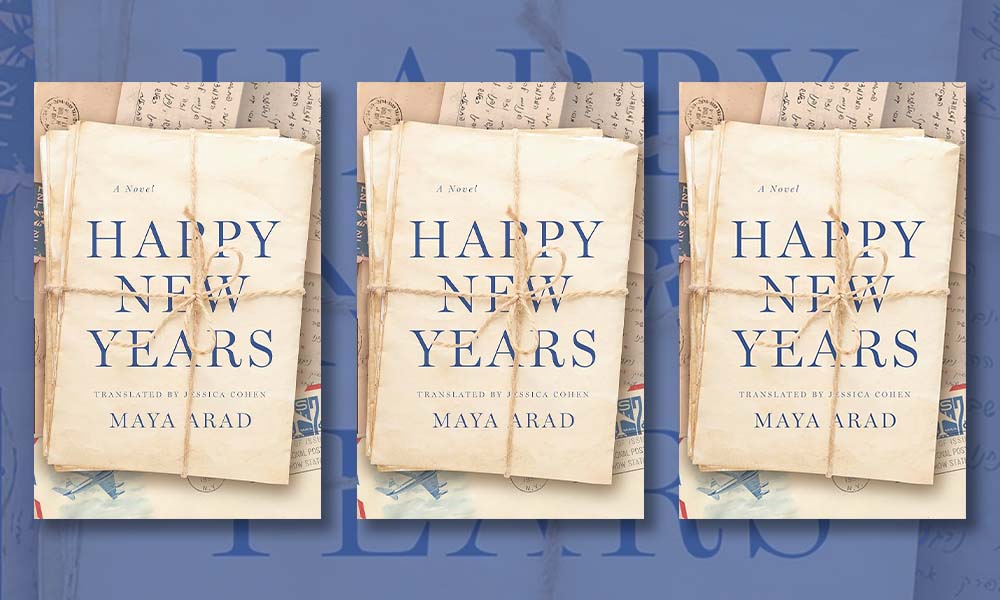
Happy New Years
By Maya Arad
Translated from the Hebrew by Jessica Cohen
New Vessel Press, 360 pp.
After making a splash last year with The Hebrew Teacher, the first of her works of fiction to be translated into English, the Israeli writer Maya Arad has now created an unusual epistolary novel in which the main character, the Israeli-born Leah, writes one letter per year from America during the Rosh Hashanah holiday period to a group of women who were her classmates in Israel. This structure allows the reader to follow Leah’s reflections on her year ahead and the year behind, but more broadly to understand the scope and themes of her life.
Who is Leah? An expat Israeli who found herself in America almost by chance? Or a symbolic character, a stand-in for the universal (heterosexual) woman who searches for a man’s love, or at least for a man who can pay the bills? A woman of unbounded optimism and drive from the time she leaves Israel to the time her life ends in the United States? A diligent worker in a wide variety of jobs? A doting grandmother and loyal letter-writer for 50 years? A woman stuck in memories of her first love affairs in Israel? The letters contain glimpses of all these identities.
Leah comes to America in 1966 when, at the behest of her Israeli Teachers’ College instructor, she goes off to be a Hebrew school teacher in the United States. On the flight she flirts her way into a friendship with a man named Tsvika, just one of many relationships with men that will ultimately disappoint her. When she arrives in the United States, the principal of the school at which she expects to teach says they were not expecting her and there is no job. “I was on the verge of tears,” she writes in an early letter, “but just then a young woman walked into the office—I could tell straight away that she was Israeli—and I told her what had happened. Ruthie (that’s her name) heard my story and told me not to worry, that I could stay with her in the meantime.” This type of coincidence happens to Leah continuously no matter where she lives, starting in Worcester, MA, and ending in California. Over and over, she’s in a jam, and something happens to give her a way out.
At the end of the book, Leah’s final letter to her college friends asks the question many readers will have been thinking: “Why am I even writing all this? Why did I write for five decades, year after year? So [you] wouldn’t forget me? So I wouldn’t disappear in America as if I never existed? So I wouldn’t be wiped off the face of the earth?”


Leah’s questions are profound. She left Israel with the intent of returning quickly, true of so many Israelis past and present. But one thing led to another and she stayed. Although she is a clever woman who knows how to take advantage of the opportunities America offers, ultimately, and despite all her bravado, she has been lonely in this vast country into which she, in fact, has “disappeared.” In the letters to her friends, Leah addresses this existential pain by trying to make her life as Jewish and Israeli as possible. For example, she recounts how she and her two children from her horrific first marriage spent a wonderful month at a Jewish camp in northern New York State. When she returned home, she learned she had won a prize for contributing to the Hebrew school where she’d been teaching, above and beyond what was expected: creating “a school Chanukah party with Israeli songs and jelly donuts that I made myself, a Purim show with the Book of Esther story that I organized single-handedly, and…the Hebrew library that I set up with my own two hands.” This level of energy is her hallmark.
Leah’s letters to her friends over the years after she leaves Israel are filled not only with sweet pleasantries and descriptions of her everyday life but also with conflicts and resentments. Despite longing for her friends in Israel, she also recalls the pain of being with them as students in the college where they excluded her from their friendship circles because she was “an immigrant” to Israel (from Romania) rather than a “sabra” born and raised in Israel. Her true friend from her college days (addressed in the letters as Mira or by the affectionate nickname Miraleh) responds to her letters with advice and understanding. It is difficult to know what her other friends think of Leah or her letters.
The annual Rosh Hashanah missives span 50 years, but Leah’s closing thoughts could have been written when she was in her early twenties: “I’ve had good years in America, and I believe with all my heart that I will have more. There are still surprises in store for me. I’ll get better. I’ll make it to Israel. And to Europe. And to all the places I’ve dreamed of visiting. I’ll meet more interesting people, and I’ll find the love of my life. I’ll write a book. It’s not over. No. Just like the lyrics in the song we used to sing when we were young, ‘The song is not over, it’s only just beginning.’” These sentences suggest the degree to which Leah—ultimately a positive, appealing yet simple character—was sustained by her optimism and her faith in other people, especially any potential Prince Charming. Despite her transnational relocation and her half-century of American life, she has hardly changed over the course of her lifetime.
Arad’s previous book, the prize-winning The Hebrew Teacher: Three Novellas, addressed many of the themes explored in Happy New Years—the search for home and love and the difficulty finding it—but I found her new book more satisfying. The structure of The Hebrew Teacher, with its three “short” stories, left Arad less room to explore her female protagonists deeply. Happy New Years, instead, remains focused on one immigrant and her drive to be a happy, successful woman in America while also remaining both Jewish and Israeli. Many stories are waiting to be told about Israeli women in the United States—how they build their lives, how they live transnationally and how they are truly at home in both countries and in neither.
Shulamit Reinharz is professor emerita of sociology at Brandeis University. She was the founding director of Brandeis’ Women’s Studies Research Center and the Hadassah Brandeis Institute.