
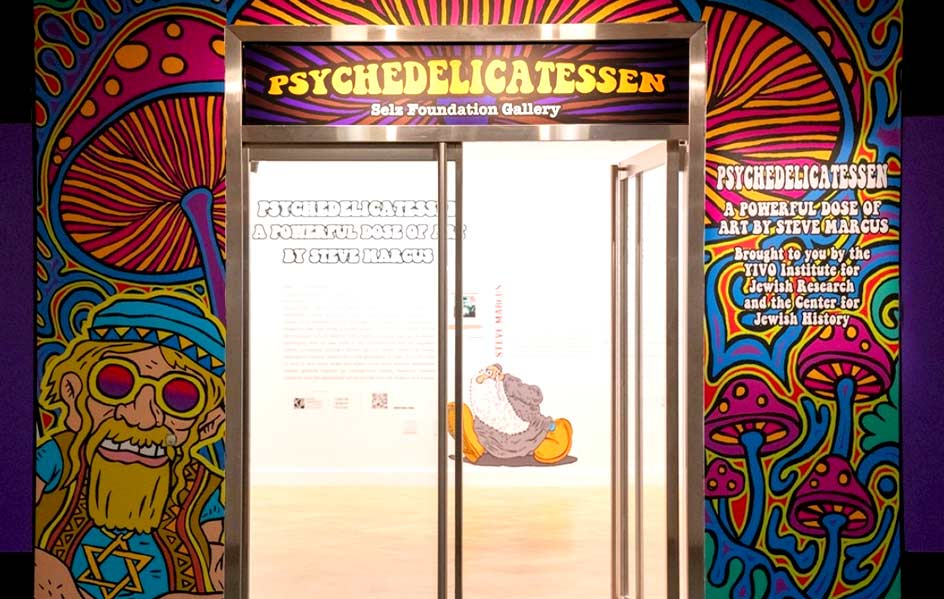
Loud and colorful artworks fill the four walls of the second-floor exhibition room at the YIVO Institute for Jewish Research in Manhattan. Filled with hypnotic visuals and Jewish humor, these limited edition fine art prints are the core of the latest exhibition from New York-based artist Steve Marcus, entitled “Psychedelicatessen: A Powerful Dose of Art.” Featuring Jewish puns like the one made for a sacred rock band, “The Grateful Reb,” and Yiddish interpretations of the underground comix movement, Marcus puts a Jewish spin on 1960s counterculture.
Marcus hasn’t always infused his art with Jewish themes. Working in the 1990s and 2000s in “both popular and unpopular culture,” Marcus made art with poet Allen Ginsberg and novelist Ken Kesey as well as for High Times magazine, the Cannabis Club, MTV and Cartoon Network. Then, in 2009, his life took an unexpected turn.
“My father died; he had a heart attack on Rosh Hashanah,” Marcus tells me, recounting his embrace of Judaism later in life. “I ended up saying Kaddish for my father three times a day, one day short of 11 months. About five and a half months into it, I ended up at this yeshiva and then started learning about what I was involved in…I’ve now been going for about 17 and a half years.”
Not wanting to leave the secular, edgy spaces he’d been working in for years, Marcus instead integrated his newfound faith into his art. “Psychedelicatessen” presents elements of Jewish life and culture through the style of psychedelic Pop Art from the 1960s. The exhibit is co-sponsored by the Center for Jewish History and runs through December at YIVO.
YIVO Institute for Jewish Research
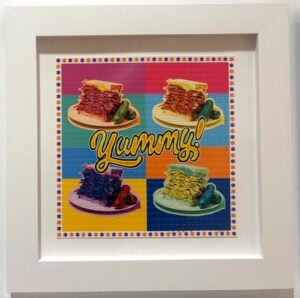
Many of the works, hand drawn by Marcus in pen and ink before being made into giclée prints to be exhibited, display products one might find in a Jewish deli, surrounded by mesmerizing lines and patterns, each filled with eye-catching saturated colors. His series Warholian Blotter Art depicts classic delicatessen finds, such as pastrami, Dr. Brown’s soda, mustard and knishes. Through both visual style and the reference to Warhol’s Campbell’s Soup Cans series, these traditional Jewish foods are reimagined as mass-consumed products of mainstream culture. His piece Flour Power, of course referencing the “Flower Power” movement of the late 1960s and early 1970s, becomes a visual Hamotzi for challah bread, while Slivovitz Rising halos the Passover-favorite spirit with thick pink and yellow sun rays in a heavenly landscape of birds, flowers and mountains. Soup of the Day transforms mushroom and barley soup from a daily special inspired by yesterday’s leftover ingredients to a mind-altering meal of psilocybin, or “magic” mushrooms. His attractive and mesmerizing depictions repackage the iconic Jewish foods as items worthy of artistic representation.
YIVO Institute for Jewish Research
“Psychedelicatessen” is more than just a way for Marcus to express his own complex identity. Marcus explained that he hopes the accessible and relatable nature of pop culture can foster a deeper connection between museumgoers and Judaism.
“When people come [to a Jewish museum], especially young people, they see tefillin, a kiddush cup, a Sefer Torah, whatever it is, and they’re already bored…When they display it like that, it makes us, the Jewish people, look like we’re extinct. So I think it’s important to bring in the history, but then you also need a contemporary voice to show a positive future.”
While the 1960s aren’t exactly contemporary, Marcus, himself a Gen Xer, feels that the aesthetic and values of that era have remained present in the cultural ether. “Psychedelicatessen” works to bring that contemporary voice to an institution that houses an estimated 24 million items in its archive. It is a reminder to YIVO attendees to celebrate the lively landscape of Jewish culture in addition to remembering its storied past.
This ethos of pop-culturizing the representation of Judaism while still respecting tradition is carried through all of Marcus’s work. Although connecting the 1960s hippie culture of psychedelic drugs with Jewish identity might risk disrespecting more conservative imaginings of the faith, Marcus is careful to keep his art kosher, as he puts it. This means adhering to the prohibitions on artistic representations laid out in Exodus 20:4 of the Bible, which states: “Thou shalt not make unto thee any graven image, or any likeness of anything that is in heaven above, or that is in the earth beneath, or that is in the water under the earth.” To respect this rule, mainly followed by Haredi Jewish communities, Marcus does not represent the moon or the sun, skull and bones, or a full three-dimensional human form.
“I like to make art that’s fun and accessible to anybody,” he says, “which means from a Satmar Hasid to somebody who’s not Jewish.”
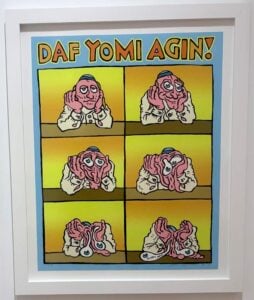
Marcus’s ambition to appeal to a wide audience is made possible through his expert ability to layer meanings without compromising the visual clarity of a work. Daf Yomi Agin, for instance, is a poster displaying six comic book-style panels that on the surface depict a man losing his composure. His head melts between his two hands onto the table, his eyes widening and drooping further away from his skull in each panel. This relatable representation of exhaustion is made more complex if one is familiar with the tradition of Daf Yomi, the practice of reading a page of the Talmud every day until completion. Only then can one understand the specific struggle that Marcus is representing. The work is then revealed to be even more layered as it is actually a recreation of a page from American artist R. Crumb’s work, Your Hytone Comix, that bears the caption “Stoned Agin!” The connection drawn between an altered state of consciousness induced by drugs and the state of consciousness brought on by following Daf Yomi is a connection that few would be able to make just by looking at the work, yet the piece remains approachable and humorous without any of this added context.
YIVO Institute for Jewish Research
“There are levels of understanding. If you ask someone to turn on the light and they flick the switch, they understand something about electricity…The light comes on. Somebody else understands that the breaker box is connected to that switch. Somebody else understands that there’s a switch in the basement that connects all the breaker boxes…Then there’s some guy who understands the metaphysics and abstraction of what electricity actually is…But the guy who flicked the switch, he also made the light turn on, just like the guy who understands the abstraction of electricity. I like to layer things in, but if you just look at the picture, and you like the picture, hey, that’s cool. That’s all I care about.”
Once again, the idea of an altered state of consciousness induced by religion is explored through a 1960s visual vocabulary in the poster P.O.T.-L.S.D.. The title humorously draws viewers in, only to reveal the small text “Put on tefillin, Let’s Start Davening” displayed over a hypnotic visual pattern. The practice of davening, the recitation of prayer, encourages mental focus to elevate one’s mind and heart toward God, and Marcus makes viewers understand this crucial aspect of the practice by connecting it to hallucinogenic drugs. The weekly Shabbat celebration is similarly elucidated and reimagined for modern audiences in Shabbos Lava Lamps. In this piece, the melting wax candles drip onto hot pink and gold lava lamps serving as candlestick holders. Lava lamps, popular in the 1970s, display colorful wax rising and falling through liquid in a meditative cycle, reminding viewers of the cycle of labor and rest that Shabbat is meant to celebrate.


Perhaps the most daring series presented in “Psychedelicatessen” is called Rabbinic Trips. These artworks arose from Marcus’s trip to Europe, where he was inspired to visit the graves of influential religious figures, a practice called kivrei tzadikim. Each piece features an image of the grave in the center, surrounded by repeating images of the face of the figure in question. Most of the works are vibrant and multicolored, and all are inked onto perforated blotter pages. Blotter paper was popular in the 1960s and 1970s as a delivery method for LSD. Marcus is careful not to equate a spiritual experience that may be induced by drugs with one that is inspired through prayer. To him, the connection felt like a fun and innovative way to commemorate the importance and meaning of his experience visiting the graves, not to mention an excellent use of the double meaning of “trip.”
“[I thought] it would be cool to be able to express the graves of these great rabbis using [the blotter paper] because, really, in the psychedelic world when they say trip, you’re going out of this world, and really when you’re praying, you’re also kind of leaving this world.”
Marcus says that he hopes “Psychedelicatessen” inspires audiences to come back to YIVO and continue engaging with Jewish art and spaces.
“I want people to have an amazing experience and to want to come back for another exhibition that’s not mine…I look at the institution, myself, the viewer and the people that work there as all in a symphony together.”