
Six Israeli/Palestinian Peace Projects Active Since October 7
Just as with the proverbial tree, the best time to work for peace in the Middle East was 25 years ago. The second best time? Today.
Despite the horrors of October 7 and Israel’s subsequent invasion of Gaza, many Israelis and Palestinians remain committed to working together and building the relationships necessary for peaceful coexistence. “It’s hard. And it takes a long time,” says Ittay Flescher, an Australia-born Jew living in Jerusalem. “But if you want peace in 20 years, you’ve got to start working on it now.”
Six peace projects aimed at creating coexistence between Israelis and Palestinians in the Holy Land
Sulha Peace Project fosters relationships between Israelis and Palestinians
Created during the Second Intifada in 2000, the Sulha Peace Project is dedicated to creating meaningful encounters and friendships between Israelis and Palestinians. The organization’s inspiration comes from a process of mediation called Sulha, which is derived from the Arabic word sulh, meaning “to make peace.” There are four main parts of sulha mediation: forgiveness, reconciliation, ritual and honor; the Sulha Peace Project meetings all contain the spirit of sulha. Their programs include tribal fires, which bring Israelis and Palestinians together for listening circles and shared prayer; the Sulhita program, which allows Israelis and Palestinians to experience a nature getaway together; and the 20-30’s program, which addresses the growing tension among younger Israelis and Palestinians by bringing both cultures together for professional training and project-based learning. Since October 7 the Sulha Peace Project has continued their work. “This is our sixth meeting since the beginning of the war and yesterday we talked about fear,” the group posted to Facebook in November.“We shared the fears we walk with and found ways to convert them into power.”
Sikkuy-Aufoq advocates for a shared society between Jews and Arab Israelis
Sikkuy-Aufoq focuses less on fostering individual relationships, and instead vies with the Israeli government for systemic changes in the disparate ways Israeli and Palestinian citizens are treated. In 2015, for example, Sikkuy-Aufoq played an important role in advocating for Resolution 922 at the Israeli Knesset, which granted Israel’s Arab communities NIS 12 billion (then about $3.1 billion USD) to improve conditions in housing and education over five years. Sikkuy-Aufoq then worked with local Arab authorities to ensure the proper allocation of funds. In 2021, under the Bennett-Lapid government as part of a coalition agreement with Raam, the Knesset followed up with Resolution 550—another five-year plan that committed NIS 30 billion (then about $8.6 billion) to improve Arab economies.
Founded in 1991, one of the organization’s main internal priorities has been maintaining an equal representation of Israelis and Palestinians within its management. Sikkuy-Aufoq has remained active since October 7—on February 14, 2024, members of the organization attended a meeting in the Knesset’s Finance Committee to oppose the Israeli government’s proposal to cut Arab society programs by 15 percent—three times the cut of other governmental programs—amid the increased funding of the Israel-Hamas War.
Women Wage Peace—A woman-led grassroots movement nominated for a Nobel Prize for its work with Palestinian sister group Women of the Sun
Women Wage Peace (WWP) was founded in 2014 following Operation Protective Edge, Israel’s 2014 action against Gaza, with the aim of promoting a political agreement between the two sides. A non-partisan group, WWP has grown to 44,000 members—mostly Israeli and Palestinian women. This group has come to particular prominence in recent months due to the killing by Hamas of one of its members, Vivian Silver, on October 7.
WWP’s first large-scale event—the March of Hope—took place in 2016; more than 3,000 women marched segments of a two-week journey from the border of Lebanon to Prime Minister Benjamin Netanyahu’s residence in Jerusalem to raise public awareness of their cry for peace.
WWP has proposed a bill to the Knesset called “Political Alternatives First” that would force the Israeli government to explore political alternatives before resorting to military conflicts. The bill has yet to be passed, but WWP has continued their fight by creating a petition called “Mothers’ Call.” The petition calls on the Israeli government to support the resolution of the conflict and to adhere to UN Resolution 1325—which urges countries to make a conscious effort to incorporate female voices into peace efforts. WWP was part of a joint-nomination—along with their sister Palestinian group Women of the Sun and EcoPeace Middle East—for a Nobel Peace Prize in early January for WWP’s continued commitment to peace following Silver’s death and the outbreak of the war. Since then, WWP’s main priority has been the return of Israeli hostages. In January, WWP and Women of the Sun met with Paris Mayor Anne Hidalgo and the French parliament—with the intent to increase international support for the release of hostages. Since the capture of hostages, WWP has had innumerable demonstrations demanding their release; on February 11, WWP posted on X: “We will continue to stand at Hostage Square, at intersections and everywhere and will demand that everything possible be done to save the hostages and to begin a political process. #BringThemAllHomeNow.”
EcoPeace Middle East—An organization focused on saving the Middle East’s environment
EcoPeace was founded in 1994, following the agreement of Egyptian, Israeli, Palestinian and Jordanian environmentalists to join forces to promote the importance of environmental cooperation. EcoPeace’s Good Water Neighbors program has introduced school curriculums to educate Israeli, Palestinian and Jordanian students about climate change. Their Water Diplomacy program has also allowed Israeli, Palestinian and Jordanian students interested in the environment to attend meetings and events together to develop a strong network of upcoming environmental activists.
EcoPeace was the driving force behind the Green Blue Deal, a report and policy recommendations that addressed water scarcity in the region. The report was instrumental at the 27th official United Nations Climate Change Conference in Egypt in November 2022. One recommendation—a proposal for Israel, Jordan and the United Arab Emirates to exchange solar power for desalinated water—resulted in a memorandum of understanding between the three parties. EcoPeace was also instrumental in swaying Israel to facilitate the resources to Gaza in order to build a sewage treatment plant in 2021; the plant’s success prompted two additional plants to be built.
Since October 7, EcoPeace has been helping to organize food and clothing packages and shower and sanitation facilities for displaced Gazans. EcoPeace’s Palestinian office has facilitated daily water trucking services to shelters and has provided hygiene kits to over 10,000 displaced Gazans. Meanwhile, the Israeli office has led the charge in advocating for additional entry points into Gaza to increase humanitarian aid for Gazans.
EcoPeace was included in the joint-nomination—with WWP and Women of the Sun in early January—for a Nobel Peace Prize for their continued environmental peacemaking efforts.
Road to Recovery—An Israeli transportation service for Palestinians in need
Road to Recovery (R2R) was founded in 2010 by Yuval Roth, whose brother was killed by Hamas in 1993. The organization provides round-trip transportation from Gaza or the West Bank to Israeli hospitals for Palestinian families with sick children. It is a complicated process, as the Palestinian Authority’s Ministry of Health has to cover the medical cost, and for cases in Gaza, Hamas needs to approve of the Palestinians’ exit. But when all goes well, volunteers pick up Palestinian families from military checkpoints along Gaza and the West Bank, and R2R provides participating children with equipment such as wheelchairs. Along with transportation, R2R arranges Fun Days—outings where participants of R2R are transported to beaches, zoos and other excursions to ease their minds from treatments.
October 7 was a brutal day for R2R as some volunteers lost their lives—including WWP founder Vivian Silver. Since Israel has banned all crossings in or out of Gaza, R2R has been forced to transport Palestinians exclusively from the West Bank. On February 12, R2R CEO Yael Noy spoke to CNN about R2R’s continued involvement in the West Bank since October 7. “The time that [Israelis and Palestinians] are together are like seeds of hope,” Noy said. “Palestinians will remember that [R2R] gave their hands even in those terrible times.”
Peace Now is dedicated to establishing a two-state solution based on the June 1967 borders
In 1978, a letter cosigned by 348 IDF soldiers and reservists called on Prime Minister Menachem Begin to promote Palestinian settlements beyond the Green Line. The support that the letter received from some Israelis quickly led to the creation of Peace Now, one of Israel’s longest-standing peace organizations. In 1982, Peace Now carried out a 400,000-person demonstration—the largest in Israel’s history at the time—to protest Israel’s involvement in the Sabra and Shatila massacre, a mass killing of Palestinian refugees in Beirut. Since the failure of the Oslo Accords, Peace Now has created an interactive settlement watch program that allows users to track the advancement of Israeli settlements in the West Bank. On February 15 of this year, Peace Now continued their efforts against Israeli land expansion by releasing a comprehensive report called “A Good Year for Settlements; a Bad Year for Israel: Summary of Settlement Activity in 2023.”
This article is part of a package of stories highlighting projects committed to building a lasting peace between Israelis and Palestinians since October 7. Other stories in this package include:
From the Editor’s Desk: A Podcast for Those in Search of Nuance
Podcasts for Peace: Six Shows That Feature Nuanced Conversations about Israel/Palestine
From 2005 | Breaking the Barrier: A Look at All Peace Radio
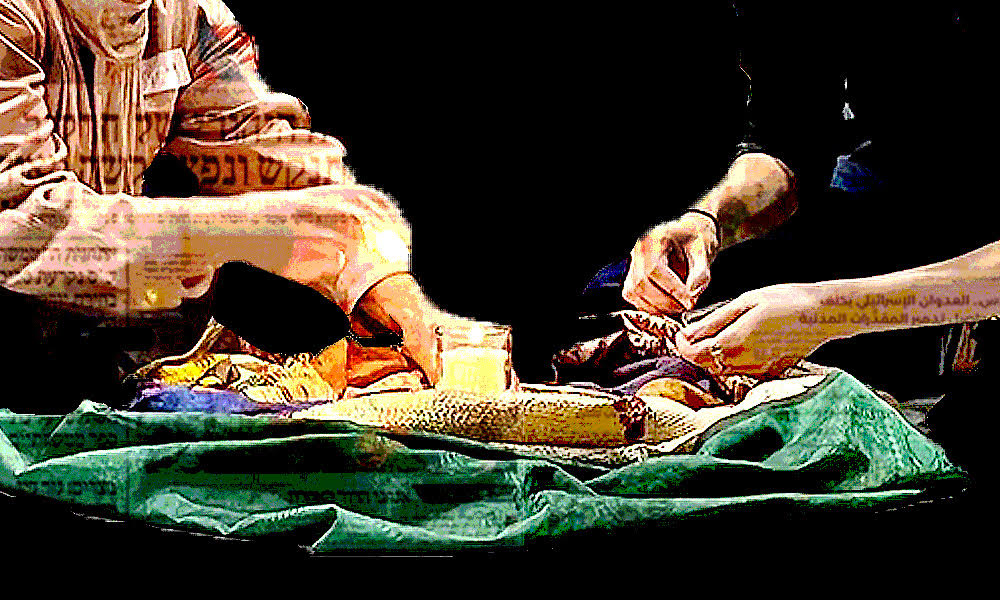
Top image: A collage, using a photo from Sulha Peace Project’s Facebook page.