
As fate would have it, the barriers to U.S. immigration that existed for Pati Jinich’s grandparents, fleeing the horrors of pogroms and later the Holocaust, would shape her family story as a Mexican one.
“They built a wonderful life in Mexico,” she says, recalling both her father’s Polish parents, denied entry to the United States due to early 1900s immigration quotas, and, on her mother’s side, her Austrian grandmother and Czech grandfather who escaped the Nazis two decades later and were likewise unable to seek asylum further north. Instead they each came through Veracruz. “The state that opens its mouth to the Gulf of Mexico,” says Jinich (pronounced “yee-nitch”), adding wryly, “I know people call it a different name now, but Mexicans insist on calling it the Gulf of Mexico.” They would all eventually settle in Mexico City, which to this day has the largest concentration of Jews in the country, estimated to be between 40 and 50 thousand. It’s where both Jinich’s parents were born, and where they raised her and her three sisters.
“They came from very humble origins, from tiny shtetls,” she says of her paternal grandparents. In Mexico her grandfather and his brother sold furniture, then turned to shirt-making. “The first brand they made was called Negev shirts,” she notes. Her maternal grandparents had met just once back in Europe, at a mineral bath popular with young people. Nazi fascism was on the rise, and in a spirit of youth they joked that “if anything went wrong, they’d meet in Mexico.” Serendipitously, they did and soon married, finding success as metalsmiths. Her great-aunt survived Auschwitz and joined them, later opening an Austrian bakery in Acapulco.


Jinich recalls her Polish grandmother making “delicious, super-typical Yiddish Ashkenazi food” that, with time, became enriched with Mexican flavors and sauces. Her maternal grandmother made more sophisticated Austrian dishes, which likewise benefited from Mexican spices and chiles and from different varieties of meat and produce. One of the recipes passed down to Jinich is Gefilte Fish a la Veracruzana.
“Instead of just being white and eaten with chrain [horseradish], the fish patties are cooked in a rich tomato sauce with pickled chiles and capers and olives,” she says. And instead of the Eastern European tradition of using carp or pike, which Jinich notes have an intense taste, “in Mexico, they use red snapper, which is warm and almost sweet. It’s an example of how, as Jews emigrate to different places and grow roots, our foods change.”
“Food makes us open up something we wouldn’t open otherwise, just like with poetry or music.”
Jinich is effusive about how much she learned from her forebears about crossing borders and blending cultures. Her family wasn’t kosher or particularly active in the Jewish community in Mexico City, but they regularly observed Shabbat and the High Holidays with her Polish grandparents at their home. Mexican culture is, of course, deeply rooted in the Catholic church, with indigenous traditions mixed in, and so she was also celebrating the Day of the Dead and going to Christmas parties and posadas (festive reenactments of Mary and Joseph’s search for lodging on the eve of Jesus’s birth). “It’s this mestizaje, this mix of cultures and religions,” she notes. “Whether you’re a Catholic or a Muslim or a Jew, you’re eating the Day of the Dead bread and buying those sugar skulls and licking them.” Hers was a happy childhood, she says, “where I had one foot in one place and the other in the other. There wasn’t a contradiction—I just celebrated it all.”
Born Pati Drijanski in 1972, she earned a bachelor’s degree in political science at the Instituto Tecnológico Autónomo de México in the mid-1990s and in 1996 married Daniel Jinich, also a Jewish Mexico City native. The following year they moved to Dallas, TX, where he pursued a career in finance, and they started a family (today their three sons range in age from 18-25).
“I learned firsthand how to make a new home your home—by cooking the recipes that we as Jews continue to pass on, that are part of our DNA and that keep us together as a people, while also honoring the new place that welcomes you.” Jinich’s interest in cooking was likewise fueled by a nostalgia for her native country and a desire to pass Mexican culture and cuisine on to her kids. She also had a sense of “wanting my boys to be stronger where I felt weaker,” and so she and Daniel enrolled them in Jewish school. “I moved to the U.S. a Mexican Jew, and then I was having American-born boys, and then I became a dual citizen. I felt that by way of the kitchen, I could really make sense of my many identities,” she says. “There’s a beauty in how cultures enrich each other, and I could feel it within me and in the food I was cooking and sharing.”
Jinich did a stint as a production assistant on a cooking show that aired on a local PBS station in Dallas, but her interest in political science was still strong. In 2000, the family moved to Washington, DC, where Jinich got her master’s in Latin American Studies at Georgetown University and started work at a think tank. But the kitchen’s rich aromas and melting pots—literally and figuratively—remained potent. In 2006 she left her job as a political analyst and went to culinary school in nearby Maryland. She would go on to publish four cookbooks and start a culinary program at the Mexican Cultural Institute (part of the Mexican embassy). This entailed putting on elaborate dinners as the resident chef and teaching classes, including one on Jewish-Mexican cooking.
“Mexican Jewish cuisine is not just throwing a jalapeño into a matzah ball soup,” she says, noting that since Jews fleeing the Spanish Inquisition arrived 500 years ago, there have been many different immigrant waves of Jews and their cuisine into Mexico from different parts of the world. “Delicious waves of Turkish Jewish; Middle Eastern Jewish, which includes Syrian and Lebanese and is extraordinarily sophisticated and delicious; and of course the Ashkenazi.”
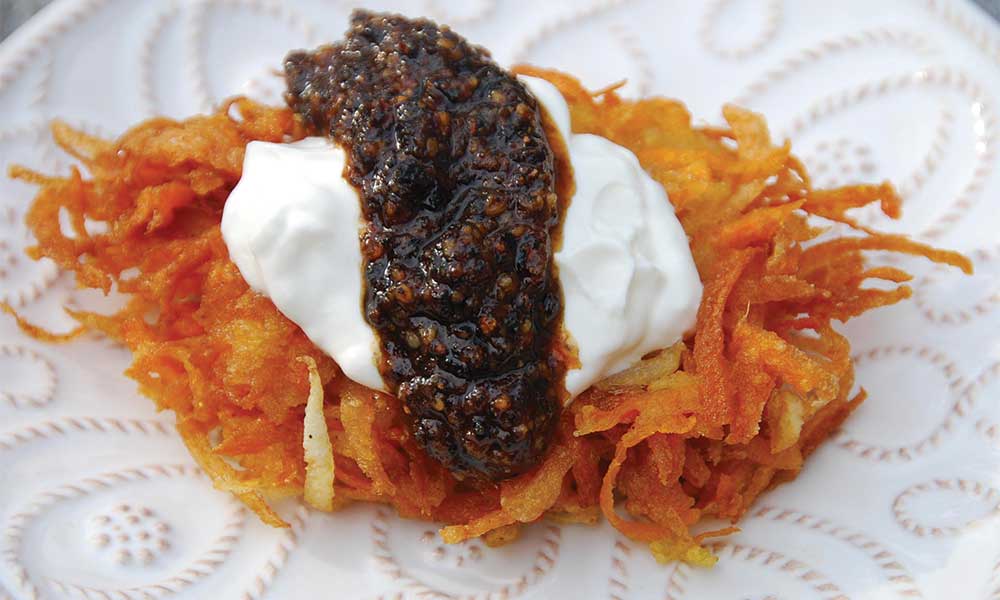
Potato, Sweet Potato & Granny Smith Latkes topped with Fennel and Lime Crema and Salsa Macha.
In 2011, Pati’s Mexican Table debuted on PBS and is now in its 14th season. (In the season’s final episode, Jinich returns to Mexico City to retrace her Jewish roots.) Her keen interest in breaking down myths and misconceptions about different cultures and peoples and in building bridges through food also led to two PBS docuseries, which Jinich produced and starred in: La Frontera, in which she traveled along the U.S.-Mexico border, and Pati Jinich Explores Panamericana, inspired by the Pan-American highway.
How does Jinich think cross-cultural bridges can best be reinforced today, when immigrants are being vilified and aggressively targeted by government forces? Rather than feel hopeless or defeated, Jinich says it makes her double down in pushing herself to talk with people who she suspects don’t think like her.
“Because food is such a teller. Food is such a loudmouth, you know? If I happen to sit at your table, and you cook something for me that’s meaningful to you because it’s part of your family, your history—already by making it, you’re in touch with a vulnerable part of you. And by me eating it, there’s no way we can’t connect. I really believe that food makes us open up something we wouldn’t open otherwise, just like with poetry or music. It’s these soft-power dimensions that help build bridges.”
Of course food is also about celebration. With Hanukkah on the horizon, Jinich switches gears, joking: “The Jewish mother and the Mexican mother have so much in common: We’re overprotective, we nurture, and we have an obsession with feeding our kids. And something else that’s very Mexican and very Jewish is frying food.” Her favorite thing to make for Hanukkah are her latkes made with potatoes, sweet potatoes and Granny Smith apples. She tops them with Mexican crema flavored with fennel and lime and with “Salsa Macha,” a robust sauce made with chipotle chiles, nuts and seeds. (“The name is a funny one,” Jinich writes in the recipe notes on her website, “because macha is the feminine of the word macho. So it can translate as being a masculine female salsa. Macha can also translate as brave, so you can take your pick!”)
Thinking back to her grandparents, whose journeys to Mexico were fraught but who blended their pasts into new and prosperous lives, Jinich is reflective while also looking forward. “I’m very grateful for how three cultures have enriched my life with different languages, different histories, different foods, different ingredients. And I feel a duty to do right by all of them,” she says, adding that when her future grandkids talk about her, she hopes they say: This is what my grandmother did, and it has worth.
Watch a clip from Pati’s Mexican Table.
RECIPE: Potato, Sweet Potato & Granny Smith Latkes
by Pati Jinich
Yield: 16 to 18 latkes
INGREDIENTS
1 1/2 pounds russet potatoes
1 1/2 pounds sweet potatoes
1/2 pound Granny Smith apples
1/2 cup grated white onion
1 1/2 teaspoons kosher or sea salt
2 large eggs, well beaten
1/2 teaspoon ancho chile powder (may substitute another dried ground chile powder)
2 teaspoons baking powder
1/4 cup all-purpose flour
– Pinch ground ceylon or true cinnamon
INSTRUCTIONS
1. Wash and peel the potatoes, sweet potatoes, apple and onion and grate them into a large bowl filled halfway with ice water. After you are finished, let it all sit for a few minutes and thoroughly drain with a strainer. Wrap all the grated ingredients in cheesecloth or a clean kitchen towel and wring energetically, squeezing out as much liquid as you can.
2. Transfer to a bowl and combine with eggs, ancho chile powder, salt, cinnamon, baking powder and flour. Mix well.
3. Fill a large, heavy casserole or skillet with ½ inch of oil and place over medium-high heat. After 3 to 4 minutes, test the oil by adding a teaspoon of the mix. If it bubbles happily all around the edges, it is ready. Working in small batches to not crowd the casserole, spoon latkes of about 3 tablespoons each into the hot oil. (I use a large serving spoon or my hands and shape them in flattened ovals.)
4. Cook until the first side is crisp and golden brown, about 4 to 5 minutes, and flip to the other side, letting it crisp and brown as well, about 3 to 4 minutes. Transfer to a wire rack set over a baking sheet. Once you are finished, you may keep them warm in a 250-degree oven, or you may cover and reheat later on.
Lime Crema/Crema de Eneldo y Limón
INGREDIENTS
1 cup Mexican style cream
1/2 cup finely diced fennel bulb
1 tablespoon fennel fronds, chopped
Zest of 1 lime
2 tablespoons fresh squeezed lime juice
1/4 teaspoon kosher or sea salt, or to taste
INSTRUCTIONS
In a small mixing bowl, combine all the ingredients. Done!
Yield: 1 cup
Salsa Macha
INGREDIENTS
2 ounces dried chipotle chiles, stemmed, seeded torn into pieces, about 1½ to 2 cups
2 1/2 cups olive oil
1/3 cup raw unsalted peanuts, or other unsalted nuts if you prefer, such as pecans or pine nuts
4 cloves garlic
2 tablespoons sesame seeds
1 teaspoon kosher or sea salt, or to taste
2 tablespoons brown sugar
3 tablespoons white distilled vinegar
INSTRUCTIONS
1. Set a large heavy skillet over medium heat and add the oil. Once the oil is hot, but not smoking, add the garlic cloves. Stir and fry for about one minute, until they start to gain color.
2. Add the chipotle chiles and peanuts, stir and fry for about two minutes.
3. Add the sesame seeds, stir and continue to fry for about a minute. Remove from heat.
4. Carefully transfer all the contents from the skillet into the jar of a blender. Let cool for about 10 minutes.
5.Add the salt, sugar and vinegar. Process until smooth, starting with low speed and building up to high speed.
6. Pour into a container, let cool and refrigerate if the salsa will not be used that day.
Yield: 3 cups
All recipes courtesy of Pati Jinich.
Opening picture: Courtesy of Pati Jinich