
Everything about the release of Christopher Nolan’s The Odyssey has made me unreasonably happy. There’s the movie itself: For a classics geek-from-way-back, who once stood on tiptoe atop the ruined citadel of “windy Troy” thrilling to the touch of the Homeric breeze, it’s the purest luxury to see it all laid out on the screen in lush and loving detail—the ships and the armor, the archaic fortresses and disgusting monsters, the great scenes of revenge and recognition.
Even better than the movie is the argument about the movie, a wine-dark sea of commentary flooding the beaches of social media to encompass what seems like the entire commentariat of the English-speaking world. Some of the objections are sweeping, some ridiculous, but what a treat to disagree about them, so vigorously, in such detail, with such a presumption that they are worth the attention!
Why does Odysseus in the movie eat the lotus flowers and forget about home, when in the poem it’s his men who do this, and on another island entirely? Why does he skip the island of the Phaeacians, where Homer had him wash ashore and be recognized, and instead narrate his adventures to the nymph Calypso? Why is Helen of Troy Black, and since she’s a mythological being, why would anyone even care? What’s going on with the elaborate added backstory and subplot about Sinon, the Greek youth left to be killed on the Trojan beach as part of the famous trick?
The deeper question keeps bubbling up: How dare the modern artist make such changes—to the plot, to the framing, to the meaning? What gives Nolan the right? So it was probably inevitable that I came up for air after a long comment swim muttering, “Haven’t any of these people ever heard of midrash?”
Midrash, the ancient rabbis’ practice of illuminating stories that confused them by making up more stories to fill the gaps, doesn’t seem—on its face—to proceed from the same impulse as the itch to update Homer’s epic poem. (Midrash claims divine authority, for one thing.) But once I started learning about midrash in a synagogue context—some years after I’d graduated from college with a literature degree steeped in fancy concepts like “mimesis” and “intertextuality”—I couldn’t unsee the parallels between the the practice of midrash and that of literary imitation.
Midrash makes literary imitation and reinterpretation seem natural, and vice versa. In Jewish text, stories we think of as canonical, like Abraham smashing the idols in his father’s workshop, are in fact the interpolations of later rabbis—that is, readers—puzzling over the holes in the story and figuring out a way to tell it better. Likewise, a fair chunk of Western literature flows specifically from later poets’ drive to get imaginatively closer to Odysseus—to tell the incomparable stories again in a new vocabulary, to add characters and fiddle with outcomes. To repurpose the online jeer, to “make it make sense.”


Just one example: Nolan joins a long line of poets, notably Alfred Lord Tennyson (1809-1892), who struggled to come up with reasons why Odysseus would leave home again, so soon after finally arriving. In the famous Victorian poem “Ulysses” (the Latin for Odysseus), Tennyson suggests that the aging king couldn’t bear to “rust” on the shores of Ithaca after his years of adventure. Nolan’s idea, of a reparative pilgrimage, is definitely modern—and I’m not sure I buy it—but his right to throw in an interpretation of his own is unquestionable. A similar authority attends modern midrash such as Anita Diamant’s The Red Tent, which reimagines Genesis, or the “new” characters stitched into the Abrahamic first family in Esther Goldenberg’s The Scrolls of Deborah.
You can always uncover the truth in stories by telling more stories. My favorite innovative aside in the Nolan film comes when Menelaus, the King of Sparta here imagined as a sort of brash fitness bro, introduces Telemachus to the repatriated Helen, the famous beauty with “the face that launched a thousand ships,” and then sneers, “Well, maybe 500 ships now,” and turns her face with his hand to show how she’s scarred and branded. The image isn’t made up, exactly; it emerges from millennia of imaginative debate over whether Helen, carried off to Troy, was a victim or had agency as to her fate. The possibilities are endless—and plausible all the way down. Like midrash. We only treat stories this way when we trust them deeply—not to be true, exactly, but to carry a truth we can reach only by adding our own.
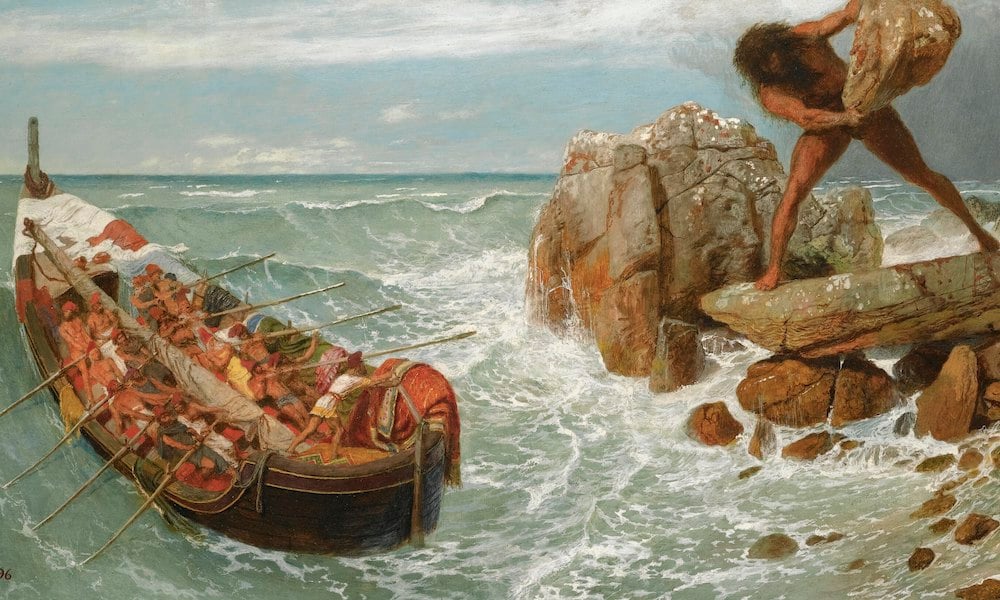
(Top image credit: Arnold Böcklin, Public domain)
2 thoughts on “Haven’t ‘The Odyssey’ Scolds Ever Heard of Midrash?”
I can’t stop reading articles about The Odyssey. You pretty much can’t avoid seeing one on a regular basis. We saw the movie at an IMax. Finally, someone nailed it! Thank you for this insightful commentary.
Thank you for this insightful commentary. You are correct that almost every publication has a commentary about The Odyssey. And, I have read my share. Being honest, it is fun to participate in “fluff” in today’s scary environment. Finally, a commentary that nails it. Midrash, of course! Great read. I have shared with family members.