
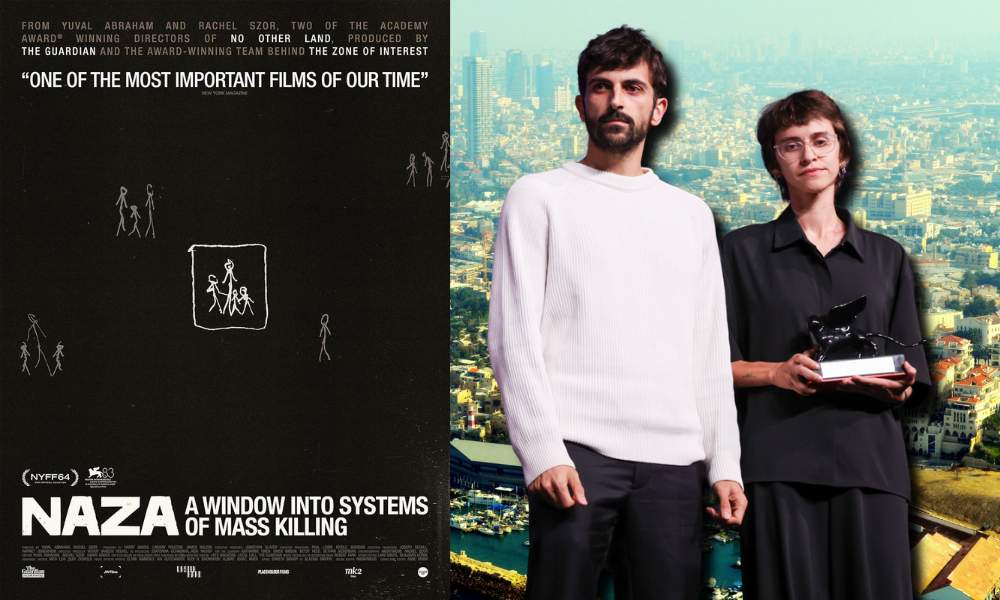
People have asked me what I thought of NAZA, the documentary by Yuval Abraham and Rachel Szor about Israel’s targeting of Hamas operatives in Gaza. My honest answer is that it is devastating, and that it is also incomplete. Both things are true, and I think anyone who cares about Israel, about the people of Gaza, or about the laws of war has to acknowledge them both at the same time.
The title comes from the Hebrew nezek agavi, “collateral damage,” the military term for the number of civilians expected to die in a strike. The film is built around anonymous testimony, presumably from Israeli soldiers and intelligence officers describing how targets were tracked, often to their homes, and how many civilian deaths were considered acceptable to kill them. What stays with you is not the policy language. It is the wives, the children, the elderly parents who were in those homes when the bombs fell.
Those deaths are horrific whether or not the men being targeted were legitimate targets. A child killed in her bed did not choose her father, his organization, or his war. It would be hard, and I think wrong, to watch this film and not be shaken by it. I was.
But being shaken by a film and being persuaded by it are different things. The question I keep coming back to is what the film actually proves, what it doesn’t, and what we would need to know before reaching a judgment about whether what it depicts was lawful, unlawful, or something in between.
NAZA relies almost entirely on anonymous sources. The faces of the witnesses are hidden and their voices distorted. I understand why: without anonymity, the film couldn’t exist, and some of these people have taken real risks to speak. Their testimony builds on investigative reporting by +972 Magazine, Local Call and The Guardian going back several years, and it deserves to be taken seriously and investigated.
But testimony is not a verdict. Anonymous witnesses cannot be cross-examined. The film presents the cases the filmmakers chose, not necessarily a representative sample. And it cannot show what a court would most need to see: the intelligence on each target, what commanders knew at the moment of decision, what alternatives were available, and how the expected civilian toll was weighed against the military objective. The Israeli military denies the film’s central claims, including any 200-casualty threshold, but hasn’t said what its thresholds were; the filmmakers stand by their sources. Neither side’s assertion settles the matter.
NAZA raised questions I believe Israel must answer honestly.
The law of armed conflict, based on the Geneva Conventions, their Additional Protocols, and the customary rules of war that bind every nation, including Israel, does not prohibit strikes that foreseeably kill civilians. If it did, no modern war could be fought at all. Instead, a target must be a legitimate military objective, the expected civilian harm must not be excessive in relation to the concrete military advantage anticipated, and the attacking force must take every feasible precaution to minimize civilian harm. Israel never ratified the 1977 protocols, but its Supreme Court has held, and its government has formally acknowledged, that their core targeting rules (distinction, proportionality and precautions in attack) bind Israel as customary law.
Applied to what the film describes, that means a strike on a Hamas operative at home, even one that kills members of his family, would generally not be illegal under such laws if: the target was a verified, active member of Hamas with a real operational role, especially a senior one; removing him offered a real military advantage, such as preventing future attacks; there was no practical alternative place or time to reach him; and the expected civilian toll was proportionate to the military value of stopping him.
By contrast, the same strike would much more likely be unlawful, even criminal, if: civilian casualties were pre-authorized as a standing quota by rank, particularly for junior fighters whose death offers little military advantage; targets were deliberately timed to be home with their families when they could feasibly have been struck elsewhere; targets were identified by algorithms or thin intelligence without adequate human verification; or retribution (such as for participating on October 7), rather than prevention (of a future attack), was driving who was targeted. The film’s witnesses describe practices that fall into that second list: preset casualty allowances (twenty per fighter, by one account), a tracking system that confirmed when targets had returned home, and AI-generated targets accepted with little scrutiny. If those accounts are borne out, they raise very serious legal questions. Other allegations, like firing on civilians near aid sites, aren’t collateral-damage questions; if true, nothing could justify them.
There is one point I want to acknowledge directly, because I think many people who support Israel find it counterintuitive. Under international law, the legality of killing a terrorist in the manner the film describes depends far more on his current role and seniority than on whether he took part in October 7.
That can feel backwards. Surely a man who murdered families in Be’eri or Kfar Aza deserves to die more than a fighter who didn’t? Morally, many people would say yes. But the law of war is not a system of punishment. Punishment for past crimes belongs to courts. What the law of war permits is the use of force to defeat an enemy and prevent future harm. A fighter’s past acts matter as evidence of his role and his dangerousness, not as a license.
This matters most for the civilians around him. The collateral damage in a strike is far more likely to be a war crime if the purpose of the killing was payback for October 7 rather than preventing the next attack. And if the deaths of a terrorist’s family come to be seen as part of the payback, the attack moves toward deliberately targeting civilians and collective punishment, both absolutely prohibited.
A useful test is a simple counterfactual: Would this strike, with this expected civilian toll, have been approved against a fighter of equal current importance who had nothing to do with October 7? If yes, any desire for justice and retribution is legally incidental. If no, retribution is doing work the law does not allow it to do.
I suspect many viewers don’t realize that the very same act shown in the film can fall into a completely different legal category depending on these facts. A strike on a senior commander, carried out to stop future attacks, with no realistic alternative place to reach him, is a different legal act from the same strike on a low-level fighter intentionally timed to catch him at dinner with his children, and particularly so if the attack is primarily for retribution for his participation in October 7. On screen they may look identical. Telling them apart requires information the film does not share.
My deepest reservation about NAZA is what it chooses not to show. My memory is that the film does not spend even five minutes on October 7, 2023: the massacre of roughly 1,200 people, most of them civilians, the rapes and mutilations, the burning of families in their homes, and the abduction of some 250 hostages, including babies and the elderly. Unlike the strikes the film examines, whose legality depends on facts we don’t have, October 7 was unambiguously illegal under international law. It was a deliberate attack on civilians as civilians, which is the gravest violation the laws of war recognize. Moreover, the film’s closing images of death and destruction from an Israeli strike in Gaza are never contrasted with images of the horrific Hamas attacks of October 7.
Nor does the film convey what that day did to Israeli consciousness and Israel’s sense of security. For a country founded as a refuge after the Holocaust, October 7 was the deadliest day for Jews since 1945. It shattered the belief that the state could protect its citizens in their own homes, and it shaped every decision that followed. A viewer who doesn’t understand that cannot understand why Israel fought the war the way it did, even if they ultimately conclude what it did was wrong.
The film also does not grapple with the fundamental asymmetry of this war. Hamas deliberately embeds its fighters, weapons and command centers among civilians, in homes, schools, hospitals and mosques, and under them in hundreds of kilometers of tunnels. It does not consider itself bound by any of the laws the film holds Israel to. That doesn’t relieve Israel of its own legal obligations; the law is clear that one side’s violations don’t license the other’s. But it does shift a large share of the moral responsibility for civilian deaths onto Hamas, and it makes every targeting decision in Gaza far harder than the film suggests. A film about the cost of fighting an enemy that hides among civilians should say something about the enemy that chose to hide there.
This is not the first time a democracy has faced these questions. At Hiroshima and Nagasaki, something like 200,000 civilians were killed. The justification was that ending the war quickly would save far more lives—two to three million by some estimates—than an invasion of Japan would cost. Historians still argue about whether that was right, and about whether the bombs or the Soviet Union’s entry into the war did more to force Japan’s surrender.
I’m not citing Hiroshima as a legal defense of anything in this film. In fact, the laws of war that apply today were written partly in reaction to Hiroshima and to the firebombing of cities in World War II. Under those rules, a strike can’t be justified by a general claim that it will shorten the war and save lives overall; each one has to be justified on its own terms, by its own concrete military advantage. I mention Hiroshima because it shows how agonizing these judgments are for any nation at war, and how differently history has judged them depending on who made them.
Part of what makes this so hard is that the law asks us to do something almost unbearable. There is a line often attributed to Stalin that one death is a tragedy and a million deaths are a statistic. The film forces you to experience what can be directly understood. Every one of those ten or twenty civilian deaths in a single strike is a tragedy, and the death of any innocent person, especially a child, is gut-wrenching. Proportionality asks a commander to weigh those lives against a military objective. It is a legal necessity, because without it there would be no limit at all. But no one should pretend it is an easy or comfortable calculation, and no one who watches this film will find it one.
A more recent comparison is more telling than Hiroshima, because it involves the same rules that apply to Israel today. In 2016 and 2017, the U.S.-led coalition fought ISIS in Mosul and Raqqa: Western democracies against a terrorist group embedded in dense cities among civilians, much as Hamas is in Gaza. Thousands of civilians were killed. An Associated Press investigation published on December 20, 2017, estimated around 9,000 to 11,000 civilian deaths in Mosul alone. There were investigations and critical reports, but nothing approaching the global outrage, the protests, or the campus activism that Israel’s war in Gaza has provoked.
The pattern goes beyond Gaza. The UN Human Rights Council has a permanent agenda item devoted to Israel alone, something no other country faces. Over many years, the UN General Assembly has passed more resolutions condemning Israel than all other countries combined.


I think it is fair to ask why Israel is held to a standard that so few other nations are held to. There are explanations that have nothing to do with prejudice, but when a single state is singled out year after year, when the world’s attention to civilian deaths seems to rise and fall depending on whether Jews are the ones accused of causing those deaths, it is reasonable to recognize that sometimes that double standard comes from somewhere darker than a concern for international law. (Abraham and Szor are both Israeli Jews, however.) The working definition of antisemitism adopted by many governments explicitly includes holding Israel to standards not expected of any other democratic nation. Not everyone moved by this film is driven by that. Criticism of a specific military practice is not antisemitic simply because other countries escaped similar criticism. But anyone who cares about honesty in this debate should be willing to ask the question.
None of this means that someone who believes in Israel’s right to exist and defend herself should look away from this film or dismiss it. Just the opposite. The questions it raises about Israel’s response to October 7 in Gaza are devastatingly important. If preset civilian casualty quotas were applied to junior fighters, if families were struck because it was convenient rather than necessary, if algorithms marked bakers as combatants when the baker’s cell number was in the phones of Hamas customers, then those things happened in Israel’s name, and they matter to anyone who holds Israel to a reasonable moral standard.
But it would be just as wrong to treat the film as a verdict. Condemning Israel on the strength of anonymous testimony alone and dismissing that testimony because it reflects badly on Israel are the same mistake made in opposite directions: letting what we already believe substitute for evidence. The right response is the one serious legal systems use, including Israel’s own Supreme Court in its 2006 ruling on targeted killings: Treat credible allegations as grounds for independent, transparent investigation, strike by strike, and reserve judgment for what that investigation finds.
So what did I think of NAZA? I think it is a film about the human toll and horrendous tragedy of war, and about the serious possibility of war crimes. It made me grieve for the innocent people in Gaza who died in their homes. It did not make me forget the innocent people in Israel who died in theirs. It raised questions I believe Israel must answer honestly. It did not answer them, but a film can’t. That work belongs to investigators, to courts, and to a public willing to hold multiple hard truths at once.
Michael W. Sonnenfeldt is the founder and chairman of TIGER 21, a network for entrepreneurs and wealth creators, and chairman of MUUS & Company, a climate-focused investment firm. He is also a co-founder of the Israel Policy Forum and has led inspection teams to 28 UN peacekeeping missions in conflict zones around the world.
(Top image credits: Ondine Goat, CC BY-SA 4.0, Amos Meron, CC BY-SA 3.0)