
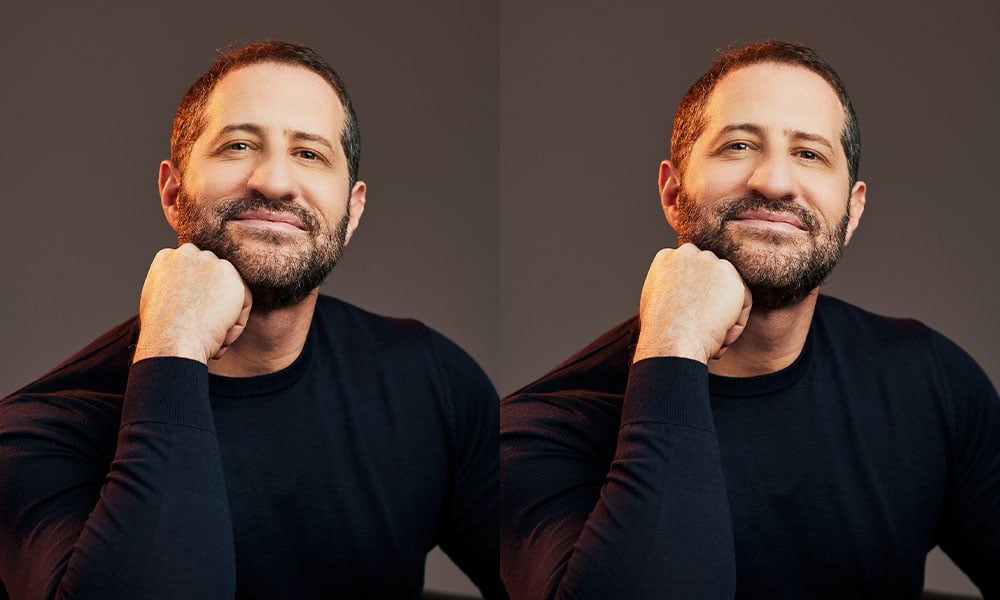
Antisemitism has changed, the comedian Mordechi Rosenfeld—who goes by Modi—alleges in his latest stand-up special, Know Your Audience. “Back in the day, you saw a guy with a yarmulke on him, you punched him,” goes the set-up. “Today, it’s not original anymore.” As a gay Orthodox Jew, Modi uses his act to spear Jewish stereotypes, marriage and millennials, proving any part of one’s personality can be mined for a good laugh. There’s a lot of material—his non-Jewish husband is also his manager—but fortunately, his queerness hasn’t been as much at odds with his Orthodox faith as one might have expected.
Born in Tel Aviv in 1970, Modi moved with his family to the United States at the age of seven, later majoring in psychology and minoring in voice at Boston University. He briefly worked in finance before entering the world of comedy, where he built up a Jewish—mostly Orthodox—fan base, becoming a mainstay of Passover programs, nonprofit fundraisers and synagogue galas. His comedy lovingly skewers elements of the Jewish community, including differences between Ashkenazim and Sephardim, Shabbat elevators and sleepaway camps. As COVID shutdowns shuttered venues, his viral comedy clips grew his audience exponentially and led to his headlining comedy shows around the world. Modi was in Israel on October 7, and since then he has asked his audience to stand and sing the national anthem of Israel after every show. “I tell them we’ve just healed and become a community in this room through laughter. And to remind ourselves where our hearts, our souls, our prayers are, let’s sing ‘Hatikvah’ together.’” Moment’s Jacob Forman spoke with Modi about acceptance within the Orthodox community, anti-Israel sentiment online and “Moshiach energy.”
What was your early personal experience of being gay and Orthodox?
I grew up in a home that wasn’t completely Orthodox, just a very traditional Israeli-American home. I went to shul, I went to a public school. Afterwards I went to Boston University, where there was a Chabad yeshiva on campus I attended. And at the same time, I realized that I was gay. The two had nothing to do with each other—I just liked studying Torah, and I was also gay.
When you came out, what was the reaction from people who had been hiring you as a comedian in the Orthodox community?
Overwhelmingly positive. There was almost no negativity. People who had been hiring me kind of already knew. I’m talking about super Orthodox organizations—where there is a mechitzah down the middle of the audience. They had no problem. They know I’m going to be correct and work the room appropriately. Actually, one of my specials is called Know Your Audience. Obviously, whenever I go up on stage, I know the audience I’m working with. It might be Orthodox, might be conservative Jews; it might be rich Jews, it might be middle-class Jews. You have to know. You have to feel the room and see what’s going to work there.
As someone who’s spent a lot of time in Orthodox communities and a lot of time in gay communities, what do you see as the main frictions between queerness and Orthodoxy?
Thank God I don’t see friction. I’m a gay Orthodox guy in a Jewish community. I wake up in the morning, I put on tefillin, I do my prayers, I go to the gym. All day, I’m with my husband, who runs the business. He understands what’s happening with American Jews and in Israel, and he understands how important it is to sell out shows in markets where Jews have felt completely left out. We’ve done shows in Raleigh, for example, and in Milwaukee—places where Jewish communities need to come together and laugh. We’re creating Moshiach energy.
What’s that?
When you’re looking out at a room full of people who are going through difficult times and they’re coming together and laughing together. That’s it. Until Moshiach (the Messiah) comes, you have to create Moshiach energy. And my husband and I, that’s what we focus on. That’s what we do.
How did the two of you meet?
I met my husband almost ten years ago. We were on the 6 train in Manhattan. We made eye contact, and then I got off the train. I felt a tap on my shoulder, and it was him asking me if I’d like to go on a date. “Absolutely,” I said to him. “If you want to go tonight, I’ll bring you to a comedy club.” I took him to the Comedy Cellar. He didn’t know that I was performing, and I led him to the area where the comedians sit. Three minutes later came the announcement: “Ladies and gentlemen, please help me welcome Modi!”
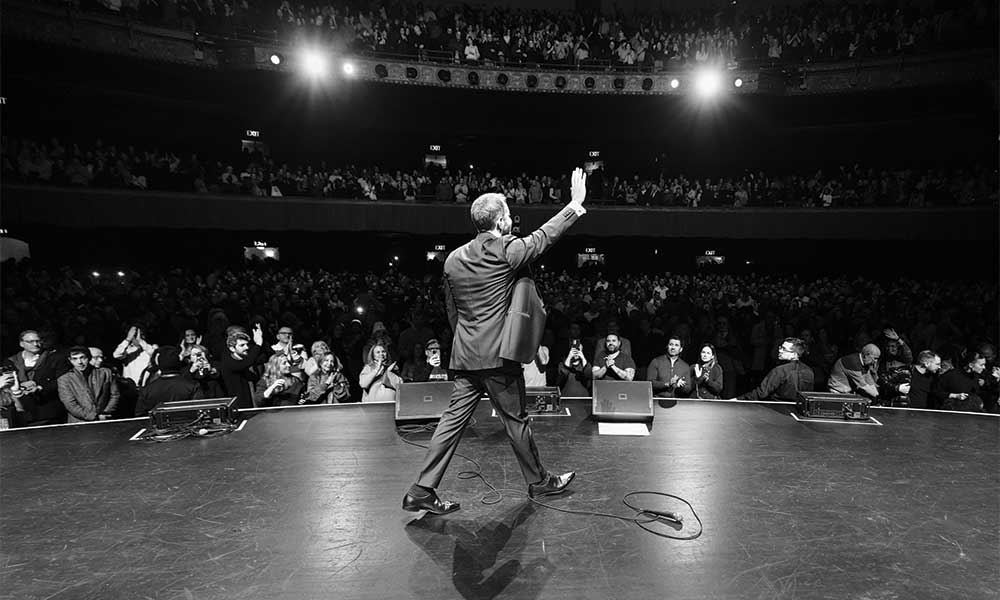
Photo credit: Daniel Landesman
“Oh, you’re a comedian?” he said to me.
“Yep.” We had three more dates, and then he moved in.

I’ve heard from other queer Orthodox people that Orthodox communities can get over the marriage being gay, but they can’t get over the marriage being between a Jew and a non-Jew. Have you ever experienced this?
I’ve heard of it. I have had friends whose mothers would say, “Gay, but you have to marry Jewish.” It’s blown my mind.
That exclusiveness is not your cup of tea?
I put on tefillin in the morning, we light candles on Friday, and I go to shul, hoping that it makes me a better person—not so I can tell somebody else, “I did this and you didn’t.” The practice of tefillin is an energy of restriction. So maybe if I get angry and want to yell at somebody, if on that morning I’ve put on tefillin, it’ll help prevent me from making too much of something. That’s also the energy of Shema Yisrael: “He’s the Lord our God, the Lord is one.” Not that there is one God that’s up there saying, “You’re good. You’re bad.” Oneness is God.
I asked if there’s friction between being Orthodox and being gay, but are there joys involved in being both?
I enjoy both. I can just as easily have a great time on Fire Island or at a gay rave as I do going to my friends’ houses for Shabbat and singing zemirot [traditional Jewish religious songs] all night.
“When you’re looking out at a room full of people who are going through difficult times and they’re coming together and laughing together—that’s Moshiach energy.”
What is the balance between acceptance and traditionalism? Or is it really up to the community?
Again, I’m incredibly fortunate. I’ve belonged to the Sixth Street Synagogue in Manhattan for over 20 years. Rabbi Gavriel Bellino is the rabbi there now, and he and his wife accept me completely. There are many gay people in that synagogue—not that they advertise it as a gay synagogue. It’s an Orthodox shul, men on one side, women on the other. There are also trans members. Again, Moshiach energy.
I have two married friends, doctors, up in Hastings-on-Hudson. There’s a Chabad house there where they had their kids’ bar mitzvahs. They had this whole thing, the whole Shabbaton, around it. Families came from both sides, from France and from Montreal, and the two fathers spoke. And the rabbi was so accepting and so beautiful about it.
Chabad in general, I’ve noticed, is very accepting of their members. Even if they’re gay, and also if they’re in a mixed marriage. They treat the kids with respect, and they treat the families with respect. “Love your neighbor as yourself.” That, to me, is Moshiach energy—a little bit of light that can take away the darkness. And believe me, I know for every amazing story I’ve heard and lived, there are stories in the Orthodox world that are not cute.
Has the environment changed over the past 10, 20 years vis-à-vis acceptance of queer Jews in Orthodox spaces?
I would have to say 100 percent yes. I think the Orthodox community realized the situation: “Some of our kids are going to be gay, and we can choose whether to disown them (which is such an insane thing) or just say, “Okay, our son’s gay. He’s married to another guy,” or, “My daughter’s gay. Let’s hope they have kids, and let’s first hope they’re happy.”
I’ve been asked what you should do when your kid comes out. Don’t be like, “Oh my God, I can’t believe this is happening to us! How am I going to get your sister married off?” The first thing you do is ask your kid, “What’s going to make you happy?” and take it from there. Because let me tell you something, if you handle that the wrong way, you might find the kid hanging in the garage. And that’s not going to make anybody happy.
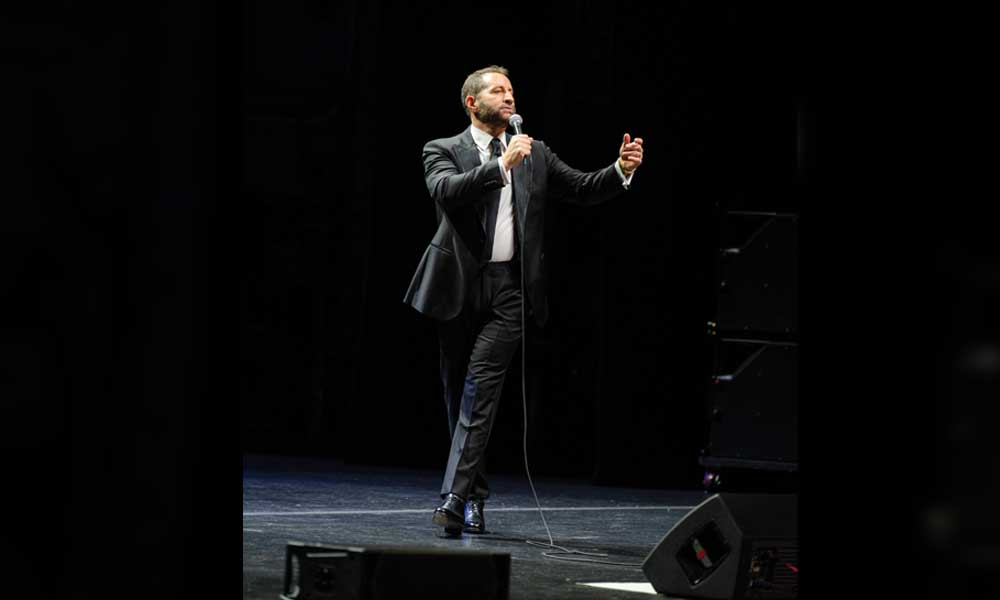
Photo credit: Daniel Landesman
But I do think, from what I’ve seen, that there is a lot of acceptance in the Orthodox community. There’s an organization called Eshel for gay Orthodox Jews, which is a thriving community. I’m so honored to be a part of it.
Eshel put out the results of a survey recently saying something to the effect that 50 percent of queer Orthodox youth end up leaving Orthodoxy. Do you see that as a major problem?
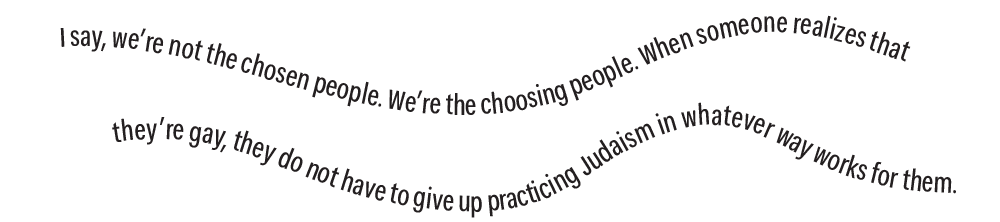
I think it’s everybody’s own journey. I say, we’re not the chosen people. We’re the choosing people. When someone realizes that they’re gay, they do not have to give up practicing Judaism in whatever way works for them. I don’t think it’s all or nothing.
Have you experienced anti-Israel sentiment in queer spaces you’re a part of?
Yes. It’s nothing short of mind-boggling to see LGBT people screaming and yelling for Palestine to the point where they argue Israel shouldn’t even exist. Mind-boggling to see a trans person screaming anti-Israel sentiments. This person would have equal rights in Israel, whereas the people they are demonstrating for would shoot them in the face onsight. Absolutely mind-boggling.
Why are people in that community so virulently anti-Israel?
I think it’s because they feel the need to stick up for somebody. The algorithm of their social media is showing that Israel is the aggressor against Palestinians. Instead of understanding that there were hostages there and Israel has to avoid another October 7, they’re going with “Israel is attacking and displacing all these people.” And it’s not just “Hey, let’s help out the Palestinians who are innocent.” It’s like, “Israel should be stopped. America can’t support Israel.” Crazy stuff. Just shocking.
Do you think there’s a solution to that? A way queer Jews can fight back against that ideology? Or is it just about creating your own spaces at this point?
You have to do whatever you can. There’s no overnight solution. Again, create Moshiach energy wherever you go. For me, I’m going to give relief with comedy. I don’t cover anything political. I’m here for a moment, a pause for a laugh. Look at whatever Modi just posted, I want people to say. I want them to share it, watch it and move on.
One thought on “Q&A | Comedian Modi Is Running on ‘Moshiach Energy’”
You are a great comedian. Really enjoy your shows. Would you consider performing in Long Island,NY at the Nassau Coliseum?