
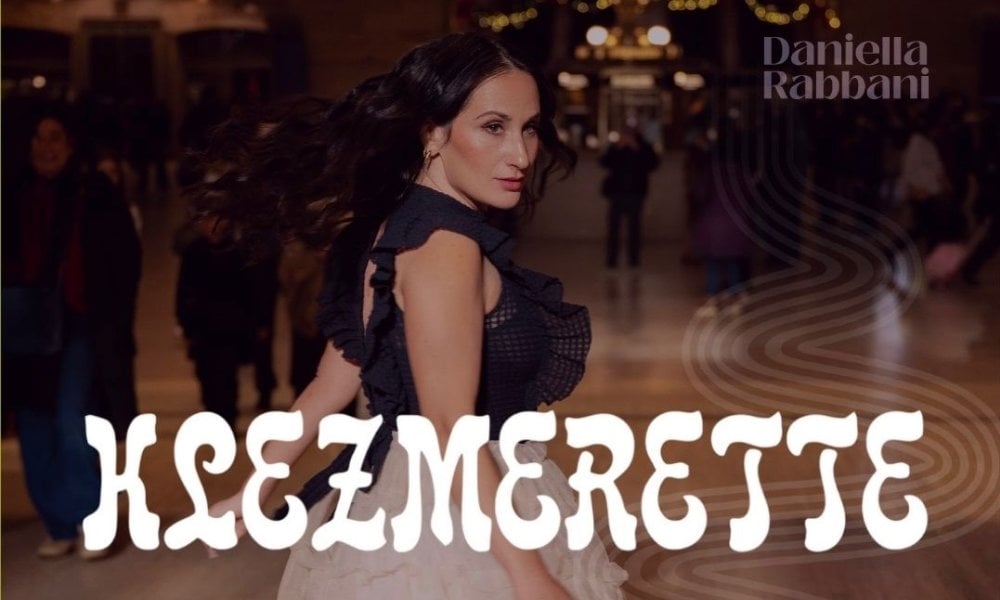
Daniella Rabbani believes in the power of Jewish joy. And what brings more joy than a celebration of Yiddish culture through music?
On her new album, Klezmerette, Rabbani brings new life to old Yiddish standards, classic cultural tunes and traditional theatrical sounds. A New York City native, Rabbani’s music video for “Ketzele Broygez” (“Lover’s Tiff”), the first song on the album, was filmed all over the city. Her goal is to show her city, and the world, that Yiddish music is beautiful, poetic and deserves to be heard.
Klezmer music originated in Eastern Europe in Ashkenazi Jewish communities as the music of celebrations, often played at weddings and joyous holidays. Klezmer music is traditionally instrumental. The word “klezmer” is Yiddish derived from Hebrew meaning “instruments of music,” but it has come to refer to the Jewish musicians themselves. With changing European borders, klezmer traveled the continent, and when Jews immigrated to the United States, klezmer music found a new stage. Through its evolution, klezmer music took on new styles—the original instrumental, celebratory tunes merged with the genres of new cities and cultures.
Since starting her podcast Mom Curious seven years ago, Rabbani has gained a following on social media, not only for giving advice on motherhood but also on how to be a Jewish advocate and activist. Especially after the attacks of October 7, 2023, Rabbani has been a strong voice against antisemitism and hate. But after years of fighting, Rabbani, who trained at NYU as an actress and singer, is ready to return to joy.
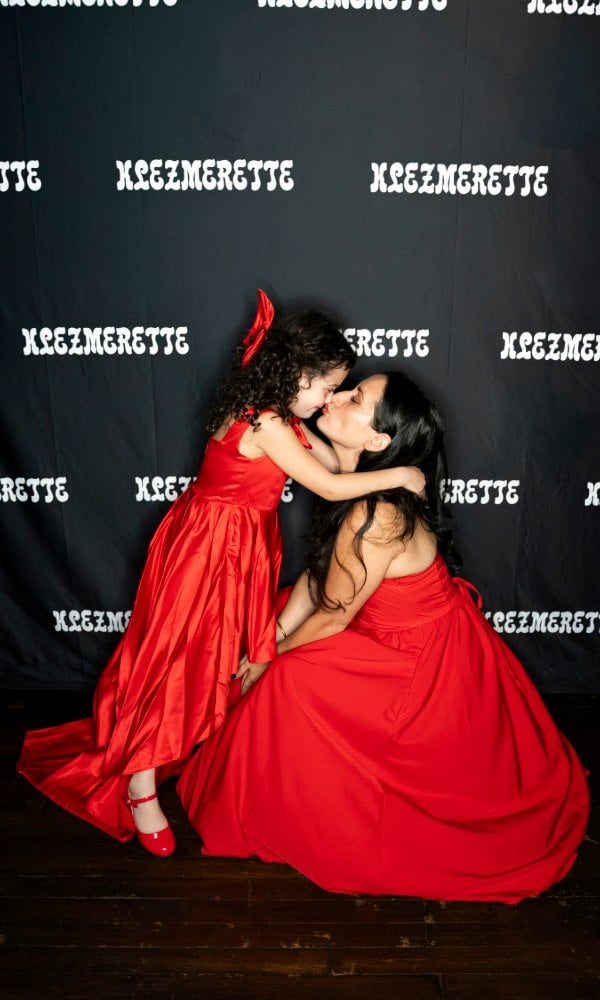
Photo by Nadia Leon
What made you decide to record this album?
I have been singing Yiddish for nearly 20 years. I started out touring with a little troupe at old-age homes and JCCs, and then I started singing internationally and on fancier stages here, like Jazz at Lincoln Center. I did a lot of work with the National Yiddish Theater Folksbiene, and I always wanted to concretize the work in an album, but it turns out being a recording artist is wildly different from being a concert singer. So I put it off for a while. Then, in 2023 I recognized that people would look to me for chizuk, a little bit of strength, and for an understanding of our history and our people—because of the work that I do, delving into Yiddish texts. The album became my offering.
Do you have a personal connection to Yiddish?
I was raised Modern Orthodox here in New York. My parents are Israeli. My grandparents on my mother’s side were Holocaust survivors, and my grandfather spoke Yiddish. I didn’t speak it growing up, but after I graduated from NYU, I got a scholarship to study Yiddish and gravitated to it very quickly. It’s a bunch of languages mixed together, primarily Hebrew, which I was raised speaking, and German, which is much like English, so it worked out well for me.
Can you talk about some of the specific songs you choose to include? What are the stories behind them?
A lot of them are Yiddish standards because a lot of people have no idea what Yiddish music is. I felt like we had to start at the beginning. “Oyfn Pripitchek” (“At the Hearth”) is probably the most famous Yiddish song I included. It’s been recorded a million times, and I put my stamp on it too. Then there’s “A Yiddishe Mama” (“A Jewish Mom”). There’s a song that’s never been recorded ever, to my knowledge, “Nor a Stral Fun Glick” (“Just a Strand of Luck”), which is just a silly song about a lesson the writer’s father gave him, which is: All you need is a little bit of luck, and you could be happy; you don’t need the whole world. It’s an up-tempo, fun, cute song.
There are some more serious pieces like “Friling” (“Springtime”). It’s the most accurate depiction of grief that I have ever heard. It was written by Shermke Kaczerginski, who survived the war, but his wife did not. He never once mentions the Holocaust in the song, but the poetry is out of this world. He sets the music to a tango beat, which was very popular at the time, but it also says a lot about the love and lust and longing that never went away—doesn’t go away—when someone dies. She just disappeared, and he questions, “how is it possible that the world is going on and you’re not here?”
There’s this great song called “Der Nayer Sher” (“New Dance Tune”), and it was written right after the Holocaust. What’s so crazy about it is it wanted to be the hora. It just asks people to dance. It asks the klezmer (musician) to play music. It says all of our haters can go fuck themselves. It just feels so indicative of the Jewish spirit. We can have a crazy person storm into Central Synagogue in New York City, and the next day it’s packed. It says, “you’re not going to stop us.” I love that, and I hate that we need it so much right now, but we do, and so I’m here to provide.
Michael Winograd is this virtuosic klezmer, and he plays the clarinet, he arranged the music and he produced the album with Joanie Leeds. Michael put a new spin on each of the songs, but they’re not modern; he didn’t change them. For the most part, the ten songs are meant to be an appetizer to lure the fans in to enjoy klezmer.
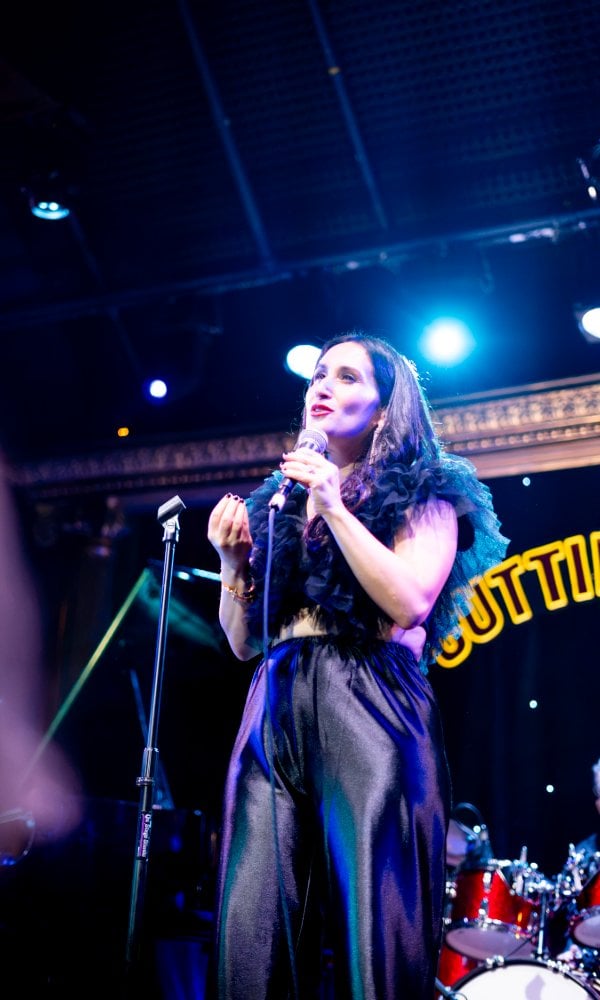
Photo by Nadia Leon
Just an appetizer? Are there plans for more?
Let’s see how this one goes, but I do think that there is an appetite for Yiddish. I’ve been on Instagram for ten years or more, and in the past two months, I’ve nearly doubled my following, and that’s because I’ve been sharing more Yiddish. People like it. People are curious about Yiddish. They think it’s a fun language.
A lot of older generations ask me, “Do you think the young people will like it?” And I say, “They already do. They like it a lot. Good music is good music.”
Why did you choose the New York setting for your music video?
Klezmer music doesn’t need me to dress up in shtetl garb. I don’t have to pretend that I am anything but myself, which is a New Yorker. I think of klezmer music as world music, and I think of New York, which I’m native to, as a melting pot of all of these amazing cultures and sounds. I don’t speak any Spanish, but I love Bad Bunny; I don’t speak any Hindi, but I love Bollywood dance and music. That’s because I’m a New Yorker, and I get to enjoy people’s cultures, and I wanted to say that in the music video. I think New York Jews could use a little bit of a reminder that this is our city too, and that we are part of the fabric of the many cultures that exist side by side.
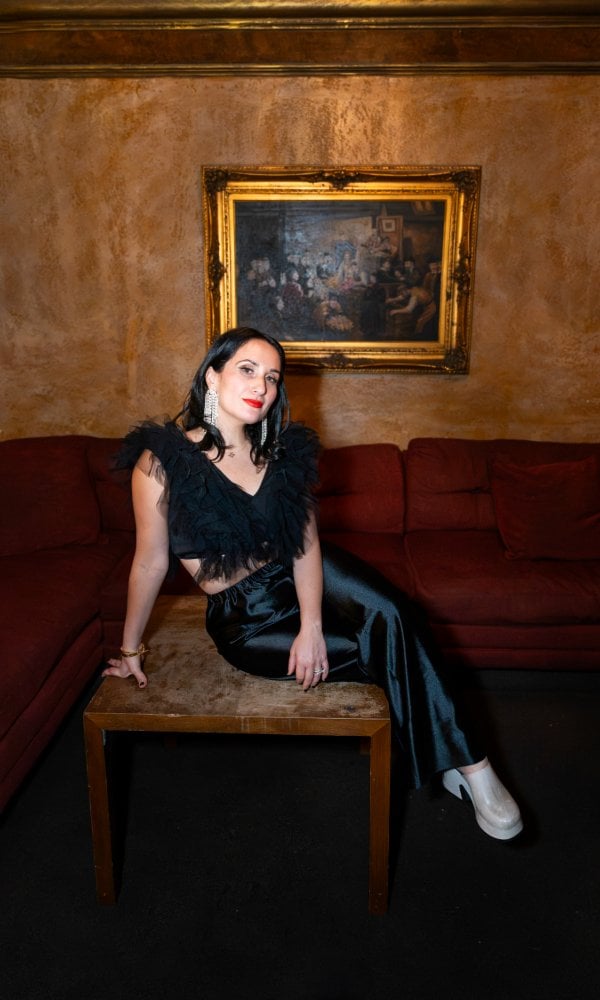
Photo by Nadia Leon
Did you always want to be specifically a Jewish performer?
I don’t really think of them as different career paths. I think it’s the same. It’s often Jewish people who see them as separate. I always wanted to be an actor, and I’m Jewish, so I wanted to tell Jewish stories.
When I started Stella Adler, which is one of the acting studios at NYU, I found out that Stella, who taught Marlon Brando and all these incredible icons of American acting, was raised on the Yiddish stage. Her father Jacob P. Adler brought his Yiddish theater from Russia after being closed down due to antisemitism, and he became like a king, like a rabbi, this huge figure on the Yiddish stage, and she was raised there. So, I studied Shakespeare, Chekhov and Ibsen. And after one of the Shakespeare plays that I did, Stella’s grandson, who directed me, said, “You act like my family. Will you carry on the legacy of the Yiddish theater?” And that lens made it so that I never for one second thought that because it’s in a different language or because it’s a niche or audience that it’s not within the realm of classical acting and great theater work. At 21, I was just grateful to have a job. I had no idea that I would fall in love with it.
What are your hopes for the album?
I’m really hoping that we can make a mark with klezmer music as world music. Obviously, the people who will buy the record or listen to the record are probably Jews, but Jews are just people too. My producer, Joanie Leeds, won a Grammy. She’s wonderful, and she has a Grammy initiative to create a Jewish music category. It’s a little tough because the Jewish community is small, and within the Jewish community, it’s a smaller subset of people who listen to Jewish music. If we can enter the world music conversation, I really do think that would be great for the Jews. I think that would be great for the world.


How did you get into your career in advocacy? How does it interact with your podcast and now your music?
They’re two separate tracks. I became a mother and wanted to stay home a little bit more with my kids, but I didn’t want to fully abandon my career. I had a lot to say about motherhood, and I wanted to create a space where people coming up on that journey would have a resource, and so I created Mom Curious, produced by Hoff Studios here in New York City, and now we’re seven seasons in and it’s still going strong. It’s a really beautiful community, I can’t believe I did that. Always alongside that, I was very outspoken about fighting against antisemitism and dispelling the lies about Israel and the Jewish people that felt really personal and important to me. I went on a trip with the Tel Aviv Institute in 2021, and I felt like I had a community of people who were doing the same, and so I continued. But at some point, it was really very uncomfortable, and I realized, “I’m a sensitive person, and death threats and rape threats are not what Judaism is to me.” Judaism is a beautiful culture that I don’t want to fight about. I can do better as a singer, as an actor, as a podcast host. Art can be advocacy too.
Which is your favorite song on the album?
It’s defintely “Friling” (“Springtime”). The content of it is so sad, but it’s also so beautiful. I just lost my sister, and it means a lot to me that someone put the words—even if the words are in Yiddish—to my experience.
My sister Ariana really was like my first talent scout. She was seven years older than me, and she would dress me up like a doll and put me up on stage, which was the living room, and give me a mic, which was a hairbrush, and teach me song after song, and I would perform for her. My family is religious, and so Kol Isha (listening to women sing) was an issue, and performing on Shabbat, or even just not being tznius (wearing modest clothing) was a real consideration when I went into acting. My sister really believed in me, and I made her so proud. She was front and center at every performance with flowers. I owe her a huge debt of gratitude because being an actor is not an easy job, and you need people who really believe in you, no matter what. And she did.
I’ve always loved “Friling”, but it means a lot more to me now. I have this deep understanding of what people have been feeling for from the beginning of time. There’s like this beautiful lyric in the song that says, “Where did you go?” Well said, Shermke Kaczerginski. Well said.