
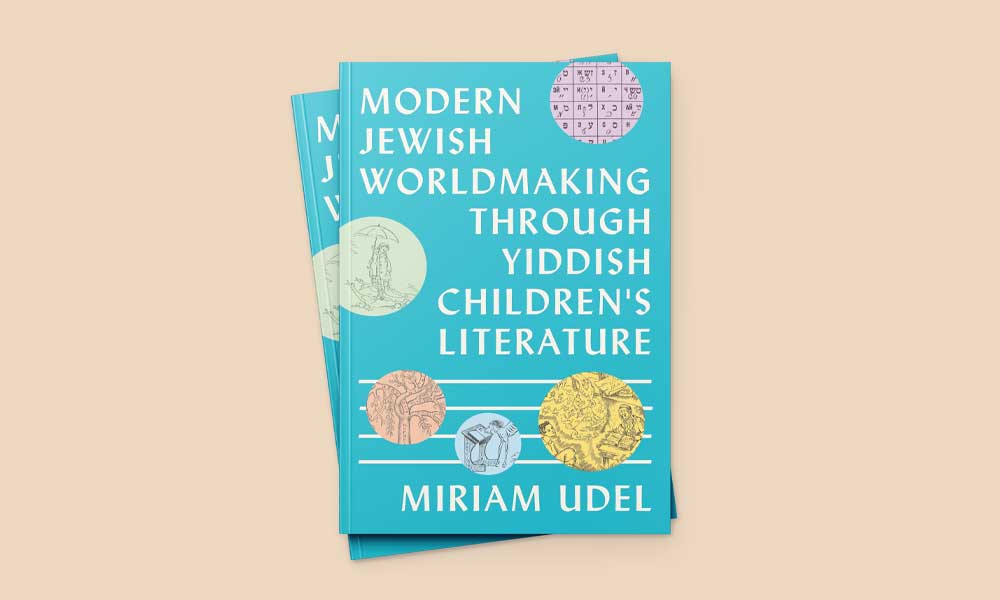
Modern Jewish Worldmaking Through Yiddish Children’s Literature
By Miriam Udel
Princeton University Press, 384 pp.
As a scholar of Yiddish and a mother of young children, Miriam Udel heard that enthusiastic Yiddishists were translating children’s classics such as Curious George from English into the mamaloshen. While reading endlessly at home to her own children, Udel found herself wondering whether the golden age of secular Yiddish literature had produced much in the way of original literature for children.
It had, of course. Udel dived into research and ultimately discovered a treasure trove of more than 1,000 mostly forgotten children’s books written in Yiddish in the 20th century—an “orphaned” literature produced by artists, reformers and educators seeking to raise Jewish children in a quickly changing world, whose work was left unread after the violent disappearance of the community of Yiddish secular readers for whom it had been created. The texts ranged from early-1900s folklore to post-Holocaust stories written for children in Israel or the Soviet Union (until Stalin quashed such manifestations of cultural identity). In 2020, Udel published her translations of almost 50 of these tales in the anthology Honey on the Page: A Treasury of Yiddish Children’s Literature. Now she has followed up with a sweeping scholarly survey of the whole corpus, putting Yiddish children’s literature in the context of the language’s tumultuous 20th-century history and analyzing its idealistic purposes.
The Yiddish authors, Udel writes, sought to create a “portable homeland,” giving Jewish children a culture that went beyond an environment rife with old-fashioned notions and (often non-Jewish) fairy tales. Enlightenment thinkers, or maskilim, saw a need to cure children of superstitions they might imbibe from the non-Jewish world around them, including from caregivers. (“Never trust the nanny,” the author summarizes drolly.) It was, she writes, “a venture of make-believe that sought to secure the Jewish future by creating a usable past.” Authors explored the changing roles of women and girls while reimagining traditional Jewish folktales and introducing children to their heritage through holiday stories and whimsical alphabet guides. “While their vibrant texts cut across continents and ideologies,” Udel writes, “they shared in their creators’ overarching goal: to write a better world into being in a distinctively Yiddish key.”


Prior to the Holocaust, some 11 million people spoke Yiddish worldwide. Absent a territory, with nationalist movements rising on all sides, educators had to grapple with problems of Jewish identity when religion was no longer central. How could Jewish nationalism exist without a land? Some turned to socialism, others to Zionism. Progressive ideas that would once have been alien to Yiddish-speaking European Jewry spread in Europe and migrated into the New World. Well-known authors such as Sholem Aleichem and Isaac Bashevis Singer were urged to write stories for children: Singer ended up publishing more than a dozen volumes of such stories, with themes similar to his writings for adults but with happier endings. In “A Hanukkah Eve in Warsaw,” Itshele, lonely, self-conscious and bullied at school, is left to walk home alone. He gets lost and wanders in a frightening, unreal landscape where he seems to encounter imps, demons and dark spirits. Rescued from the path of a trolley by a passing adult (whom he takes for a demon carrying him off), he finally regains home and safety.
Central to this complex history is regret for a future that could have been if only there had not been a Holocaust.
Udel’s volume highlights other important authors who also wrote for adults, such as the early feminist writer Kadya Molodowsky (1894-1975). The Soviet author Leyb Kvitko (1890-1952) survived the war and became one of the most famous children’s authors in Russia but was murdered under Stalin along with other Jewish poets.
Until the 1900s, Yiddish books specifically for children had not been widely available, and were mostly read aloud. Jewish children had a rich oral tradition—golems, angels, dybbuks, demons. Religious sources encompassed holiday tales, the Haggadah, biblical heroes and local folklore. With the availability of printed materials, a new form of storytelling in Yiddish came into being, a modern movement that could draw from the well of tradition. In the adult world, Yiddish, once only the language of the home and some women’s prayer books, began to boast a growing cultural life complete with theater, literature, graphic artists and professional educators. Many people passionately sought ways to shape a better world in a time of ideological ferment, demographic shift, urbanization and displacement, not to mention two world wars.
Children’s literature was enlisted in this struggle. Udel is at pains to restore this modern, reformist, passionate feel to a language too many experience as old-fashioned: “Yiddish now trails a kugel-scented vapor of nostalgia that threatens to obscure its fierceness as a medium for revolution, for remaking the world.”
Her book is structured chronologically, from the late 1800s to the years after the Holocaust, using the lens of children’s books to trace the impact of societal shifts. The first section treats the rise of modern ideas and the rejection of strict religiosity. Writers secularized folkloric traditions: The poet Itzik Manger (1901-1969) took biblical tales and set them in the shtetl. Many stories dealt with poverty and wealth inequality, with orphaned children and young heroes and heroines making their way in an unjust world. In Mordkhe Spektor’s 1889 story “Kinder,” young children demonstrate Jewish values when they raise money for Old Shmerl, a water carrier.
Eliezer Shteynbarg (1880-1932), a noted writer of Yiddish fables, published a 1921 alphabet book, Alefbeyz, to help children learn to read the Hebrew letters. Moyshe Kulbak (1896-1937) personified the wind as a parable to help children with their emotional storms and to draw them closer to nature in his allegory “The Wind that Got Away.” Soviet writer Kvitko also employed allegories, as in “A Nanny Goat with Seven Kids.” The littlest goat, thin and limping, saves the day when a bear takes the other six hostage.
The volume’s second section highlights the Jewish left, particularly in the orphanages and children’s homes that were set up to deal with the vast numbers of World War I orphans. This section also examines shifting expectations of girls.
Kadya Molodowsky’s 1931 story “Olke mit der bloyer parasolke” (“Olka with Her Blue Parasol”), has a six-year-old heroine whose parents overwork her but who defies them by using her imagination to seek other lands, Mary Poppins-like, with the help of her toy parasol. As she shelters under it, dreaming, the buttons she is struggling to sew become wheels, which assemble themselves into vehicles that whisk her away from patriarchal authority and household drudgery. Another character who escapes life through her imagination is Shprintse, the heroine of David Rodin’s more recent story “An Unusual Girl from Brooklyn,” published in Tel Aviv in 1973, who physically disappears into whatever book she is reading.

Yiddish writing for children persisted even after a million Yiddish-speaking children perished in the Holocaust. Udel’s third and last section deals with the Yiddish stories created by educators and writers to help surviving children come to terms with the catastrophe. Reassuring books about the calendar and the alphabet, she writes, were efforts to transcend historical time and “re-embed young readers in the Jewish eternal, a discursive spacetime safely beyond history.” At other times, the healing message involved Zionist ideals, as in the 1958 novella The Story of a Stick by Zina Rabinowitz (1895-1965), a multigenerational family saga featuring a stick engraved with a line from Leviticus: “When you come to the land, you shall plant.” Passed down as a family talisman, the stick rescues some of its owners but is hidden by others who are afraid or ashamed of its Hebrew lettering. Finally, the last generation, young Stefek, saved from the Warsaw ghetto and ignorant of Hebrew, winds up in Palestine, where the stick reveals that he is home and what he must do.
Yiddish had ardent devotees, but for many it remained a zhargon, or jargon, with no prestige compared to German or Hebrew. This highly detailed volume, well indexed, is a testament to many creative educators and writers devoted to elevating it to a world-class, standardized language. Some of these organizations remain active today, including the Jewish Bund, the Workmen’s Circle and YIVO.
Central to this complex history is regret for a future that could have been—what Udel calls the subjunctive—if only there had not been a Holocaust. Ironically, Yiddish culture reached its high point in the decades that preceded its destruction. Writers, theaters, publishers and the institutions that sustained them were mainly destroyed while the language succumbed to assimilation in the United States and the wider diaspora. Even in Israel, Yiddish was discouraged in order to promote Hebrew.
In a coda, “Hasidic Herring and Swedish Fish,” Udel briefly notes two disparate sources of Yiddish children’s books today. Members of Hasidic communities never stopped speaking Yiddish to their children and constitute by far the largest contemporary market for Yiddish children’s books, with an impressive enterprise producing books, recordings and educational materials. Not surprisingly, the texts are highly traditional, with no sign of the adventurous and imaginative Olkes and Shprintses of earlier works. Girls are shown mostly helping their mothers cook and prepare for holidays, while boys go to synagogue with Tate (Daddy). By contrast, Yiddish materials produced in Sweden, where Yiddish is subsidized as a minority language, are egalitarian, but cannot claim to have much if any Yiddish-speaking readership.
As rifts within Judaism continue, Yiddish has sometimes become an emblem of a leftist, secular, non-Zionist Jewish identity. Udel’s book transcends this specific association to convey a broader picture of a complex and pivotal time for Jewish culture. Is it possible, through an act of will and imagination, to create a hopeful environment for the young? Now, as then, we could use a little hope for a better future.
Miriam Isaacs is a scholar of Yiddish language and linguistics whose work includes sociolinguistic studies of Yiddish in Hasidic communities in Israel and America. She taught Jewish Studies at the University of Maryland.
Moment Magazine participates in the Amazon Associates program and earns money from qualifying purchases.