
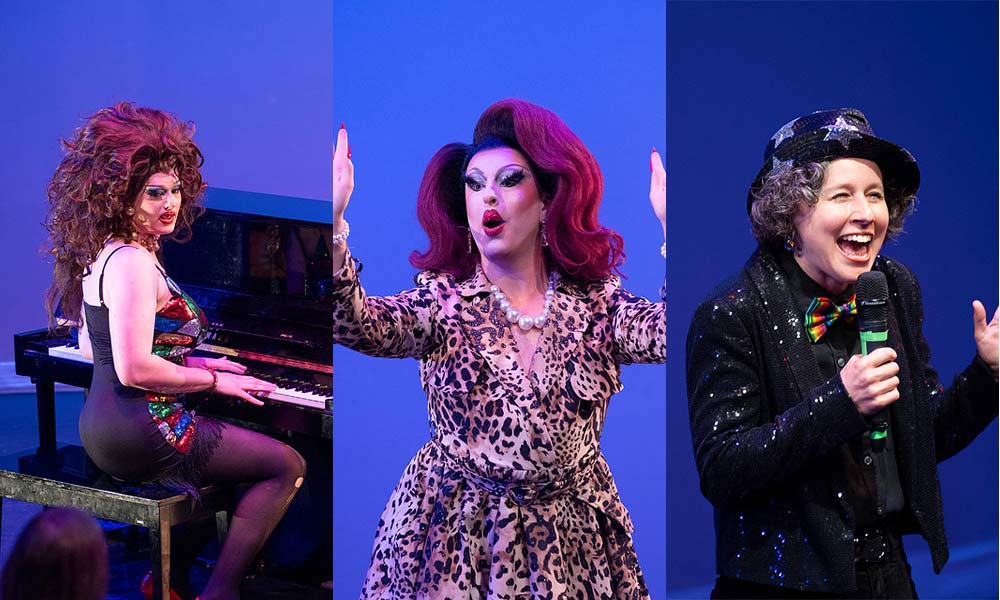
It’s impossible to say when Jewish communities started engaging with drag, the performance art form that presents exaggerated or stylized expressions of gender. The Torah prohibits cross-dressing in Deuteronomy, so in early Jewish communities, the only space where it was allowed was in Purim spiels. The festive Jewish holiday encourages disguise, costumes, drama, comedy and performances of all kinds. As the Sage Rava puts it in the Babylonian Talmud, “A person is obligated to become intoxicated with wine on Purim until one does not know how to distinguish between ‘cursed is Haman’ and ‘blessed is Mordecai.’” Transformation and hidden identities are integral to the holiday, thus cross-dressing characters became fixtures of the celebration. These roles, while not drag performances in the modern sense, still allowed Jews to play with gender at a time when gender roles were rigid and strictly enforced.
In the 1920s, drag was embraced by Jews who took part in Weimar Germany’s cabaret culture, but it was the Broderzinger movement in Eastern Europe that truly expanded and cultivated Jewish drag. Over the course of the 19th and 20th centuries, drag found its footing in Yiddish theater through this movement, establishing itself beyond the single day of Purim. One of its biggest stars was female singer and comedian Pepi Litman, whose signature role was a male Hasidic Jew. Wearing pants and sporting a deep husky voice, Litman embodied a typically male sexuality, charisma and physical presence that was unusual (if not unheard of) for women to adopt at the time.
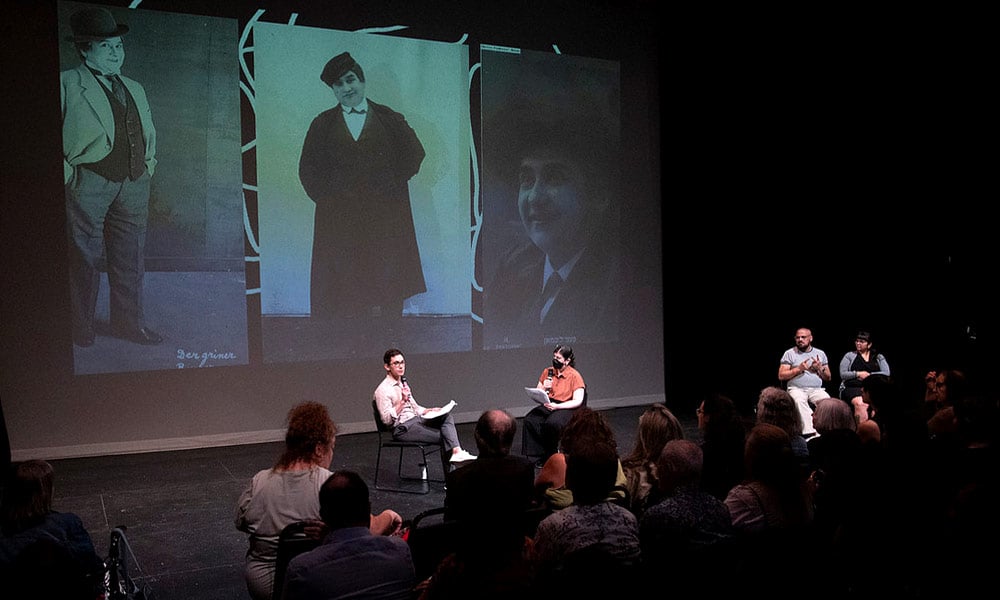
Helena Gindi (R) of the 14th St. Y interviews Golan Moskowitz (L). Images of Pepi Litman are projected on the screen behind them. Photo credit: Melanie Einzig
“We can’t necessarily say that this was a queer art form that she was engaging in,” says Golan Moskowitz, associate professor of Jewish studies at Tulane. “But there are elements of gender transgression and a kind of queer desire that she’s playing with in her performances.”
Litman explored the role of women in Jewish society by embodying masculinity, which was, of course, controversial but was also an inspiration to women who imagined a life beyond the private spaces in which they were usually confined.
That a local reform synagogue, the heart of the Jewish community, was embracing queer culture reminded queer attendees and performers who may have distanced themselves from Judaism of the beauty of the faith.
Drag as an independent art form arose in the United States in the 1960s and 1970s, and many LGBTQ+ Jews found in it a unique way to come to terms with their intersecting identities. Drag pioneer and queer activist Flawless Sabrina, born Jack Doroshow, is credited with starting one of the first drag pageants. Though introduced in the late 1950s, it was the 1967 competition, “Miss All-America Camp Beauty Contest,” that drew the most attention, and was immortalized in the 1968 documentary The Queen. Doroshow drew from his Jewish identity to craft his persona as Flawless Sabrina, a pushy yet loving “bar mitzvah mother” who wanted the best for her kin. This character was a way to reckon with a culture that both shunned queer identities and villainized Jewish mothers.
“There were all these negative stereotypes of Jewish mothers holding their children back and being manipulative,” says Moskowitz. “It was convenient from a straight male perspective (think Woody Allen or Philip Roth) to critique Jewish womanhood and Jewish mothers for being needy, controlling, excessive and embarrassing when their sons were trying (and sometimes failing) to assimilate and to become well-adjusted American men.”
As Flawless Sabrina, Doroshow not only became a loving mother figure to the young queens who competed in the pageant, she revised the stereotype of the Jewish mother, portraying her instead as glamorous and supportive, Moskowitz contends.
Another impactful Jewish drag queen Moskowitz highlights is Gilbert Block, who as Sadie, Sadie the Rabbi Lady fought against American apathy in the face of the 1980s AIDS epidemic.
“Sadie, Sadie the Rabbi Lady was involved in protesting [Ronald] Reagan’s willful ignorance around AIDS,” he says. “There’s a picture of her holding a poster of Reagan with a Hitler mustache drawn on his face and a swastika next to him… [she] wrote in her memoir about facing the constant death and hopelessness of the AIDS crisis by drawing strength from a Holocaust survivor she knew growing up, who would occasionally take some time to close off from the world, scream, and sit with their pain, and then find a way to move on and move forward.”
To raise awareness of the AIDS epidemic and how it was devastating the drag community, Sadie, Sadie worked with the street theater group the Sisters of Perpetual Indulgence. Portraying themselves as nuns with drag costumes and makeup, the sisters confronted those who were ignoring the issue and protected and advocated for those who were too often alienated by religious authorities. They raised funds for communities affected by the AIDS crisis and in 1983, held some of the first candlelight vigils for victims in San Francisco and New York City, gifting the gay community a rare opportunity to grieve and process the ongoing tragedy.
Since the 1990s, one of the most famous Jewish drag queens has been Israel-born Rabbi Amichai Lau-Lavie, who performed as Rebbetzin Hadassah Gross and is the subject of the 2024 documentary Sabbath Queen.
“Figures like Lau-Lavie are able to use drag as a kind of third space, you could say…partially yourself but partially a performance,” says Moskowitz. “Because [Lau-Lavie] felt like he grew up in a context that was highly patriarchal with this image of God as a masculine judge and this photograph of his Holocaust victim grandfather…who was always looking down on him and judging him as a boy, he felt like he had to enter this more theatrically feminine or queer manifestation of himself to experience spirituality honestly, and drag helped him to do that.”
In an interview with The Canadian Jewish News last year, Lau-Lavie described what he learned performing as Rebbetzin Hadassah Gross:
“Coming out as gay in a religious family meant I had to ask: Which narrative do I follow? My heart, that allows and demands of me to come out and be who I am and love who I love versus the Torah, the laws and the family expectations?” he asked. “[Rebbetzin] gave me the permission to be very publicly out as gay, and very publicly out as Jewish—and, dare I say, spiritual, maybe even religious—and do it through the wig and with the makeup.”
Today, drag is more popular and mainstream than ever, offering a unique space of self-acceptance where personas are loud and proud. Jewish drag performers like Pink Pancake (aka Michael Witkes) continue to foreground their Jewish identity, to the delight of fans and the performers themselves. Witkes’s 2024 one-woman show Today You are a Man! featured Pink Pancake lip-syncing to real audio clips from his bar mitzvah. In a Moment interview at the time, Witkes shared that drag offered an opportunity to reclaim that bar mitzvah, where the pressure to become a man was traumatizing, and turn it into a celebration of who he is today. Other performers use the platform offered by drag pageants to show off Jewish identities that are negatively stereotyped and transform them into fun and comedic acts. From Miz Cracker’s celebration of the Jewish American princess to Alvah Klempt as “the Jewish mother you never asked for,” drag allows Jewish identity to shine.


In the last two decades, drag has also expanded far outside queer circles. The popularity of MTV’s RuPaul’s Drag Race catapulted drag into mainstream culture, perhaps best exemplified by the sheer amount of drag vocabulary that has been adopted into general vernacular (i.e., the verb “serving” to mean delivering a confident and memorable look, the verb phrase “reading someone” as accurately picking out one’s flaws, and the noun “tea” meaning gossip). And while drag story hours where kings and queens read books to children have invited controversy, public libraries all over the country have hosted them. These, as well as the increased popularity of drag brunch events have introduced and welcomed more and more Americans into the culture of drag.
This expansion, of course, brings backlash from people who believe the art form should remain a subculture, but this growth can be really beautiful. Moskowitz recalls the impact of a queer night at his local reform synagogue. That the synagogue, the heart of the Jewish community, was embracing queer culture reminded queer attendees and performers who may have distanced themselves from Judaism of the beauty of the faith.
This phenomenon was no doubt on the minds of the organizers of the recent program, “Jewish Drag Icons: Then and Now,” at the 14th Street Y in New York City. The evening celebrated both the complex history and the lively contemporary drag scene, featuring a conversation with Moskowitz and a spirited live show with performances by Alvah Klempt, Matzah Belle Soup, Yochai Greenfeld and Miryem-Khaye Siegel. The performers delivered dazzling vocals, choreography and a lot of laughs to the sold-out Pride event, perfectly illustrating why the artform has remained popular for so long.
-
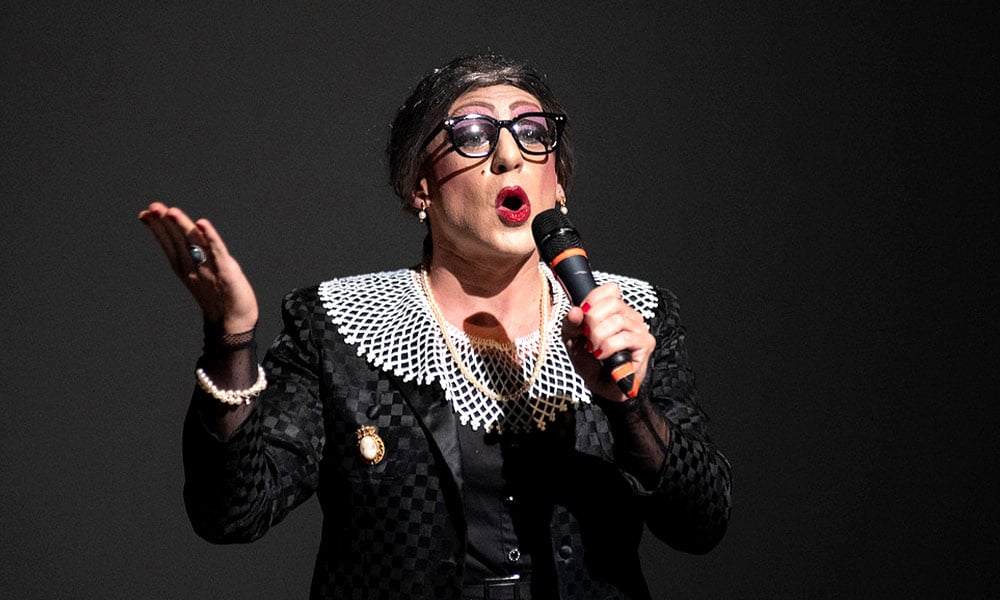
- Yochai Greenfeld as RBG. Credit: Melanie Einzig
-
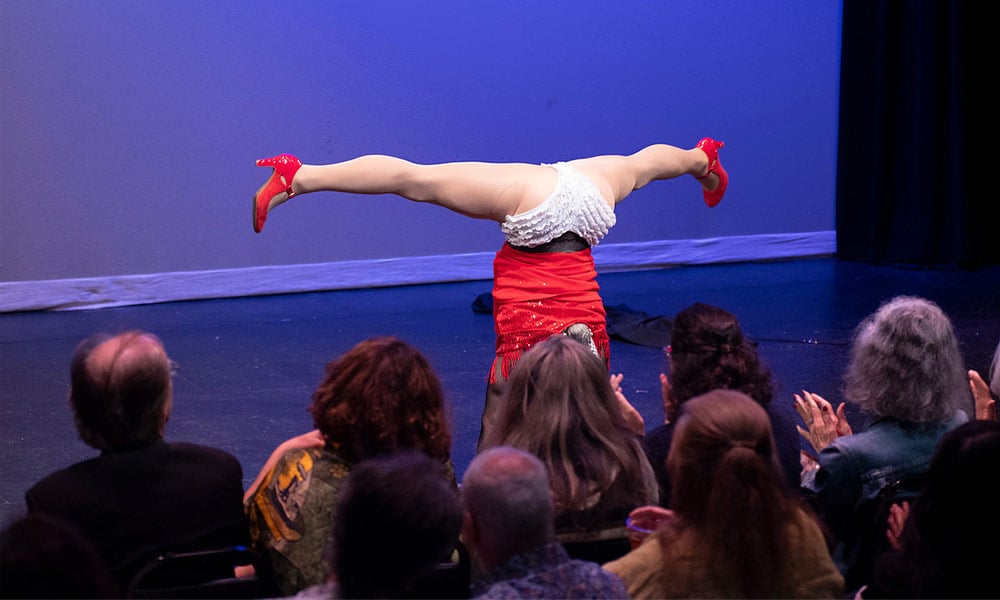
- Yochai Greenfeld. Credit: Melanie Einzig
“Ironically, or maybe paradoxically, the opening of minds can work not only toward getting mainstream perspectives to think otherwise,” says Moskowitz, “but also toward getting LGBTQ or progressive perspectives to find more beauty or personal relevance within tradition.”
Top image: “Jewish Drag Icons: Then and Now,” at the 14th Street Y in New York City featured (from left to right): Alvah Klempt, Matzah Belle Soup and Miryem-Khaye Siegel. Photo credit: Melanie Einzig.
One thought on “The Legacy of Jewish Drag—with Historian Golan Moskowitz”
That is such a fascinating deep dive into the history of Purim spiels and Yiddish theater! It’s amazing how performance art has always found a way to push boundaries, especially with trailblazers like Pepi Litman. As anyone who does heavy stage makeup or wears dramatic falsies for these types of performances knows, keeping your eye area clean afterward is a nightmare. I highly recommend using a proper lash shampoo like the one from Stacylash to completely break down the stubborn glue and makeup without damaging your natural lashes.