
As Israel’s July sun beats down on his broad shoulders and veined arms, Alex Aaron does bicep curls with a discarded scrap of a Hamas rocket near the Gaza border. “I think I just invented rocket curls so can someone please trademark that for me!” the 20-year-old Michigan native captions his Instagram post. With close-cropped Clark Kent hair and a Magen David dangling on his brawny chest, it’s easy to see why Aaron’s grown into an online influencer—on his Instagram, @alexaaronlab, he merges fitness advice and Judaism in a stream of Gen Z lingo to nearly 100,000 followers. During a typical week, he’s as likely to talk about searching for a Jewish wife as how to format a successful back workout.
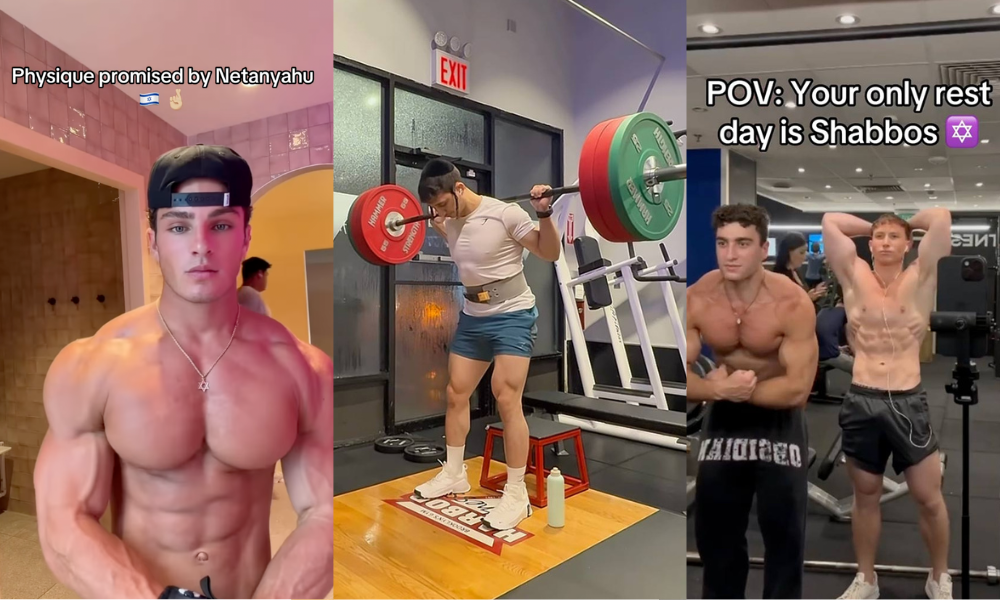
Currently a pre-med student at the University of Colorado Boulder, Aaron stumbled upon his mix of fitness and Judaic content accidentally. When he was 18 years old, he won the 2024 Colorado Muscle Classic, his first bodybuilding competition, and the following year started posting videos on the advice of his friends. His Instagram started taking off when he posted a shirtless video captioned “Jewish genetics.” The hate comments that flew in boosted his engagement, and ever since, his beat has been Jewish fitness. “Making people mad based on the fact that I’m Jewish and that I work out is hilarious,” Aaron says. Some of his most popular posts subvert antisemitic language and memes, with captions joking that his abs were “promised by Netanyahu” or hitting the gym to “scare away the keyboard antisemites.”
Aaron spent this past summer in Israel on a Birthright sponsored trip, making more fitness content and partnering with a clothing brand. He plans to move there in the next two to three years after graduating. “It’s where I’m meant to be, where Jewish people are meant to be,” he says, noting that Israelis are welcoming and outgoing, but also have no filter, a trait he says he shares. “Israeli culture is saying what’s on your mind, doing whatever the fuck you want to do.” Most importantly, though, he wants to highlight Israeli athleticism, which fewer people are aware of.
He’s part of a small but growing contingent of young people, mostly men, posting fitness content to social media that centers their Judaism, either jokingly or inspirationally. Around seven million users visit Aaron’s page monthly, and his comment sections are a mix of antisemitic remarks and praise from fellow Jews who look up to him. Yoel Levy, known as The Jewish Fitness Coach, posts advice to over 267,000 followers, and Ryan Behrmann, a friend of Aaron’s, says he owes his muscles to “Jewnetics” and advises how to make Shabbat meals fit your macronutrients. Yuda Katz, a Hasidic Jew, once shared a video of himself squatting 315 lbs wearing a yarmulke and peiyot. This new cohort of Jewish strongmen celebrate their physical prowess, challenge assumptions they perceive about Jewish strength and cast Israel as a new fitness mecca.
“What Jews need to do is to get out of our box,” Aaron says. “We need to post more on social media. There’s so many fit, good-looking people in Israel that the world needs to know about.”
***
Today’s new Zionist muscle men are, unknowingly or not, mirroring a movement that contributed to Israel’s founding. When Zionism began to catch on in Europe, the prevailing stereotype of a Jewish man was a nebbish or a weakling. It didn’t come out of nowhere, says Michael Brenner, editor of the book Emancipation Through Muscles: Jews and Sports in Europe: Jews were historically barred from professions like agriculture, so they turned to areas like religion and academics. “The assumption was they were mainly studying, sitting in these dusty rooms without being exposed to fresh air,” Brenner says.
Things changed at the Second Zionist Congress in 1898, where physician and author Max Nordau coined the term “Muscular Judaism” as the way to achieve Zionism’s goals. (At the time, “Muscular Christianity” was making the rounds, too.) In a subsequent article, Nordau advocated for a “Jewry of muscles” that sought to abandon “the narrow Jewish street [where] our poor limbs soon forgot their gay movements.” In his vision, physically weak people wouldn’t be able to forge their own country. “Let us take up our oldest traditions,” he wrote, “let us once more become deep-chested, sturdy, sharp-eyed men.”
This new male ideal inspired Jewish men across Europe. “By creating this image and creating a new Jew, they’d create a new Jewish society, which would lead to a new Jewish state” that would need to be taken by force, Brenner says. To achieve this, one had to work hard and train instead of studying in a yeshiva. Jewish sports clubs began popping up around Europe in the early 20th century, offering the most popular sports at the time: gymnastics, boxing and football (what Americans call soccer). And with antisemitism on the rise in Germany, many Jews also enrolled in self-defense classes at the clubs. The organizations were named either after heroic characters in Jewish history (i.e., Bar Kochba and Samson) or embodied words or phrases about power: HaKoach (strength), Gibbor (brave) and Gevurah (heroism). The most famous was the Maccabi World Union, named after the Jewish liberation movement that fought for independence, and which to this day hosts the Maccabiah Games, known as the “Jewish Olympics.” The Maccabi World Union, its website reads, “emphasized physical development in service of the Jewish nation.”
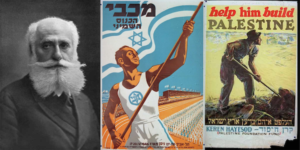
Left: Max Nordau, 1906, public domain. Center: Poster from the 1946 Eight Annual Maccabiah Gathering in Tel Aviv, public domain. Right: 1940s Keren Hayesod fundraising poster, public domain.
In imagining the “New Jew,” Nordau forged a path for the sabra—the muscular, sun-kissed, Israeli-born Jew who would help create what would become the Jewish state. Best portrayed by Paul Newman as Ari Ben Canaan, a soldier for Israel’s independence in the 1960 movie Exodus, the sabra cultivated both his body and the land, and in posters, he was often depicted with agricultural tools. It was part of a “religion of labor,” which emphasized a working-class connection to the land as a reason for Zionism, and was advocated by philosopher Aaron David Gordon, who emigrated to Palestine in the early 20th century. “We lack the habit of labor—not labor performed out of external compulsion, but labor to which one is attached in a natural and organic way,” he wrote in 1911. “This kind of labor binds a people to its soil and to its national culture.” Cambridge Professor of Modern Hebrew Studies Yaron Peleg writes that “by 1948, both farmers and soldiers became two of Zionism’s most distinct symbols, national ideals of productivity and physical force.”
Not everyone was convinced that physicality was the best strategy for establishing a Jewish state. For Ahad Ha’am, the prominent Hebrew essayist and pre-state intellectual who is considered the founder of “cultural Zionism,” physical strength’s absence in Judaism was a feature, not a bug. He envisioned a future Jewish state as a spiritual center, divinely handed down, instead of taken by force. Historian Anita Shapira writes in 1992’s Land and Power: The Zionist Resort to Force that Ha’am thought “the Jewish people did not suffer so much affliction for thousands of years just to achieve the mundane goal of bringing into being still another tiny polity like Serbia or Montenegro.” A special people should have a special nation. “Israel’s salvation will be brought about by ‘prophets,’ not ‘diplomats,’” he said.
After Israel’s founding in 1948, the cult of Muscular Judaism faded, but its mindset remained. In the 21st century, the typical stereotype of an Israeli Jewish man has been one of physical strength, and Israel touts one of the most technologically advanced militaries in the Middle East. But on October 7, 2023, the country’s aura of invincibility vanished, leaving young Jewish influencers such as Aaron feeling the need to regain the mythos of power and advocate for Israeli security and prowess by fortifying their body and commitment to the land.
***
“People fucking hate us,” Aaron says in a May Instagram video, a crystalline Israeli beach sparkling behind him. “We need to be strong as Jews.” He’s speaking to Sammy Yahood, a British expat who agrees, then encourages Jewish viewers to say Modeh Ani, the traditional morning prayer, setting the tone for the day. Afterward, Yahood reminds people watching to head to the gym.
If Aaron is bulky and daunting, Yahood is scrappy and lean, with a Star of David tattooed at the bottom of his chest. A 26-year-old self-defense instructor who first taught krav maga in London, he can almost seem rabbinical in preaching life lessons to his nearly 200,000 Instagram followers about diasporism, resilience training and the importance of a strong mindset. Through his online platform Peace Through Strength, he strives to promote confidence and positive masculinity “underpinned by Jewish values” through bootcamps, seminars and workshops, priced at $28 a month.
“Testing our resilience is the only way we can ensure that we can be confident when discomfort is placed upon us,” Yahood tells me on FaceTime while strolling through Tel Aviv, where he moved two years ago. This includes anything outside normal comfort zones, from taking cold showers to engaging in difficult conversations to asking a barista their name. For Yahood, the body and the mind cannot be separated. Both are needed to confront online antagonists.
“Our role as Jews is to be the light,” Yahood says. “If Tucker Carlson and Candace Owens are the dark, and we only focus on them, our light will just get dimmer and dimmer until it goes out. If, as the light, we decide to come together to pool our resources, experience and expertise…then that’s how we win.”
Yahood’s philosophical musings often come with a bite. He hasn’t been shy about filming himself waving the Israeli flag in the London streets, and he’s been known to disrupt pro-Palestinian encampments in the middle of the night. On a trip to the United States in May, after browsing shirts emblazoned with maps of Gaza and Israel at a Florida campus pop-up store, he asked if the sellers were Jihadi. On one of the posts pinned to his profile, he says he was assaulted by a “gang of Islamist thugs” in England who left a red scratch on his cheek when stealing his Israeli flag. “I kicked the shit out of two of them,” he says over the whistles of Bobby McFerrin’s “Don’t Worry, Be Happy.” When I ask if he considers himself a provocateur, he rejects the label: “If my existence as a Jew and an Israeli is provoking, then you’re the problem.”
The rise of antisemitism is a war, he says, that Jews are fighting in the wrong way. He rails against the controversial Blue Square antisemitism ad that played during the 2026 Super Bowl, where a bullied teen is rescued after finding a sticky note with “dirty Jew” written on it stuck to his backpack. Yahood thinks it is a perfect encapsulation of a victim mindset. “You can’t be the most successful minority and win every single war your surrounding hateful neighbors start against you, have the most technologically advanced military, one of the most wealthy nations per capita…and also play the victim,” he reasons. Even if non-Jews understand that antisemitism is pervasive, if it’s exaggerated, “people will stop listening and stop believing,” he says. He also worries that Jewish children who watched the ad may have internalized the narrative of being helpless and unable to rely on their own strength.

Left and right: Sammy Yahood (screenshots from @sammyahood). Center: Post shared by the Jewish Defense Network (@jewishdefensenetwork).
This points to what Yahood and his fellow social media strongmen see as the “gulf” between Israeli and diaspora Jews—“maccabees and bubbalas.” After the Holocaust, he says, Jews “took two boats in opposite directions.” One went to Israel, where “we required strength, resilience, bravery and courage to fight for our nation.” The other boat went to America, where Jews assimilated their Jewish identities away. “We bubble-wrapped our children, so they could be shielded from the trauma.”
It’s this coddling, Joseph Kotel argues, that has made American Jews complacent. As the founder of the Jewish Defense Network (JDN), an online group that advocates for American Jews to pick up self-defense and firearms training to avoid becoming victims of antisemitic attacks, he aggregates resources on his website and Instagram, which boasts over 80,000 followers. In a 2024 TikTok reel with an Israeli flag behind him, Kotel discusses what he sees as hard truths. “Most of you are weak, and if you were assaulted in the street, you would fold like a lawn chair.”
Clad in a shirt emblazoned with an American flag-patterned Star of David, Kotel, who requested to use his Hebrew name out of privacy, describes how his family immigrated from Russia to New York City when he was three. He attended a self-defense camp in the Catskills as a teen, an experience that came to mind after October 7. No other group was aggregating self-defense advice and empowering Jewish identity, so he created one himself, focusing on tangible resources such as first aid, martial arts and legal defense.
On one hand, Kotel rejects comparisons between his Jewish Defense Network and the infamous Jewish Defense League, which was founded in 1968 by extremist Rabbi Meir Kahane in New York City to protect Jews from antisemitism by “whatever means necessary” and has been classified as a right-wing terrorist group. On the other hand, he says he strives for the Jewish Defense Network to be “the JDL for the modern age.” Certainly the language Kotel uses mirrors that used by Kahane in a 1968 JDL ad he took out in The Jewish Press: “We are talking of JEWISH SURVIVAL! Are you willing to stand up for democracy and Jewish survival?”


In everything he posts, Kotel emphasizes self-reliance in the face of violence; his slogan, “Never Again Begins With You,” insinuates that our bodies are the first line of defense in preventing another Holocaust. “You are your own first responder,” he says. “No one’s coming to save you.”
He’s reflecting a common anxiety among Jews. According to the American Jewish Committee, 91 percent of them say that violent incidents in the last several years—including murders at the Capital Jewish Museum; the arson attack on Pennsylvania governor Josh Shapiro’s home; and the Boulder, Colorado, firebombing—made them feel less safe, and 78 percent say they feel this way because of October 7 and subsequent wars.
This translates to tangible patterns. There’s been a recent plethora of Jewish self-defense books, whose titles include The Wrong Jew: Defeating Those Who Want Us Dead, Self-Defense: A Jewish Manifesto and The Armed Jew: The Case for Jewish Gun Ownership. A June cover story in the Orthodox magazine Mishpacha detailed surging gun ownership among Orthodox Jews, and Lox and Loaded, a Jewish firearm training group, now has chapters in 24 states and partners with the National Rifle Association.
Earlier this summer, Kotel posted the news that two men, one Jewish and one Asian, had been stabbed in New York, along with a call to re-up on security measures like pepper spray, or a concealed carry permit. “If you’re openly Jewish,” he said, “your head should be on a swivel.”
***
The machismo bubbling up on these Jewish influencers’ Instagram accounts also reflects the brash messaging from the upper echelons of the U.S. government, where White House media and officials specifically marry physical prowess and nationalism. President Trump’s obsession with fit, handsome men culminated in this summer’s UFC fight on the White House lawn, from which he barred “fat soldiers” and praised fighters with “big, strong muscles.” The official White House X account advertised the event with AI-generated images of a jacked Uncle Sam/Trump crossover, one of which promoted “strength through sacrifice.” (After their matches, nearly all of the sweaty, battered cagefighters thanked Jesus.) Robert F. Kennedy Jr. and fellow cabinet member Pete Hegseth post videos bench pressing or doing other workouts in jeans. Hegseth recently announced his “Department of War” will screen servicemembers over 30 for appropriate testosterone levels. “This initiative,” he said, is about “ensuring you have the biological foundation required to sustain the fight.” Maybe it’s not surprising that this weird soup of body fascism would reignite the dregs of Muscular Judaism. Everyone, it turns out, is receptive to the propaganda that might makes right.
Of course, it’s unclear whether social media’s Semitic strongmen are posting in an attempt to redefine the Zionist image…or just to be funny. Aaron, the bodybuilder, certainly doesn’t see himself as a pundit on Israeli affairs: “There are people that are smarter than me that can do that, that’s not my place in the fitness industry,” he says. True, he usually just flexes with friends. But even so, he frequently talks about antisemitism, he says, to inspire young Jewish kids.
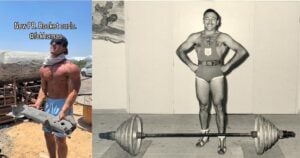
Left: Alex Aaron (screenshot @alexaaronlab). Right: Jewish weightlifter, Hapoel Kiryat Haim Weightlifting Club
Yahood, more on the serious side, has the struggles of the Jewish people constantly top of mind. “Were our grandparents forced to wear a yellow star just for us to end up choosing to hide our beautiful Magen Davids out of fear?” he asks in one video. “This can’t be the way. We must get stronger together.”
On the beach with Yahood in another post, Aaron talks of his ancestors walking thousands of miles through the Sinai. Our shared baggage, he says, has a modern parallel. “Our IDF soldiers [are] carrying 50-pound bags, walking through rubble, and you’re in the diaspora, sitting on your fucking couch in your million-dollar house and you’re not able to at least make your body a form of symbolism for our culture, by at least looking good?” he asks. “You’re not doing your part.”
Twentieth-century Muscular Judaism, which was effectively a “PR campaign,” Brenner says, resulted in a new nation. Who knows what will happen this time? Could this new era of Semitic strongmen reinvent the Jewish image online? To one Instagram commenter, Aaron is the “only Jew I’ve ever seen in shape in my life.” Maybe it’s possible to change a stereotype one bicep curl at a time.
(Top image credits: Screenshots from Alex Aaron (@alexaaronlab), Yuda Katz (@yuda.katz), Ryan Behrmann (@ryan.behrmann))
2 thoughts on “The New Era of Jacked Jews”
Small yet mighty David against Goliath, using brains along with brawn; ancient Maccabee men hammering away at the destruction of our ruined temple to shine the eternal light; how awesome it was to read about this renewal and reversal of the nebbish Jewish man. The genetics were always there. With the social and video skills of this rebirth of muscular Judaism generation, they can move mountains of hate and terror and keep all our spirits strong with hope for peace. And look good doing it.
yes, this is important and these young men (no women?) should be encouraged and admired. Jewish intellectuals are numerous enough already and traditionally might take a smug dismissive view of something this fundamental and un-nuanced. But Nordau had a very limited impact on Jewish history and the founding of Israel, was really and easily marginalized. To build Jewish ‘strength’ however it’s defined, must be a priority even if it goes against the passive and reactive establishment. Having muscle enough to be able to perceive what is good and productive for Jewish well-being must take its place alongside all the paradoxes and unanswered questions and double-edged swords and blather, in which depressingly large numbers of Jews fail to have even basic awareness of what is good for their future, and what is clearly menacing based on what people openly espouse. In a test of wills which physically fit men standout in, the edge may well belong to the fit and the ready. And those against Jews must not be the only ones in that category…