
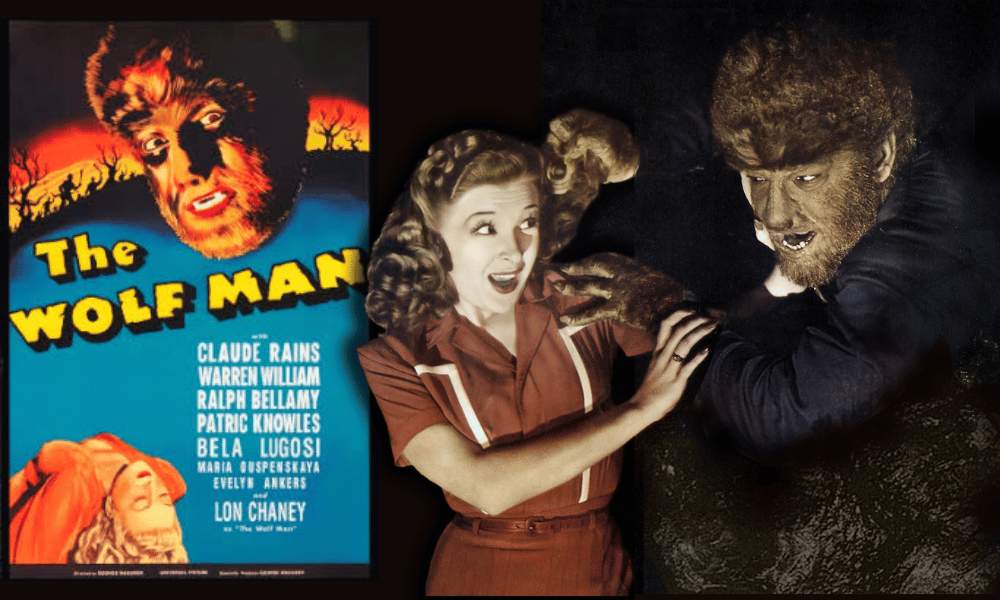
The Universal Studios franchise of classic monsters is firmly embedded in the zeitgeist. Everyone knows Frankenstein, Dracula, The Wolf Man and The Creature from the Black Lagoon. If you haven’t seen the original movies before, you might not realize how many of them are more complex psychodrama than nonstop horror show. Released mainly from the 1930s through the 1950s, many of these films folded into their narratives the instabilities and catastrophes of mid-century Europe. With 1941’s The Wolf Man, screenwriter Curt Siodmak had personal experience to draw from.
Siodmak was a Jewish man born in Dresden, Germany, in 1902. As a young man, he found a foothold as a writer of screenplays, such as the silent film People On Sunday, which he co-wrote with fellow future refugee Billy Wilder (Sunset Boulevard). With Nazism and antisemitism on the rise, he sensed that it was only a matter of time before he was no longer safe in Germany, so he left for safer shores—first in England, then in Hollywood, where he brought the story of the legendary Wolf Man to life.
“I am the Wolf Man. I was forced into a fate I didn’t want: to be a Jew in Germany,” Siodmak said in a 1999 interview.
In the film, a man named Larry Talbot (played by Lon Chaney Jr.) goes to his ancestral home in Wales to attend to family business and try to mend the relationship with his estranged father (Claude Raines). A local woman named Gwen (Evelyn Ankers) catches his attention. Before long, his courtship attempts land him at the table of a fortune teller at a Romani encampment—where he is bitten by a wolf while trying to play hero. This fateful incident sets Talbot down the road to his lycanthropic transformation, and turns the town into a whisper chamber with him caught in the middle.
The story of the werewolf has ancient roots, but in modern stories has often been used as an allegory for male aggression. The man who seems normal by day but turns into a dangerous beast by night is an enduring story to tell in a patriarchal society. The Wolf Man however is not just a story of male aggression—it is a story of what can happen to the psyche of the accused, to someone who finds himself in the middle of events beyond his control.
When watched through the lens of the wartime Jewish experience in Europe, more similarities become clear. He might be a werewolf by the full moon, but when he is not in wolf form he lives the life of a victim with something to hide. As Talbot starts to link his memory gaps with werewolf attacks in town, his paranoia and shame isolate him. How can he seek help if that involves guaranteed persecution? Blending in, pretending that all is well, and downplaying his reality seems like the best bet for survival. But one cannot wear those two faces for long before confusion reigns.
It is as if The Wolf Man was a bucket into which Siodmak poured the many swirling emotions he had at the time. Even in human form, Talbot is an outsider. A big and burly man—not exactly the ideal of the Hollywood leading man at the time—he simply stands out.
When he sees Gwen for the first time, it is love at first sight, and the courtship takes on a voyeuristic quality. He notices her from afar and locks his gaze on her movements. Gwen seems to represent the feminine ideal of the gentile persuasion, and a woman who may even be out of Talbot’s league. Attempting to win her heart is actually the move that starts the trouble in the first place.
Another important feature is how his victims are marked. According to lore, when Talbot sees a star pentagram reflected on somebody, that means that they will be his next victim. A star marking people for death? That sounds familiar. “I am the Wolf Man. I was forced into a fate I didn’t want: to be a Jew in Germany,” Siodmak said in a 1999 interview with the Writers Guild of America, a year before he died at the age of 98. “The swatika represents the moon. When the moon comes up, the man doesn’t want to murder, but he knows he cannot escape it, the Wolf Man destiny,” he wrote, suggesting a cycle of violence that consumes everybody, even the oppressor.
Eventually, Talbot sees the star reflected on Gwen. Perhaps this suggests a fear that Siodmak carried with him of contamination—that being close to anyone at all could potentially harm them, as if bad things followed him where he would go. The fears of guilt by association are palpable, as if the only way to keep loved ones safe is to isolate oneself. Thus the Wolf Man remains an eternal “other.”
This experience of being othered, of being an outsider, comes through in other monster films of the time. Dracula takes a look at the immigrant experience of Eastern European outsiders in western culture. Frankenstein is the story of a mad genius who, through his hubris, creates a tragically misunderstood “monster.” These outsiders inspire hysteria, unrest, mob rule, persecution and mistrust in the societies they enter. But only the Wolf Man successfully assimilates himself into society by day. And notice where his transformation takes place—upon visiting a fortune teller at a Romani encampment, another group of outsiders who are bestowed a magical quality by society (the teller himself is played by Bela Lugosi, who famously starred as Dracula in many films). Of course, this magic can be used against them if ever need be.


While watching, I couldn’t help but also note that the depiction of the Wolf Man has some interesting overlap with antisemitic Nazi propaganda: The scraggly hair, the animalistic features, the aggressive facial expressions that suggest ill intent. This was how Joseph Goebbels hoped the citizens of Nazi Germany would start seeing Jews. In foregrounding an exaggerated other, Goebbels succeeded in convincing some to see the Jew as a threatening humanoid, making them into easier scapegoats.
Finally, what is interesting about the Wolf Man is he is blamed and targeted so much, and his reality is split to such an extent that it almost doesn’t matter whether he is guilty or not. How he perceives himself and how the fearful villagers perceive him are exactly the same. Many persecuted groups end up internalizing messages of the oppressor, which makes the tragic end seem almost pre-ordained.
The Wolf Man (1941) is available on various streaming services, including Peacock, Amazon Prime Video and YouTube Primetime.
Top image: Promotional movie poster and l image featuring Evelyn Ankers and Lon Chaney Jr.