

Jewish Politics & Power is published every other week. Sign up for our newsletter for updates.
1. Mamdani is catching up
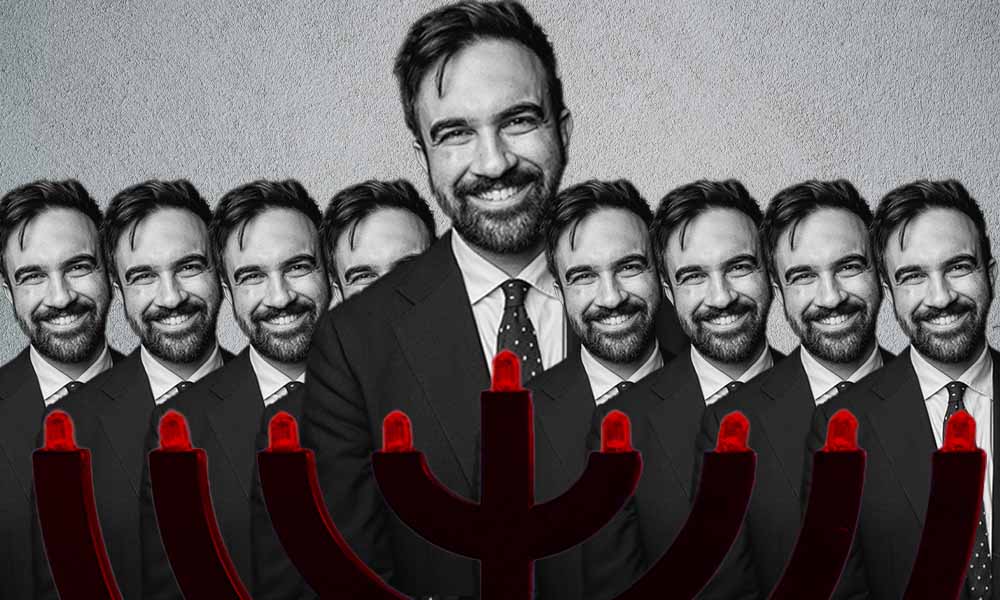
On the seventh night of Hanukkah, mayor-elect Zohran Mamdani lit the menorah at the home of actor Mandy Patinkin. He flipped latkes in the frying pan, joined in the blessings and sat down for a nosh.
On the fifth day of Hanukkah, Mamdani celebrated with members of New York Jewish Agenda, a liberal local Jewish organization.
A week earlier, the mayor-elect was with Satmar Hasids in Brooklyn for the somewhat obscure Kuf Alef Kislev, an annual celebration marking the escape of the sect’s leader Rabbi Teitelbaum from the Nazis. And yes, he visited both rival factions of Satmar.
On the day of the horrific antisemitic attack on Jewish Australians celebrating Hanukkah in Sydney, Mamdani put out a lengthy statement unequivocally denouncing the terror act. The next day, he visited the “Ohel,” the burial site of revered Chabad-Lubavitch Rabbi Menachem Mendel Schneerson in Queens, to pay his respect to members of the Lubavitch community who were murdered in Sydney.
Mamdani will be sworn in as New York City’s mayor on January 1. In between preparing to move into Gracie Mansion and setting up his new cabinet, Mamdani has spent a lot of time reaching out to his most difficult constituency—New York Jews.
He met privately with a group of rabbis who had criticized him (reporting a “candid” and “positive” meeting, although differences remained) and attended numerous Jewish events. A Sienna poll found that his efforts may be bearing fruit. Mamdani’s favorability among Jewish New Yorkers is now at 35 percent, a far cry from previous mayors, but a remarkable improvement compared to only 18 percent of Jews who viewed him favorably in November.
A moment of truth with the Jewish community came last week, after he announced his choice of Catherine Almonte Da Costa to serve as director of appointments, a position overseeing City Hall hirings. Shortly after the announcement, the ADL found disturbing and blatantly antisemitic comments Da Costa had posted on social media 15 years ago. Mamdani distanced himself from her comments, effectively showing Da Costa, who had previously served inBill De Blasio’s NYC administration, the way out. The next day, she announced her resignation.
Will the mayor-elect’s quick response help mend relations with the Jewish community?
The ADL insisted that this was not enough and asked Mamdani to review his vetting policies. Mamdani made clear that his team was not aware of Da Costa’s comments prior to choosing her and that the mayor-elect has decided to appoint an outside expert to oversee the vetting process. This response may not calm the concerns of all Mamdani’s critics, especially not of those at the ADL, but his handling of the case is a clear indication that the future mayor of New York has been listening to what the Jewish community is saying.
2. But what about globalizing the intifada?
The Sydney antisemitic terror attack brought to the fore the debate over the legitimacy of using the phrase “globalize the intifada” in pro-Palestinian demonstrations.
The phrase, seen by protesters as a mere call to stand up for Palestinian rights worldwide but viewed by Israelis and many Jewish Americans as a call for violence, plagued Mamdani’s mayoral race. The mayor-elect refused to condemn the use of the phrase, while stating he does not use it and would “discourage” others from doing so.
Following the Bondi Beach attack, the American Jewish Committee issued a fact sheet noting that in Australia and in the UK, authorities now view “globalize the intifada” as hate speech and that Mamdani is still reluctant to take on this approach. An Instagram post liked by more than 16,000 viewers called on Mamdani to speak out against use of the phrase in anti-Israel protests. Renowned scholar and former U.S. special envoy on antisemitism Deborah Lipstadt wrote on X: “Mr. MayorElect [sic], when you refuse to condemn & only ‘discourage’ use of the term ‘Globalize the Intifada,’ you help facilitate (not cause) the thinking that leads to Bondi Beach.”
Mamdani, asked whether he’ll be willing to reconsider his previous approach and condemn the saying following the attack in Australia, wouldn’t budge: “I continue to discourage the use of that phrase, a phrase that I do not use myself, and I continue to focus on the work at hand of keeping Jewish New Yorkers safe in the city,” he said, sticking to an approach that is nuanced, but falls short of what some Jewish New Yorkers would like to hear.
3. There’s a new antisemitism special envoy
Last Thursday, the U.S. Senate confirmed the nomination of Rabbi Yehuda Kaploun as the new Special Envoy to Monitor and Combat Antisemitism. Kaploun, a rabbi affiliated with the Chabad-Lubavitch movement, will be the first rabbi to serve in this post, as well as the most senior ultra-Orthodox Jew in the administration.
And while it is common for presidents to choose for the post candidates of their liking who agree with their political viewpoint, Kaploun will be the first to come to the position from a background of partisan political activism. A Florida native, Kaploun was an early and staunch Trump supporter and during his latest presidential campaign was in charge of much of Trump’s outreach efforts to Jewish voters.
This could explain the results of Thursday’s Senate vote: 53 Republicans voted in favor, 43 Democrats opposed. A strictly partisan vote.

4. A Trump-style Hanukkah
It was Donald Trump’s first reception for the Jewish community since returning to the White House in January. On the third day of Hanukkah, the president hosted the traditional reception for the Jewish community, and it was quite different from those held under his predecessor Joe Biden.
First, the event was unusually cramped, due to Trump’s construction project, which brought down most of the East Wing. The White House opted for two separate events, one for “influencers” and other younger Jewish activists, and another for the more traditional set of Jewish communal machers.
Even at the second reception, the audience was markedly different from previous years: more Orthodox Jews, more kippahs in the audience, and a lot more talk about Israel.
And then there was Trump’s address to the gathered audience.
The president started with a brief recognition of the Bondi Beach attack, stressing that it was indeed an antisemitic attack, and describing it as “a terrible thing.”
He then moved on to what sounded like a campaign speech, but one tailored to what he believes are the interests of his Jewish supporters. Trump went through his usual reflections on his electoral victory. “I got the highest Jewish vote. Now I have to say in Israel, they say I’m at 99 percent. But over here, I was like at 50. It meant that 50 percent of the people over here voted for Kamala. Is that possible? Is that even possible, right?” the president asked the crowd, which responded: “No.”
Next came a lengthy explanation of how Israel is losing support in Congress. “My father would tell me, the most powerful lobby that there is in this country is the Jewish lobby. It is the Israeli lobby,” Trump said using a choice of words that in the past would have made Jewish listeners cringe. He went on to explain that “You have a Congress in particular which is becoming antisemitic,” name-checking Alexandria Ocasio-Cortez and Ilhan Omar and once again confusing anti-Israel views with antisemitism.
The audience, however, didn’t mind it a bit. The president’s stump speech was received with cheers and applause, although as it neared its end, after 9 p.m., some were already making their way to the doors.
When speaking about his success in bringing back the remaining hostages from Gaza, Trump exclaimed, “We didn’t have anywhere close to the 28 dead. And I said, ‘There’s no way’ but I said, ‘you got to get them back. You got to get them back.’ I told that to Hamas, ‘Got to get them back.’ And you know what? One by one by one, we got them back and we got the last one back. We got them all back.” But Trump misspoke. Not all deceased hostages had been returned. The last one, Ran Gvili, whose sister was among the guests, remains in Gaza. Speaking to reporters the next day, he repeated this mistaken claim.
5. Will Miriam Adelson bankroll a third term?
But what drew national attention in Trump’s address at the Hanukkah reception was a comment made by Miriam Adelson, a Trump megadonor who was among the invitees.
“Come up here, Miriam,” Trump said, turning to the casino magnate during his speech. “Miriam gave my campaign indirectly and directly 250 million. She was number one. When somebody can give you 250 million, I think that we should give her the opportunity to say hello.”
Adelson took the stage. “I met Alan Dershowitz and he said the legal thing about four more years. And I said, ‘Alan, I agree with you.’ So we can do it. Think about it,” she said to Trump.
The president seemed to enjoy entertaining the idea of another presidential run in 2028: “She said, ‘Think about it. I’ll give you another 250 million,” Trump joked, and Adelson, without missing a beat, responded: “I will give.”
Were the seeds of a third Trump term—and of an unprecedented constitutional crisis—sown at the White House Hanukkah reception? The Wall Street Journal reported Wednesday that just before the reception, Dershowitz presented Trump with his analysis that a third term could be legal.
With Dershowitz’s encouragement and Adelson’s cash pledge, the fantasy concocted on the sidelines of a White House latkes reception could turn into reality. Trump may even brand it as his own Hanukkah miracle.
Top image credit: Dmitryshein (CC BY-SA 4.0)
One thought on “Mamdani Flips Latkes, Trump Talks Third Term”
I feel like Alice in Wonderland reading this Trump nonsense…