
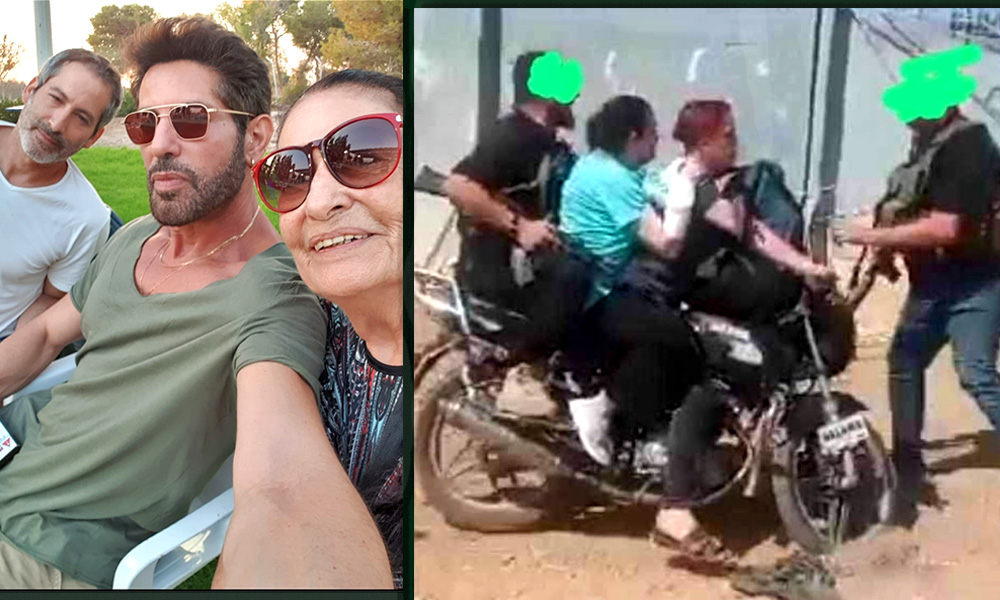
The last picture Uri Rawitz has seen of his mother Elma was taken almost two weeks ago. The video still—of the 84-year-old sitting on a motorcycle between two armed men—had been circulated on Palestinian social media channels. Elma, a resident of Kibbutz Nahal Oz, the kibbutz closest to Gaza, had been taken hostage by Hamas terrorists on October 7 during what has become known as Black Saturday. Since then Rawitz, an actor who is usually based in Madrid but who had been visiting Israel during the attacks, has been searching for more information about her and her condition. Below is a version of our conversation, edited for length and clarity.
“I was in Tel Aviv, and then I heard an alarm. And obviously, the rockets. I realized that if it’s happening in Tel Aviv, it might be happening at Nahal Oz as well. My phone was on silent but when I woke up I saw that there were five missed calls from my mom. I immediately called her and she told me she was in the safe room but couldn’t actually lock the door because it takes a lot of power, and she is weak. So she couldn’t lock it, but she was there.
“The last conversation that I had with my mom was at 10:20 am. It was a short conversation. She called me, and said she could hear shouting very close to her. And I tried to call my brother who also lives on the kibbutz in a different house. At that moment, we didn’t get exactly how bad it was—but we were hearing they are burning houses, they are killing people. We knew that something terrible is going on there. But we didn’t know about the numbers. And I tried to call my brother and then he wrote me, “I cannot speak because they can hear me.” He was in his safe room. I responded “Can you write?” He said, “Yes, a little.” I wrote to him “Listen, I cannot get through to mom.” He said, “me neither.” Then the media said that the cellular communication in the area failed, so if somebody doesn’t answer you, it doesn’t mean that something happened to them. So for an hour and a half, I’m telling myself that story, that maybe my mom is in this situation.


“Later, I spoke with one of my mom’s neighbors at the kibbutz who probably had the last phone conversation with my mom. She had been talking with my mom and in the middle of the conversation my mom says, “There is a terrorist in my house.” I asked the neighbor, “When was it?” And she told me, “It was 11:05.” So, I know exactly at what time the terrorist came to my house.
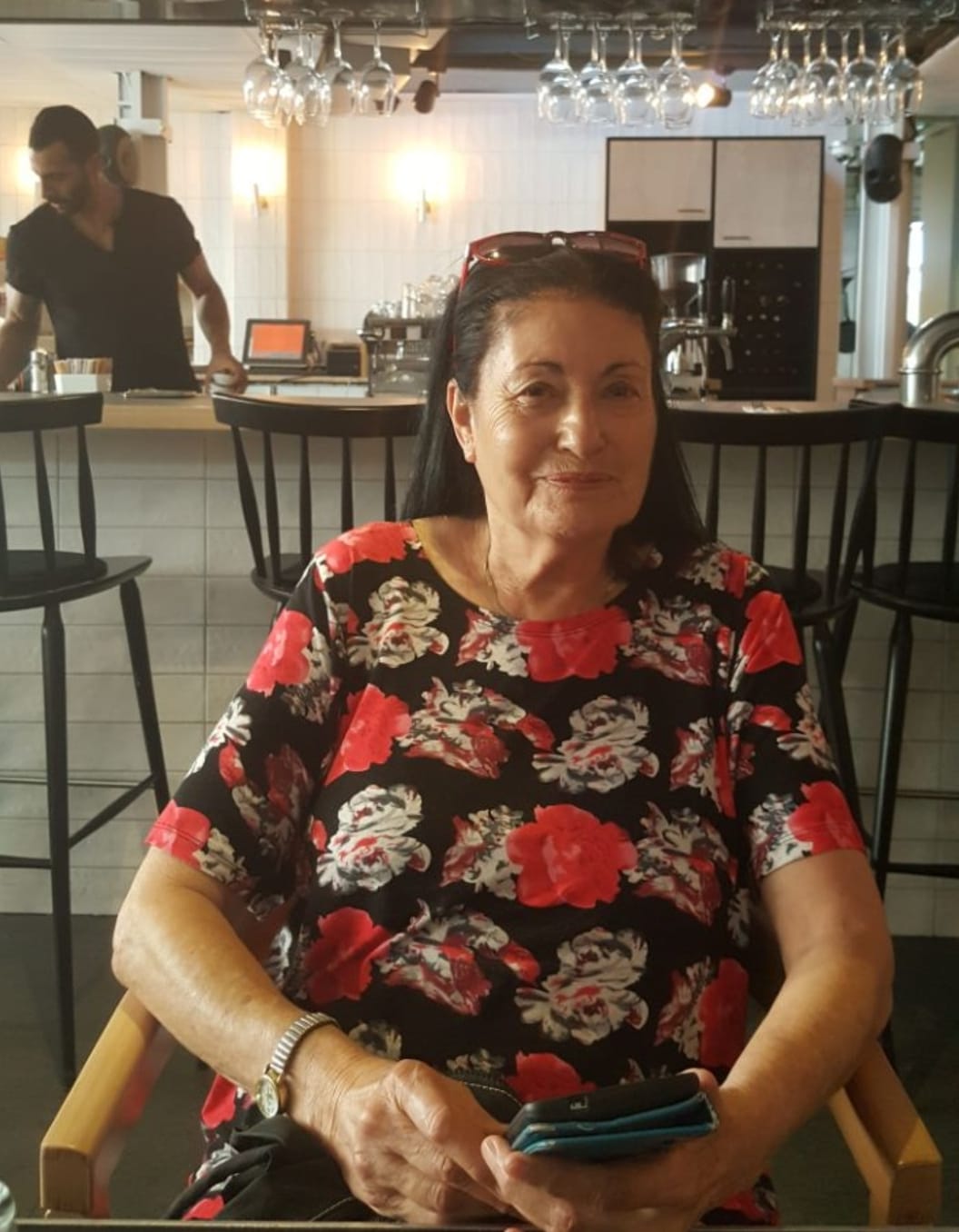
Uri’s mother, Elma, at a bar.
“It took 10 or 12 hours for the soldiers to get to my brother. There was no communication and nobody could get to my mom because everybody was in their safe rooms. When the soldiers came to evacuate my brother, he said he wouldn’t leave until he went to my mother’s house. So two soldiers went with him. The house was open. The safe room was open. The house was a mess. Her bed was flipped over. But she was not there.
“I was then connected to the police. I told them there was no connection on her phone, and that she was probably kidnapped because she’s not there.
“Sunday, I think it was 10:00 in the morning, we got a picture from some relative of our family of my mom being kidnapped. I saw my mom at 84 years sitting on a motorcycle with two terrorists with guns. They put something on their faces, so you cannot recognize them. I only recognized my mom. There is another woman in the photo whom I don’t recognize. This was a sign that my mother is alive. Well, she was alive in that picture. And I knew, officially, that she was taken by Hamas.
“Right now it is chaos. There are more than 200 people who were kidnapped. More than 1,400 people were murdered. There were a lot of people who got hurt. So, it is chaos. I got an official announcement from the government that my mother is a hostage, probably because of the photograph. I mean, there is evidence that my mom was alive when the picture was taken, but nobody knows what happened a minute later. She is very old. She needs medicine. She has not had it for two weeks. I don’t know what her physical condition is right now after two weeks without medicine.
Access Moment’s ongoing coverage of the Hamas-Israel war here.
“We don’t know exactly what the Israeli government is doing because negotiations like this are usually done under the table. I know that people are working on it 24 hours a day and there is a diplomacy effort. I personally spoke with some ambassadors, but you don’t know exactly what they do. It’s a very, very delicate subject.
“What has helped me is to see the spirit of the Israeli people. It’s amazing to see the citizens who work together, who leave the arguments they may have had before and stand with you. I try to tell my mom’s story and tell the world what’s going on here. So, this is my mission. I’m doing this so I’m not thinking, “What’s going on with her? Where is she now? Is she suffering?” It keeps my mind going and probably keeps me sane.
“This is a crime against humanity. It’s not a very local struggle between Israel and Gaza. It’s against all Israelis, all Jews. And it’s not only Jewish people who are involved, there are a lot of foreign citizens who were there. I don’t understand the logic of these brutal attacks, but, obviously, it was to kill as many Jews as possible. The world should know this horror is beyond anything one could imagine. They torch, they rape, they cut. There are some bodies that you cannot recognize. This fight is about light and dark. It’s about a liberal world or a radical world.”
Featured image: Uri with his family (left), Elma before she was taken to Gaza (right).