
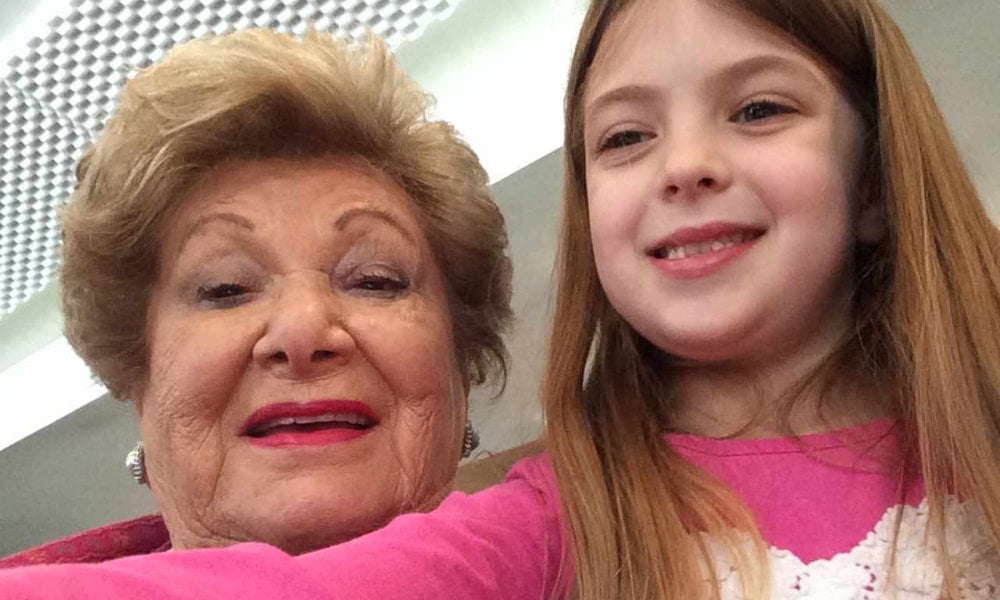
In 2021, at my twin brother’s and my bnei mitzvah, I had to give a speech to the entire congregation. The synagogue was packed with people from the community, all watching me give my speech. There was also a livestream where over 10,000 people were watching from the comfort of their own homes. I had practiced my speech countless times with my parents and brother as my audience, but this felt so different. My heart was beating in my chest and my hands were shaking slightly as I put the paper with my speech on it down on the table in front of me. I took a deep breath and looked at the audience. My eyes immediately drifted to my great-grandma, who was sitting in the front row, smiling proudly. She was sitting next to my grandma and her walker stood in front of her seat. I was still nervous, but I managed to calm myself down and began to speak. My Torah portion was about the power of dreams and turning them into a reality, so I decided to focus on my great-grandparents’ experiences during the Holocaust, their dream for survival and their desire to share their story with the world. As I began my speech, my voice sounded clear, despite my nervousness. After introducing what my speech was about, I started talking about my great-grandparents. I made eye contact with my great-grandma as I spoke about her. “My great-grandmother Lilly, whom we call Nini, was hidden with her parents David and Rose in a grain cellar for two-and-a-half years and lived in fear of being discovered by the Nazis.”—
***
Around three years ago, my mom, brother and I were having lunch at my great-grandmother’s house with the rest of our family. We were all sitting at our normal seats around my great-grandmother’s elegant dining room table, with me and my brother at the end of the table next to the window and my great-grandmother sitting at the head of the table with her back to the entrance of the house. The window behind me reflected light onto my great-grandma, making her short, light-gray hair almost shine in the sun. You could barely see the tint of blonde on the edge, left over from when she used to dye her hair after it started turning grey. I remember specifically that she was wearing her pink long-sleeved sweater that day. My brother was talking excitedly to my great-grandmother from across the table and mentioned that we might be getting a dog soon. My brother, dad, and I had been trying for years to convince our mom to let us get a dog, and she said she would think about it. Nini’s response to my brother was, in a heavy Eastern European accent, “A dog? Achh, That would give me something to live for!” My mom stopped thinking and immediately started researching different breeds. We ended up visiting a pet store the next Saturday where we met our dog Cookie and adopted him before we even left the shop. My great-grandmother loves our dog, but doesn’t get to see him that much because we live in Manhattan and she lives in Queens.
I recently found out that my great-grandmother had a dog when she was younger, before the Holocaust. Her dog’s name was Rex. My great-grandmother lived in a small town on the border between Poland and the Soviet Union. One day, her dog got loose and ran too close to the Soviet side of the border. The Soviet soldiers shot Rex. Nini tried to get him to a vet, but it was too late for them to do anything. She was devastated. In hindsight, when telling me about her dog, she realized it might have been better that her dog died then, as a few months later, the Holocaust began in that part of Poland and my great-grandma and her parents had to go into hiding from the Nazis. If Rex had still been alive, they would have had to leave him behind.
When she told me her own story, I was able to feel how she felt in those moments and how she feels today.
The Holocaust was the systematic, state-sponsored persecution and murder of six million Jews by the Nazi regime. When the Nazis came to power in Germany in 1933, they began to target and exclude Jews from German society by enacting discriminatory laws, organizing violence and relegating Jews to ghettos. This culminated in what the Nazis referred to as the “Final Solution to the Jewish Question,” which was the mass murder of European Jews. Some Jews, like my great-grandparents Hadassah and Josef, were captured and sent to concentration camps like Auschwitz and Bergen-Belsen. Other Jews, like my great-grandpa Sam, were partisans and fought against the Nazis. And then a smaller number of Jews, including my great-grandma Nini, were hidden by kindhearted non-Jews who risked themselves and their families to help their Jewish neighbors. In Nini’s case, she and her family were hidden by a farmer who owned land adjacent to land that Nini’s father owned.
After learning about Rex, I thought back to when Nini found out my dog had lost one of his front legs. In the summer before 9th grade, my dog was hit by a truck. He’s okay and healed well, but one of his legs had to be amputated. My grandmother, Jeanie, told us that she would tell Nini about Cookie’s accident before we visited her next. So the next time we visited Nini, we were under the impression that she already knew. Jeanie, in fact, had not told Nini because she was worried about how Nini would react. Nini loved Cookie, maybe even more than us. Whenever we visited her and brought Cookie along, her eyes lit up with happiness and a wide smile broke out across her face as she watched Cookie play with stuffed toys. “Kill it! Kill it!,” she laughed, as Cookie shook a stuffed animal in his mouth. Jeanie was terrified that hearing this news would devastate Nini and make her lose that happy spark in her eyes that Cookie brought. “She doesn’t see so well. She probably won’t notice,” Jeanie told us. She noticed. We were about to take a family photo outside when she saw that Cookie didn’t have a leg that he definitely had the last time we saw her. She was understandably very upset and asked us what we’d done to him. However, the joy at seeing Cookie didn’t leave her face—Cookie was just as energetic as he’d always been around her, and at least he was still alive.
My great-grandma always offered food to others. In fact, whenever I think of any memories that I have with my great-grandma, the first thing that comes to mind is her snack drawer. She would always keep a drawer in her kitchen stocked with cookies and Lays chips for my brother and me to eat whenever we would visit her. She would always offer us chips and cookies until eventually my brother and I just knew that this drawer was always filled with snacks for us to eat. We would normally either ask her for some or just go to the drawer ourselves and grab our snacks. I think she also used to ask us what snacks we liked so that she would always have our favorites stocked for us. She always made sure that my entire family had enough food to eat. In all of my memories of eating food at her house, she always offered everyone else parts of her meal or other food that she had stocked in her house.
This need to make sure everyone she cares for is fed comes from her experience in the Holocaust. When in hiding, they had little to no food. Her family of four was given one tea kettle of water per day for drinking and washing. When my brother and I interviewed her, Nini told us how they got food from the neighbor that hid them: “We used to get food twice a day. Once in the morning he would come. He would knock like this on the straw.” Nini made a knocking sound on her chair. “It was—It was usually some kind of kasha, you know, some kind of grain that was cooked. And in the winter in the evenings it was either potatoes—we never had meat. We never had any fish. We never had all that stuff.” The four of them shared this very little amount of food between them, so they were hungry constantly. Because she had very little access to food for two and a half years, she wants to make sure everyone she cares about has food. I imagine that in the grain cellar, since she was a child, her parents and aunt would have tried to give her the majority of the food. I don’t know if this is what actually happened, but if it did, I imagine that Nini might remember those moments when her family was not eating for her sake. I think then, as well as making sure everyone else has food, she also might want to make sure that we have more than her, sort of as a way to repay her parents and aunt. Maybe that’s why she always offers me and my family parts of her meal.
A few months ago, my brother, mom and I went to Nini’s house to have lunch with her. We brought our own food from home and joined her. One of her caretakers made her curry chicken. I had a chicken avocado wrap, which I finished pretty quickly. When she noticed that I finished all my food, she started offering me some of her own. She offered me some of her chicken, a piece of corn and cherries that she had been given for dessert. Her habit of making sure everyone has enough extends to my dog as well. She always tries to sneak him food off of the table when we’re all eating together. She doesn’t really get that he can’t eat certain foods that will make him really sick. She tried to feed him steak from the table, and when we stopped her from doing that, she tried to feed him cake (which he definitely can’t have). Something about my dog is that he’s allergic to chicken. Whenever he eats chicken, he gets very itchy. The same day when she offered me some of her chicken curry, we brought Cookie with us to visit her. We took our eyes off of them for one second and when we looked back, we saw my dog with yellow curry around his mouth, the tiny piece of chicken that my great-grandmother gave him nowhere in sight.
***
My great-grandmother speaks slowly and deliberately, as if putting extreme care in every single word she chooses, sometimes searching for the exact right word to use in English. You can clearly hear her thick Eastern European accent, but it’s difficult to place. To explain my great-grandmother’s accent, we have to go back to her childhood. She was born in 1929 in a small town called Podwoloczyska, directly on the Polish-Russian border (located in Ukraine on present-day maps). She started out life speaking Polish while her town was under Polish rule, and then learned to speak Russian when her town was under Soviet rule. She learned Hebrew as part of her Jewish education outside of her secular school that was taught in Polish or Russian, depending on who was in control of her town at that time. During the Holocaust, at 12 years old, when she went into hiding with her parents and aunt underground in the grain cellar, she was not able to speak louder than a whisper for over two years out of fear of being discovered by Nazis. She was literally scared to death to speak. In an interview with Bill Boggs, an American television host and journalist, she said that after being liberated, “I had to relearn how to talk practically.”
After her liberation at 14 years old, she and what remained of her family went back to her hometown, which had been conquered by the Soviets who declared the town to be in Ukraine. After learning Polish, Russian, Hebrew, and then not speaking for two and a half years, she then went to school for a year taught entirely in Ukrainian. Then, she and her family were allowed to repatriate to their “homeland” of Poland, where she went to school for the next year taught in Polish. As if four languages were not enough, she and her parents made their way to Germany in an attempt to get to America, and they ended up in the British zone of Germany where she attended an accelerated high school program in Hanover, taught in German. After getting her diploma, she was admitted to medical school at the University of Bonn in Germany where she studied medicine for two years. On school holidays, she joined her parents in the Displaced Persons Camp of Bergen-Belsen in the British zone of Germany. There, she learned English, but the common language of the Jewish Holocaust Survivors in Bergen-Belsen was Yiddish. By the time she arrived in America in November of 1949, she was 20 years old and could read, write and speak seven languages. I can’t help but marvel at how Nini went from not being able to speak above a whisper to speaking seven languages fluently.
In America, English became her primary language, although she still continued to speak many of the other languages with her friends and family. She pronounces each word she says with extreme precision. Sometimes her accent makes it difficult to understand what she’s saying, and occasionally she pauses to search for a word, sometimes saying it in Polish before she can find it in English. I imagine that when this happens, there is a swirl of words in her head, all different languages, but none the exact word she wants. When this happens, I can see the frustration on her face and hear it in her voice. She pronounces her W’s as V’s and sometimes she emphasizes parts of a word differently than how a native American English speaker would. When she’s telling a story, though, especially her own story, you can clearly imagine exactly what happens as she speaks regardless of the language. When she told me her own story, I was able to feel how she felt in those moments and how she feels today.
***
During COVID-19, when the entire world basically shut down, my great-grandmother was once again trapped in one place for an extended period of time. I have no doubt that she must have been reminded of the childhood that she described to me, when she wasn’t allowed to leave that grain cellar: “It was a shelter for the grain. And we slept on the grain, okay? There were little mice…I could never stand on the floor of it because then I was, like, very low. And you couldn’t walk. You couldn’t do anything because it was one on top of the other…You really couldn’t breathe. And we only were able to open a little piece of that straw that I told you. A corner—the window was like that…That’s where the light came in, okay?” However, this time, instead of being trapped in a small grain cellar where there wasn’t even room to stand up, Nini had to stay in her big home with plenty of space, light and food. During this time, my great-grandma was interviewed by the New York Jewish Week about being stuck inside during COVID. There was fear of dying due to the pandemic, but according to Nini, “You cannot compare it in any way to what we lived through. Nobody is looking for me, to kill me.”
In this interview, my great-grandma put on a strong front, speaking as though she was not bothered at all by being stuck inside again. I wonder how true that is. During this period of time, I remember my mom talking about how hard it was being stuck inside for Nini. One specific memory I have during COVID is when we went to visit my great-grandmother for the first time after the pandemic started. We didn’t want to risk her getting sick, so we stood outside on her porch as she looked at us from the window of her den. I didn’t make this connection at the time, but later, my mom told me a bit more about the circumstances of when Nini lived in the grain cellar. Besides how small the cellar was, there was also very little light. The light came from the only entrance to the cellar, “a little window, which was as big as a very small television set.” Now, I can’t help but wonder if seeing us through her window reminded her of the time when she was stuck in the grain cellar, unable to leave, and the only way to see outside was through that tiny window.


***
I don’t remember an exact moment when I learned about the Holocaust and my great-grandparents’ experiences. It’s just something I remember always knowing. When I interviewed her, Nini told me a story of her friend Renata, though Nini affectionately called her Renusha, who died during the Holocaust. She gave Nini’s father a piece of paper that said “I know that Lila [her nickname for Nini] and you will survive the war. And if you do, please tell the world, because I won’t.” When Nini was telling me this, she broke down into sobs. “That’s the story of my friend, which—none of my friends survived.”
She had started crying when talking about Renusha, but she really started sobbing when she mentioned my great-grandpa Sam who passed away in 2018. This mission of remembering what happened during the Holocaust and sharing her story is one of the reasons why my great-grandma married my great-grandpa Sam: They both shared this purpose to remember. “When I met Grandpa Sam, I knew by talking to him that this was his purpose, to—to remember. And that’s why I liked him. And that’s why he liked me. And that’s why we got married. And that’s what we did all our life.” Because of this goal, to remember, Nini, Grandpa Sam and my other set of great-grandparents, Grandma Dassah and Grandpa Yossel, taught their children about the Holocaust and continued to teach the future generations of my family about the horrific events that our family went through.
When I was younger, I knew that my family survived something horrible. Even at a young age, the overall feeling I had, though, was not one of fear but of thankfulness. Thankful that my great-grandpa Josef escaped from Auschwitz; thankful that my great-grandma Hadassah’s medical knowledge saved her from being sent to the gas chambers along with her husband and son; thankful that my great-grandpa Sam was able to escape the ghetto to the forest of Belarus to fight against the Nazis; thankful that my great-grandma Lilly, my Nini, survived two and half years in a grain cellar; and thankful that they all met after the Holocaust ended and created a family together.
Basically, the story of my family, specifically my great-grandmother, isn’t about the horrors that they experienced during the traumatic events of the Holocaust. Instead, the story of my family is one of rebuilding. The main goal of my great-grandparents after surviving the Holocaust was to make sure no one would ever forget the traumatic experiences they went through, so that it would never happen again. I’d like to think I do a pretty good job of continuing to share their stories. Even this essay is a continuation of my great-grandma’s legacy and the goal of sharing their stories so no one ever forgets what happened.
***
—I kept my eyes focused on Nini as I continued speaking, a smile rising on my face as I shifted from talking about the tragedy that she survived to to how happy I was that she was able to watch me at my bnei mitzvah as I gave this speech. “Our Great-Grandma Nini is here with us today, sitting in the sanctuary. Nini, we love you so much and we are so happy that you are here to share this special day with us!” Normally, when someone is speaking at services, the rest of the congregation is silent. I expected the same to happen when I said this line. However, contrary to my expectations, the room erupted in cheers. I was almost startled, but I continued to smile at my great-grandma as the room around me celebrated the fact that Nini was able to be there, listening to me tell her story. Her pride in me and my brother showed on her face as she smiled back at me. She watched as I shared her story, continuing not just her legacy, but also the rest of my great-grandparents and my entire family.