
It’s tempting to stare at the mess that is today’s Republican Party, gawk at the lurid circus on the fringes of Donald Trump’s MAGA movement and conclude that this too shall pass. Nearly every generation in America witnesses a cyclical surge in antisemitism and xenophobia, we may tell ourselves; the phenomenon is often tied to disruptive shifts in the nature and availability of work. Past generations grappled with industrialization, automation, computerization; right now, the driving factor is the explosive growth of AI.
Although some Republicans see the party falling into what Senator Ted Cruz of Texas called “an existential crisis” over growing antagonism toward Israel, others point to this spring’s primary defeat of the outspoken Israel critic Representative Thomas Massie of Kentucky as evidence that the party has effectively neutralized incendiary rhetoric coming from people like Tucker Carlson, former Georgia Representative Marjorie Taylor Greene and right-wing podcaster Candace Owens. “Being anti-Israel in today’s Republican Party is not— unlike [in] the Democratic Party—a path to success,” Matt Brooks, chief executive officer of the Republican Jewish Coalition, told the group’s summit in June.
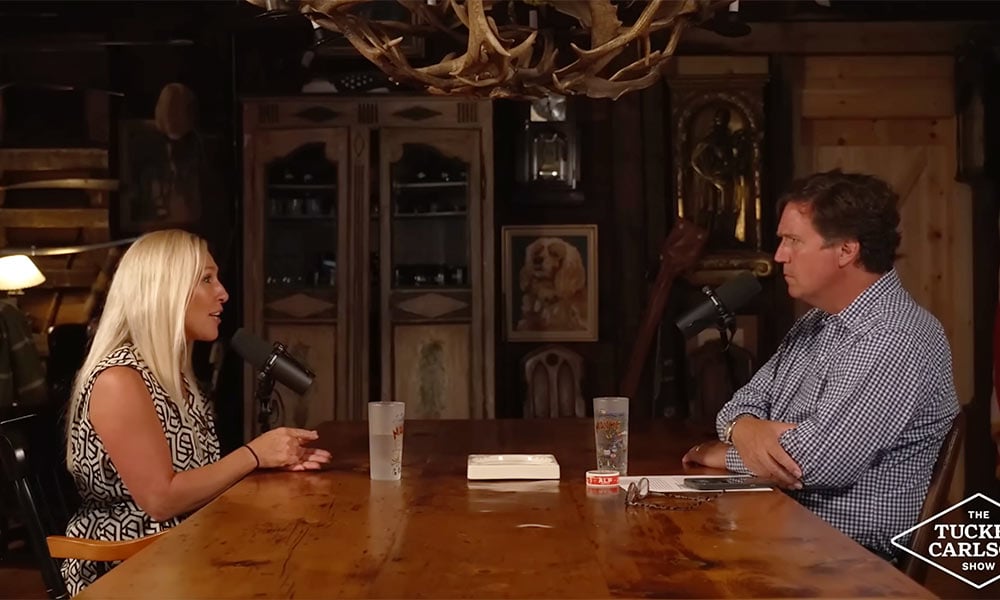
But the extreme rhetoric coming from Carlson and company cannot be dismissed as standard politics. Carlson and Greene announced over the summer that they were formally cutting ties with the Republican Party to help launch a third party—one that would focus, in Carlson’s description, on ending all immigration, putting America first and halting aid to Israel. (Massie, too, has flirted with joining his renegade friends.)
“I’m in the ‘Hitler Sucks’ wing of the Republican party,” Lindsey Graham said.
Carlson, whose TV shows were mainstays of Trump’s viewing list for many years, has grown ever more extreme in his statements: In a Columbia Journalism Review interview this summer in which he discussed leaving the Republican tent, he called Trump a “slave” to Israeli Prime Minister Benjamin Netanyahu. Days later, Carlson posted about “our treasonous Congress” being “likely to merge the U.S. military with Israel’s genocidal armed forces.” Throughout his life, Carlson told the CJR, his attitude was, “I’m not interested in Israel. It’s not in our hemisphere. It’s got no resources. So I just don’t care. But once you start taking over my political system and destroying my country, then I have a right to care.” He denied any animus toward Jews: “If I was an antisemite, I would just say so.” But he has repeatedly provided a forum for overtly anti-Jewish voices such as Nick Fuentes, the white supremacist podcaster, and Owens, who has claimed that Israel was behind the assassination of right-wing polemicist Charlie Kirk. And Carlson’s seeming eagerness to blame all manner of bad stuff on purported Jewish power has helped bring him a podcast audience in the millions.
Similarly, Greene’s social media postings bashing Israel have won her new followers. For years the ultimate Trump loyalist, Greene now spurns the president, her party and purported Jewish influence over it. “America First needs to go 1776 on the Neocon Epstein-controlled Republican Party,” she posted at one point. She quit her House seat in January after saying that Trump and the GOP have been “captured by a foreign government.”
The marvel of the two-party system is its ability to temper extreme forces, to nudge most people toward an acceptable, if often uninspiring, middle. Seen this way, Carlson’s and Greene’s bolting the party could just be the system doing its job. Right now, though, anti-Israel sentiments are not entirely fringe in either party. More than 100 House Democrats, a majority of the caucus, voted in July to end military aid to Israel, though the measure was defeated. Six in ten Americans hold unfavorable views toward Israel, according to a Pew Research poll this spring, a startling increase from 42 percent in 2022. And those views trend young: A majority of 18-to-29-year-old voters surveyed in the latest Yale Youth Poll agreed with the statement, “America should end the slavish surrender to Israel, its wars and its demands for foreign aid.”
Will Republicans spurn Carlson and Greene as extremists or bring them back into the tent? Former Republican Illinois congressman Adam Kinzinger, who views the pair as performers aiming to keep their audience in a constant state of outrage, argues that Carlson and Greene have already won this battle: The party has “absorbed their grievances, adopted their language, and made their worldview [its] official ideology.”
Others have pushed back hard, including the late Republican senator from South Carolina Lindsey Graham. “I’m in the ‘Hitler Sucks’ wing of the Republican party,” Graham said last year at a Republican Jewish Coalition event. “I want the world to know antisemitism, anti-Israel rhetoric, anti-Israel thought is not the road to being elected as a Republican. You will lose.” Carlson and Greene seem to agree; thus, their third-party gambit.


It’s true that third parties almost never win in America. But their ideas do sometimes leach into the bloodstream of the major parties. Policies espoused by Norman Thomas’s Socialist Party in the early 20th century emerged as core elements of FDR’s New Deal; Barry Goldwater’s extreme conservatism was soundly rejected in 1964 but became the foundation of Ronald Reagan’s revised Republicanism over the following two decades. Carlson and Greene are savvy enough to know that their proposed new party likely won’t win elections, but its ideas—including a strong reliance on anti-Israel policy with casual acceptance of anti-Jewish rhetoric—may have real staying power.
As through most of history, Jews will have to navigate our way through the fluctuations of unsteady allies while strongly confronting the realities of freshly energized antagonists. There’s no call for American Jews to panic—yet. But it’s always wise to keep a close watch on the creatures infesting the fringe. They can infect the mainstream in a flash.
Marc Fisher was a columnist, reporter and editor at The Washington Post for 39 years.
(Top image credit: YouTube Screenshot)
3 thoughts on “Opinion | The GOP’s Tucker Carlson Problem”
To Moment: Can someone wake me please when this nightmare of Carlson and Greene ends? After decades and decades in the classrooms of teaching 20 century history and the particular chapter on the elimination of European Jewry, the ‘never again’ and ‘never again’ refrains and chorus we repeated and thought we were searing into the national soul, is it possible these two as well as their MILLIONS of followers are back to interwar fascism and propaganda, spreading it smoothly and pervasively online (never possible a century ago)? It’s as if the Holocaust never happened at all. The deniers need not to have bothered. Deborah Lipstadt’s brilliant victory over David Irving apparently never occurred. It is all back now, all of it, and more coming, with the spirit of Henry Ford again at the wheel, and in the same state and place no less. Vast numbers of young Americans now voting joyfully for anti-Semites….they must have slept through all our classes and workshops and movies on hidden staircases in Amsterdam. All for nought – now Jews even playing the ‘good Jew’/’bad Jew’ game of courting favor with outspoken enemies, letting themselves be defined and labeled in the best tradition of Hitler’s inspirational Mayor Karl Lueger in Vienna who started what Mamdani now follows seamlessly in New York with Jewish votes, no less. So let the media feature these new fascists with their ancient libels and tropes. They make excellent copy and sell space. We apparently never knew what real ‘influence’ was, I suppose because you cannot uproot bigotry and hatred with words, after all. Just wake me, one day….
Lots of handwringing. Lots of Federation-speak about combatting antisemitism while most sense this is a deja-vu circling of the drain. We have the longest historical survival memory on the planet, but that survival has been serendipitous, never a result of planning on a community or national basis. There is need for a serious conversation to work out how a minority can mitigate the greatest harm when the worm turns. For us, Israel is certainly a (new) answer, but not the only one, and the Jewish experiment has survived by remaining multifocal since our first diaspora. We have an obligation to our descendants to formulate Plans B and C.
The criticism of the U.S.’s unconditional support for Israel, both political and military, which enabled the settlement annexation project to proceed for some five decades is a valid one. It hasn’t served U.S. interests or Israel’s. That project served as a Petri dish for the growth of an evermore extreme religious nationalist movement in Israel, which is also attacking the democratic institutions of the state. Why should the U.S. support a Greater Israel movement whose inevitable aim is to expel the Palestinians from both the West Bank and Gaza. Its most extreme members have even began organising settlers to move into South Lebanon and Syria. The real question is why has the organised Jewish community remained essentially silent for all these decades. There would be no Marjorie T. Green or Tucker Carlson attacking the American Israeli relationship if American Jewry had done its job.