
Here at Moment we’re usually inundated with the written arts—books to read, magazine articles to discuss—and rarely make space for the visual. But there are plenty of rising Jewish artists that explore and experiment with mediums like paint or film but even beeswax or plankton, crafting stunningly original works of art centering spirituality, the climate or the uncanniness of the human body. Here are five eye-catching artists making an impression on Jewish culture.
Alex Woz
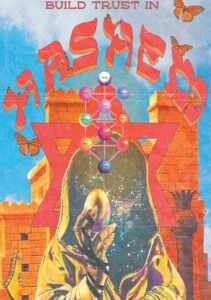
Alex Woz, “Trust Hashem”
“Build trust in Hashem,” reads the trippy, sunburnt text, surrounded by butterflies and cradling a hooded figure in the center. He holds an egg, but the face is removed in favor of a glittery galaxy, interlaced with Hebrew chakras. In another work, “You cannot erase those who are eternal” frames a crystal ball with a Disney-like castle perched atop an opal cloud in its center. In a third piece, a sunflower glittering with tiny Stars of David holds an Evil Eye, juxtaposed against a sienna background. “Hashem is in every flower,” warped script reads, “if you look for him.”
The psychedelic prints of Alex Woz, a 27-year-old Argentinian Jewish graphic designer and artist based in Los Angeles, are bright, discombobulating and playful. His placelessness is particularly arresting—like a woman rising out of gilded trees, Kafka reading in a flower field, or a cloaked woman before a Greek structure resting on a black-and-white checkerboard floor. That piece, Assimilation—A Process of Rejection, was inspired by the many countries Jews tried to fit into, later “discarding elements of their identity for acceptance.” Woz’s goal, his website reads, is to unravel years of unrealistic representations, and through his use of old photographs usually imbue each print with a dreamlike haze; he wants each to spark a humane recognition. “We are forced to reconcile our own narratives within us that have been constructed by others,” he writes. “What are Jews supposed to look like? What are Jews supposed to wear? How are Jews supposed to act?” His robust shop offers both paintings and apparel, so expect to see Woz’s designs everywhere.
Yam Shalev
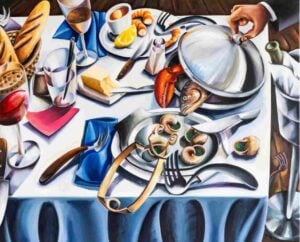
Yam Shalev, “White cloth night”
The perspective of Yam Shalev Alkoby’s paintings often mirrors our normal vision—watching a waiter refill a wineglass with a challah loaf resting on the tablecloth, a damp morning scene, with a young man in blue closing his eyes at a table in a highrise, or open-concept kitchen shelves with pots, ladles and jars, a familiar view for eyes that have been wandering while washing dishes at the sink. But each is warped and skewed, cartoonishly amplified; the fish on one table spread is nothing but bones, the nearby fork curled. In another post-lunch slump titled Dispute, a man and a woman dining outdoors, plates dirtied from the jambalaya pot, seem to be eclipsed by a wine bottle and a stroller just out of reach. Other plates rest in front of empty chairs; the missing guests might be taking a tour of the house or washing up, leaving the two stragglers to enjoy the last dregs of their wine.
Born in Tel Aviv and now working in Berlin, Germany, Shalev usually sublimates himself within the scene to capture its reality, not assert his presence. “My paintings grow out of my observational personality: I regard myself more as an observer than a participant in the situations I find myself in,” he told the Mack Art Foundation, where he was a past resident. “Through my paintings, I use this lens to analyze human behaviors, scenes, and interactions, learning about myself and my relationship through my surroundings.” Earlier this year, he presented a solo exhibition at New York’s Room57 Gallery.
Julia Elihu
A sixteen-year-old girl in a hijab, Caroline, rides through the desert with her father, singing along while throwing plum pits out the window. Suddenly, they’re stopped by a patrol officer who demands they both get out of the car, wondering why they’re venturing so far from their homeplace of Tehran. While her father is interrogated, Caroline tucks her Magen David in her lips; later, after talking to the officer, she spits it out.
In the Garden of Tulips, self-directed by Julia Elihu and the winner of Best Live Action Short at the 2024 St. Louis International Film Festival, is a tense and gripping portrait of an Iranian-Jewish family caught in the height of the Iran-Iraq war, based on a true story. The prolific California-based director often turns toward her own biography to inspire storylines—the dark Winter of ‘79 is based on her family’s persecution during the Iranian Revolution, and at 19, she wrote Yasamin, a tribute to her mother’s story of immigration.
But her other short films can be vivid and playful—Team Meryland, which followed a 12-year-old Latina boxing champion, was released with The New Yorker, and her newest work, a comedy called The Only Normal Girls in LA, was born from patchwork conversations out of her Notes app.
Ilana Savdie
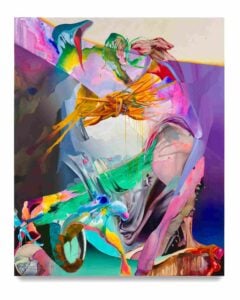
Ilana Savdie, “Houdini and His Wife”
Venture into the abstract and mutated with Ilana Savdie’s stunning, puzzling and visionary paintings, made with oil, acrylic and beeswax. There are shapes, but rarely recognizable figures—a talon from the grayscale Traicioneros y Chismosos reaches into a void from a wisp of an above cloud, and a woman, or perhaps a hand, basks in The Old Lie, Dulce Es’s cerulean-to-Fanta-orange landscape, her body interposed with bones, limbs and a knotted ball of what could be intestines. As soon as your eye catches onto something in her bizarre world of color, it just as quickly goes to something else.
The Colombian-American has had work featured at The Jewish Museum, New York and The Whitney Museum of American Art with her provocatively titled exhibitions like Glottal Stop, Ectopia and Radical Contradictions. “Painting serves as a reminder that I have a body,” she told the Michael Kohn Gallery. “I can pervert, rescale, reconfigure, and reroute the paths of power in figures that co-exist intimately on the canvas as contrasting textures, gestures, and colors.” In Retractor, a metal scalpel holds up a skin-like world of deep blues and fungal cylinders against a dirty bubblegum-pink backdrop, and Gorgon Stare sees two diagonal, wildly textural worlds opposing each other, one gripping an eye or an orb—something that reflects the opposing force or allows a glimpse of a whole new world.
Cynthia Beth Rubin
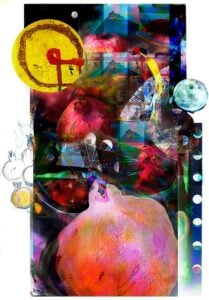
Cynthia Beth Rubin, “Pomegranates and Moon Cycles”
Science and art collide in Cynthia Beth Rubin’s freaky and enlightening digital mixed-media work, which combines drawings and micro-imagery of plankton with Jewish iconography and manuscripts. They might seem like an odd duo, but Rubin traverses scale to mash the primordial and spiritual. They’re “two previously unseen and unknown elements in our world,” she notes: “one, the microscopic life in our waters that form the basis of all life, and the other, hidden texts that may have given rise to some of the important philosophical and spiritual thought of our contemporary culture.”
Initially experimenting with computer animation, Rubin also collected undersea footage from a camera that seals bumped into and projected it onto a skyscraper to create Antarctica Underwater, mutated sites of Moroccan Jewish culture in Les affinités recouvrées, and participated in 2014’s Waltz with Planet Earth: Art Kibbutz, in New York, an eco-friendly art installation.
Her work with plankton is intense and liminal, pulling from humanity’s basic essentials to create something novel. The splashy Diatom Collage in Red and Yellow resembles an album cover for a jazz-punk quartet, its collage bright and impactful, whereas Plankton Universe State 3 is textural and deformed, interspersed with the Leningrad Cotex, the oldest known manuscript of the Hebrew Bible. Rubin seems to argue that no matter what we’re constructed of—religious musings or infinitesimal organisms—each is a product of thousands of worlds and ideas.