
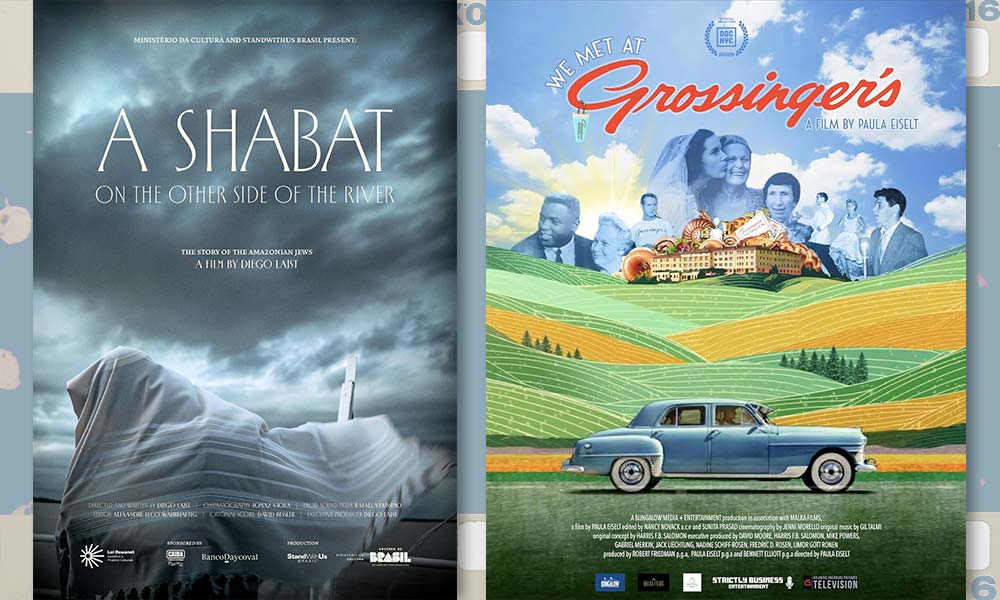
The Philadelphia Jewish Film & Media organization recently curated a film series in Philadelphia (surprise!) called “Docs & Dialogues,” highlighting new documentaries that explore many corners of the Jewish experience. Below are thoughts on two standouts.
A Shabbat on the Other Side of the River
What is it to be a Jew? I’m an American Jew, with Polish Ashkenazi roots. When I meet Jews from other countries I often wonder: What do we have in common, aside from cultural and religious practices? It seems like what we most have in common dates back about 2,000 years. So, I’m always amazed to watch a documentary like A Shabbat on the Other Side of the River, about the history of Jews who migrated to Brazil, that gets me thinking about what ancestry I may share with people who live in such a different place.
When the Romans destroyed the Second Temple in the first century CE, many of the Jews who were kicked out of Israel ended up scattered across central and western Europe and North Africa. After the Inquisition in the 1400s, Jews who settled in Spain and Portugal were forced to cross the Mediterranean and settle in Morocco. They made a life for themselves there, integrating into the culture and bringing their traditions with them. Then, in the 19th century, the rubber boom hit Brazil, and many Jews saw an opportunity. A Shabbat on the Other Side of the River tells the story of these Jews, who sought to create a sustainable economic foothold for themselves in a precarious world—even if it meant venturing away from the urban centers they were used to, and deep into the waters and jungles of the Amazon. The story is illustrated through images of primary source artwork—paintings and drawings from the era—and artifacts from the rubber boom held in museums. The narrator says that in Brazil, the Amazon River is part of the people. One gets swept away in the beautiful footage of the massive river, teeming with the sounds and images of life.
They were migrating to a nation that, like America, had a brutal history of slavery and racial tensions. But as the documentary lays out, in Brazil the Jews were actually seen as white. This meant that they were eventually allowed to practice their religion out in the open, when other minority religions had to practice in secret. The Jews arrived in the town of Belem, the gateway to the Amazon, and from there spread throughout the region, but not before establishing synagogues and other cornerstones of Jewish life in the area. The oldest Jewish cemetery in Brazil, known as Necropole Israelita, is not far from Belem.
In a time when many people try to pigeon hole or essentialize Jews as a monolithic group, it is more important than ever to consider the vast history across the world. Yet I couldn’t shake the feeling watching this documentary that I did not know much about this population of Jews beyond the fact that they were Jewish and brought their customs with them to a far away place. The film feels valuable as a source of information, but is lacking in telling a narrative that breaks through the surface.
We Met at Grossinger’s
The Borscht Belt—the hundreds of resorts and hotels in the Catskill Mountains of upstate New York that served as summer getaways for New York City’s Jews—looms large in the history of American Judaism. The new documentary We Met at Grossinger’s seeks to capture its impact by focusing on one that seemed to be a sort of flagship for the whole region: Grossinger’s Resort.
If you’ve seen Dirty Dancing, then you get the sense of what a summer at Grossinger’s was like.
The documentary opens with images of gated-up lots of overgrowth and decaying buildings that nature seems to have reclaimed. Before being told, one understands that these are the remnants of Grossinger’s, and many other such places that were once teeming with life during the summers of the mid-20th century. A quick journey backwards through footage from its heyday reveals a stark contrast. I found myself asking along with the film, how did we get from there to here? From everything to nothing?
If you’ve seen Dirty Dancing, then you get the sense of what a summer at Grossinger’s was like (it served as the essential model for Kellerman’s, the fictional resort from the movie). Thousands of people—families, couples, singles, staff, entertainers, instructors and more—all mingling together for the summer, escaping the brutal heat of a New York City summer for the fresh air and cooler temps of the Catskills. One thing that Dirty Dancing never quite says is that Grossinger’s was a Jewish institution—run by Jews and meant to serve Jews. This grew out of an era of institutionalized antisemitism where resorts all over the country refused to serve Jews. Like many oppressed groups do when they are shut out of something, the Jews decided to create their own thing. We Met At Grossinger’s functions as not only a history of the titular place, but a history of 20th-century American Jewish life.
Jews came together to celebrate amidst the backdrop of institutionalized antisemitism at home and genocide abroad. They allowed themselves to try things they may not have otherwise had the opportunity to engage in—tennis, boating, Latin dance—and generally participated in all kinds of popular American trends without the watchful and judgmental eye of the larger public. It was a “safe space” in so many ways. So many families began as a result of all the socialization (the film makes the point that love was very much in the air on a nightly basis at Grossinger’s). Following the Holocaust, as the Jewish people felt a strong duty to repopulate, this felt especially significant.
One of the more fascinating aspects of Grossinger’s that the film explores is that it functioned as a matriarchal organization. Jennie Grossinger was probably one of the most influential yet little-known women of the 20th century, an unsung leader and creator of bedrocks of culture and institutions as we know them, like a mix between Anna Wintour and Katharine Graham. She made Grossinger’s into a place to see and be seen, and she knew who was worth knowing. For example, without the entertainment she booked at Grossinger’s, we may not have gotten standup comedy as we know it (Joan Rivers got her start there, while an unknown Mel Brooks was fired for being too raucous of an entertainer ). Eventually, famous non-Jews such as Jackie Robinson, Eleanor Roosevelt and Robert F. Kennedy began making the trip to the Catskills as well.
Grossinger’s was wildly successful at creating a fun and confidence-building environment, and undoing the dominance of antisemitism as an American attitude. It was a force for integrating Jews into American culture. It was so successful, in fact, that eventually Jews no longer had to remain excluded from vast swaths of social America. Fewer if any clubs no longer disallowed “dogs and Jews.” This combined with the Woodstock generation and modernization led to the surprisingly quick and sudden end to the Borscht Belt.


This is even written into the Dirty Dancing screenplay. Knowing that the youth of 1963 were outgrowing the old traditions, the character Baby (Jennifer Grey, whose father Joel Grey was a featured entertainer at Grossinger’s) helps lead Kellerman’s into the future. The famous finale features Kellerman’s guests—young and old—all dancing together and seemingly celebrating new styles, new music, new culture. But in real life, it was not to be. Jennie Grossinger died in 1972, and the resort was never the same again. By 1986, the property was closed and sold, along with so many other Borscht Belt institutions, like the Concord or the Nevele.
The sad but true irony is that the Borscht Belt was a victim of its own success. Integration and assimilation can make things disappear. This reflects some of the modern anxieties still facing Jewish identity today.
4 thoughts on “Dispatches from ‘Docs & Dialogues’”
As an 80 plus old I spent many falls at the Concord, Grossingers, and Brown’s, at JCC conferences. The dining was so much different than many other resorts in these and other Borscht Belt resorts and should be mentioned.
I look forward to viewing this flick.
Thank you for sharing, how special that you got to experience that piece of history!
Yes, “We met at Grossingers!” My wife and I met at a summer singles week there. It was my third summer at Grossingers’ singles week and I enjoyed every one of them. I don’t know why the movie did not highlight this pre-J Date experience. On arrival, each single completed a questionnaire asking about likes and interests. They were processed as IBM punchcards
and the next morning you received a list of 8 to 10 “matches” with room numbers. It provided a ready-made icebreaker. — When you called one of rooms on your list, the opening line was, “Are you on my list?” For us the rest is history. We were engaged a year after our meeting and it’s now been 53 years. The movie made no mention of this matchmaking effort. Does anyone else remember this fun feature at The G?
Incredible story! I am sure there were countless things they had to leave out due simply to time. Thank you for sharing!