
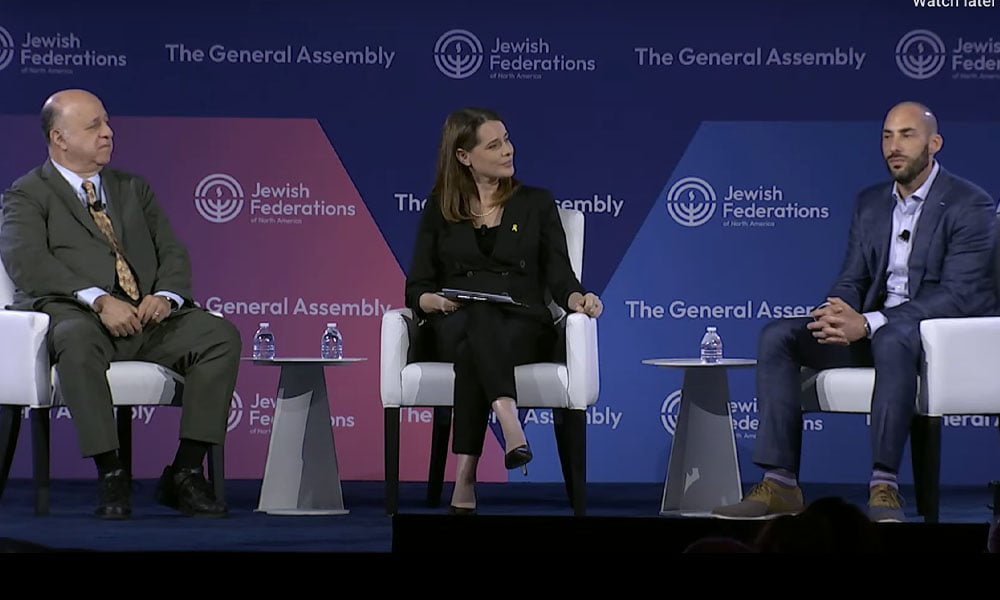
The Jewish Federation of North America’s annual General Assembly (GA) convened two weeks ago, drawing thousands of Jewish professionals and lay leaders from across the country to tackle some of the most pressing issues facing the community. This year, the mood was sometimes sober as participants grappled with widening internal rifts and intensifying debates over Israel and American politics. An innovative debate technique, though, helped the plenary discussion end on a constructive note.
Many attendees noted that the Jewish community feels more divided than at any point in recent memory. Long-standing disagreements over Middle East politics have deepened amid recent developments abroad and at home—including the election of New York City Mayor Zohran Mamdani, which has heightened already simmering tensions.
Those divisions took center stage during the afternoon plenary session on Monday, November 17, which focused squarely on the fractures within the community. The director of the Sapir Institute, Chanan Weissman, opened the discussion with a pair of revealing questions.
First: “Who has disagreed with a colleague over the events in Israel?” About 40 percent of the audience raised their hands. Second: “Who has gotten into an argument with a friend over the events in Israel?” This time roughly three-quarters of the room responded.
From there, the plenary moved into a debate over the viability of a two-state solution—an issue that has long polarized Jews across the political and religious spectrum. In addressing the question, Is there a realistic future for the two-state solution? Commentary Editor John Podhoretz argued no and Israel Policy Forum Chief Policy Officer Michael Koplow argued yes. The debate was moderated by Israeli journalist Tamar Ish-Shalom, host of the podcast Jewish Crossroads.
The debate’s organizers introduced a twist designed to shift the tenor of the conversation: a format called “One Good Point.” Borrowed from a growing set of initiatives aimed at restoring civility to public discourse, the method requires each participant, at the conclusion of the debate, to highlight a single compelling argument made by the opposing side. Supporters say the exercise encourages deeper listening, intellectual humility and a willingness to engage honestly with competing perspectives.


Koplow went first and acknowledged that Podhoretz “is 100 percent right that Israel can’t do this by itself…it requires real work on the other side.” He added a second point made by his debate opponent that he agreed with: “Until the other side absolutely and implacably accepts that Israel isn’t going anywhere, then we’re not going to see a two-state solution.”
Addressing Koplow, Podhoretz said: “I believe that, as you suggest, if we pursue this with an idea that the timeline for this is in the future and that things need to happen in the future to lead to that prospect and that possibility, that we will reach that eventually.” Adding that it may not happen in his lifetime, Podhoretz concluded that because he believes Israel is eternal, “we have the time necessary to get to this final end that you see.”
While no single debate can resolve the longstanding disagreements that shape Jewish communal life, many attendees saw the technique as a hopeful model. At a time when arguments often turn personal and conversations fracture relationships, the effort to infuse discourse with mutual respect felt especially urgent.
The Jewish community has long embraced the adage “two Jews, three opinions.” Perhaps future discussions might generate “three good points” as well.
Opening Image: Jewish Federations of North America screenshot