
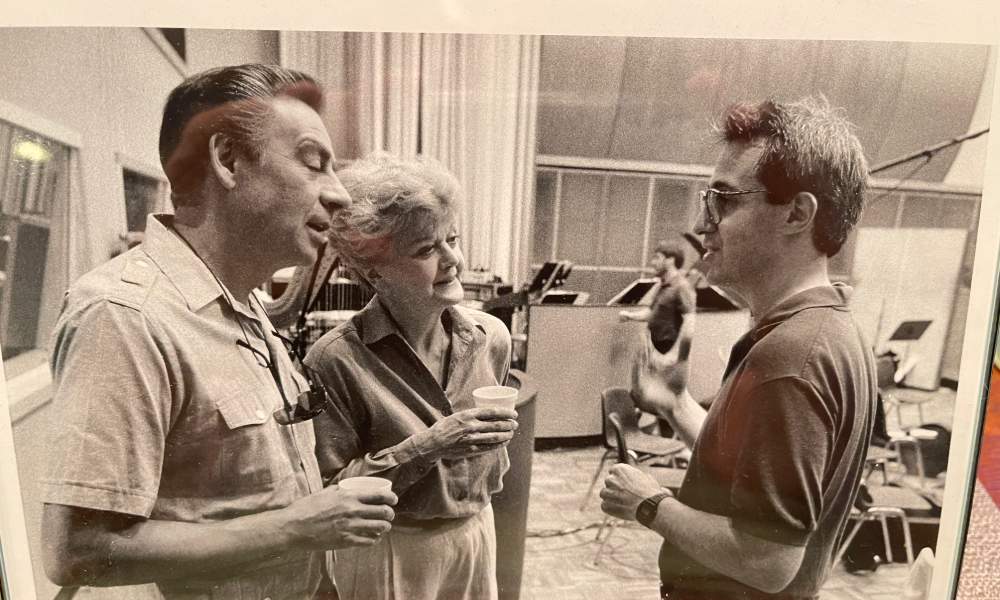
David Friedman has spent over 40 years in show business, on Broadway, in film, recorded music and more, as a musician, conductor, music director and songwriter. Now in his latest book, David Friedman: The Stories of My Life, he looks back on his experiences not only in his career but in his life growing up—Judaism, friends, family, love and healing—through over 1,000 stories and anecdotes.
At 17, Friedman received his teacher’s certificate from the Dalcroze School, a music school in New York City. The head of the school sat him down and told him that he was gifted—the youngest person ever to receive this certificate from the school. But she warned him of the “trashy nightclub idiom” that she noticed in his improvisations and further warned that if this were to continue, he would end up in the pit of a Broadway show.
“And I thought, ooh, that would be fun,” Friedman tells Moment.
Growing Up Jewish
Friedman was born into a Jewish family in New York during the 1950s, where both his stories and musical journey began.
On his mother’s side, his Nana came to America on a boat by herself when she was 12, and Friedman says that there was a “certain anxiety” built into her from her experiences. Friedman begins his book with some stories about her, saying that he wanted to start with what shaped him first.
“A lot of times when we think, why am I like this? Why am I so anxious? Why am I so angry? Or whatever,” Friedman says, “It’s built into the history, so I want to start with what influenced me and then we can talk about what we do with that.”
His parents, whom he describes as “intelligent, artistic people,” were opera lovers who’d had a subscription to the Metropolitan Opera since 1947, taking him to see his first opera at 12 years old.
Friedman’s father loved classical music, and with that influence, he began studying music as a young child. At seven, he started attending the Dalcroze School and later began playing piano. His father stopped his lessons after Friedman chose to play outside with friends instead of practicing.
“When I was 12, I was going out to play punchball—this is the bad part of Jewish parents—and my father said, ‘Where are you going?’ I said, ‘I’m going to play punchball,’ and he said, ‘I want you to practice piano.’ I said, ‘I told my friends I’d be out. I’m gonna practice later.’ He said ‘If you leave the house, I’m stopping your lessons,’” Friedman says. “I left the house and I never had another lesson until college.”
With what he calls the “craziness of a Jewish family,” it was never considered that Friedman wouldn’t go to college; in fact, he almost ended up in business school because he did not appreciate his talent. Luckily, a family friend, who was a musician, recognized it.
“She said to my parents, ‘If he doesn’t go into music, this is gonna be an enormous loss for the world,’” Friedman recalls. “So she recognized my talents. And at the last minute I decided to come into music.”
“A Jewish upbringing had its fears and its control issues and I was never allowed to keep a dime I earned. It was taken right out of my hands for college,” Friedman says. “But it also gave me a sense of family, a sense of solemnness, a sense of what’s important.”
Where His Career Took Him
Looking back, Friedman notes that the interesting thing about his career is that he has had so many of them. His original career goal was to become a concert pianist. Then he returned to New York and worked in theater as a music director and realized he wanted to conduct, so he made the switch. He said he then realized he wanted to write and switched his career to songwriting and then discovered metaphysics, part of his own search to heal his own anxieties.
After Friedman was warned that he might end up in the pit of a Broadway show, it did not take long for that prediction to come true. Friedman spent a summer working at the Charles River Creative Arts Camp in Dover, Massachusetts, helping campers write musicals. It was there that he realized his talent and soon after returned to New York to pursue a theater career.
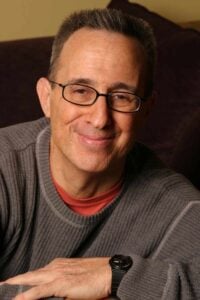
David Friedman. Courtesy of David Friedman.
Friedman was playing piano for an audition for a family friend’s daughter in the office of Mitch Leigh, who had written Man of La Mancha and was working on developing a new Broadway show, Saravá. He was “not quite seasoned enough” to star in the show, but Leigh asked him to leave his card.
“And I said, ‘no.’ He said, ‘why not?’ I said, ‘well, I don’t have a card.’ But I went back the next day. I forgot my umbrella and I left a note,” Friedman said. “And he called me and said ‘what do you want to be when you grow up?’ And I said, ‘I want to conduct on Broadway.’ And he said, ‘well, I have a conductor for this show, but would you be my assistant?’”
While working as Leigh’s assistant, he was also allowed to serve as vocal arranger. Friedman later became the assistant conductor, but when the conductor was fired, Leigh began interviewing other candidates, telling Friedman that he needed him in the job of assistant. After interviewing others, he relented and offered Friedman the role.
Working as a conductor on Broadway, Friedman would be paged at the stage door. Often, he says, it was a young child who would ask for tips on how to achieve their dream of conducting on Broadway. He’d say that he could tell them how it happened for him, but noted there’s no “prescribed” way of doing it. He added that many of them became Broadway conductors later because they “had the nerve.”
“You want to speak up? The worst that can happen is someone will say ‘drop dead,’” Friedman says. “And then you’ll be no less far than you were before. So, ask. People help me, so why not help them?”
Friedman’s career did not stop with the stage, however. His work expanded to the world of film after meeting Disney composer Alan Menken while working on God Bless You, Mr. Rosewater. Friedman was the musical director and conductor on the project (based on Kurt Vonnegut’s novel of the same name), with Menken as the composer.
Friedman recalls a “tiff” after inviting Menken to a show that Lori Beechman, whom he played piano for often, was singing in after he had written some songs for her.
“One time I said, ‘Are you coming to our show,’ and he said, ‘Are you doing any of my songs?’ I said, ‘no.’ And he said, ‘Well, I won’t come then.’ And I was like, ‘really?’”
Three weeks later Friedman was in bed reading a magazine when Menken called, telling him that he had just signed a deal with Disney Studios for Beauty and the Beast and Aladdin. He asked Friedman to work with him, he said yes, and Menken replied that he would call him in the morning.
“I didn’t even know those films existed,” Friedman says. “I wasn’t interested in doing movies. I thought I was a Broadway guy. So I always say sometimes you push and fight for things, sometimes just because of who you are, they show up.”
On both films, Friedman conducted the score and worked as the vocal arranger. In his book, he tells the story of how he convinced Angela Lansbury to do Beauty and the Beast. He describes getting a call from Disney telling him that Lansbury wanted to turn down her role of Mrs. Potts in the movie because she did not think she could sing it. Disney asked him to go to Boston, where she was staying in a hotel, and convince her to do the movie. Friedman later learned that Disney had sent her the Celine Dion pop version of Mrs. Potts’ classic song, “Beauty and the Beast.”
“No wonder she was afraid she couldn’t sing like that!” Friedman wrote.
When they recorded the song in the studio, Lansbury “nailed it” in one take. Friedman wrote that she then pointed to him and said, “It was HIS doing,” calling it the best moment of his film career.
In the middle of working on Pocahontas and doing music supervision for the Broadway production of Beauty and the Beast while it was still in Houston, Friedman went to Menken and told him that he was “making a fortune here” but was depressed.
“[Menken] said, ‘Well, you’re depressed because you’re one of the few people who’s supposed to be doing what I’m doing. And if I were you, I would take three years and phase me out of your career.’” And so, I did a little less.”
Writing was something that he had wanted to do early on, he said, but was too afraid to do. Friedman wrote in secret, but finally gave a concert in 1991 featuring 33 songs that he had written, performed by singers including cabaret star Nancy LaMott, Judy Kaye, Lesley Gore and others.
He staged a revue show, Listen to my Heart, in Tampa, during which a collection of his songs were performed by cabaret singers and Broadway veterans, accompanying them on the piano. He recalls this production as one of the best that the cast did and said everybody loved it except one critic who said that his music was sappy and overemotional. Friedman recalled the review, which noted that Friedman seemed to think that the most important thing in life is love.
“Well, I do,” Friedman says. “And I was given that by my upbringing. I decided, if there’s someone who doesn’t understand that and criticizes me, I have to keep doing this.”
The Stories He Has To Tell
One of the first ideas in the book is that Friedman does not consider himself famous.
“I once looked it up and I think my name is on 120 million pieces of product around the world,” Friedman explains. “But many people wouldn’t know my name.”
His husband always jokes there is either a the in front of his name or a who after it.
Friedman has written three books on what he calls his “Thought Exchange method,” two books drawing inspiration from his songs, a book collecting stories of how different couples met, and now a book telling stories from his own life.
The idea for the latest book came from actress Lucie Arnaz, daughter of Lucille Ball and Desi Arnaz, while he was visiting her and her husband in Palm Springs. They were taking a walk and she pointed out to him that he always tells so many stories when they talk. She said, “You always say, ‘Did I ever tell you?’” Friedman almost took that line and made it the title of the book until an editor commented that many other books carried that name and that Stories of My Life would better represent what he was writing.
According to Friedman, the overarching theme of this book is healing.
Friedman says that if asked who he is, he would say a healer, but his favorite role in his career has been as a songwriter.


“A lot of the other stuff was me afraid, because that really is you putting yourself out there. It’s you,” Friedman explains. “And so I hid behind Alan Menken’s music, Andrew Lloyd Webber’s music, John Barry’s music.”
“I thought that this book shows in all different ways how that is,” Friedman explains. “Whether you’re laughing at a joke, whether you’re being entertained by something, whether you’re being given a piece of spiritual advice, it’s my aim for people to be happier and seen.”
One of the things he hopes is that people who read the book will see how much wisdom they have. Recently, he gave a talk on the book and a one-hour workshop and spoke about his belief that everybody has a story to tell.
“I put a microphone in front of the room and said, come up and tell us the story that you find yourself telling the most. And let’s talk about what it means to you, why you’re telling it and what it means to us,” Friedman said, “and invariably it has meaning beyond just the story.”
While writing, he included almost every story that he could think of that he felt was appropriate for the book but jokes that he has thought of two stories that he forgot so far.
“We can always stick them in on the next edition,” he says.
(Top image credit: David Freidman (right), with Angela Lansbury and Jerry Orbach at a Beauty and the Beast recording session. Courtesy of David Friedman)