
Sometime in the early 1960s, in a finished basement in Great Neck or a carpeted den in Shaker Heights, a host slid a black vinyl disc out of a cardboard sleeve, set it on a turntable, lowered the needle and waited. Neighbors, cousins, the couple from down the block all leaned in. Within seconds, the room was laughing. Not just smiling. Not chuckling at a screen. Laughing together at a shared cultural text.
That text was a comedy album. Often, it was a Jewish comedy album. And the gathering around it, what we would now call a listening party, was one of the great unsung communal institutions of post World War II Jewish American life. It has no historical marker, no museum wing, no documentary. It dissolved so quietly that we never bothered to give it a name, let alone a eulogy.
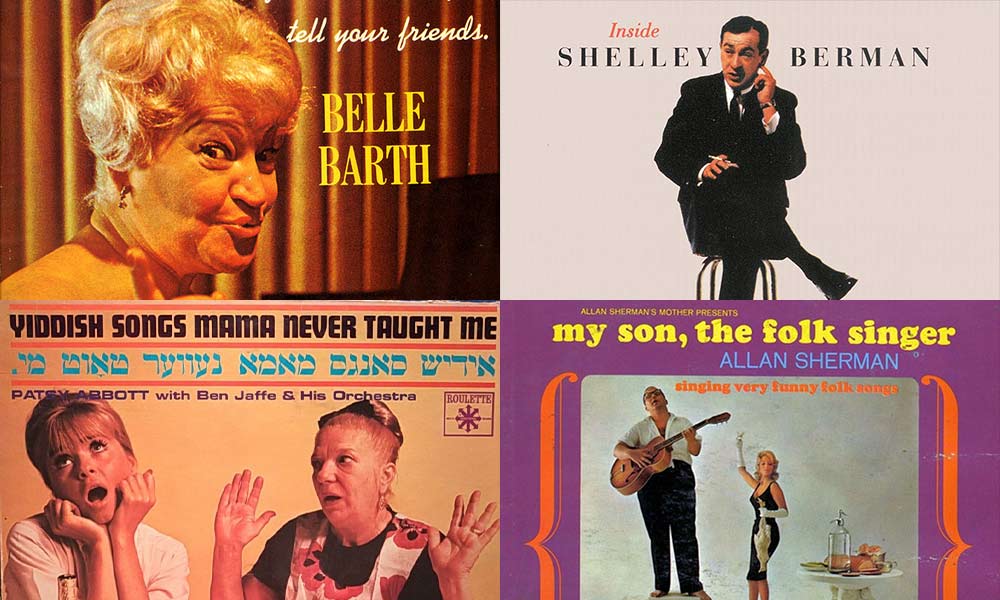
For roughly a decade, from the late 1950s into the late 1960s, the long-playing comedy album was one of the most vital popular art forms in America, and arguably the most Jewish. The roster is staggering, even at a glance. Shelley Berman’s Inside Shelley Berman became the first comedy album to go gold, reaching No. 2 on the Billboard chart, and the first record to win a Grammy for Best Comedy Performance, Spoken Word. (Berman was known for his “one-sided telephone conversation” bits in which his caller would get increasingly annoyed with the person on the other end.) Mike Nichols and Elaine May turned the anxieties of the modern urban couple, many of them recognizably Jewish anxieties, into chamber music for two voices. Mort Sahl essentially invented political stand-up on vinyl, and did it in a cadence imported straight from the Reed College debating society by way of a Jewish sensibility that could not stop arguing with the news.
Satirist Allan Sherman took “Frère Jacques” and “Greensleeves” and refitted them with Yiddish-inflected parody lyrics. Americans, Jewish and otherwise, put his My Son, the Folk Singer at the top of the charts in 1962. Mel Brooks and Carl Reiner’s 2000 Year Old Man had been a party piece in living rooms for years before Steve Allen persuaded them to commit it to tape.
And on the other shelf, sold quietly, often literally under the counter, were the so-called party records. Pearl Williams, working the Miami Beach circuit in the Sophie Tucker lineage. Patsy Abbott, born Goldie Schwartz, whose Yiddish Songs Mama Never Taught Me adapted Yiddish folk material into bawdy numbers. B.S. Pully, born Murray Lerman in Newark, was a Borscht Belt veteran who would later create the role of “Big Jule” in Guys and Dolls but whose party-record career trafficked in material no mainstream stage would host. And Belle Barth, born Annabelle Salzman, whose If I Embarrass You, Tell Your Friends and I Don’t Mean to Be Vulgar, But It’s Profitable combined piano patter, Yiddishkeit and material too blue for radio, television or the movies of her day. (“I’m gonna line a hundred men up against the wall/I bet a hundred dollars I could bang them all…”)
For the length of a 20-minute-or-so side, the room would become a single organism, breathing in on the setup and out on the laugh.
These comics moved enormous quantities of vinyl through channels that never reached the Billboard chart, because adults wanted to hear, in the company of other adults, material that broadcast television and mainstream film would not touch for decades, and that cable and streaming would only catch up to in the 1990s.
It was a Jewish golden age hiding in plain sight on a turntable. But the albums are only half the story. What matters, and what has gone missing, is the room.
A comedy album was not designed to be listened to alone. It was designed to be dropped onto a spindle in a living room full of people who had just finished a bowl of onion-soup-mix dip or the last of the Manischewitz wine. Someone would say, “Wait, wait, you have to hear this one.” The needle would come down. And for the length of a 20-minute-or-so side, the room would become a single organism, breathing in on the setup and out on the laugh.
This was a ritual with rules, even if no one wrote them down. You did not talk over the bit. You did not explain the joke to the person who didn’t get it; you’d let them get it on the second listen, or the third, because everyone knew these records were going to be played again. You laughed harder than you might have laughed alone, because that is what laughter does in a room; it multiplies. And when the record ended, you turned it over, or you put on another, or you argued affectionately, Jewishly, about whether Nichols and May were funnier than Berman, whether Sahl had lost a step, whether your cousin’s Allan Sherman impression was better than Allan Sherman’s.
There is a reason the party records sold in the quantities they did. The living room (or downstairs den), with the door half-closed and the kids in bed, was a permission space. In that room, on that night, a group of adults could hear Belle Barth say what Belle Barth said, or Patsy Abbott sing what Patsy Abbott sang, and laugh at it, go home, and return to their jobs as accountants and pediatricians and schoolteachers on Monday morning. The transgression was bounded; it did not leak. It was not searchable. No one was going to clip ten seconds of it and send it around.
This is easy to miss now, because we have convinced ourselves that the move from broadcast to cable to streaming was a straight line toward more freedom of expression. And in certain respects, it was. But the living-room listening party was its own kind of First Amendment micro-environment, one that predated HBO by a generation and operated on a principle the platforms have never replicated: The audience was known to itself, trusted itself and took responsibility for what it heard.
Consider, by contrast, the experience of watching Alex Edelman’s Just for Us on HBO, or Modi Rosenfeld’s Amazon Prime special Know Your Audience, or Ari Shaffir’s latest on YouTube. The comedy is, in many cases, brilliant. The Jewish content is more explicitly Jewish than anything Berman or Sherman could have attempted in 1962. Edelman’s entire show is a first-person account of walking into a meeting of white nationalists in Queens. You could not have pressed that onto a Warner Bros. LP and sold it at Korvette’s.
And yet the typical viewing experience today is often one person on a couch with a laptop, or one person on a subway with earbuds, or one person propped on a pillow at 11:47 p.m. scrolling through a carousel of thumbnails. Chances are the algorithm recommended it. And even if a friend did, they likely didn’t host a viewing party. The laughter, if there is laughter, is solitary: the small, almost embarrassed exhalation of a person alone in a room, registering a joke in private.
The material has gotten freer, but the audience has gotten lonelier. That is the trade-off we made, and we made it without noticing.
It would be too easy, and not quite true, to say that nothing has replaced the listening party. Something has. When Edelman’s special drops, or Shaffir says something provocative, or Sarah Silverman posts a bit to Instagram, a community assembles almost instantly on X or TikTok, in group chats, in the comment sections beneath the clip.
People argue about the joke. They quote-tweet it, perhaps clipping a few seconds, and recontextualize it for an audience the comedian never addressed. An outrage cycle forms, runs its course, and dissolves quickly. This is, technically, a community. It is a community of strangers, adjudicating in public, often in bad faith, what a comic meant and whether they should have said it. It is the anti-den: a room with no host, no threshold, no trust and no agreed-upon understanding that what happens inside stays inside. The listening party produced laughter. The replacement produces litigation.


What’s worth remembering here are the specific forms of community that Jewish American life depended on in the second half of the 20th century, without quite realizing it. The listening party was one of those forms. It required a host, a room, a turntable, a record and at least three other people. It produced in return a weekly or monthly rehearsal of shared sensibility, a reminder that there was a collective “we” who found these things funny for these reasons.
And it is worth remembering when these parties tended to happen. They happened on Saturday nights. After sundown, after the week had ended, after whatever observance or non-observance the household kept on Shabbat had given way to the social hours that followed. The listening party was, in this sense, a secular Havdalah, with a shared cultural text in place of a braided candle and a spice box, and collective laughter in place of blessings.
The comedians of the album era are no longer with us. Mel Brooks, at 99, is the last man standing from the room that invented this art form. The albums are on Spotify, most of them one click away. There is no shortage of brilliant new Jewish comics, and some of them are doing work that honors and extends the tradition.
But we’ve traded a room full of neighbors and relatives for a feed full of strangers, a turntable for an algorithm, and a Saturday-night laugh for a Friday-afternoon outrage cycle. Whether any of that is progress is a question Jewish America has not yet sat down, in a room together, to answer. Perhaps, when we do, someone will put on a record.
9 thoughts on “When the Comedy Album Was a Jewish Art Form”
Bring them back on Facebook
oy vey
“When You’re in Love The Whole World is Jewish” another great album.
What a fun assignment–one I would have loved when i was at Moment
<3
OMG I still have my parents’ copy of “My Son the Folk Singer”. I am 72 years old and remember when someone gave it to them as a gift. I was a little kid and got some of the jokes. But when I later learned the original versions of the folk songs I laughed all over again at Sherman’s genius of forming Jewish/Yiddish parodies of them.
Thanks for this fun article. Calling the listening parties a form of Havdalah was a good laugh also!
Thanks for memories –
I’m now considering organizing this kind of soirée for friends who might listen this old time Jewish Comedy for the first time, or as a retreat to nostalgia.
Beautifully written as well
Don’t forget the works of Tom Lehrer…his satirical songs of culture and politics were way ahead of his times.
Very insightful and nostalgic. We are five couples in our 70s who get together after Havdalah and watch a movie. We have the same cultural touchstones and similar but not identical sensibilities. Close but no cigar.
Must be mentioned: “You Don’t Have to be Jewish,” which IMHO is the funniest of all.