
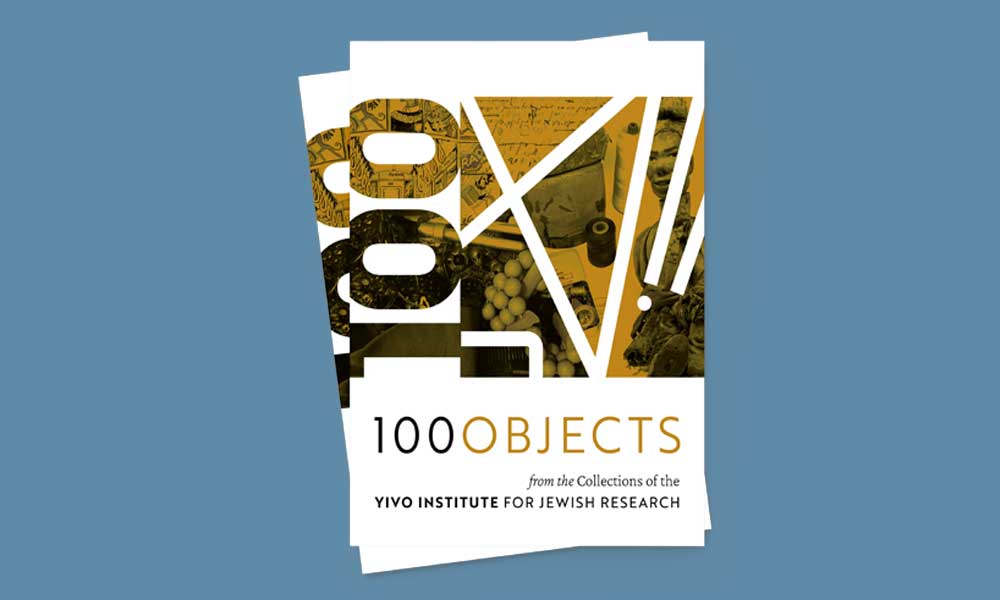
100 Objects from the Collections of the YIVO Institute for Jewish Research
YIVO Institute for Jewish Research, 316 pp.
Twentieth-century American Jews were no strangers to charitable giving, responding generously and frequently to public entreaties for food, clothing, furniture, and even cash for those in need. What they hadn’t ever done was to donate their prized personal possessions—family photographs, say, or keepsakes from the Old World—to a public institution where these items would be put on display for the benefit of the commonweal.
But that’s precisely what the Yidisher Visnshaftlekher Institute (Institute for Jewish Research)—YIVO, for short—called on the American Jewish community to do during the dark days of World War II and its immediate aftermath. Taking to the airwaves and to print, this relatively new institution, itself a New York transplant from Vilna, urged its Eastern European constituents to transfer correspondence, photographs and artifacts that reflected their “intangible heritage” into its care before it was too late. “Every note and scrap of paper, every document and object that reflects Jewish life in the Old World is part of a national patrimony that must be protected from becoming lost,” Yedies fun YIVO, its newsletter, cautioned in 1944.
Lest prospective donors have any qualms over parting with family memorabilia, now rendered more precious by the ongoing devastation of European Jewish life, YIVO reassured them that it wouldn’t throw anything away “as so often happens in private homes—when moving, by accident, or because children don’t understand their value.” More reassuring still, it promised not to “let anything go to waste.”
Once accumulated, these items were intended to be the basis of a museum—the first of its kind in the United States—that would furnish American-born Jews of Eastern European descent with a “more palpable image” of their parents’ and grandparents’ lives, showcasing Eastern European Jewry’s patrimony and at the same time serving as a memorial to its destruction by the Nazis. It would combat prejudice, too, acting as a “weapon against the libels of Nazis and other antisemites, which are often disguised in the cloak of enlightened scholarly information.”


Excited by the project’s possibilities, American Jews at the grassroots responded enthusiastically to YIVO’s call, even forming collecting groups to rustle up material. Before long, photographs by the hundreds came over the transom at the research institute’s Morningside Heights address, as did letters, books, folk songs and objects that encompassed the holy as well as the everyday. Dutifully acknowledged with an effusive thank-you letter and systematically recorded, donated items were carefully placed on storeroom shelves where, nestled alongside a scrapbook that contained newspaper clippings about the venture and archival boxes that housed internal documentation of its progress, they awaited the day when this “museum for posterity” would open its doors.
That day never came. As Jeffrey Shandler, the distinguished Rutgers University scholar of Yiddish culture, recounts in his deftly told and poignant Homes of the Past: A Lost Jewish Museum, YIVO’s museum never got off the ground. Ahead of its time, perhaps? Thwarted by limited economic resources or a lack of trained museum personnel? Stymied by competing communal agendas such as the postwar reconstruction of European Jewish life and the salvaging of what remained? It’s difficult to assign blame or apportion responsibility when every one of these factors was in play to one degree or another. What’s crystal clear is that the enterprise, as Shandler evocatively puts it, “rested on a foundation of losses even as it endeavored to redress them,” causing the project to falter. Ultimately, the items YIVO had hoped so proudly, determinedly, to exhibit were folded into the body of its general holdings, their distinct identity and provenance all but erased.
Labeling it a glorified scrapbook wouldn’t fit the bill, though its fusion of words and images, its blurring of the self and the collective, brings one to mind.
Until now. Eighty years later, in 2025, as YIVO marks its centennial birthday, some of those artifacts have now returned to view, both in a series of anniversary exhibits (reviewed in last issue’s Visual Moment) and in an accompanying volume, 100 Objects from the Collection of the YIVO Institute for Jewish Research. A “caution” and a “celebration,” a “declaration” and an “invitation,” this beautifully illustrated volume pairs each object with a sensitively drawn mini-essay—a commentary—by a leading scholar, 57 in all, in the field of modern Jewish studies. Each commentary ensures that readers will understand what they’re looking at, and why: a Remington Rand Deluxe Model 5 Hebrew typewriter that belonged to novelist Chaim Grade, who wrote in Yiddish; a galaxy of mischievous wooden toys carved by the artist Mayer Kirshenblatt; an Isaac Gellis “Kosher Provisions” plombe, the lead seal that once graced the plump end of a kosher salami to reassure consumers that it was produced under Rabbi I.M. Gorelick’s watchful eye; and many more.
Many of the featured artifacts made me smile, their delight in the material world, their tactility and fullness, readily apparent. Others, like a hand-drawn paper chart whose tiny red and black figures seated at equally miniscule individual desks measured library usage in the Vilna Ghetto, left me in tears, as did a crumpled handwritten petition—a kvitl—calling on Rabbi Elijah Guttmacher, the Tzadik of Grätz and a celebrated miracle worker, to do his magic on behalf of a besieged storekeeper named Shlomo Shmuel. Each one is a testament to an alchemy of hope and despair.
Every object tells a story and stands on its own; when added together, their cumulative impact is even more powerful, prompting readers to acknowledge and applaud the ongoing hum, the vitality, of Jewish daily life even under the most wrenching of circumstances. Heralded as relics, the stuff of documentation, the 100 objects thoughtfully culled from the collections of the YIVO Institute for Jewish Research and brought together on its 100th birthday can also be read as models of steadfastness and resilience, much like YIVO itself.
This celebratory volume broadcasts itself as a coffee table book, a designation that, at first blush, makes sense. True to form, the volume is oversized and meant to be casually thumbed through rather than the beneficiary of concentrated reading. What’s more, pride of place is given to its eye-catching images, its pages more of a visual treat than an intellectual encounter. And yet, the coffee table designation doesn’t seem right: to feature YIVO’s assemblage of 100 objects as if they’re close kin to British country houses or Venice’s secret gardens—the genre’s customary bill of fare—is too slight a gesture, one that’s incommensurate with their heft.
What, then, should we call it? A catalog, perhaps? That’s not quite right, either, since, strictly speaking, the volume is not the companion piece to an exhibition per se, though it certainly feels as if it could be. Nor would labeling the text a glorified scrapbook fit the bill, though its fusion of words and images, its blurring of the self and the collective, and its freezing of time, brings one to mind.
As I scratched my head in search of a designation that rang true, it occurred to me that thinking of this compilation as a latter-day, contemporized yizkor bukh might do. A genre all its own, the yizkor bukh was a post-World War II phenomenon, a collective memorial book commemorating a Jewish community destroyed during the Holocaust and serving as both a vanished settlement’s biography and its tombstone. At once an object and a book, its unusual combination of image, text, and tone, which ranged from sadness to pride leavened with a touch of wry folk humor, brought into sharp and affectionate relief the human flourishes and foibles that had rendered Eastern European Jewish Yiddishkeit so very alive.
This centennial salute does much the same thing: It’s as much a celebration of Jewish history as it is of YIVO. Artifact, narrative, and emotion once again collude, giving rise to an arresting, warmhearted book, whose emphasis on the “small details” enables us to see the big picture, inspiring us to assume—and, yes, to relish—our ongoing responsibility as stewards of our past.
Jenna Weissman Joselit is the Charles E. Smith Professor of Judaic Studies and Professor of History at the George Washington University.
Moment Magazine participates in the Amazon Associates program and earns money from qualifying purchases.