
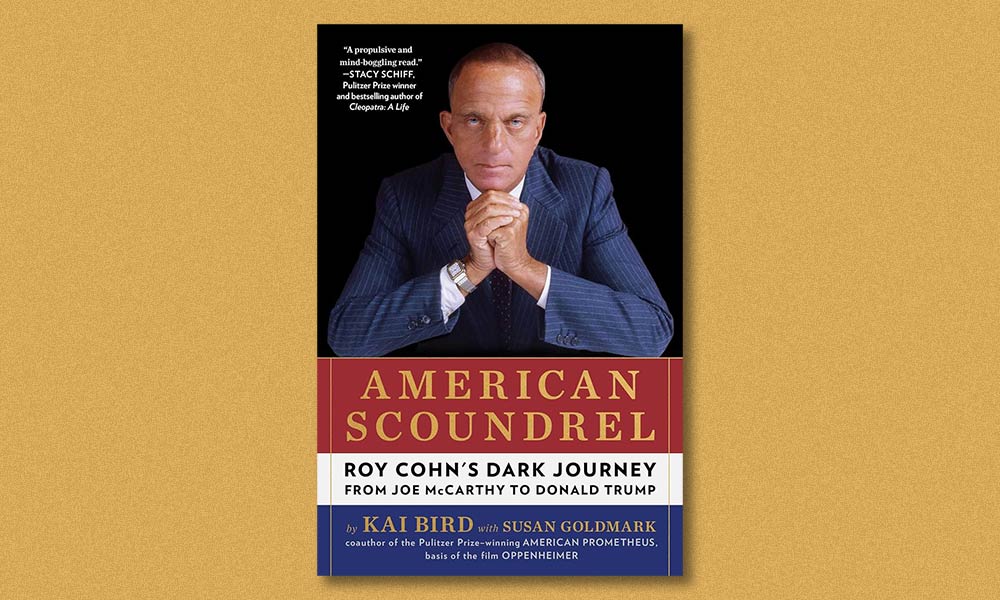
American Scoundrel: Roy Cohn’s Dark Journey from Joe McCarthy to Donald Trump
By Kai Bird with Susan Goldmark
Scribner, 528 pp.
In the annals of great American villains, the lawyer Roy Cohn managed to win himself a place alongside Benedict Arnold, Richard Nixon and Mr. Potter from It’s a Wonderful Life—menaces who undermined trust, fueled cynicism and normalized greed. But Cohn, a boy wonder among New York City’s legal machers who deserves considerable credit (if that’s the right word) for building Joseph McCarthy and Donald Trump into history-changing rogues, was a somewhat different brand of bad guy.
Broadly recognized as a serial fabulist who had utter contempt for the law and rarely met a rule he didn’t break, Cohn (1927-1986) was no cartoon villain. He was a brilliant tactician and a loyal friend, especially to his circle of New York buddies in the worlds of politics, the media and showbiz. He was also an effective litigator, albeit one who did near-zero preparation for court and was frequently accused of paying off judges.
The trick to writing a worthy biography of Cohn is to somehow distinguish your book from a mere indictment. Cohn was on the receiving end of plenty of those, but he got off every time. Every time. As Kai Bird’s title suggests, there isn’t a whole lot of room for nuance when drawing conclusions about Cohn’s meaning and impact. The man himself relished the idea that he was a scoundrel, a scrappy, no-holds-barred fighter. He built a life of great prominence out of a few basic—and these days, very familiar—foundations. Indeed, those foundations are on daily display from his most successful protégé: Always deny. Delay, delay, delay. In your own defense, make stuff up. When attacked, hit back ten times harder. Ignore the rules.
He named his yacht “Defiance.”
It is difficult to think about Cohn without going immediately to Trump. It would be incorrect, though, to see them as peas in a pod. Yes, everything from Trump’s bloody rhetoric to his libertine approach to sex to his cavalier attitude toward court orders echoes Cohn’s Way.
Like Trump, Cohn had few friends. In high school, he recalled, “When I finished my homework, I would lie in bed without any clothes on and I would just think about politics.” In his early 20s, he was already scheming to get his name in the papers.
Like Trump, Cohn wasn’t much for paying his bills, he did business with mobsters, and he promised to destroy people who prosecuted him. Also like Trump, Cohn managed to escape from repeated prosecutions—for bribery, conspiracy, extortion—without significant consequences. He once delivered a seven-hour closing argument in his own defense, leaving at least one juror in tears. After just a few hours, the jury acquitted him of charges that he had bribed a city official to influence the outcome of a civil suit. Finally, in 1986, less than two months before he died of complications from AIDS, Cohn was disbarred for unethical conduct, including failing to pay back loans from one client and coercing another to make Cohn his executor.
But whereas Trump’s achievements and misdeeds seem to stem from the deepest of insecurities, Cohn’s, in Bird’s telling, were driven by a consummate confidence. Both Cohn and Trump come across as champion narcissists, but dig beneath the showmanship and differences emerge. Both men loved to boast about their rogue reputations, but Trump’s thousands of lawsuits and leak-hunts demonstrate how thin-skinned he really is. Cohn, by contrast, wasn’t personally threatened by anybody’s opposition; the record suggests that he relished it and actually believed that your only responsibility as his adversary was to spell his name right. (Cohn once sent a note to the editor of New York’s Village Voice “to protest the damage to my professional reputation by the failure of the Voice to libel me even once in the February 12 issue.”)
The Cohn saga, which Bird says portrays “the fragile character of American democracy,” has been told before. Nicholas Von Hoffman’s 1988 biography Citizen Cohn is more novelistic in style—a richer read—but equally addicted to the lowlights of his subject’s snaky life. A significant advantage of Bird’s book is that although Cohn left almost no paper trail, Bird got hold of FBI records that document a lifetime of nastiness from the man with the bloodshot eyes and hooded lids.
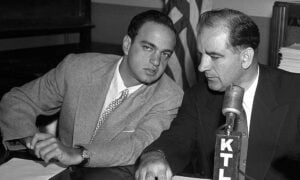
Senator Joseph McCarthy (right) confers with his HUAC chief counsel, Roy Cohn (left), in 1953. (Los Angeles Times, CC by 4.0)
Cohn was what used to be called a mama’s boy; his mother Dora taught young Roy that “rules were for commoners.” He lived with her until she died, when he was 40. Roy was never told “No,” according to his aunt. His bar mitzvah reception was held at the Waldorf-Astoria. Right out of law school, he became a federal prosecutor in Manhattan. At age 24, he got a plum assignment to prosecute Ethel and Julius Rosenberg for espionage. Cohn was instrumental in getting Judge Irving Kaufman named to handle the case. (Cohn’s father, a judge in the Bronx, had helped Kaufman get nominated to his judgeship.) Throughout the Rosenberg case, Cohn stayed in backstage communication with the judge, using a private staircase to visit Kaufman’s chambers.
Cohn never harbored doubts about sending Ethel Rosenberg to the electric chair. The idea was to get her to cough up names of other communists. But she never talked, and Cohn was fine with the result. “I would have pulled the lever myself,” he said years later. “I did resent very much the idea of associating Jews with a sympathy toward communism.”
After the Rosenberg trial, Cohn became a full-time communist-chaser. In 1953, he won the job of chief counsel to Senator Joseph McCarthy’s investigations committee, beating out one Robert F. Kennedy. Cohn said he got the gig because he was Jewish: McCarthy had caused a ruckus by calling one of his staffers a “miserable little Jew,” and hiring Cohn was an effort to massage his own reputation.
When he wasn’t accusing people of being communists, Cohn was busy driving homosexuals out of the government. He pushed some 800 federal employees out because of their alleged sexual perversion.
In 1954, Cohn’s persistent drive to win favors for his friend David Schine, an avid anti-communist whom he’d gotten hired onto McCarthy’s committee staff, got Cohn in trouble. After Schine was drafted, Cohn tried to get his buddy assigned to light duty. When the Army secretary refused, Cohn launched a crusade against the Army, hauling in officers he accused of subversive behavior. The televised hearings in which McCarthy and Cohn interrogated Army personnel—while Cohn was simultaneously being put on the hot seat over his pursuit of favors—lasted 36 days and got higher ratings than the World Series.
Cohn returned to New York and boosted his legal practice by serving as a gossip-monger, feeding the columnists and reporters who kept his name on the front page and Page Six (the New York Post’s gossip column). From the Stork Club to Studio 54, he starred in a nightlife in which he appeared to be openly
gay, though he always denied it. He was, as POLITICO once put it, “a homosexual homophobe” who lobbied against gay rights bills in New York because granting such rights would “destroy the fabric of the city.”
Bird spends many pages detailing Cohn’s alleged sexual escapades—the orgy at the Plaza Hotel where Cohn supposedly entertained J. Edgar Hoover, the young blond boys, some still in their teens, whom he was said to host every night, the 15-year-old Irish boy he had delivered to his Paris hotel room for a tryst, the porn theaters he owned, the house party at which a guest had sex with a dog. Bird takes many of the stories at face value. Some seem confirmed by his interviews with Cohn’s friends; others seem, as we say in the news biz, too good to check.


Bird’s primary contribution to the historical record on Cohn is his hard-won access to FBI investigative files. The biographer also gets the goods on Cohn’s payoffs to the judges and legislators he needed to help his clients. (As Cohn once said, “I decided long ago to make my own rules.”) At other points, Bird relies too heavily on chatter from Cohn’s associates, which he concedes is not exactly solid fact.
As for the relationship that has kept Cohn’s name infamous: The Cohn-Trump mentorship began in 1973, when young Donald and his real estate developer father Fred were targets of a federal investigation into their practice of refusing to rent apartments to Black applicants. Cohn guided Donald into a campaign of delay, legal counterattacks and aggressive PR. After two years, the Trumps were forced to settle and take affirmative action to rent to Black tenants. Cohn nonetheless declared victory. “Trump learned from Cohn that the court of public opinion is far more important than a court of laws,” Bird writes. For years, Trump kept a framed photo of Cohn in his office. When negotiations about a deal got tense, Trump would point to the picture and say, “Would you rather deal with him?”
Cohn foresaw a future in politics for Trump. In 1980, he asked legendary political operative Roger Stone to meet his protégé. “Is he a Republican?” Stone asked. Trump in those years contributed mainly to Democrats. Cohn replied, “Donald likes a winner.”
Bird concludes that Cohn’s major legacies, McCarthyism and Trumpism, “poison[ed] the American political landscape for decades to come.” Cohn, the author decides, was a clever smarty who was mostly an obnoxious jerk.
But he was something more insidious too. Long before Trump, Cohn honed his central insight, one that defines our politics today: The system runs on trust. Ignore its rules and you can get away with almost anything.
Marc Fisher is co-author of Trump Revealed: The Definitive Biography of the 45th President and was a columnist, reporter and editor at The Washington Post for 39 years.
One thought on “Book Review | The Ruffian Who Taught Trump How It’s Done”
Great review, Marc. Always glad to see one of your pieces pop up on my page.
But, why, oh, why have we allowed such creeps to make themselves wealthy, and in Trump’s case, to damage ourselves in the eyes of the world?