
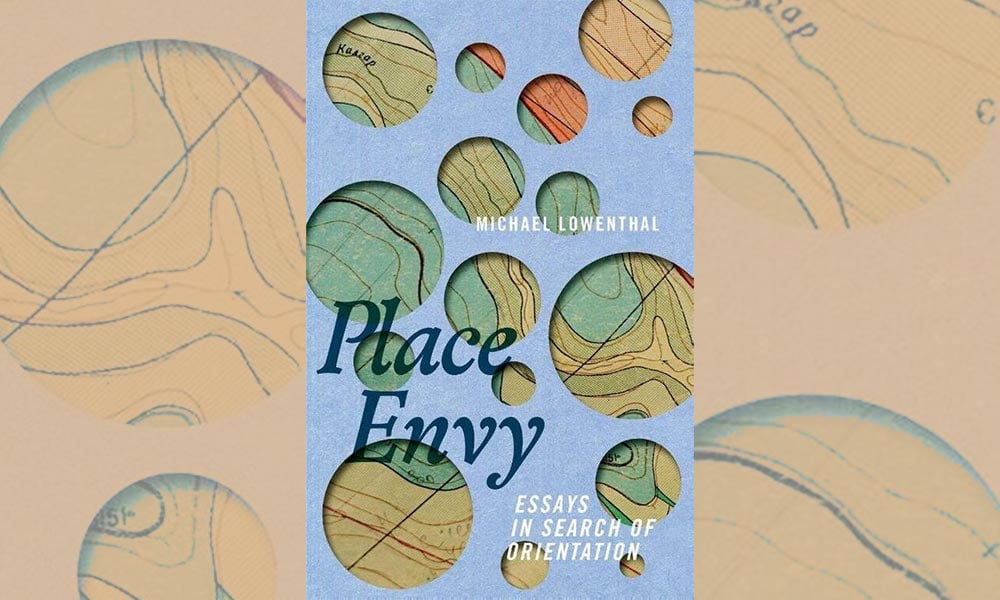
Place Envy: Essays in Search of Orientation
By Michael Lowenthal
Mad Creek Books, 296 pp
I, too, have been a victim of the phrase “Wherever you go, there you are.” I was a 17-year-old who couldn’t wait to escape Florida to attend college in California, where I was born and frequently visited; its sunny (but not oppressive) days and chill energy were just what I thought I needed. But I quickly found that my neuroticism and overthinking found new, Californian things to latch onto, and the disappointment that I was not suddenly a new person was as great as that of finding out the ocean is basically too cold to even dip a toe in.
Michael Lowenthal has a similar problem. In his debut book of essays, Place Envy, he travels from Germany to Brazil, from Amish country to China, not explicitly searching for enlightenment but finding new depths to himself. Usually his travels result in personal liberation, as when he spends a summer with a closed-up Amish family then vows to return to Dartmouth, out and proud. Yet it can threaten to split him apart, like his frequent trips to Brazil to see Uílliam, a local he falls into a sexual relationship with, while his partner, Scott, waits at home. All is allowed—Scott sees other people at home—but Lowenthal’s attention, split across continents, is at odds with how he sees himself: as a loyal man. This is made worse by a handsome stranger who makes a pass at him on the bus. “Was this what I wanted, to fission myself into bits?” Lowenthal writes. “A bit for Uílliam, a bit for Scott, a bit more for strangers on the street.”
Lowenthal’s candor makes Place Envy a wonderful and often surprising book, one willing to play in the mud if it means getting closer to truth. This can jangle the reader’s nerves, such as in the first essay, where he digs up an old photograph of a long-lost cousin, Peter, who died in the Bergen-Belsen concentration camp. His glasses and long swoop of hair stirs up sexual feelings for Lowenthal. “The incest-taboo aspect of these stirrings didn’t trouble me, considering that my feelings were wholly theoretical,” he writes. “The worse taboo, it seemed to me, was lusting after a Holocaust victim.”
Nevertheless, he persists, trying to figure out the mystique of Peter, who isn’t mentioned much in family correspondence. Nana Susi, Peter’s great-niece, might remember something about him, Lowenthal thinks, but she’s reluctant to talk, as her father, and much of her family, died in the Holocaust. Yet Lowenthal presses her (“Oh, please! I don’t want to think about these things anymore!”) for more information, until his internal line of thinking gets uncomfortably personal: Did he, too, chafe against our family? Would he have loved me? He unearths and outsources translation for a letter from Peter’s mother, who narrates Peter’s decline in the camp plainly, sending it to “all who loved Peter,” a group that, “I wanted to say included me,” Lowenthal writes. “But did I love the real Peter? Or did I mostly love my own ideas?”
The author returns to this aspirational deep dive in the second part of the story, where, visiting a German cemetery, he notices a grave next to that of his relative Moses—a boy named Rudolph, unrelated to the family. The two men were young, and died days apart from each other. Lowenthal translates the poems etched into their gravestones, which attest to the pair’s friendship. But could they have been, Lowenthal thinks, a little more than friends? It sets him on yet another scavenger hunt.
It is strange to read these passages where Lowenthal investigates the sexuality and relationship between the two boys, unable to confirm or decline. These are real people’s legacies we’re playing with, and even if it is a mostly imaginative exercise, he still manipulates (within reason) how they lived, projecting feelings onto them. Does he even have a right to? His actions aren’t good or bad, just interesting, and the book is richer for these morally grey moments where self-interest usurps acceptable thinking about your own family members.


Like a good David Sedaris essay, Lowenthal’s are honest, self-compromising and mischievous. This might be the result of a situation he narrates in one essay, wherein a piece he wrote in the gay magazine The Advocate about a trip to China is later cited in a sociology book. He excitedly buys it, only to see his writing was quoted as an example of orientalism, flattening the gay Asian man to a stereotype. Lowenthal is disturbed—his trip to China was much more intelligent and nuanced than portrayed—but remembers leaving out much of the trip’s sexcapades and conflicting for a smoother narrative, one where he’s kissed by a flirty drag queen. Omitting, instead of engaging and interrogating, got him in hot water. He doesn’t make the same mistake again.
Lowenthal places himself in ridiculous situations, candid about wanting to use them for a novel—he has written four, along with a book of short stories. He plays free jazz with Sun Ra in college, goes on a cruise for blind gay men (and tries to avoid his roommate feeling him up, which he says is part of the getting-to-know-you process) and works with an Amish family, where he has to conceal his queer identity and adapt to their laws (musical instruments are apparently just as bad as television). But the riskiest story comes in “Unmolested,” where he returns to his former summer camp that recently erupted in a sex scandal and almost triggers another one.
The Quaker camp’s loosey-goosey rules—nude swimming, roughhousing and eating; multi-stall outhouses with no doors—had resulted in predatory behavior, which Lowenthal plans to mine for fiction. But while there, he tries to balance how to be a positive gay role model with one boy’s rampant attraction to him. Lowenthal’s attraction to slight, skinny men—which got him branded as a Chinese fetishist before—has him keeping his distance, even when the boy, Ricky, sends him letters asking for blowjobs and naked pictures. Ricky’s letters, boyishly written yet sexually charged, are uncomfortable to read and even more so to think about. But in probing the relationship years later, Lowenthal is able to move past it and see the narrative for what it is—a good story.
Place Envy brims with experience, and it’s a testament to Lowenthal that he places himself in these situations simply because he thinks it will be funny to do so. A long time ago my mother told me that “you either have a good experience or a good story,” and I’ve found it’s true—if things are awkward or bad, at least I can use the experiences for something. Lowenthal seems to agree, and he realizes the power of writing your own tale when he’s lingering at the twin graves in Germany, wondering who will visit his grave and think about him. He and Scott don’t have kids, but he has his work. “For years,” he writes, “I had grasped at our history for validation, clutching tight to every tiny scrap, but the power was really in my own hands. The story I was finally sure of was my own: a story about the telling of stories.”
Moment Magazine participates in the Amazon Associates program and earns money from qualifying purchases.