
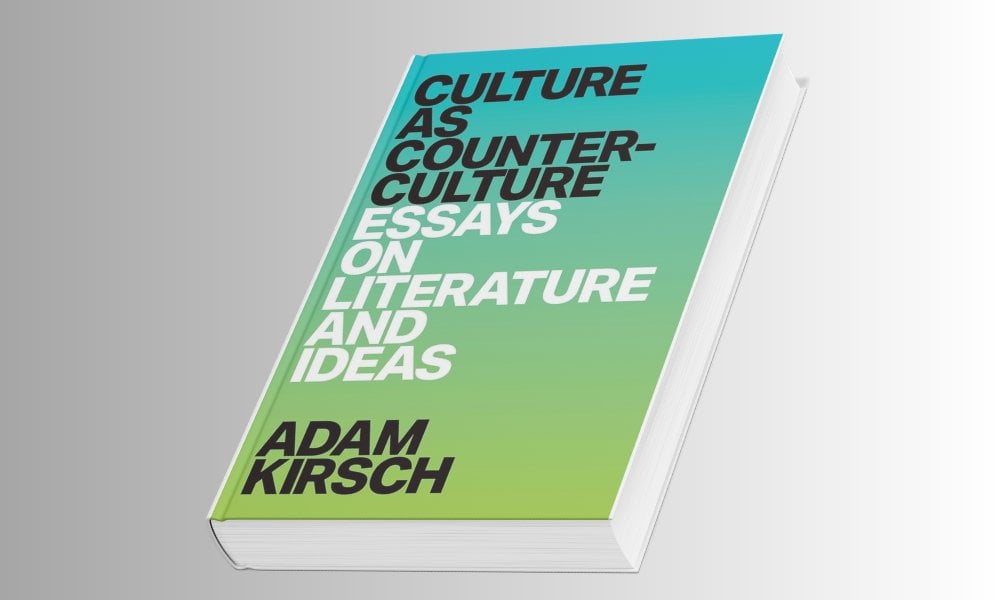
Culture as Counterculture: Essays on Literature and Ideas
by Adam Kirsch
Oxford University Press, 240 pp.
To readers unfamiliar with Adam Kirsch’s work, a title like Culture as Counterculture might bring to mind a polemic in the tradition of Allan Bloom’s The Closing of the American Mind (1987) or Clement Greenberg’s essay “Avant-Garde and Kitsch” (1939). However, in his steady output of criticism over the last two decades, Kirsch has never been one to issue doom-and-gloom proclamations about the death of art and the evils of mass media or, as he discusses in “Eliot’s Animus” (a 2020 essay that appears in this new collection), “[to crush] people with his negative reviews.”
“Mere spite,” he says, “could never motivate anyone to write truly interesting criticism”—though, he is careful to add, literary criticism must be written out of “‘animus,’ in the sense of a fixed intention, a partiality.”
The results of this approach are essays teeming with ideas and yet refreshingly free of opinion—that is, the sort of all-or-nothing, one-sentence appraisals that have become almost a prerequisite in today’s criticism. Often it seems that Kirsch sees his function less as commentator and more as teacher, and many of his best essays could double as lectures. For example, “On Not ‘Getting’ Poetry” is at once a convincing defense of traditional poetic meter and a useful guide to the ABCs of verse form. After reading it, one can imagine that in another era, Kirsch could have hosted the poetic equivalent of Leonard Bernstein’s Young People’s Concerts.
Today, “things like aestheticism, pessimism, and the embrace of difficulty…are more subversive than the 1960s counterculture ever was.”
“Culture as Counterculture,” the first essay in the collection, makes an intriguing and, at first glance, disheartening claim: What we might call “high culture,” which throughout the 20th century functioned as “the superego of a society that still nominally believed in artistic values like genius, originality, beauty, and complexity,” no longer has a place in our wider culture, either as the standard-bearer of quality or even as a referent. Beethoven or James Joyce can’t be wielded as a weapon in a culture war if those names carry no meaning. To explain this development, Kirsch begins with the 19th-century English poet and critic Matthew Arnold, for whom the proliferation of high culture had a social function: An educated populace, introduced to the highest quality of thought and artistic creation, would then embrace “the pursuit of our total perfection.”
By the mid-20th century, however, this process had been perverted. “The same forces that made high culture accessible also created a mass culture that was a thousand times more popular and profitable,” Kirsch writes. The same radio that could bring Beethoven into every home in America could do the same with Amos ’n’ Andy. Today, a streaming service that has in its vast library The Rules of the Game and Pather Panchali, two of the finest movies ever made, also might have a dozen Marvel movies and all ten seasons of Friends—and it is safe to assume that the latter have accumulated thousands of times more views than the former. Access is no guarantor of viewership. To further illustrate this, Kirsch cites the sale rankings in Amazon’s “Literature and Fiction” section in 2021: in 833th place, The Great Gatsby; at approximately 81,000th, Ulysses.
And yet—with Kirsch there is always an “and yet”—this is not necessarily a moment to despair. The reason, he explains, is that high culture is now counterculture—i.e., cool. Today, “things like aestheticism, pessimism, and the embrace of difficulty…are more subversive than the 1960s counterculture ever was, since the latter…promoted a hedonism that was very much in the American grain and proved to be easily assimilated to plain old consumerism.” It is not socially beneficial to like the “old, distant, and difficult”—it is likelier to mark someone as arrogant than interesting or to make a worldview seem narrow rather than expansive. (Kirsch gives as evidence the trope of the movie villain who likes classical music.) Although the “old humanistic dream” of Arnold and his ilk is dead, there is the benefit of “an end to the evasions and compromises that are inevitable when culture is conceived of as an edifying force.” Indeed, what remains the most countercultural feature of high culture is that it “can be put to no use” and “is not a means to an end but an end in itself,” making “it the exact opposite of money, our usual standard for measuring worth.” Culture as counterculture gives us the pleasure of “a certain stylish defiance.”
Kirsch’s talents are perhaps on fullest display in “Freud as Talmudist,” an analysis of the structural similarities between psychoanalytic and rabbinic methods of interpretation. Freud’s insistence that his Judaism was irrelevant to his work, as well as his ignorance of Jewish religious practices and texts, is well documented, and Kirsch notes that attempts to place Freud’s work in the lineage of any specifically Jewish intellectual tradition is unsupported by evidence. His alternative explanation is ingenious: Psychoanalysis and Talmudic hermeneutics bear such resemblance because “they were dealing with the same challenge: how to create useful meaning in a recalcitrant text while convincing themselves that they only found it there.” For Freud, the “recalcitrant texts” from which meaning must be unearthed are dreams. The methods are similar because the needs of both practices are similar.


Freud, Kirsch writes, “approaches dreams as linguistic artifacts that need to be ‘read’” and, in his own words, insists that dreams “are capable of hyper-interpretation, and even require such hyper-interpretation.” Kirsch connects this to the gezeira shava, the rule of Talmudic interpretation that allows for biblical passages to be connected as long as they contain the same word, which can lead to dizzying chains of association underlying Jewish law. Just as “the improbability of a Talmudic interpretation…is a tribute to the infinite meaningfulness of Torah, which reflects the infinite mind of its author,” so too is the improbability of Freudian dream interpretation a testament to the unknown depths of the unconscious. Like the rabbinic tradition, he argues, psychoanalysis is “immune to disproof by rational argument” and therefore “lies in the realm of faith.” It is better understood as a spiritual movement than as a science, with Freudian analysts, the holders of “the authority to interpret,” akin to rabbis, and vice versa. Kirsch concludes: “Even if one can’t believe in the truth of the interpretations, it is still possible to marvel at the creative power of the interpreters.”
In recent years, the staunchest defender of criticism as literature has been Cynthia Ozick, and it should be no surprise that the contemporary critic she most often cites as its major representative is Kirsch. (She has made a habit of describing him as a Lionel Trilling-like figure, and he, justifiably, has said the same of her.) Criticism, she has claimed, is the novel’s “ghostly twin,” which “not only unifies and interprets a literary culture, but has the power to imagine it into being.” The true critic puts into order those disparate parts of which our culture consists and, in doing so, makes it—and the larger world that is its subject—make sense. “Without the critics,” she says, “incoherence.”
When reading Kirsch, one is left with that very thought: Without him, incoherence.
Benjamin Kravitz is a New York City-based writer and editor.