
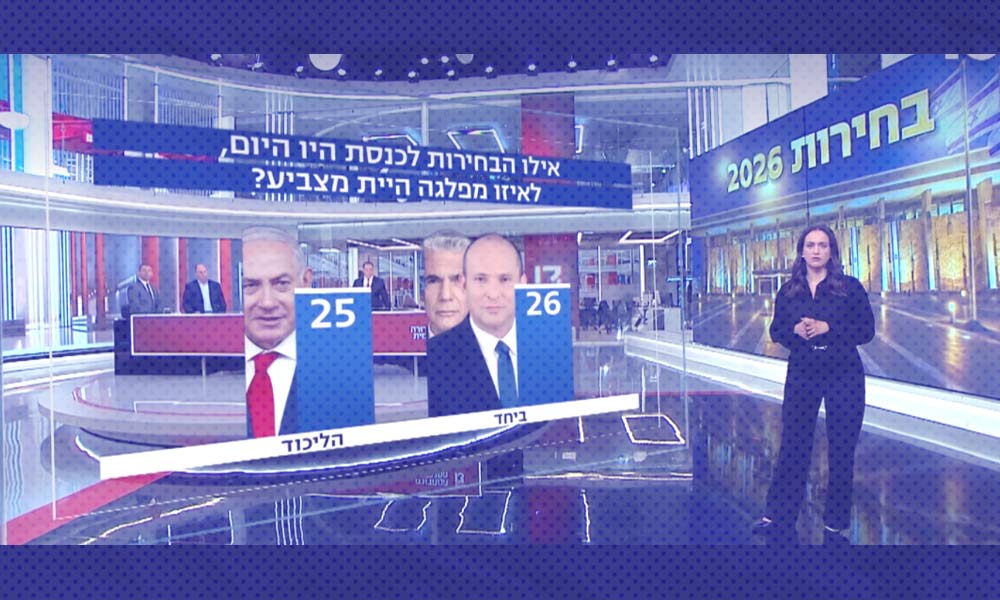
“B’Ivrit: A Hebrew Language Media Roundup” is a monthly look at the news through the eyes of Israeli media consumers.
1. Jews-only election polling?
It’s election season in Israel. A final date for the upcoming fall elections has yet to be set, but political junkies, i.e., all Israelis, are already in a frenzy. Fueling this election fever are Israeli media outlets that have largely begun shifting from wartime mode to political coverage, with a special focus on polling. Nearly every newspaper, website and TV network now publishes weekly polls, trying to predict the election outcome and the odds of Benjamin Netanyahu’s political survival.
It’s a bit more complicated than American political polling. Since Israel is a multiparty parliamentary system, pollsters need to provide a detailed breakdown of expected votes for each and every party. Then the political commentators move into action and analyze the results, trying to predict based on these numbers who will have the best chance of forming the next ruling coalition. The Knesset is made up of 120 seats, so whichever bloc can gather at least 61 seats will anoint the next prime minister.
The latest poll released by Reshet-13, a major TV network, concluded that the current coalition, led by Netanyahu, will have 56 seats in the next Knesset. The opposition bloc will win 54 seats. At this point you may be wondering: “Where are the missing 10 seats of the Knesset’s total 120?” They are not missing, and this is not an error of arithmetic—these are the 10 seats that are expected to go to the parties representing Israel’s Arab population.
An election poll published the same day in Maariv offered a similar breakdown: 59 seats for the opposition parties, 51 for Netanyahu’s bloc and 10 seats for the Arab parties.
Does this mean that these 10 seats are up for grabs? That the Arab parties could either enter Netanyahu’s coalition or the opposition bloc? Not really. There’s practically a zero percent chance of them joining Netanyahu’s right-wing coalition. Then why not add them to the opposition bloc? Well, because in Israeli society, and in the Israeli press, the political parties representing Israel’s Arab minority are viewed as outsiders.
Consumers of the Israeli media get better coverage of the Arab populations in neighboring countries than of their own immediate neighbors.
Throughout the years, Arab parties (which include one that is predominantly Arab but also contains a small Jewish left-wing representation) avoided joining the governing coalition. The ideological gap between their beliefs and those of the Zionist Jewish parties that rule Israel was too deep to reconcile, and the Jewish parties were more than happy to set up exclusionary coalitions that were more palatable to their Jewish voters. The one notable exception was the short-lived 2021-2022 coalition led by Naftali Bennett and Yair Lapid, which included the Raam party led by Mansour Abbas.
This could happen again in the upcoming elections. Raam, or even fragments of other Arab parties, could join a future anti-Netanyahu coalition. Currently, almost all opposition parties, except for the left-leaning Democrats, have stated they will not include Arab parties (which they conveniently refer to as “non-Zionist” parties) in their future coalition, but the prevailing notion is that once the votes are counted and opposition leaders understand that their only path to 61 seats goes through sharing power with Arab parties, they will rethink their positions.
The Jewish Israeli majority may not be ready to accept Arab political parties as equal partners. Bias runs deep, and the Israeli public has evolved even stronger anti-Arab views in recent years. The media could help overcome this bias by treating Arab political representation as equal to that of Jewish parties and by ending the practice of segregating Arab poll numbers from the coalition/opposition calculation. So far, it has chosen not to do so.
2. Israeli media’s blind spot
The Arab community makes up 18 percent of Israel’s population, but you’d never know that by watching Israeli TV, reading Hebrew language newspapers or consuming news from popular websites.
Most outlets, with the exception of liberal-leaning Haaretz, have at most one Arab reporter. Arab cities and towns are covered by regional reporters who in many cases do not speak Arabic, and Arab commentators are hardly ever included in TV and radio panel discussions. An ongoing monitoring project conducted by The 7th Eye, a media watchdog website, found that in 2025 Arabs made up only 1 percent of all speakers on Israeli TV and radio outlets. This marks an all-time low, but even in the best of times, Arab representation in the news media stood at less than 4 percent.
Add to that the fact that most reporters, editors and commentators have very little knowledge of Arab-Israeli society and that most were educated in Jewish-only schools and live in Jewish cities. That helps explain how and why the Hebrew-language press provides very little coverage of Arab society and lacks the tools to understand and share with its audience the needs and sentiments of Arab Israelis.


3. Covering criminal violence in the Arab community
The few instances in which the lives of Arab Israelis make it into the mainstream Hebrew media are those related to the wave of criminal violence plaguing the Arab-Israeli society. The Israeli press chronicles gang and criminal-related murders daily and will pause, once in a while, to tally the deadly toll. A recent report in Zman Israel, an online publication, noted that 2025 was the worst year on record, with one murder case every second day; 2026 is shaping up to be just as bad, if not worse.
But while this troubling rash of murderous violence is not ignored by the Israeli press, the built-in bias is easy to notice.
In April, on Israel’s Independence Day, Yemanu Binyamin Zelka, a 21-year-old Jewish worker at a pizza parlor in Petah Tikva, was brutally beaten and stabbed to death by a mob of teenagers after he asked them to stop spraying party foam inside the restaurant. The case captured the headlines for days. Ynet, Israel’s largest news website, reported extensively on the murder, quoting Zelka’s parents, co-workers, and even Israel’s First Lady Michal Herzog, who expressed her horror. Mako, the website owned by Channel 12 News, criticized the police for being too slow in investigating the case and for the days that passed until more than a dozen teens involved in the murder were arrested. Every outlet in Israel offered their audience interviews with family members, reports from the scene, and daily updates on the state of the investigation. Some highlighted the fact that the victim was an Ethiopian Jew, hinting at a racist motivation for the violent attack.
The Israeli media was rightly outraged by this senseless murder, but as Arab-Israeli activist Sliman al-Amour noted in a Ynet column, it demonstrates the gap in media coverage of criminal violence in the Jewish and Arab communities by the Israeli press. “It’s not only the difference in the amount of minutes devoted on TV to cover the murder of Jews and of Arabs, but a representation of a deeply rooted dangerous worldview,” he wrote. Al-Amour noted that while the Israeli press was covering Zelka’s murder, a 16-year-old Arab boy was stabbed to death in his hometown, but the Hebrew-language media hardly covered the event.
4. The language barrier
Even though Arabic is mandatory in Israel’s public schools, most Jewish Israelis have very poor knowledge of the language. Israelis, including those in the press, don’t speak or read Arabic, and therefore are unable to provide meaningful reporting on the lives of a fifth of Israel’s population.
This is not to say that Israeli newsrooms are void of Arabic speakers. On the contrary—every outlet has several reporters who are fluent in Arabic, who can read, write and converse in Arabic, and who follow the Arab press closely. But their expertise is exclusively used for coverage of the Arab world outside Israel, not domestic Arab society. Ironically, consumers of the Israeli media get better coverage of the Arab populations in neighboring countries than of their own immediate neighbors.
5. Winds of change
Several years ago, Haaretz launched an Arabic section on its website, providing original and translated reporting and columns. The liberal daily has also made a point of including Arab-Israeli writers in its regular news and opinion sections.
Another sign of change can be seen in the rise to prominence of Lucy Aharish, the first Arab-Israeli woman to host a daily news show on Channel 13. Aharish, who was recently honored by the Anti-Defamation League for her work, brings an unapologetically strong voice to the otherwise Jewish- and masculine-dominated TV news discourse. In recent months she has become a target of right-wing harassment after speaking about the need for increased voter turnout among Arab Israelis.
These examples show that the Israeli media is beginning to understand its own bias but also demonstrate how long the road is until it reaches equality.
(Top image credit: Reshet-13 Screenshot)