
“B’Ivrit: A Hebrew Language Media Roundup” is a monthly look at the news through the eyes of Israeli media consumers.
1. Waiting for Trump
On Friday, after a weeks-long stalemate in the Gulf, U.S. sources leaked to major American news outlets that the moment of truth was approaching. “U.S., Israel preparing to bombard energy-related targets in Iran,” reported CBS, which broke the news.
In the United States, this was just another news item on a busy weekend, but for Israelis, hints of the upcoming resumption of military activity against Iran immediately dominated the news cycle. TV networks devoted almost all of their reporting to the looming escalation, running chyrons announcing “attacks expected as soon as this weekend.” Trump, according to Israeli media, has lost his patience with Iran and is only hours (or days, depending on the outlet) from greenlighting a massive attack that will bring Iran to its knees and, inevitably, send Israelis to the bomb shelters once again.
Naturally, Israelis have more at stake than Americans if the war escalates. Even the possibility of entering a new phase in fighting has the power of forcing Israelis, many in the midst of their summer vacation or about to embark on one, into a state of frenzy.
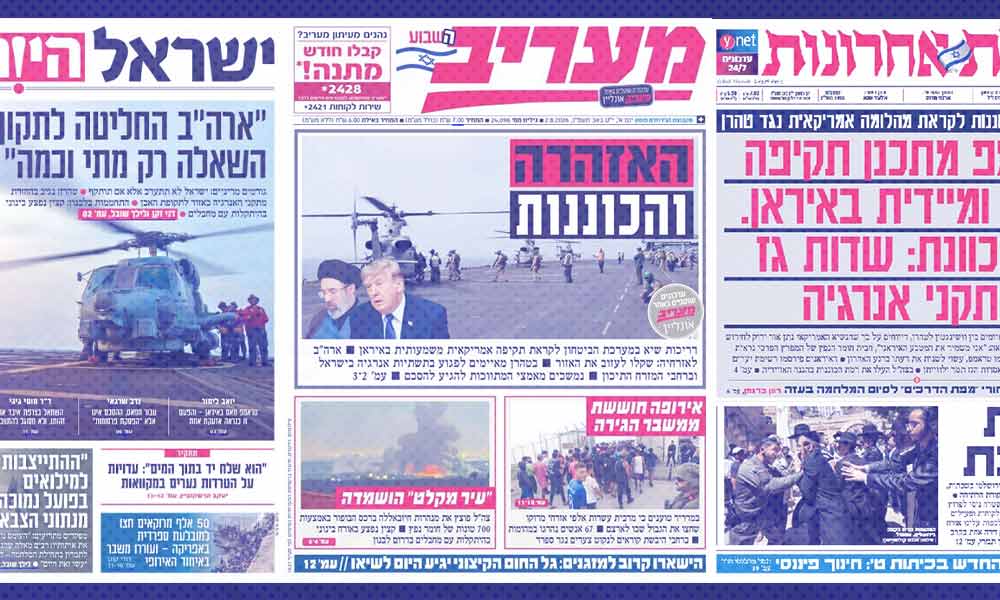
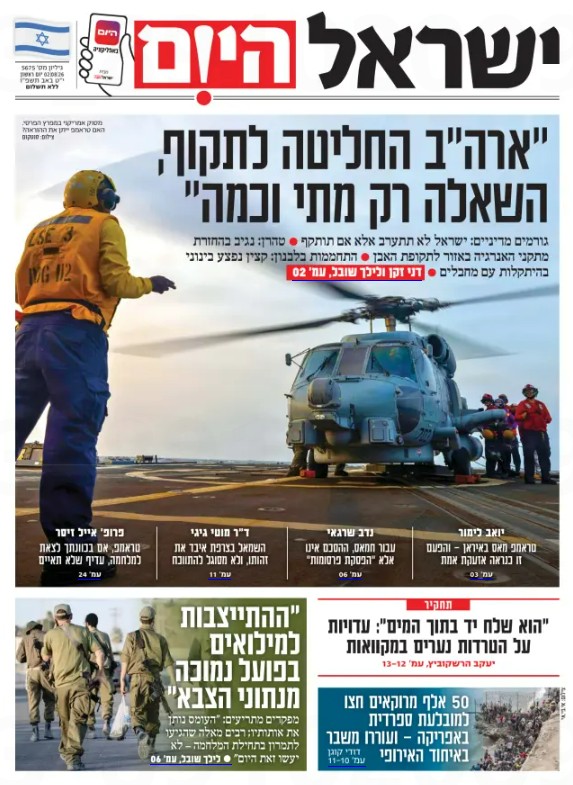
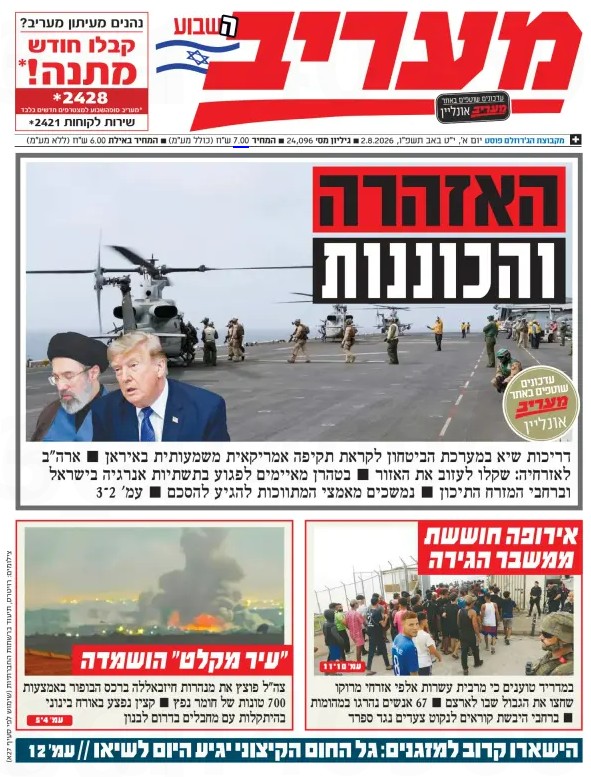
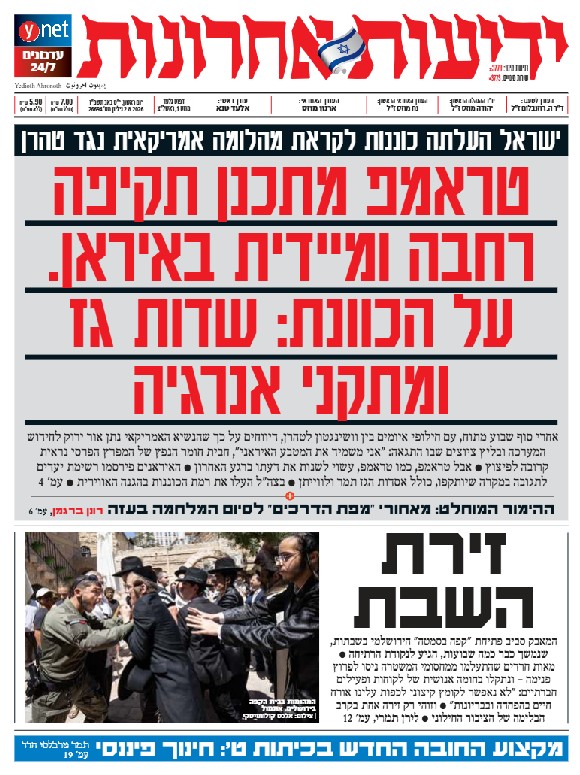
As is often the case with Israeli media, reports of the new developments dropped any nuance and ignored gray areas. “The U.S. has decided to attack, the only question is when,” announced the conservative, Adelson-owned daily Israel Hayom on its front page. Maariv, a centrist publication, reported on “maximum alert” in preparation for the imminent attack. Yediot Aharonot, Israel’s largest daily newspaper, devoted most of its front page to a headline announcing in red, bold letters that “Trump is planning a broad immediate attack on Iran.”
TV and radio reporters and commentators focused on a binary choice: Will Trump attack or not? And most responded with no qualification that the answer is “Yes, of course he will.”
Channel 12, Israel’s most influential network, reported that Israel had moved into the highest level of alert and that it was all but certain that if and when Trump decides, Israel will become a target of Iranian attacks.
Channel 13 reported on “dramatic hours” in the region, while speculating that Trump is “closer to an attack than to an agreement.” A panelist on a TV show aired on KAN-11, Israel’s public broadcasting station, explained that Trump simply has to go ahead with a broad military attack this time, “or else he’ll be like the boy who cried wolf.”
Haaretz, Israel’s only liberal-leaning daily publication, stood out with a skeptical tone. “Trump is cornered,” read a front-page analysis, noting the lack of progress on both the diplomatic and the military fronts.
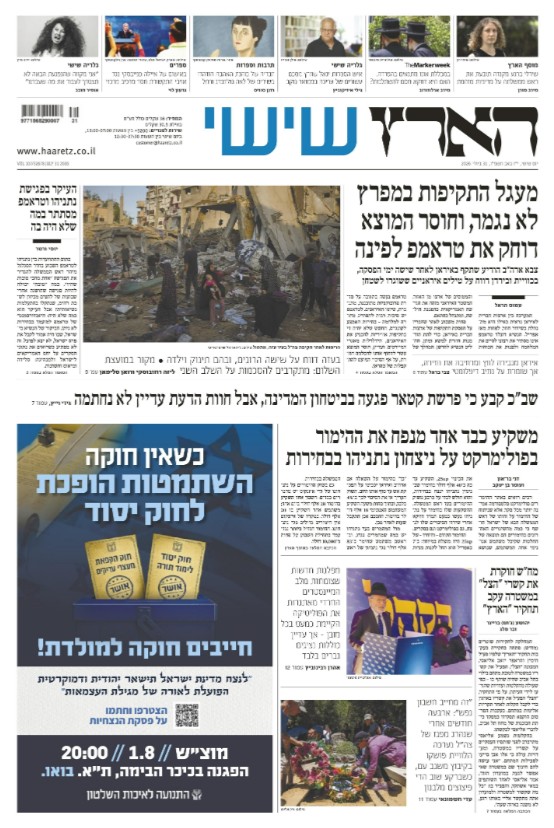
Then came Saturday night. While Israelis were sleeping with one eye open, watching for alerts on their phones, Trump took to Truth Social and called off the attack. “I have agreed, for the future benefit of the WORLD and, likewise, the survival of a successful and prosperous Iran, to cancel the attack,” he wrote.
In Israel, instead of a sigh of relief, the news was met with disappointment.
“He left us in the dark,” Channel 12 reported, noting that Israeli officials were “shocked” by Trump’s about-face.
“It’s impossible to plan ahead with a president behaving this way,” KAN quoted unnamed senior military officials. “Trump is zigzagging,” wrote Ynet, a popular website owned by Yediot Ahronot.
The Israeli media used to view Trump as Israel’s hero, perhaps even its savior, revered for his unconventional style that Israelis have hoped will enable the elimination of the Iranian nuclear threat hanging over their heads for decades.
But his erratic behavior and contradictory policy statements, initially reported by the press in Israel as sophisticated, at times cunning maneuvers meant to throw off the Iranians, are now seen as signs of indecisiveness. Trump is now widely described by Israeli media as inconsistent and as a leader whose actions are not in line with Israeli interests.
2. An innocent stroll or a planned provocation?
A tragic incident in the West Bank exposed the depth of disagreement within Israeli society over increasing Jewish settler violence against Palestinians, and the role played by the Israeli media in this debate.
On June 24, a group of Jewish settlers entered Tell, a small village near Nablus. A violent altercation broke out, which ended with four Palestinians and two Israelis killed. The Israelis were an IDF soldier and a settler who was part of the local IDF reserve defense force.
Most Israeli media outlets described the event as a terror attack. According to the account in mainstream media outlets and the IDF spokesperson, a group of some 30 settlers went on a peaceful stroll in Tell, where they encountered violent Palestinians who attacked them, one of them grabbing a rifle from a member of the Jewish group. An IDF enforcement was called and in the gunfire exchange, two Israelis and four Palestinians were killed. The choice of words is telling. According to most Israeli media outlets, the two Israelis were “murdered” by “Palestinian terrorists” in what amounts to a “terror attack.”
The liberal media told a different story. Haaretz refrained from using the term “terror” and dryly described the events as told by all sides: the IDF, the Palestinians and the settlers. The report noted that the Jewish group entered Tell without the required prior coordination, that one settler struck a Palestinian with his gun, and that eventually an all-out violent exchange broke out that ended with casualties on both sides.
The debate over media coverage of the event largely followed the Israeli political fault line: Liberal media on the left described a settler provocation; the mainstream press followed the IDF line framing the event as a terror attack; and the far-right media spoke of a planned attack aimed at killing Jews. Hakol Hayehudi (“the Jewish voice”), an online right-wing publication, ran a piece calling on the government to “wipe Tell village off the face of the earth.”
Alon Ben-David, the military affairs correspondent for Channel 13, was the only voice on mainstream media disputing the settlers’ account of the events. “This is not a description of a terror attack. The Palestinians came unarmed,” he reported, noting that the residents of Tell did not show up in order to carry out a terror attack, but rather were encountered by armed settlers who entered their village.
[Read “Are Renewed Sanctions an Answer to Settler Violence in the West Bank?”]
3. Hamas is disarming, and no one seems to care
After nearly three years of a bloody war in Gaza, an unexpected moment of hope emerged. The Board of Peace, formed by President Trump to oversee post-war Gaza, announced Friday that Hamas has agreed to disarm and move forward with a deal in which it would give up all its arms and military infrastructure and forgo any claim to leadership roles in Gaza.
This should be huge news for Israelis. Hamas, the murderous terror organization responsible for the October 7 attack, is finally willing to disarm and step down. Isn’t that the moment Israel has been waiting for?
Apparently not.
The Israeli government was quick to point out the flaws in the agreement, which would also require a future withdrawal of IDF forces from Gaza. Residents of Israeli towns bordering the Gaza Strip, which had been attacked on October 7, expressed their concerns over having no Israeli military presence in Gaza.
And the press? It simply didn’t seem all that interested in the deal.
The agreement was not covered on front pages of most Hebrew language publications, nor did it top the news of the day on TV networks.
Israelis, it seems, have lost hope in a future of peace and security. The historic breakthrough did not ignite any sense of excitement. If anything, it was met with a lack of interest and with disbelief regarding the chances of the deal ever being implemented.


4. Drinking coffee in Jerusalem—on a Saturday
Israelis love their coffee shops. That’s where meaningful moments of life take place: casual meetings, first dates, family gatherings and high-stake business one-on-ones.
But it’s not always that easy. Especially for those living in Jerusalem who want to have their double espresso or Americano on a Saturday morning. The capital, becoming increasingly more Orthodox, basically shuts down for Shabbat. The few businesses that insist on opening face an uphill battle against protesters and boycotters.
Yoel Ben-David is now experiencing these difficulties firsthand. Ever since he opened Cafe Basimta (“coffee shop in the alley”) in the heart of Jerusalem, he has faced weekly protests of young Haredi Jerusalemites demanding the place shut down and trying to intimidate its patrons. “They should be able to pray in peace and quiet and we should be allowed to have our coffee in peace and quiet,” he told Maariv.
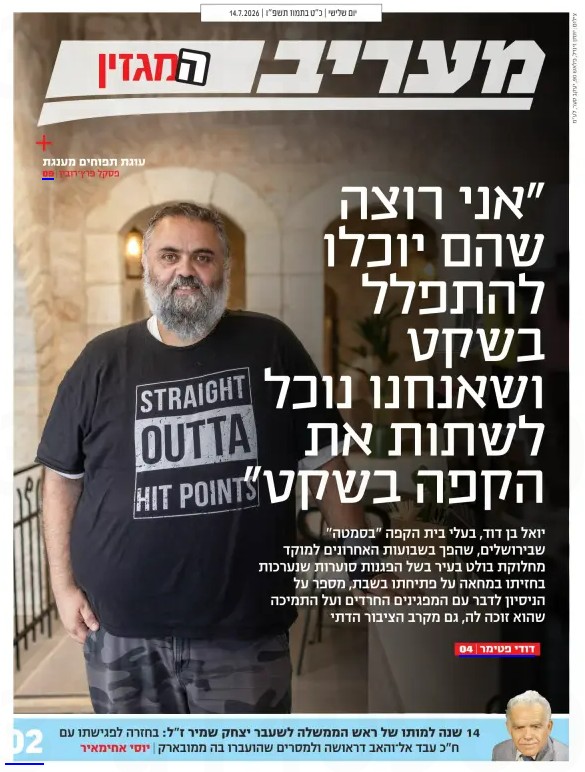
But that’s not about to happen. Every Saturday morning, an unholy ritual takes place at the coffee shop. Dozens of secular residents show up for their morning coffee, or simply to show support for one of the few establishments open on Shabbat. Across the small alleyway dozens of ultra-Orthodox protestors line up, and in between is a small police force keeping the sides apart, along with a bunch of reporters covering the weekly event. “This is only one front in the greater battle of the secular population,” reported Yediot Ahronot, which decided last week to move the coverage of the weekly event to its front page. “We will not allow an extremist minority to force us to accept their lifestyle through threats and intimidation,” one of the secular residents told the paper.
5. How one little boy captured the heart of the nation
Dani Kugan and his three young children were spending a nice summer afternoon on the Ashkelon beach, not far from their home. Four-year-old Yuval was playing in the nearby bushes when Dani turned his attention to Yuval’s two sisters on the beach. A few minutes later, he looked back and Yuval was gone.
This is every parent’s nightmare, whether in Israel, the United States or anywhere in the world. Panic ensued. Beachgoers began frantically searching; police forces poured in, methodically walking through the nearby dunes, looking for any sign.
By evening, Yuval’s disappearance was all over national news. Ynet led with the story and a photo of Yuval staring at the camera with his big brown eyes spread across the homepage. Reporters on the scene joined searchers, and Yuval’s mother, Dina, appeared on all the news shows, begging for help.
Only several miles separate Ashkelon from the Gaza Strip, and the family feared Yuval might have fallen victim to a terror attack.
Israel followed the search closely for a long night and day. Updates on the searched topped Israeli radio hourly news bulletins.
And then, just before sundown on Friday, word came from a group of volunteers scouring the surrounding area on horseback: “We found the child, he’s safe and sound.” Twenty-seven hours after his disappearance, with temperatures reaching 100 degrees, Yuval was found under a tree more than two miles from where he was last seen.
On the beach, hundreds of searchers broke into applause as they heard the news. Across the country, millions of Israelis breathed a sigh of relief and enjoyed a rare collective piece of good news, just before Shabbat.