“B’Ivrit: A Hebrew Language Media Roundup” is a monthly look at the news through the eyes of Israeli media consumers.
1. A tragedy far away from home but close to heart
News from the horrific antisemitic terror attack in Sydney, Australia, broke early Sunday in Israel. As details on the Hanukkah shooting that left 15 dead and seriously wounded scores more poured in, all media outlets in Israel shifted into emergency mode, with nonstop reporting and commentary.
The tone was worried and somber. The sheer magnitude of the attack, the fact that it took place during a Jewish celebration and the individual stories of tragedy and bravery kept Israelis glued to their screens.
Australia is rarely in the news in Israel, and most outlets do not keep reporters on the ground there. Still, the news came in—through international outlets, members of the community and survivors who got on the phone to tell their stories, and through videos posted on social media documenting the moments of horror on Bondi Beach.
The Sydney Hanukkah attack was big news all around the world. But in Israel it sounded different. While Israelis may seem at times distant from their diaspora brethren, these are the kind of moments that demonstrate how close the two communities are. Though most have never visited Australia and know very little about its Jewish community, the tragedy, as conveyed by the news media, made the thousands of miles separating Sydney and Tel Aviv disappear.
Israeli outlets also echoed claims made by PM Netanyahu tying the Australian government’s recognition of a Palestinian state with the terror attacks. Netanyahu’s argument that actions of the Australian government led by Anthony Albanese “pour fuel on the antisemitic fire,” were widely reported on online and TV outlets. Walla, a popular website with no clear political leaning, published a critical piece noting that there is no clear evidence of a direct and causal relationship between the positions of the Australian government and the Bondi Beach attack. The article also ridiculed Netanyahu’s call for Jews around the world to come to Israel, where the government and military can protect them. “The numbers show that Israel is the country where Jews are most likely to be killed,” the Walla piece argued.
2. A pardon or a get out of jail free card?
Benjamin Netanyahu’s pardon request from Israeli president Isaac Herzog caught the Israeli press by surprise. After all, Netanyahu, who is standing trial for three separate corruption charges, has stated time and again that he has no intention of asking for a pardon. And Israeli media, despite a long history of being lied to by Bibi, fell for it again.
The Israeli prime minister, in a lengthy letter to Herzog, pleaded for a full pardon, without any acknowledgement of wrongdoing or any promise to step down in return for ending his trial. The whole idea of a pre-conviction pardon is quite unusual in the Israeli legal system and has been applied only once in the past, under very different circumstances.
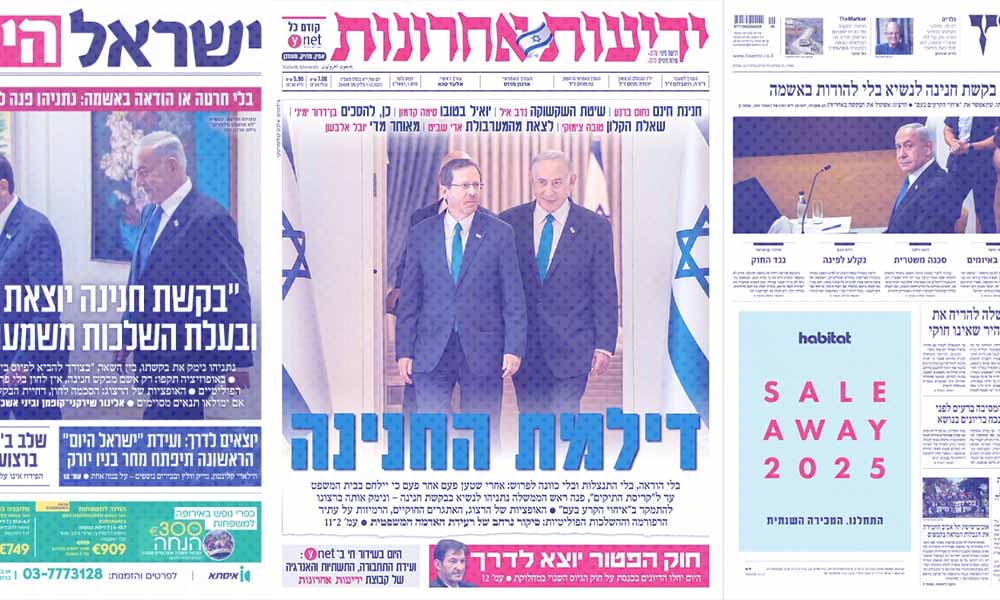
The breaking news of Netanyahu’s request immediately dominated Israel’s news cycle. “A legal bombshell,” exclaimed Ynet, Israel’s most popular news website, owned by the Yediot Ahronot group. Maariv, a centrist daily, described the developments as “a huge drama.” The liberal-leaning Haaretz stressed the obvious in its full-page headline: “Netanyahu requested a pardon without admitting he is guilty.”

By the next day, after getting over the initial shock of the prime minister’s request, the Israeli press began to ask some tough questions. First and foremost, is “pardon” the right word to describe Netanyahu’s request, given that he is still on trial and that he refuses to accept any responsibility?
Haaretz, as always, was Bibi’s toughest critic. “This would be a reward for terrorism,” wrote Gidi Weitz, who has been among the leading investigative reporters covering Netanyahu’s corruption cases. Political commentator Yossi Verter described the prime minister’s letter to the president as “extortion,” while legal commentator Dina Zilber called the move “a danger to Israel’s democracy.”
Yediot Ahronot, living up to its reputation of a mainstream publication trying to represent all voices in Israeli society, tried to remain neutral and wrote about the “pardon dilemma”’ above a half-page photo of Netanyahu and Herzog.

Israel Hayom, owned by Miriam Adelson and leaning to a more pro-Bibi right-wing approach, wrote about the “unusual pardon request,” while making sure to place on its front page both pro-pardon and anti-pardon columnists.

Within days, the coverage of Netanyahu’s case evolved into an image of the political fissures within Israel. While left-of-center outlets such as Channel 13, known for its harsh commentary on Netanyahu, stuck to their critical approach toward the pardon request, the right-wing media, led by Channel 14 news, painted the idea of pardoning the prime minister as not only fully legal but also as the only sensible way to deal with the ongoing trial.
Channel 14 highlighted a poll it conducted, which found that a majority of Israelis support pardoning Netanyahu. But the question posed in the poll was tricky. It didn’t ask whether a pardon with no assumption of guilt would be right, but rather whether pardoning Netanyahu would “strengthen Israel and heal the chasm in Israeli society.” Fifty-two percent responded positively. A column on Channel 14’s website argued that Netanyahu’s request should be seen as part of his battle against the “old hegemony” of the Supreme Court, the media, and the government bureaucracy. In another column posted by Channel 14, political commentator and anchor Yaara Zered explained how Bibi’s move is simply an act aimed at stabilizing Israel and of “ending a years-long saga that has been weakening the nation.”
While there is no way of telling if Herzog will grant Netanyahu his request and if so under what conditions, the media coverage shows that Bibi has already succeeded: The legal affair has turned into a political one, with the right-wing media rallying behind Netanyahu and providing his base with the needed arguments as this battle moves forward.
3. The ceasefire is holding, but Gaza is still closed
It’s been two months since the Gaza ceasefire took effect. Israeli hostages, except for one deceased hostage, have been returned home, most major military activity has been halted, and more aid is flowing into the Gaza Strip.
But the manner in which the Israeli press covers Gaza hasn’t changed a bit.
The choice made by the Israeli outlets not to cover the hardship of Palestinian residents in Gaza and not to question any action taken by Israeli forces is still fully in effect. Reporting from the ground is limited to brief IDF-sponsored tours into the part of the Gaza Strip still occupied by Israel, and foreign media reports bringing the voices of Gazan civilians are all but ignored.
Last week, Israel breached the ceasefire with a targeted attack against Ra’sd Saad, considered to be Hamas’s No. 2 in command and among the architects of the October 7 attack. The Israeli press celebrated the military achievement, quoted officials who described how valuable a target Saad was and even featured an interview with the drone operator who carried out the attack. The foreign media noted that four other civilians were killed in the attack and reported on Hamas’s warning that the move could jeopardize the ceasefire, but there was hardly any mention of that in the Israeli press coverage.
On the same note, last week Israel’s Supreme Court provided the government with yet another extension for its response to lawsuits demanding that Israel allow foreign reporters to enter Gaza. The war may be over, but limiting press coverage of Gaza seems to remain a priority.
4. Back to normal: dealing with the winter flu
For the past two years, Israeli media has been, understandably, fully consumed with covering the hostage crisis, the fighting in Gaza and efforts to recover from the October 7 attack. Did anything else happen during those two years? What did hardly made it to the news.
Now, perhaps as an indication that Israel is slowly returning to normality, the headlines were captured by a story not related in any way to Gaza, Hamas or politics.
A deadly flu outbreak, which claimed the lives of 40 people, including several children, had caused panic among many Israelis and prompted intense media coverage. Alongside daily updates on the number of hospitalized flu patients and reports on those still refusing to vaccinate their children, media outlets also became a healthcare resource for those scrambling to find advice on how to avoid the outbreak. Ynet provided its readers with a useful “Everything you need to know about the H3N2 virus” guide. Maariv did the same, while Israel Hayom raised questions about the effectiveness of the vaccine in countering the current flu strain.
All media outlets highlighted voices calling on all Israelis, especially the vulnerable elderly and babies, to get vaccinated. Contrary to public health messaging in the United States, anti-vaxx rhetoric doesn’t get any support in mainstream media in Israel.
5. A storm of non-biblical proportions
Everyone loves a good winter storm, especially in a country like Israel where “winter” means mild temperatures and some rain, and especially at a time when everyone is yearning for any piece of news that is not related to Gaza, antisemitism or Bibi.
And in that sense, storm “Byron,” which hit the Mediterranean last week, was—well—the perfect storm. TV news networks sent their intrepid reporters to stand out in the rain, while newspapers and websites provided advice on how to survive the tempest. “The storm is strengthening,” read an alarming front-page headline in Yediot Ahronot above a photo of lightning hitting a dark Jerusalem night just over the Temple Mount.

Alas, Byron turned out to be less than advertised, although one person in Israel died of hypothermia and dozens had to evacuate their homes for a day.
Maariv, the next day, stuck with the dramatic photo of a flooded street, but Israel Hayom with the headline “Bye, Byron,” made it clear that there was nothing more to see there. The storm is over, now back to reporting on Gaza and Bibi.


There was one region that was severely hit by the storm, and that was the Gaza Strip, where reportedly 14 people died and hundreds lost their makeshift homes and tents due to flooding. The Israeli media largely ignored those reports.