
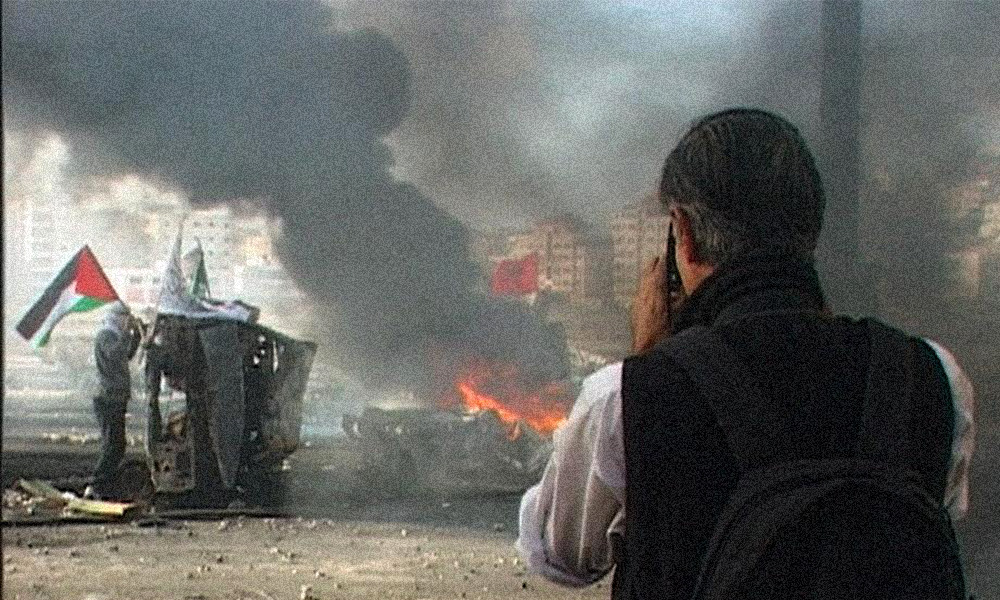
Two years after the Gaza war started, Israel’s government may ease its blanket ban on the unsupervised entry of international journalists into the Gaza Strip and allow on-the-ground coverage. And as they consider this policy change, Israeli officials are reportedly preparing for the damaging fallout.
Since October 7, 2023, Israel has banned the foreign media from entering the Gaza Strip, except for a small number of reporters who were allowed in only while embedded in Israeli military units, highly supervised and with extremely limited access to Gazans. Most were invited to tour Hamas’s tunnels or cover other aspects of the war that served the Israeli government’s attempts to justify its massive military assault on the densely populated Strip.
Israel has banned international media entry during past military conflicts in Gaza, but no other conflict has lasted so long or has been so devastating.
Israel’s tight control over access has meant that on-the-ground reporting has come from official Israeli sources, such as the IDF spokesman’s unit, or from Palestinian journalists and Gazan civilians through social media.
Senior Foreign Ministry officials told Ynet that the government will intensify its public relations efforts to counter critical media coverage.
The approach has largely worked for the government, says Oren Persico, a longtime correspondent and commentator with the Seventh Eye, an online Israeli news site that covers the media. “As long as journalists in Gaza are Palestinians, it is much easier to discredit their reporting,” he says, “and the government often contends that [their reporting] is fake. Once Gaza coverage comes from international journalists, it will be much more difficult to credibly doubt their reporting.”
Persico argues that this is a chief reason—if not the chief reason—for Israel’s refusal to allow unrestricted foreign media access to Gaza since the war started. The government, however, insists that the refusal is due to security, as it laid out in a detailed June 2025 response it submitted to Israel’s High Court addressing a petition filed by Israel’s Foreign Press Association (FPA) requesting unrestricted access to Gaza. The government responded that the unchecked presence of journalists in a war zone poses great danger to troops and reporters alike. The risk is so great that it justifies compromising the freedom of the press and the public’s right to know, the document argued.
The FPA’s petition makes clear that foreign journalists and their news organizations agree to “completely forgo any future claim in the case that any journalist will be hurt while in the area and assume full responsibility” for their safety. That is standard practice, says Robin Lustig, who covered wars for decades for The Observer, Reuters and the BBC. “No war reporter expects governments to guarantee their safety in a conflict zone. They all know the risks, but they do expect the warring parties to act in accordance with international law on the protection of civilians in war.”

The first FPA petition was filed in December 2023, shortly after the war started and Israel announced its restrictive policy. At the time, the court accepted the state’s position and refused to discuss the petition. The court did note, however, that it would be willing to consider a follow-up petition in the future, if the security circumstances changed.
“That is what we did, because the circumstances indeed changed substantively in several aspects,” says Gilead Sher, FPA’s attorney, a former Israeli senior peace negotiator under Prime Ministers Yitzhak Rabin and Ehud Barak and Barak’s chief of staff. Sher filed his second petition on behalf of the foreign press in September 2024. Subsequently, the state attorney’s office requested seven consecutive extensions before submitting its initial response to the High Court. When the court finally heard oral arguments on October 23, the state attorney asked for a 30-day timeframe to formulate the government’s new policy in light of the new reality in Gaza caused by the Israel-Hamas ceasefire agreement.
The Foreign Press Association expressed disappointment about the additional delay, as did the Union of Journalists in Israel, which joined the petition. The Committee to Protect Journalists, along with Reporters Without Borders, which filed requests to join the petition on an amicus basis in support of the FPA, also criticized the court’s extension.
Persico, who has followed the petition more closely than any other Israeli journalist, predicted that even after the 30 days are up, the state would likely try again to delay court action.
But Israeli media reports suggest a possible alternative scenario in the coming weeks. According to a report in Haarertz, Israeli officials representing security services and the Foreign Ministry met on October 15 to discuss modalities for allowing foreign journalists into Gaza. According to the report, Israeli officials realize that the security risks emanating from unhindered international media reporting in Gaza have diminished and that Israel may not have full control over the entry of journalists into the Strip once international forces deploy there, as called for in the recently signed agreement for Gaza’s future, and once the Rafah crossing between Israel and Egypt is no longer under exclusive Israeli control.
An October 25 story on Ynet, Israel’s most popular news site, claimed the Gaza Strip may be opened to international coverage in a matter of days. According to the report, Israel’s government is preparing for a “tsunami”—in the words of one unnamed official—of extremely critical coverage, documenting the impact of the IDF’s extensive killing and devastation in Gaza during the past two years. Senior Foreign Ministry officials told Ynet that the government will intensify its public relations efforts to counter critical media coverage.
A change in government policy on media coverage in Gaza would relieve the Supreme Court from the tough mission of prescribing a balanced formula between security considerations and freedom of the press, granting the government the leeway it will surely seek in determining media access in future military conflicts. The court has already signaled that it prioritizes security considerations over the principle of freedom of the press, but it has not determined clear criteria, as requested in the FPA’s petition.
A precedent-setting court ruling could be consequential. “If, indeed, the court eventually rules in the matters pertaining to this case, its ruling might be a tipping point for the future: either toward granting the executive branch too broad a leeway to limit arbitrarily the freedom of the press, or, hopefully, to reinstate the court’s commitment to protect the fundamental freedom of expression and the public’s right to know—with minimal, imperative exceptions,” said Sher, the FPA’s attorney.
Israel’s policy on this matter since Hamas’s attack on October 7, 2023, as well as during past rounds of hostilities in Gaza—unchallenged at the Supreme Court—does not bode well for greater openness in future rounds, says the Seventh Eye’s Persico. Ultimately, heavy restrictions on media coverage, even if they serve short-term security needs, harm Israel’s fundamental interests, he says. “The Israeli public has an interest in knowing what its military is doing in its name and with its money. A society built on repression and lies is weak, and is doomed to collapse.”
Top image credit: Christian Frei Switzerland (CC BY-SA 2.0)