
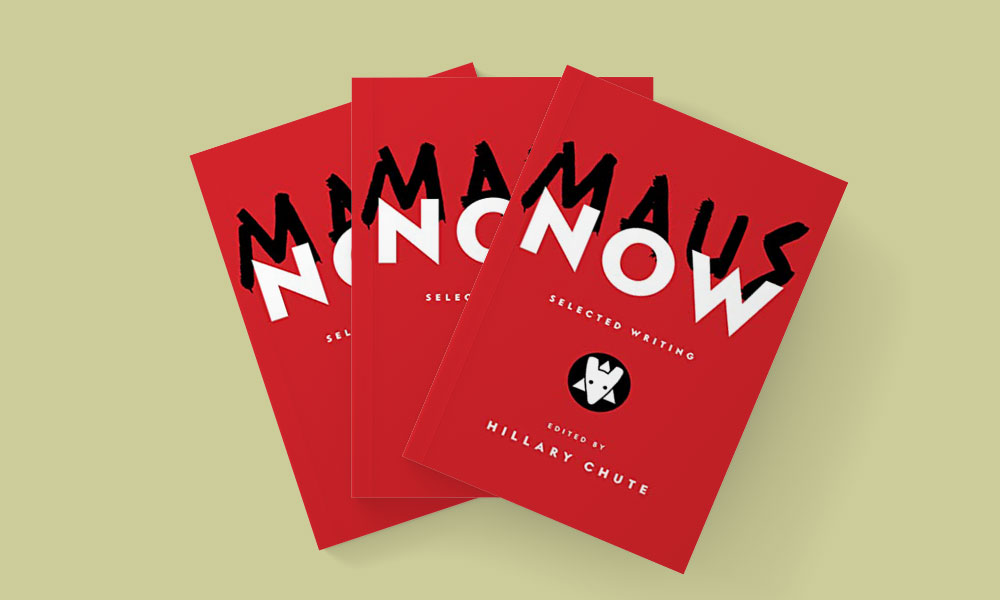
Maus Now: Selected Writing
Edited by Hillary Chute
Pantheon, 432 pp., $28.00
The latest cycle of public panic over book-banning—as distinct from the constant, threatening drumbeat of book-banning itself—kicked off last January when The New York Times reported that a school board in McMinn County, Tennessee, had withdrawn Art Spiegelman’s graphic novel/memoir Maus: A Survivor’s Tale from the eighth-grade Holocaust education curriculum. The burst of outrage that followed probably drew emotional fuel from a few additional sources—Jewish communities just then were battling broader anxieties about Holocaust denial and resurgent antisemitism, including some violent incidents. But the fracas followed a well-established pattern, familiar from many previous bans and attempted bans—perhaps with a bit more velocity in this instantaneous age.
Artists and writers heaped opprobrium on the school board and praise on Maus, the story of an Auschwitz survivor told in cartoon form. The book’s significance nowadays is unquestioned: Besides winning the Pulitzer Prize in 1992, it cemented the graphic novel as a serious genre that could take on major themes, and it also laid the groundwork for a new understanding of what’s now called “post-memory” of the Holocaust in survivors’ children. The Tennessee school board members, whose purported concern was that the book contained “profanity” and “nudity,” were assailed as Holocaust deniers. Sales of Maus shot up; in a Twitter-driven new twist, supporters of Spiegelman bought up all the available copies and gave them away for free, driving the title even further up the bestseller lists. The American Library Association, PEN America, the Anti-Defamation League, the U.S. Holocaust Memorial Museum and dozens of other organizations weighed in. The story brought more visibility to other forms of banning and censorship then gaining force, such as Florida’s so-called “Don’t Say Gay” initiative with its intensified focus on school curriculum, and right-wingers’ embrace of the novel argument that the mere presence in a school library of titles with gay or trans content constitutes “grooming.”
Then came a grim exclamation point: In August, the long-suffering Salman Rushdie, whose novel The Satanic Verses had gotten him not just banned but marked for murder in the 1990s, although he later thought himself safe, was attacked and gravely wounded by a gunman at a Chautauqua book festival. His agent, Andrew Wylie, recently confirmed that the attack cost Rushdie the sight in one eye and the use of one hand.
Literary culture has responded as best it can to this onslaught, and it’s not without resources. Rushdie’s The Satanic Verses, like Maus, remains a defiant bestseller, and nowadays every self-respecting bookstore has a prominent display of banned or most-often-banned books, typically with beloved classics such as Romeo and Juliet, The Great Gatsby and Catcher in the Rye sharing space with more recent targets. One that I came across included the Harry Potter books, Crime and Punishment, The Scarlet Letter, Brave New World and Toni Morrison’s The Bluest Eye. Another store’s display, this one of banned children’s books, featured Winnie-the-Pooh, Captain Underpants, Junie B. Jones—for “promoting bad behavior”—and Dr. Seuss’s Hop on Pop.
The activism is welcome, and it probably helps. But in all the hubbub, the distinctive power of an individual book under attack—especially one like Maus that is pathbreaking, challenging, heartbreaking—can sometimes get lost. As can a point without which the whole book-banning furor is impossible to combat in an intelligent or effective fashion: A really remarkable, important book can be deeply disturbing.
One signal contribution of Maus Now: Selected Writing, the newly released collection of critical essays edited by comics scholar Hillary Chute, is the way it drives that point home. The essays, in three chronological sections, trace Maus’s initial reception and its subsequent climb into the literary canon. While delving into the many layers and facets of Spiegelman’s artistry—the complex choices and strategies that make the book so powerful—it also provides an uncomfortable reminder of the consternation with which the work was initially met by well-meaning scholars, particularly Holocaust scholars.

For those who hadn’t read it, the one-sentence description of its premise—a comic book about the Holocaust in which the Jews are depicted as mice and the Nazis as cats—was not just controversial but sharply condemned. Wasn’t a comic about the Holocaust a contradiction in terms? Wouldn’t animal drawings trivialize the horror? People who were told about the book couldn’t imagine what Spiegelman was doing, but they could think of plenty of reasons why it was a bad idea. (Colleagues of Rushdie, when he got in trouble, were similarly prompt to point out reasons why it had been a bad idea for him to explore the mysteries of faith and doubt in a novel about Islam.) Then they read it.
Many of the early essays reflect what happened next. The German reviewer Kurt Scheel (Chute includes never-before-translated reviews from both France and Germany) writes of how obvious it initially seemed to him that a comic is “the most undignified and inappropriate form imaginable to tell the world’s most terrible story. . . There is no question that this topic must not be presented in this way—until one has read Art Spiegelman’s book.” American conservative critic Stanley Crouch had the same reaction: “When you pick up the book, you say, Hah, this can’t work…but he brings it off.”
A really remarkable, important book can be deeply disturbing.
As you progress to the later essays in the book’s second section, it’s instructive—and, for any critic, humbling—to see how the appreciation of Spiegelman’s complex artistry grows over time. The harrowing story he tells appears deceptively simple at first. The cartoonist, Artie—a mouse version of Spiegelman himself—interviews his father, the irascible Auschwitz survivor Vladek, with whom he’s never gotten along, about the experiences both parents suffered in the war and the camps. Artie’s mother, Anja, also a survivor, committed suicide some years before; Artie wants her story, too, but it turns out that Vladek has burned Anja’s diaries in a moment of depression. As the father-son relationship sputters, past and present intertwine in the drawings, sometimes horrifically: At one point, Artie and Vladek drive through the Catskills, with Vladek recounting into Artie’s tape recorder the execution of his friends by the Nazis, and the mangled corpses appear dangling from trees outside Artie’s car.
After Vladek’s death, Artie, still struggling to finish the book, asks his therapist how he can possibly draw Auschwitz. The therapist, himself a survivor, offers some tips. The artist, increasingly conflicted, is seen drawing on an easel atop a mountain of mouse-corpses. In moments of great drama or pathos, the pictures erupt from the frame, in one case as a heap of old photographs that appear to cascade into the reader’s lap. (“All what is left, it’s the photos,” Vladek sighs.)
By the third section of essays, the shift in their tone is complete: The book is a masterpiece, its cultural significance immense. Spiegelman is discussed in conjunction with Philip Roth and Elie Wiesel. Scholars say the choice to draw the characters as animals is not just forgivable but essential, a way to avoid literalizing Holocaust horrors in the manner of Steven Spielberg’s Schindler’s List. The famous medieval Bird’s Head Haggadah, one critic notes, also used animals to depict “the sacred and unknowable.” Critic David Sennett sees Maus not just as “one of the most pivotal and significant works of art produced by any American writer about the Holocaust” but also “a reflection of the way in which the Holocaust has morphed from a threatening and largely repressed communal trauma to the glue that binds the American Jewish community together.” Editor and critic Ruth Franklin says Spiegelman “has done more than any other writer of the last few decades to change our understanding of the way stories about the Holocaust can be written.”
One of the last essays, ironically enough, is a cogent argument about why it’s tough to use Maus in schools. “[I]f the goal is to study the actual history of the Holocaust together with questions about how it can be referenced and represented, its psychology, and its long-term psychological effects, the answer would be: certainly not,” writes Hans Kruschwitz, in an essay translated from German. The book’s power and pathos, Kruschwitz argues, come in large measure from the subtle ways Spiegelman’s approach makes you question whether such a story can possibly be told, or whether it can be told in a completely truthful way. The difficulties critics had with the animal drawings turn out to echo the difficulties of Holocaust remembrance itself. The Jews aren’t really mice; Artie wonders how much Vladek isn’t telling him; the mother’s story is lost forever; in the final, heartbreaking frame, the father, drifting off to sleep, addresses Artie by the name of the brother he never met, a three-year-old child who died in the Holocaust. The cumulative effect of all this indirection is wrenching. A few weeks ago, trying to describe this final scene to someone who hadn’t read Maus, I choked up and couldn’t continue.

The more these essays showed me about Maus’s power, the more it seemed to me that there is something fundamentally wrong with how we defend books against book bans. One might, for instance, find Maus overwhelmingly powerful and on that very basis sympathize with the desire to keep it away from eighth-graders. I winced every time I read an online comment—and there were plenty—jeering at the uneducated yahoo school board members for objecting to nudity in mice. I don’t know what kind of book these know-it-alls imagined they were defending, but plainly they hadn’t read Maus, or at least not the part where father-mouse and son-mouse confront each other awkwardly over a rediscovered comic that the young Spiegelman (in real life, as in the story) had published in an alternative magazine some years before about his mother’s suicide. The comic, which then takes up the next four pages of the book we’re reading, doesn’t use mice; Spiegelman was a younger artist when he drew it, and the drawings are of people, including a very human, very naked Anja dead in the bathtub.
This isn’t to say that young people should never read Maus, any more than they should be prevented from accessing the graphic novel Gender Queer, an intermittently explicit memoir about sexual identity that currently tops the American Library Association’s most-challenged list. But it suggests that we need a way of discussing these books that takes into account how they work and how they make readers feel. The argument over banned books may be particularly unsuited to Twitter wars or comment threads, since explaining what these books are doing and how they work their magic is different for each one. But if we want people to read banned books, the only real defense is the books themselves.
Amy E. Schwartz is Moment’s opinion and book editor.
Moment Magazine participates in the Amazon Associates program and earns money from qualifying purchases.