
In 2022, when Taring Padi, an Indonesian collective of artists, became the center of an antisemitism scandal at the international art exhibition documenta fifteen in Kassel, Germany, their defenders offered a series of explanations. They argued that the display of imagery evocative of Nazi-era propaganda—including a caricature of an Orthodox Jew with vampire fangs and an SS insignia—reflected cultural differences rather than antisemitic intent: The work, they explained, had been created decades earlier in Indonesia in the context of struggles against military dictatorship and global capitalism. Germans, shaped by the Holocaust, they maintained, were simply reading the images through their own historical anxieties. The controversy, many suggested, was a failure of translation.
Four years later, those explanations have become much harder to sustain.
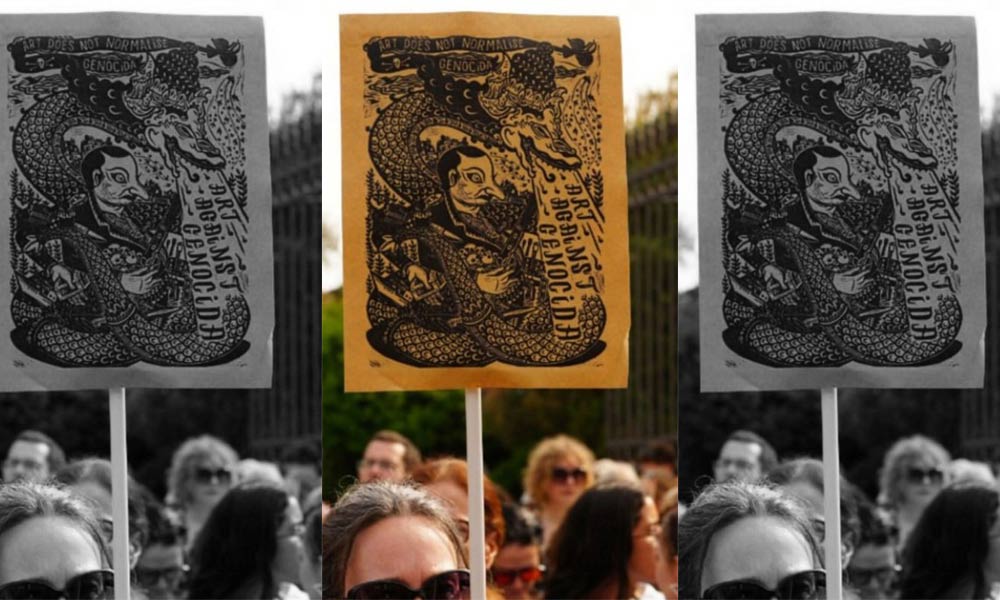
During the opening days of the renowned 2026 Venice Biennale, Taring Padi once again circulated imagery drawing on familiar antisemitic visual tropes. This occurred despite the fact that after the documenta controversy, Taring Padi acknowledged that it had depicted “the involvement of the government of the state of Israel in the wrong way” and stated that “Anti-semitism does not have a place in our hearts and minds.” At an anti-Israel protest this year near the Biennale grounds, demonstrators carried a Taring Padi poster depicting a figure with an exaggerated hooked nose clutching a chest of coins and a rifle, its body intertwined with a serpent-like dragon breathing the words “Art Does Not Normalize Genocide.” Nearby, other signs proclaimed, “Palestine is the future of the world” and “The destruction of Palestine is the destruction of the world.”
Even movements dedicated to fighting racism and injustice can develop their own blind spots.
For anyone who remembered the documenta fifteen scandal, the imagery was strikingly familiar. The antisemitic visual language had returned.
This repetition invites us to reconsider what actually happened at documenta. Together with the Venice Biennale, documenta is widely regarded as one of the world’s two leading recurring exhibitions of contemporary art. Held every five years in Kassel, its fifteenth edition was curated by the Indonesian collective Ruangrupa, whose goal was to challenge the hierarchies of the Western art world through collaboration, solidarity and shared resources: less hierarchy and more collectivity; less market and more sharing; less supervision and more trust. Its key concept was “Lumbung”—a traditional Indonesian communal rice barn or shared resource reservoir. Yet it was precisely within this ambitious decolonial experiment that the controversy emerged.
The controversy erupted when—as part of the formal exhibition—Taring Padi’s enormous banner People’s Justice was displayed in the large public square directly in front of the Fridericianum museum at the symbolic heart of the exhibition. Among the numerous figures depicted on the poster was a caricature of a man with sidelocks, vampire fangs and an SS insignia on his hat, alongside a pig-headed soldier marked with a Star of David and the word “Mossad.” International outrage followed. Taring Padi issued an apology, the banner was eventually removed, and documenta fifteen’s director resigned.
Yet People’s Justice was not an isolated episode within documenta fifteen. As the official report of the expert panel appointed by documenta later concluded, several additional works also contained visual codes or representations that could reasonably be interpreted as antisemitic. More broadly, the exhibition gave considerable prominence to pro-Palestinian and anti-Israel works and public programs. The banner became the focal point of public debate, but it emerged within a broader political and symbolic environment rather than standing alone.
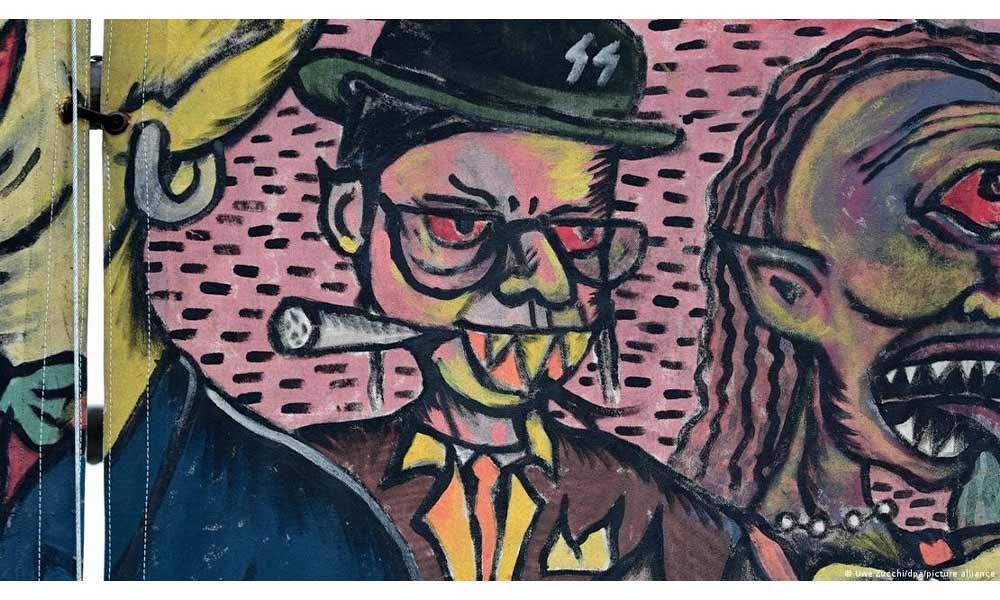
Taring Padi, People’s Justice (detail), 2002. Image: Uwe Zucchi/dpa
More revealing than the images themselves was the debate they provoked. Particularly revealing was the response within parts of the Israeli art world. While many Israelis condemned the imagery as antisemitic, a significant strand of Israeli art criticism—shaped by left-wing, anti-occupation and decolonial perspectives—responded differently. Rather than condemning the imagery, many critics shifted attention toward the danger that accusations of antisemitism might be used to silence criticism of Israel. The problem, they suggested, was not the representation itself but the way it was being interpreted. Some argued that the figures should be understood within the context of Indonesian political history. Others described the controversy as the product of German historical sensitivity. Still others maintained that accusations of antisemitism distracted from the exhibition’s broader anti-colonial ambitions.
A particularly striking example of this pattern emerged at an academic conference in Israel devoted to the documenta controversy. There, art critic Arnon Ben-Dror called the discussion of antisemitism at documenta “stupid,” prompting laughter from the audience. The episode suggested that, within parts of this discourse, the question of antisemitism itself had come to be regarded not as a subject for serious critical inquiry but as something to be dismissed.
Precisely because this cultural milieu is itself deeply critical of Israeli policies, its reluctance to confront the imagery suggests a broader blind spot within parts of contemporary decolonial critical discourse.
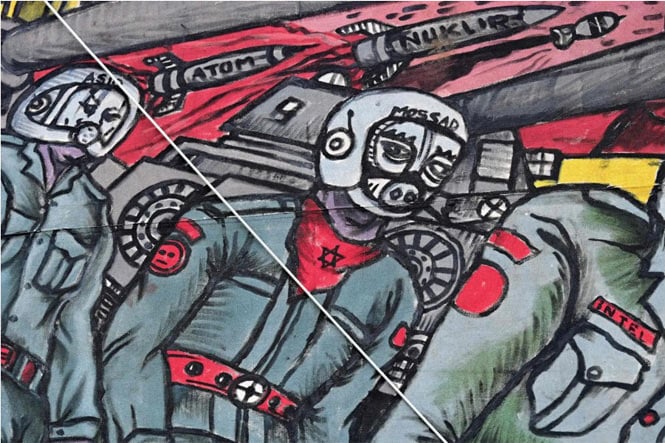
Image of a Mossad figure depicted as a pig with the Star of David in Shany Littman’s article in Haaretz, June 26, 2022. The accompanying caption in Haaretz identified the figures merely as “representatives of Western powers depicted as skulls, demonic figures, or pigs” (Image: ZYCCHI–AFP). This visual framing guided readers away from the image’s specifically antisemitic content, translating it into a generalized critique of Western imperialism.
A common theme ran through these responses. Attention shifted from the image itself to the circumstances of its reception. But this raises an obvious question: If antisemitic imagery repeatedly appears as a convenient language for criticizing power, capitalism, militarism, or the West, shouldn’t that fact itself become an object of critical inquiry?
Intentions matter, but they are not the whole story. The debate surrounding documenta fifteen often assumed two possibilities: either the artists were antisemites, or the imagery was simply misunderstood. But there is a third possibility. Political movements can inherit symbolic languages without fully recognizing their histories. Antisemitism may operate not only through conscious hatred but through images and narratives that become available as convenient moral shorthand.
Reality is more complicated than a simple choice between innocence and prejudice. Images develop histories of their own. They travel across cultures and generations. Their meanings are not determined solely by the intentions of those who deploy them.
Some readers may view these images primarily through the lens of the devastating and widely criticized war in Gaza that followed October 7. Yet the central events discussed here predate that conflict. The documenta controversy erupted in 2022, and Taring Padi repeatedly emphasized that People’s Justice itself had been created two decades earlier. The symbolic association of Jews and Israel with broader figures of colonial evil, therefore, cannot be explained simply as a reaction to recent events.
This is where Venice becomes especially important.
The reappearance of similar imagery during the 2026 Venice Biennale makes it harder to argue that documenta represented a unique misunderstanding arising from a single cultural encounter. The same symbolic repertoire once again became available as a language of political protest. Within such a symbolic framework, the appearance of antisemitic imagery no longer seems accidental. It follows from the symbolic logic of the discourse itself.
Unlike the documenta banner, which could be understood as an artwork removed from its original context, the Taring Padi image in Venice functioned as direct political propaganda in a contemporary European demonstration. It is therefore much harder to dismiss it as the product of cultural misunderstanding or misinterpretation.
The same symbolic structure could also be observed elsewhere in the Venice Biennale. Palestine occupies a prominent symbolic place not only in the demonstrations surrounding the exhibition but also in some of the exhibition’s most visible spaces. For example, at the entrance to the Arsenale, one of the exhibition venues, visitors encounter If I Must Die, a poem by the Palestinian poet Refaat Alareer, who was killed in Gaza in December 2023. Taken together with the slogans displayed in protests surrounding the Biennale as well as in some of its exhibition spaces, these elements reflect a broader symbolic vocabulary in which Palestine functions not simply as a political cause but as a universal horizon of moral redemption—indeed, as “the future of the world”—while Israel increasingly appears as the principal obstacle to that emancipatory vision.


The issue extends beyond the art world.
Contemporary decolonial discourse often relies on broad moral categories such as colonialism, racism, structural violence and oppression. These concepts can provide valuable analytical tools. But they also carry risks if they become so comprehensive that they reduce complex historical realities to a struggle between absolute good and absolute evil.
Within sectors of contemporary activist and decolonial discourse, Israel often occupies a unique symbolic position. It is not simply criticized for particular policies or governments. Instead, it is presented as the ultimate embodiment of colonialism, militarism, capitalism and global injustice.
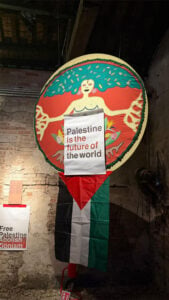
“Palestine is the future of the world”; “Free Palestine. Abolish Zionism,” 2026 Venice Biennale. Image: Tal Harada
This symbolic logic was articulated with striking clarity by people associated with documenta itself. At a panel held in Amsterdam near the exhibition’s conclusion, Gertrude Flentge, a member of documenta’s artistic team, articulated the logic explicitly: “Israel represents the Mossad, and the Mossad represents capitalism; Palestine represents Lumbung, and Lumbung represents resistance, friendship, and solidarity.” (Her recorded remarks were uploaded to the internet, but were later removed).
Whether intended literally or metaphorically, the formulation was revealing. Israel was no longer treated as one political actor among many but as the embodiment of a corrupt global order, while Palestine became a symbol of moral redemption. The problem with antisemitic imagery is precisely that it does not describe reality—it replaces reality with fantasy. Rather than criticizing the policies or actions of a government, it constructs an image of “the Jew” or “Israel” as absolute evil. Once political conflict is recast in these terms, compromise, political solutions, and even the possibility of a shared future become much harder to imagine. At that point, distinctions collapse, historical complexity disappears, and visual traditions with deeply antisemitic histories can re-enter public discourse under the banner of progressive politics.
The lessons of documenta fifteen and Venice 2026 are therefore larger than either event. They suggest that even movements dedicated to fighting racism and injustice can develop their own blind spots. One of the central achievements of critical theory has been its insistence that no institution, ideology or tradition should be exempt from scrutiny. The same principle should apply to contemporary progressive and decolonial movements themselves. The responses of parts of the Israeli decolonial art world were particularly revealing, precisely because they came from a milieu one might expect to be especially alert to the visual languages of prejudice.
The central implication of documenta fifteen and Venice 2026 is not that all criticism of Israel is antisemitic, nor that postcolonial thought should be abandoned. The challenge is simpler, yet more demanding. If progressive movements insist that racism and prejudice can exist within every social and political structure, they must also be willing to ask whether prejudice can emerge within their own moral imagination.
The deepest test of any critical tradition is not how effectively it exposes others’ prejudices, but whether it can recognize them within itself.
David Sperber is an art historian, curator and rabbi. Currently, he is co-editor-in-chief of Images: A Journal of Jewish Art and Visual Culture (De Gruyter Brill).
(Top image credit: Poster by the Indonesian collective Taring Padi displayed during an anti-Israel protest at the 2026 Venice Biennale. Image: Naama Riba)