

Water is a fundamental element of life. It can both sustain and destroy, cleanse and corrupt, connect and divide. It descends from the skies and reaches to the depths. It creates new pathways and shapes landscapes, cultures and individual histories.
Water likewise plays a vital role in Jewish life and spirituality, permeating Jewish beliefs, practices and origin stories. It is a symbol of Torah and wisdom, the power of the Divine, and of purity, renewal and life. From Creation and the Great Flood to the parting of the Red Sea, from refugees traversing seas in search of safety to the Zionist vision of “making the desert bloom,” water ebbs and flows through Jewish history. It figures prominently in Jewish ritual—in the purifying waters of the mikvah; in taharah, the sacred ritual of washing the body of the dead; in tashlich, the rite performed on Rosh Hashanah of symbolically casting one’s sins into a body of water; in the ceremony of Beit Ha-sho’eva, held during Sukkot; and in the ritual of handwashing before eating bread.


So it’s not at all surprising that the University of California, Berkeley’s Magnes Collection of Jewish Art and Life chose water as the theme of its current exhibition, “Flowing through Time and Tradition.” The show, which is on view through May 14, 2026, is organized around four themes: Believing, Sustaining, Cleansing and (Dis)Placing. It features 65 objects—sculptures, textiles, photographs, paintings, prints, rare books and manuscripts—drawn from the museum’s rich and varied holdings. The works, which date from a 16th-century map titled “Palestine or All the Promised Land” to a 20th-century color lithograph of an updated take on the story of Jonah and the Whale, come from more than a dozen countries, from India and Russia to Israel, Belgium and the United States.
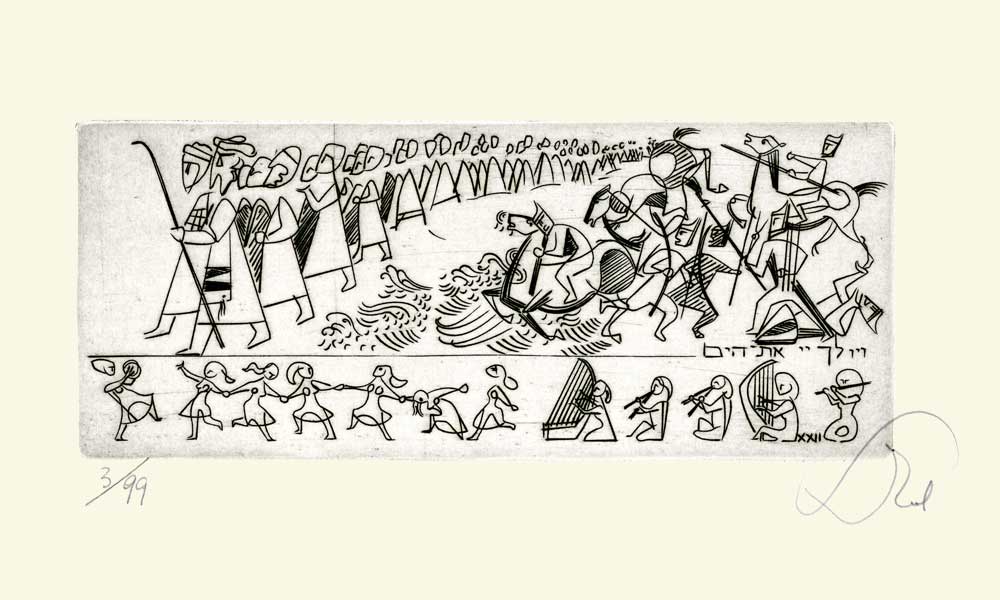
Passage de la Mer Rouge, Passover Haggadah, 1966 (Photo credit: Courtesy Magnes Collection of Jewish Art and Life)
The exhibition traces water’s role in sustaining life, building communities and influencing Jewish identity. That role is symbolic not just in its relationship to the Divine, but also in its relationship to people, to life and death and rebirth—the ability to restart or reconnect.
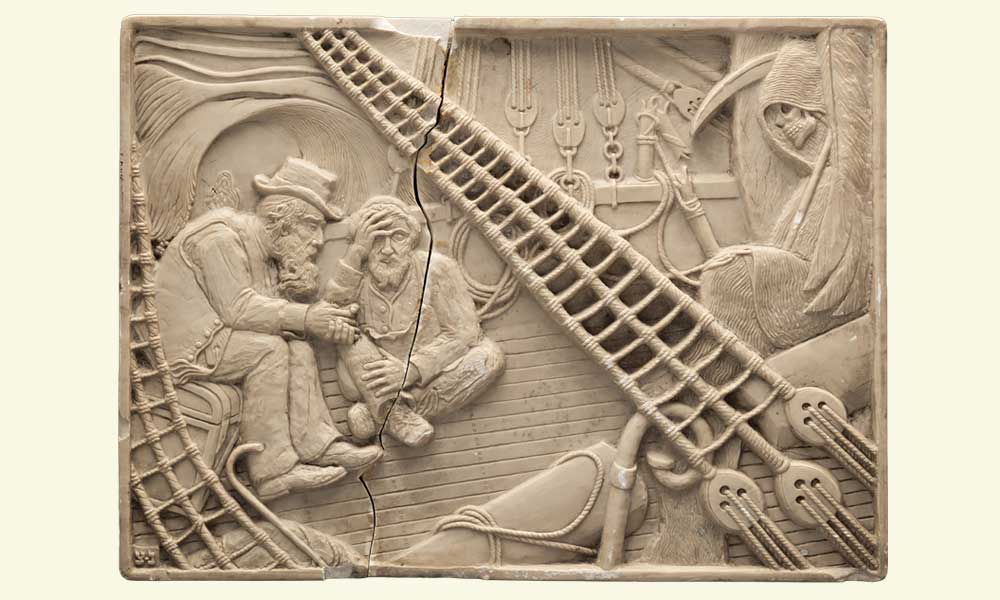
Camp Dakylie, Cyprus, 1948, soapstone carving by Zeev Ben Zvi. (Photo credit: Courtesy Magnes Collection of Jewish Art and Life)
“We have this truly amazing collection,” says exhibition curator Achinoam Aldouby, “and every year we try to pick one theme that sheds light on a new perspective and brings objects from the collection together to see what new information or viewpoint we can gain on life, on culture, and specifically on Jewish life.” Given the current climate of polarization, water can provide a common ground that all life can connect through, she says. At the same time, however, water is also a source that can cause conflict and division. The exhibition highlights that duality.
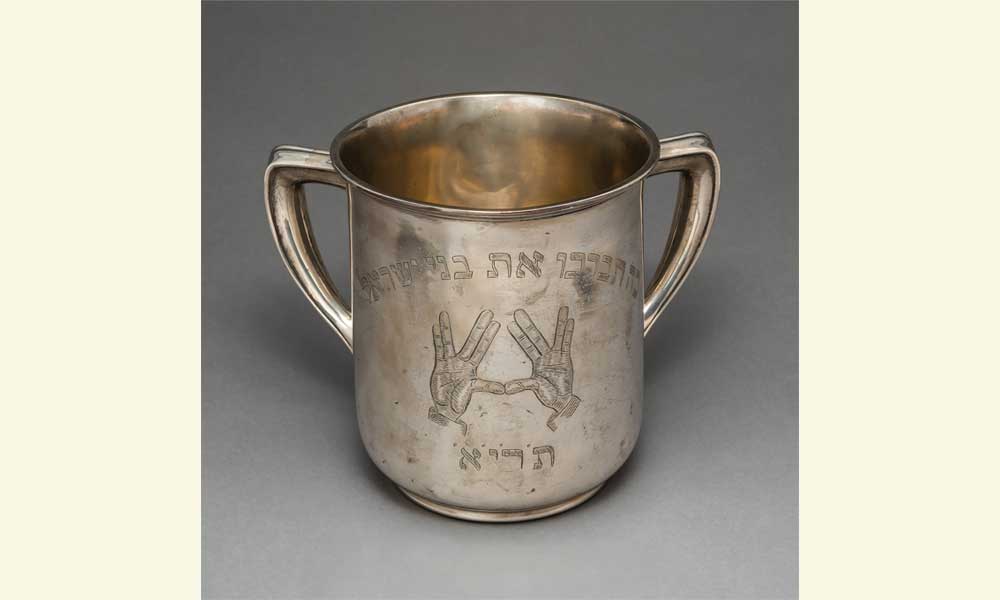
Laver for ritual hand-washing before the Priestly Blessing, 1851. (Photo credit: Courtesy Magnes Collection of Jewish Art and Life)
A compelling history of crossing bodies of water has shaped Jewish identity over the centuries, starting with the biblical story of Abraham crossing the Euphrates—the critical moment when he left his homeland in Mesopotamia to journey to the land of Canaan. The crossing marked the start of God’s covenant with Abraham and his descendants.
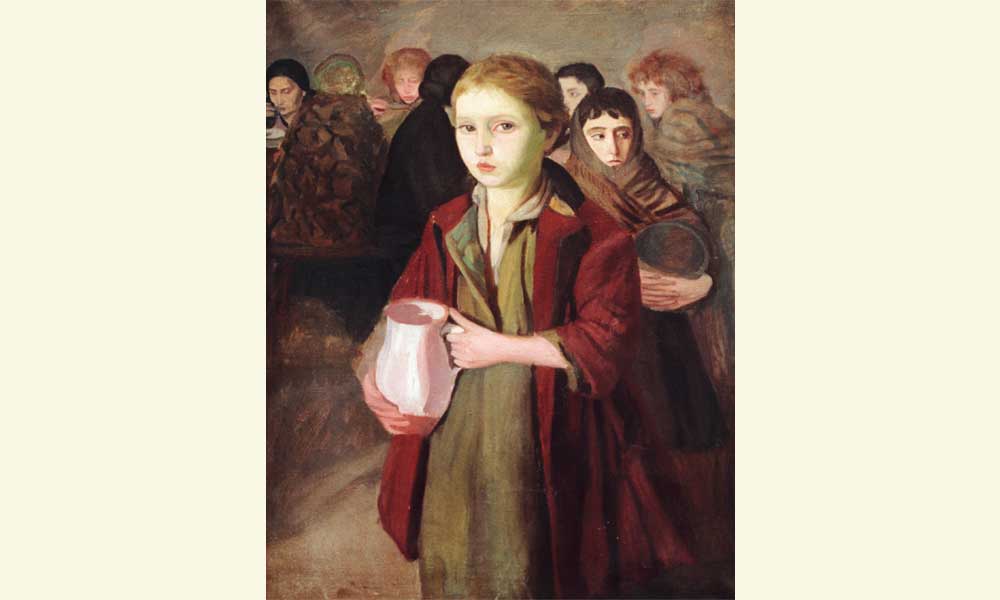
Refugee Children, 1900-1930, by Maurycy Minkowski. (Photo credit: Courtesy Magnes Collection of Jewish Art and Life)
Later, after wandering in a waterless desert for 40 years, the Israelites, led by Joshua, crossed the Jordan River to finally enter the Promised Land. These key moments of beginning—of forming identity and finding new opportunities; of fleeing and trying to find new homes; of crossing the Atlantic, reaching the Americas, starting in the late 16th century and continuing into the 21st—are showcased in the exhibition. “Each object serves as a portal transporting visitors across time and place,” says Aldouby.
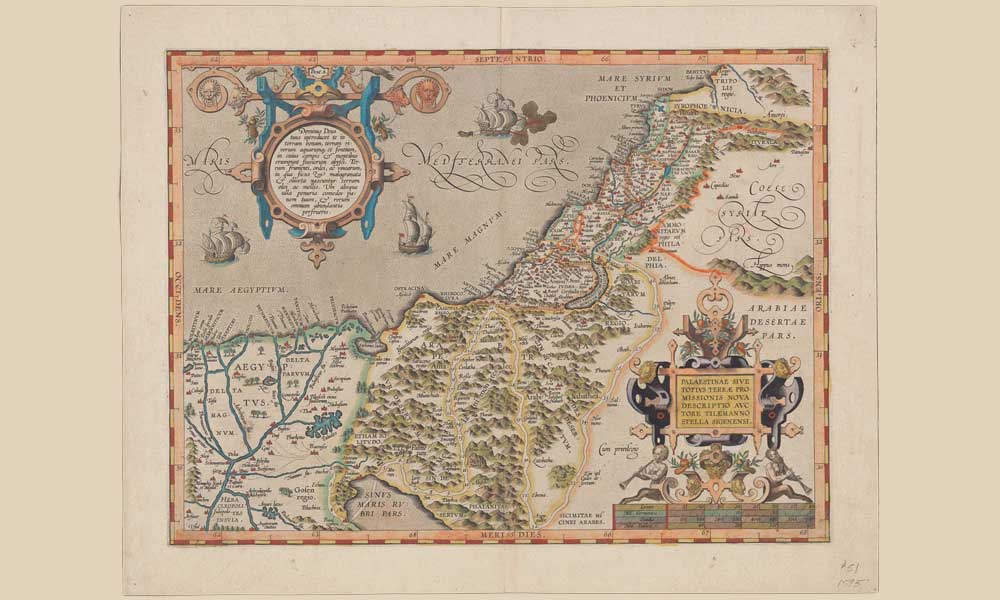
16th-century map, Palestine or All the Promised Land, by Abraham Ortelius. (Photo credit: Courtesy Magnes Collection of Jewish Art and Life)
Items in the exhibition range from a contemporary glass water container, representing the traditional duty of hospitality, of offering water to guests (its refusal, a major offense), to an 1851 sterling silver laver for ritual hand-washing. Engraved with the hand gesture used by the kohanim, the Jewish priestly class, during the traditional Priestly Blessing, the laver bears an inscription in Hebrew of the biblical verse “Thus shall you bless the children [people] of Israel.”
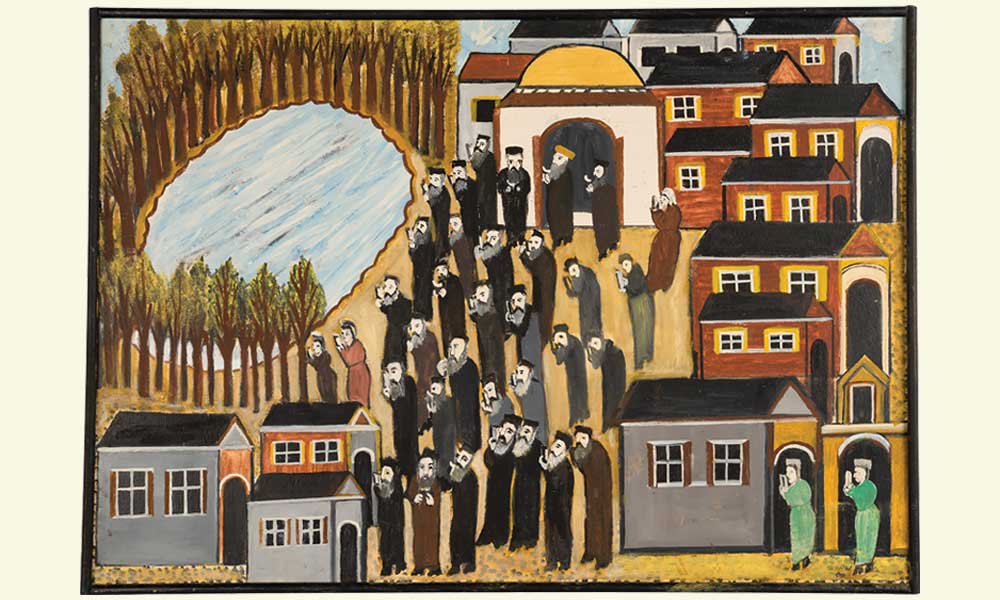
Tashlich, c. 1970, by Natan Heber. (Photo credit: Courtesy Magnes Collection of Jewish Art and Life)
A painting titled “Refugee Children” by Polish artist Maurycy Minkowski was inspired by the 1906 Bialystok pogrom and focuses on a child holding a vessel to suggest, writes the Magnes, the “thirst and solitude caused by human conflict.” An evocative soapstone carving, created by Zeev Ben-Zvi in a Cyprus detention camp in 1948, reflects the experiences of thousands of Holocaust survivors who boarded overcrowded ships to reach Mandatory Palestine but were stopped and sent instead to British detention camps in Cyprus. In his 1978 color lithograph “Jonah and the Whale in Haifa Port,” artist Eugene Abeshaus—an emigree from the Soviet Union who was permitted to leave for Israel in 1976—merges the biblical story of Jonah with the emigrant experience.
“I really had the need to create something universal,” says curator Aldouby, “to create something that definitely speaks to the Jewish experience, but also to the general experience of how water shapes our life and what other sources and resources shape the way we think, the way we interact, the way we understand ourselves and the world and our place within it.”